Ancient Greek Astronomy
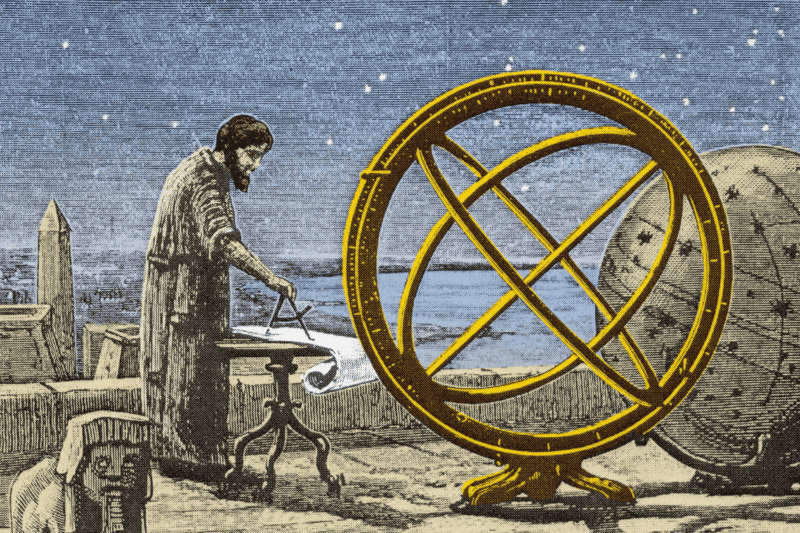
Another influential culture is that of ancient Greece, where the astrological curtain unfolded to reveal profound insights into the cosmos. In the bustling intellectual landscape of 600 BCE, Thales of Miletus emerged as a pioneer, ushering in a new era of systematic astronomical inquiry. His curiosity about the heavens laid the groundwork for a legacy that would echo through the ages.
The torch was passed to luminaries like Pythagoras and his disciples, who delved into celestial spheres and toyed with the revolutionary concept of a heliocentric universe. Greek astronomers, with their inquisitive minds, sought not only to fathom the motions of the heavens but also to weave a narrative that would shape humanity’s cosmic understanding.
Hipparchus was a cartographer extraordinaire, he took center stage by crafting the first comprehensive star catalog, an atlas that painted the night sky with unparalleled precision. His mathematical prowess extended to trigonometry, contributing crucial tools for later astronomers.
Meanwhile, Ptolemy, with a captivating blend of observation and theory, proposed the geocentric model, envisioning Earth at the cosmos’ heart. Despite its eventual debunking, Ptolemy’s model remained the astronomical blueprint for centuries. The Greek legacy in astronomy, characterized by a synergy of mathematical rigor and empirical observation, became a cornerstone for future scholars.