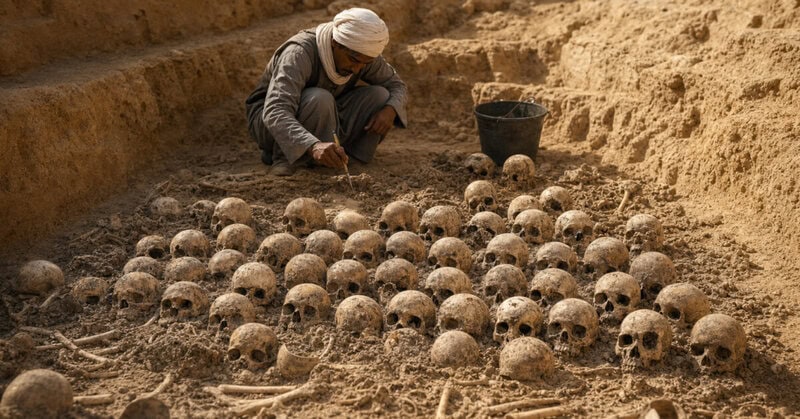
Forty-six ancient skulls, pulled from the sands surrounding the tombs of Egypt’s earliest rulers, have forced archaeologists to reexamine one of history’s most consequential origin stories. A modern forensic reexamination of those remains has produced what researchers now describe as confirming evidence that Egypt’s first kings practiced ritual human sacrifice — killing servants, officials, and attendants so the dead could rule in the afterlife just as they had in life.
The Royal Burial Ground at Abydos
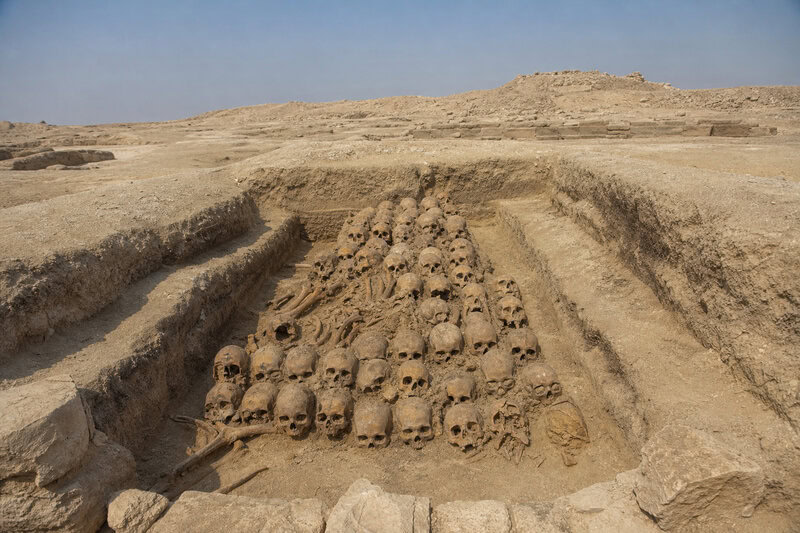
The skulls were recovered from Abydos, the sacred necropolis in Upper Egypt where the country’s founding pharaohs — the kings of the First Dynasty — were laid to rest approximately 5,000 years ago. It is one of the most significant archaeological sites on earth, and for over a century it has concealed a deeply unsettling secret.
Surrounding each royal tomb, archaeologists have long documented clusters of subsidiary graves. These were not overflow cemeteries or accidental accumulations of the dead. They were deliberate, structured arrangements holding the bodies of individuals buried alongside their king — sometimes numbering in the hundreds for a single ruler’s tomb. The sheer scale of these accompanying burials puzzled and disturbed Egyptologists from the moment the sites were first excavated, but the question of how those individuals died remained frustratingly unresolved for generations.
What made the subsidiary burials at Abydos especially striking was their social diversity. The entombed individuals were not drawn from a single class. Analysis of these early dynastic tombs has established that the buried population included both slaves and high-ranking officials who had served closely in the royal court — suggesting that whatever ritual was taking place, it was designed to replicate the full hierarchy of palace life rather than simply dispose of expendable people.
What the Forensic Reexamination Found
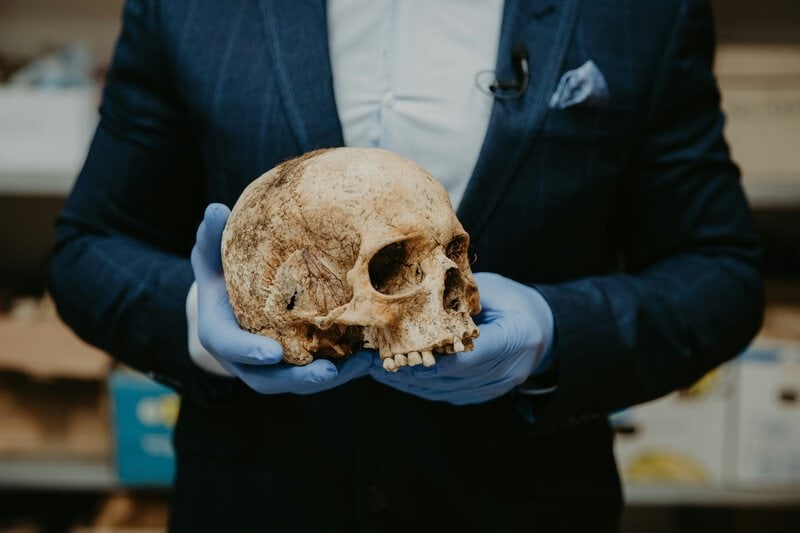
Scientists returned to the 46 skulls with modern forensic tools and methods unavailable to earlier generations of researchers. What they found was stark. The forensic analysis of these 5,000-year-old skulls revealed that over a dozen of the individuals had suffered severe, potentially fatal head injuries — blunt force trauma consistent with deliberate killing rather than accident, disease, or the ordinary hazards of ancient life.
Many of the skulls bore evidence of devastating blows, and the pattern of injury raised an uncomfortable but unavoidable conclusion: these people almost certainly did not choose to accompany their king into death. The cumulative weight of the forensic findings has led researchers to describe the evidence as confirmation of retainer sacrifice — the systematic ritual killing of royal attendants at the moment of a ruler’s death.
Older analyses of similar remains had either missed this skeletal trauma or attributed it to other causes. The new examination, applying contemporary forensic standards to this early dynastic population, closes much of that interpretive gap. Researchers have described the resulting picture as horrifying — not in the sensational sense, but in the precise historical one.
It is worth noting what this study cannot yet resolve. The sample of 46 skulls represents only a fraction of the total subsidiary burials at Abydos, and the absence of preserved soft tissue limits conclusions about the exact method of killing in every case. What the evidence does establish with unusual confidence is a pattern of lethal head trauma across multiple individuals from multiple royal tombs — a pattern difficult to explain by any cause other than deliberate violence.
Why Would Egypt’s First Kings Demand This?
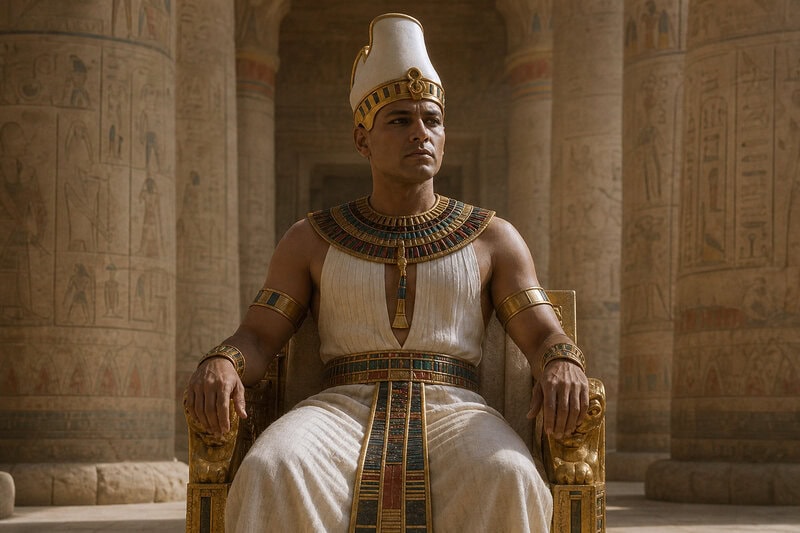
To understand the practice, it helps to understand how Egypt’s earliest rulers appear to have conceived of death and power. The prevailing religious logic of the period held that the afterlife mirrored the living world in almost every detail. A king would need his court, his administrators, his household staff, and his skilled servants to function in death just as he had in life. Sending them along — or rather, taking them with him — was not framed within that worldview as cruelty. It was closer to logistics.
Killing and entombing trusted servants alongside a ruler was a mechanism for extending royal power beyond the grave, ensuring the king arrived in the next world fully equipped and staffed. The practice also served a vivid political purpose for the living. Few demonstrations of absolute authority could be more visceral or unambiguous than the spectacle of an entire royal household being interred alongside its master. It communicated, in the most direct terms possible, that the king’s power over life and death was total.
Egypt was not alone in this. Contemporary cultures in Mesopotamia performed comparable retainer sacrifices, and the practice appears later in early Chinese dynastic burials as well. Across several early complex societies, the ritual killing of attendants seems to have accompanied the consolidation of centralized state power — a pattern that places ancient Egypt’s human sacrifice evidence within a broader anthropological context rather than treating it as an isolated aberration.
Who Were the Victims?
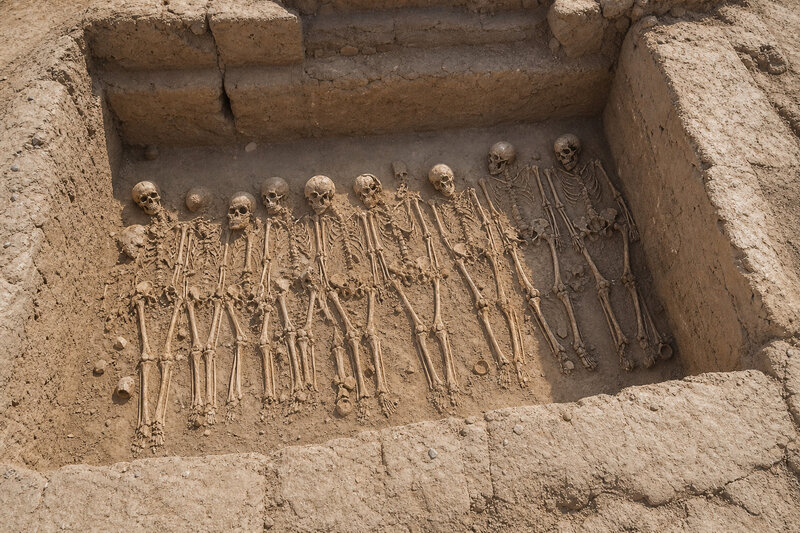
The range of individuals buried in the subsidiary graves at Abydos is itself historically significant. That the sacrificed population spanned from low-status slaves to senior court officials indicates the ritual was not simply a matter of culling the most vulnerable or the most replaceable. The design appears to have been intentional: recreate the full social architecture of the living palace inside the tomb.
Some historians have raised the possibility that certain attendants may have been willing participants, shaped by genuine religious conviction into accepting — or even embracing — their fate. That interpretation, while not impossible, is complicated by the forensic trauma evidence. Skulls bearing signs of devastating blunt force impacts do not easily support a narrative of serene, voluntary departure. The skeletal record suggests coercion was at least part of the picture for many of those interred.
The scale and organization required to carry out these burials also tells its own story. Marshaling hundreds of individuals, managing their deaths, and coordinating the construction of elaborate subsidiary grave complexes required considerable administrative infrastructure. Egypt’s first kings had already assembled the machinery of a functioning state — and they were prepared to deploy it in the service of their own immortality.
When the Practice Ended — and What Replaced It
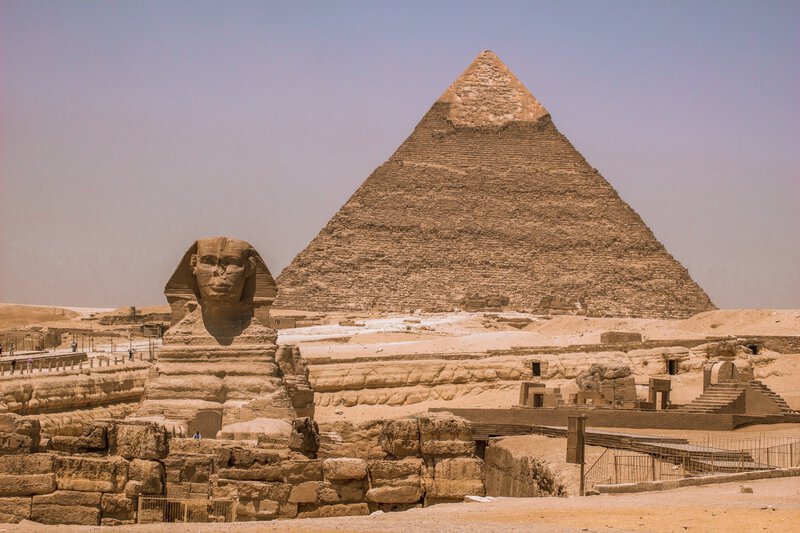
Retainer sacrifice in Egypt appears to have been concentrated in the country’s earliest dynasties and faded relatively quickly, disappearing within a few centuries of its peak. By the time Egypt entered the Old Kingdom — the era most people associate with the great pyramids at Giza — mass human sacrifice for royal burial had been largely abandoned.
What replaced it was symbolic substitution. Servant figurines known as shabtis were placed in tombs to perform labor in the afterlife. Tomb walls were painted with scenes of eternal service. Carved reliefs depicted entire households frozen in permanent attendance on their masters. The theology shifted, or was adapted, in ways that no longer required the deaths of real people to populate the royal afterlife.
Historians debate what drove the change. Moral evolution is one possibility — though the historical record offers little direct evidence of an explicit ethical turn. Practical calculation is another and perhaps more persuasive explanation: losing skilled officials and trained servants with every royal succession was economically and administratively costly. A state that buries its administrative class cannot retain institutional knowledge across generations. The abandonment of mass retainer sacrifice may, in a real and measurable sense, have contributed to Egypt’s remarkable long-term stability and continuity — making the end of the practice as historically significant as its beginning.
What This Changes About Ancient Egypt
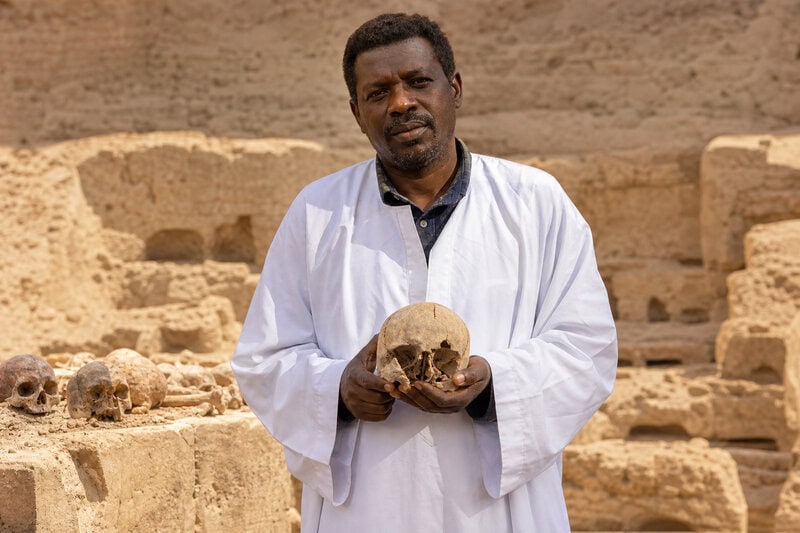
Egypt has long occupied a privileged position in the popular imagination — a civilization of breathtaking sophistication, philosophical depth, and enduring beauty. The forensic evidence emerging from these early royal burial sites does not erase that legacy, but it meaningfully complicates the founding chapter.
What the 46 skulls from Abydos now confirm is that at its very inception, the Egyptian state was built in part on institutionalized lethal violence — the systematic killing of human beings in service of royal ideology. That is not a comfortable fact, but it is an honest one. It places Egypt alongside other early complex societies in which extreme ritual coercion accompanied the birth of centralized power, and it reminds us that admired civilizations are not exempt from the darkest patterns of human history.
The finding also underscores the ongoing value of applying modern forensic science to long-excavated remains. These skulls were not newly discovered — they had been sitting in collections and archives for decades. What changed was the precision of the tools brought to bear on them, and the willingness of researchers to follow the evidence to its most difficult conclusions. What was once archaeological speculation has become, through that patient work, documented historical fact. The dead, it turns out, have not finished speaking.