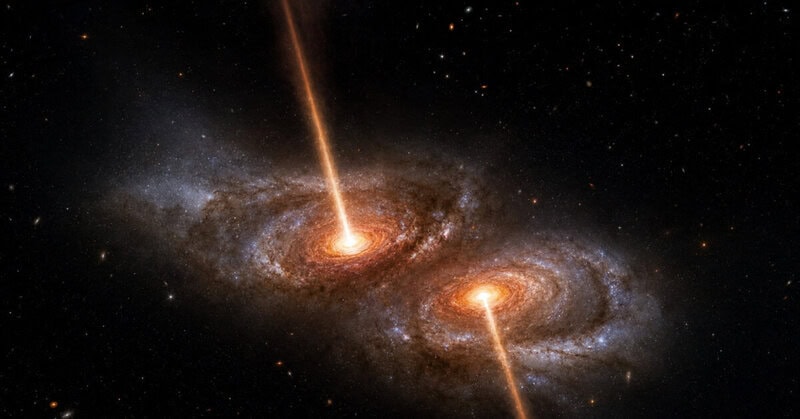
Just 900 million years after the Big Bang, two supermassive black holes were already side by side, gorging on matter at a ferocious rate — and the James Webb Space Telescope just caught them in the act. The discovery has left astronomers genuinely stunned, not simply because of what was found, but because of how thoroughly it challenges what science thought it knew about the early universe.
Two Cosmic Giants, One Record-Breaking Discovery
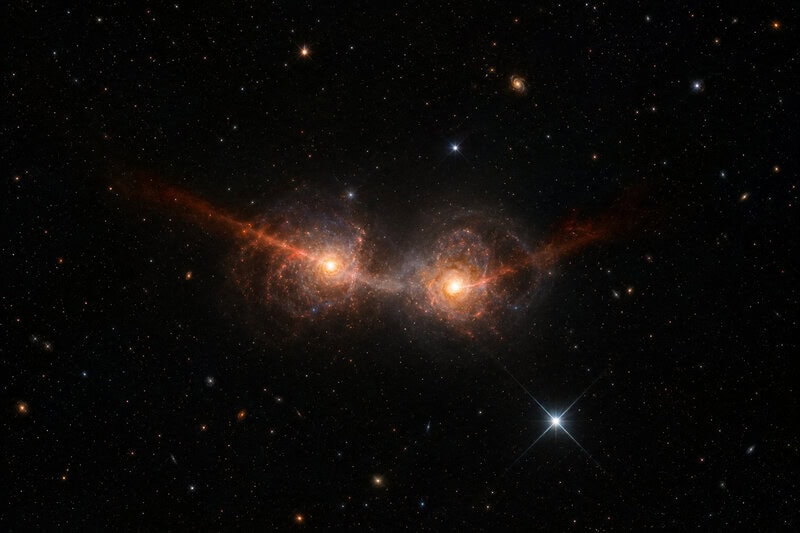
The James Webb Space Telescope has revealed the oldest pair of black hole-powered quasars ever observed, a duo given the Hawaiian name Nāpōwawāʻenakaulua. Sitting only 18,100 light-years apart, these two ancient objects were already in an advanced, violent evolutionary phase when the universe was barely a toddler. The find marks a record-breaking moment in observational astronomy and raises deep questions about how the cosmos assembled itself so quickly after its birth.
This is a story about cosmic gluttony, violent outflows, and a universe that grew up far faster than anyone expected. Astronomers described the discovery as stunning, and it is easy to understand why.
What Exactly Is a Quasar — and Why Does It Matter?
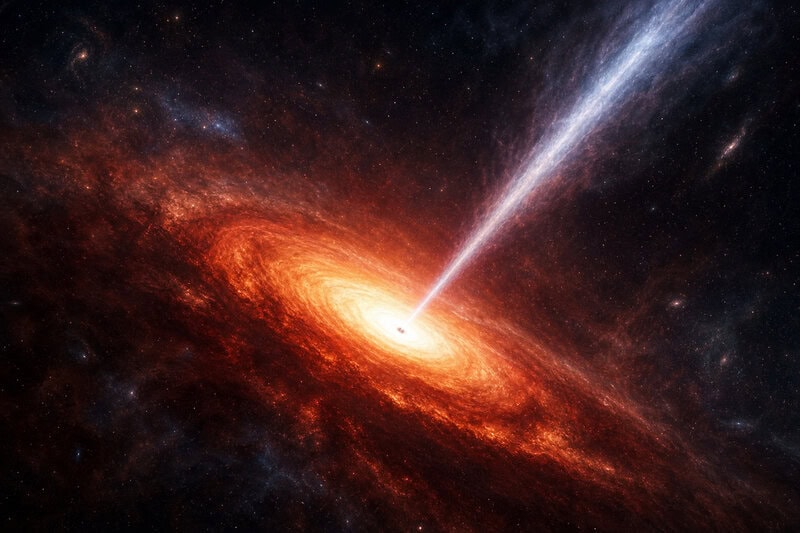
A quasar is what happens when a supermassive black hole feeds so aggressively on surrounding gas and dust that it blazes brighter than entire galaxies. These are among the most energetic objects in the known universe, capable of outshining hundreds of billions of stars across staggering cosmic distances. They are not merely bright lights in the sky — they are engines of transformation, capable of reshaping the very galaxies that host them.
Because light from ancient quasars takes billions of years to reach us, detecting one is effectively looking at a baby photo of the universe. Understanding how quasars form helps scientists piece together the full story of how galaxies — including our own Milky Way — came to exist in their current form. Finding the earliest known pair, already mature and feeding simultaneously, makes this discovery particularly significant for anyone who wants to understand where everything came from.
Meet Nāpōwawāʻenakaulua: The Universe’s Oldest Known Quasar Pair

The quasar pair’s name, Nāpōwawāʻenakaulua, is rooted in Hawaiian tradition, honoring the Indigenous culture of the land where many of the world’s great observatories are built. It is a fitting tribute — a name carrying deep cultural weight for a discovery of equally deep scientific consequence.
Both black holes in the pair are classified as reddened quasars, meaning thick clouds of gas and dust shroud their intense light. This obscuration makes them exceptionally difficult to detect with conventional optical telescopes. Their separation of just 18,100 light-years is extraordinarily close on a cosmic scale, and the combination of their dusty veils and tight proximity meant they remained hidden until JWST turned its infrared gaze toward them. The pair sets a new record as the earliest compact quasar pair ever observed, pushing back the observational frontier by a significant margin.
The Blow-Out Phase: Cosmic Violence at Its Most Spectacular
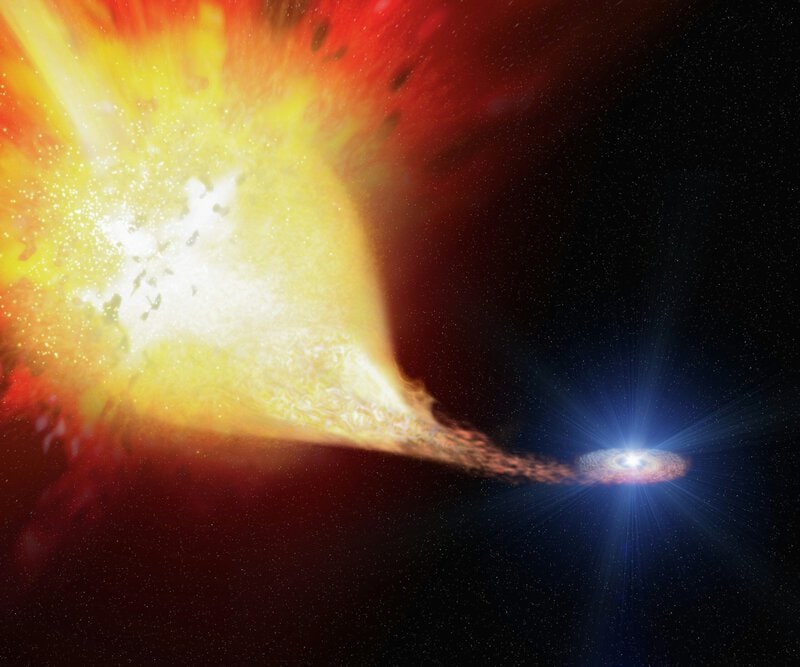
What makes this discovery especially rare is the specific evolutionary moment it captures. Astronomers found Nāpōwawāʻenakaulua locked in a brief, violent stage known as a blow-out phase. During this period, quasars blast powerful winds outward, pushing surrounding gas and dust out of their host galaxies in dramatic fashion.
This outflow is thought to be a critical turning point in a quasar’s life — essentially the moment it begins shutting down its own fuel supply. By expelling the very material it feeds on, the quasar gradually dims itself over time. Catching a reddened quasar mid-blow-out is considered highly elusive, because the phase is brief in cosmic terms. Catching two of them doing it simultaneously, in such close proximity to each other, multiplies the scientific rarity of the event considerably. Researchers noted that the discovery poses significant challenges to existing black hole formation models.
The Deeper Mystery: They Shouldn’t Exist Yet
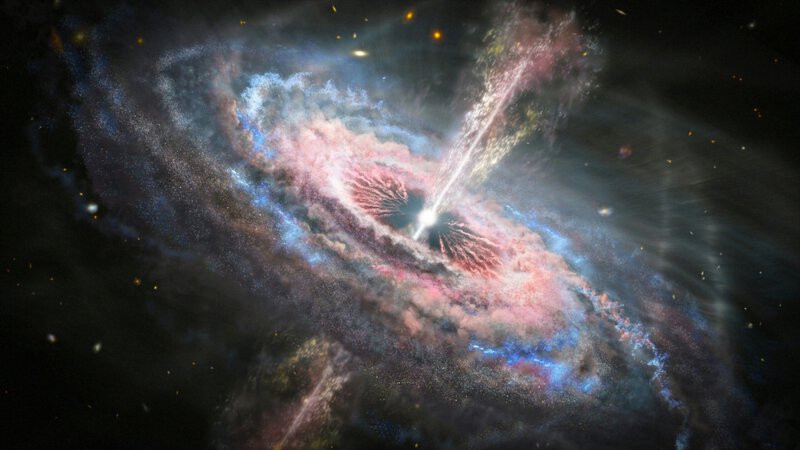
Here lies the problem that is forcing cosmologists to revisit their foundational assumptions. There is currently no definitive theoretical explanation for how even a single supermassive black hole of this scale could exist just 900 million years after the Big Bang. Standard models of black hole growth describe a process that unfolds over vast timescales — timescales the early universe simply had not yet provided.
Finding two of them, already side by side and already in an advanced evolutionary phase, makes the puzzle dramatically harder to solve. The discovery compels scientists to seriously weigh several possibilities:
- Accelerated black hole growth mechanisms that current models do not adequately account for
- Exotic seed black holes that formed through unusual early-universe processes, such as the direct collapse of massive primordial gas clouds
- Significantly higher merger rates among early galaxies than simulations have predicted
None of these explanations is settled science. The honest answer, for now, is that the universe produced something existing theory struggles to explain — and that is precisely what makes this discovery so scientifically consequential.
Why JWST Is the Only Instrument That Could Have Done This
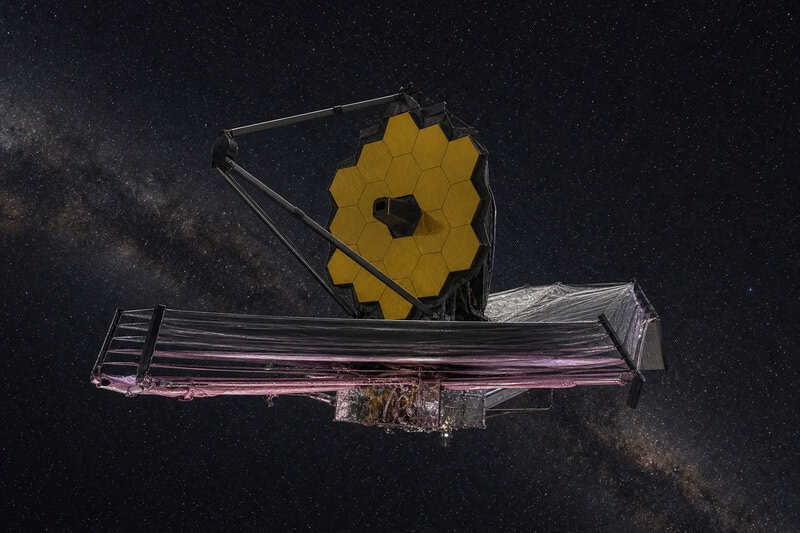
The James Webb Space Telescope was engineered for exactly this kind of challenge. Its infrared instruments allow it to see through the dense dust clouds that render reddened quasars effectively invisible to optical telescopes. Its sensitivity enables it to detect incredibly faint signals from objects billions of light-years away, and billions of years in the past.
Previous telescopes either lacked the angular resolution to distinguish the two quasars as separate objects, or lacked the infrared capability to pierce their dusty shrouds, or both. JWST removed both obstacles simultaneously. Without this specific telescope, Nāpōwawāʻenakaulua would almost certainly have remained invisible to science indefinitely — a reminder of how much the observable universe expands each time humanity builds a more capable eye.
JWST continues to reshape early-universe science at a pace that is actively outrunning theoretical models. This discovery is one of the most striking illustrations yet of a pattern that has become familiar since the telescope began operations: the early universe was stranger, more structured, and more energetic than any leading prediction suggested.
What Comes Next — and Why This Changes the Questions Scientists Ask
Researchers will now use this discovery to test and stress-test competing models of how supermassive black holes form and grow in the early universe. The blow-out phase captured here could also illuminate how quasar feedback shapes galaxy formation across cosmic time — a process that remains incompletely understood even in the present-day universe.
Future JWST observations may reveal additional ancient quasar pairs, helping scientists determine whether Nāpōwawāʻenakaulua represents a rare cosmic accident or an early-universe pattern that has simply been undetectable until now. That distinction matters enormously: if paired quasars were common in the young universe, the implications for how galaxies cluster, interact, and grow would ripple through cosmology for decades.
One conclusion is already clear. The early universe was a far wilder, more complex, and more accelerated place than even the most sophisticated theoretical frameworks predicted. JWST has pulled back the curtain on a cosmos that built its largest structures with a speed and violence that science is still working to absorb — and by any measure, the telescope is only just getting started.