The Leviathan
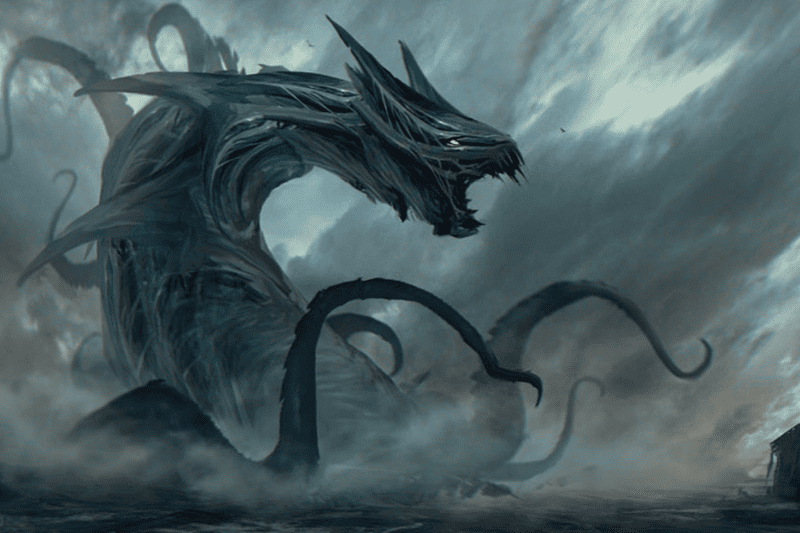
In the realm of ancient mythology, the Leviathan surfaces as a formidable sea monster, a primordial creation of God deeply entrenched in Jewish folklore and Christian Mythology. Referenced in texts like Psalms, Job, Isaiah, and Amos, as well as the apocryphal Book of Enoch, the Leviathan stands alongside the Behemoth and the Ziz, treated as godly siblings born simultaneously.
Particularly highlighted in the Book of Job, the Leviathan is portrayed as one of God’s mightiest earthly creatures, ruling the seas in contrast to Behemoth’s dominion over the land and Ziz’s rule over the skies. Despite her seemingly submissive role, the Leviathan possesses the remarkable ability to challenge God, a feat even beyond Lucifer’s reach.
Beyond her mythological prominence, the Leviathan extends her influence to the underwater kingdom of Atlantis, co-ruling with the Greek sea deity Poseidon. This unusual partnership stems from Poseidon’s persistent courtship, leading to a clash that Zeus resolves by granting them co-rule as a peace offering. The Leviathan’s mystique is further heightened by her enigmatic appearances, taking on forms ranging from a serpent to various sea creatures.
In her human guise, she manifests as a stunning woman with sea-green seaweed-like hair, seamlessly blending beauty and monstrosity. Despite her ominous demeanor, the Leviathan’s allegiance remains unwaveringly devoted to her Creator, God, navigating a complex existence as both a revered and formidable entity in the intricate tapestry of ancient mythology.
In contemporary times, she retains her original personality, showcasing a more serious and reserved demeanor, underscoring her desire for peace and privacy beneath the seas while maintaining a multifaceted character beyond the bounds of ancient myths.