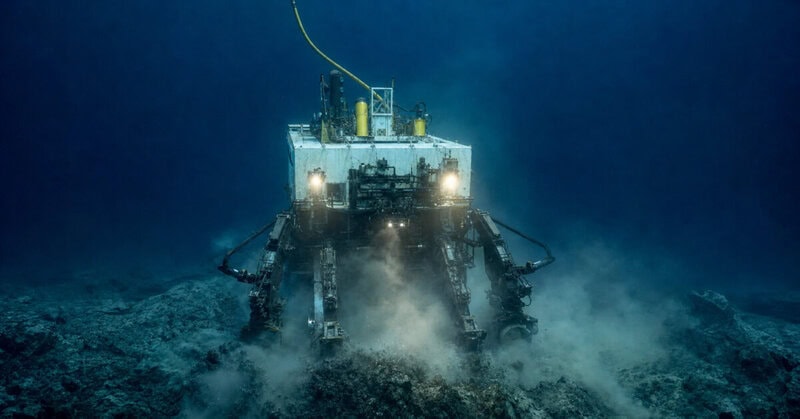
Days before the United States was set to hold its first-ever commercial deep-sea mining lease sale — targeting the seafloor off American Samoa — a federal judge in Honolulu voided the government’s environmental approval, throwing the entire proceeding into legal flux. The ruling exposed a problem that goes far deeper than procedural error: the ecosystems those leases were designed to exploit are so poorly understood that science cannot yet measure what would be lost if mining began.
A Court Stops a Sale That Could Have Erased the Unknown
The lease sale had been scheduled for a Thursday when the court intervened. The judge voided the species approval that underpinned the entire proceeding, finding that the National Marine Fisheries Service (NMFS) had violated the Endangered Species Act. The core legal defect was straightforward: NMFS limited its wildlife review to preliminary surveying and mapping activities while structurally ignoring the full-scale seabed excavation those leases were explicitly designed to enable. The agency reviewed the front door but not what lay behind it.
Earthjustice, which brought the legal challenge, framed the decision as a direct rebuke of the Trump administration’s approach. In its public statement, Earthjustice characterized the administration as having violated the law in greenlighting the American Samoa deep-sea mining lease sale without conducting the scrutiny the Endangered Species Act requires. The ruling did not merely delay a sale — it invalidated the legal foundation on which any such sale would rest.
The case crystallizes a collision playing out globally: the race to mine critical minerals from the deep ocean is accelerating faster than science can characterize — let alone protect — the ecosystems that live there. The deep-sea mining sale off American Samoa remains in flux as that tension moves from scientific journals into federal courtrooms.
What Lives Down There: Polymetallic Nodules and the Communities They Sustain
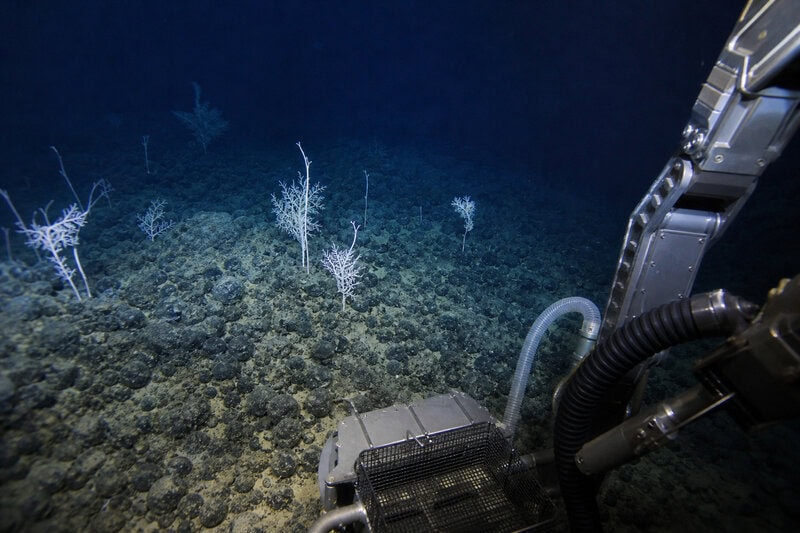
The primary targets of deep-sea mining operations in U.S. waters near American Samoa are polymetallic nodules — potato-sized concretions of manganese, cobalt, nickel, and copper that accumulate on the abyssal seafloor over millions of years. The name reflects their chemistry: each nodule is a layered archive of multiple metals, precipitated grain by grain from seawater and sediment pore water across timescales that dwarf human civilization.
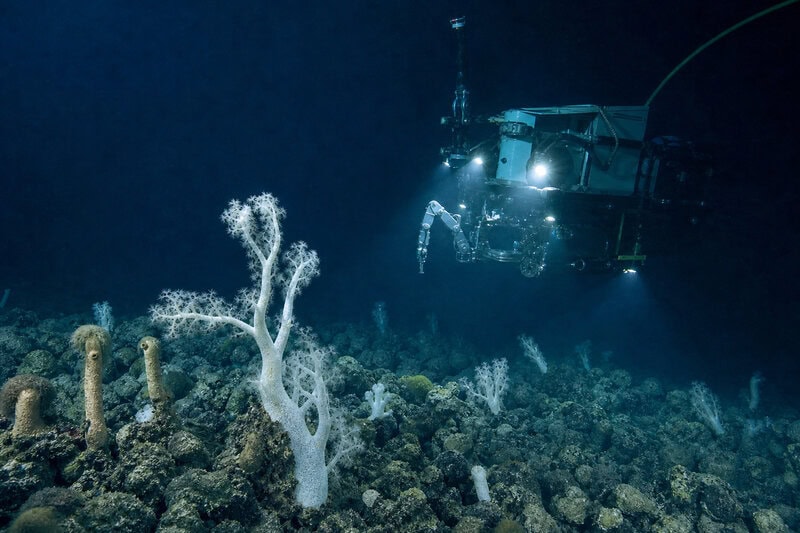
These nodules are not inert ore deposits. They function as the structural habitat — essentially the reef — for distinct biological communities that have evolved specifically to colonize their surfaces. Sponges, cold-water corals, polychaete worms, and dense microbial mats anchor themselves to nodule surfaces, forming assemblages found nowhere else on Earth, according to research catalogued by the NOAA Office of Ocean Exploration and Research. Remove the nodules and the ecosystem they support disappears with them.
The scale of that biodiversity is difficult to overstate. Research in the Clarion-Clipperton Zone — a Pacific nodule field that serves as an analog to the American Samoa lease area — has documented an estimated 8,000 species in nodule fields, more than 90 percent of which are new to science, according to a 2023 synthesis published in Current Biology by researchers at the Natural History Museum London. The American Samoa zone has not been surveyed to comparable depth, which means its true species richness remains unknown.
Nodule growth rates are measured in millimeters per million years. That figure is not rhetorical — it is a physical constraint. Any ecosystem disrupted by mining equipment cannot recover on any timescale relevant to human civilization. This is a point of strong scientific consensus, not conjecture, and it distinguishes deep-sea mining from almost every other form of industrial resource extraction.
The Legal Fault Line: What the Endangered Species Act Actually Requires
Under Section 7 of the Endangered Species Act, federal agencies must complete a formal analysis called a biological opinion before authorizing any action that could affect listed species. That opinion must cover all reasonably foreseeable consequences — not merely the first phase of a multi-phase project. The legal standard exists precisely to prevent agencies from fragmenting a large project into small, apparently benign pieces and reviewing only the first piece.
The Honolulu court found that NMFS did exactly that. By scoping its review to cover only preliminary surveying activities, the agency structurally excluded the commercial extraction that would follow if leases were executed. The judge held that distinction was legally indefensible. Legal scholars have noted this phase-limited review strategy has appeared in other extractive-industry permitting contexts, and courts have increasingly rejected it as a mechanism for avoiding the cumulative-impact analysis required by both the ESA and the National Environmental Policy Act.
The practical consequence of the ruling is specific: by voiding the “no jeopardy” finding — the official conclusion that an action will not jeopardize listed species or adversely modify their critical habitat — the court established that no lease sale can lawfully proceed until a legally sufficient biological opinion is completed and survives judicial scrutiny. The court’s finding that the seabed mining approval was flawed has also cast doubt on a related lease sale near the Marianas, suggesting the legal problem is not geographically isolated.
Why American Samoa? The Geopolitics and Geology of a First-of-Its-Kind Sale
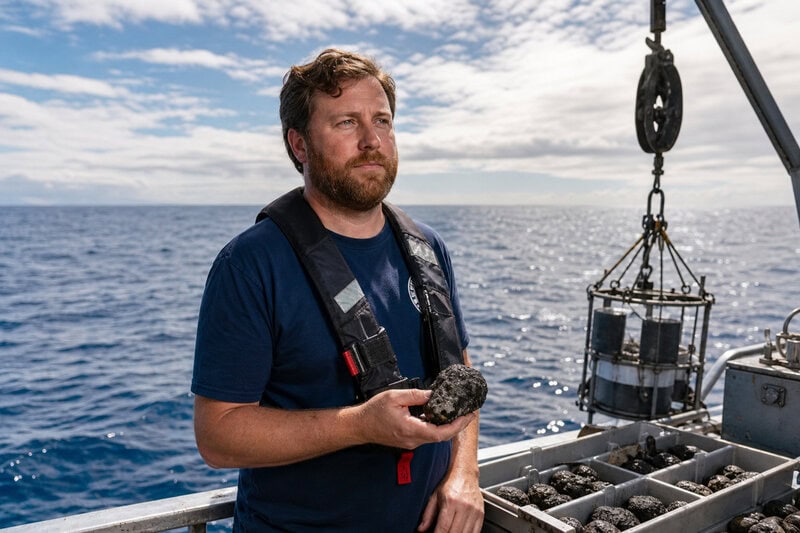
The U.S. Exclusive Economic Zone around American Samoa sits atop one of the Pacific’s richest documented polymetallic nodule deposits. That geology intersects with a pressing geopolitical reality: Washington has been seeking to reduce dependence on Chinese-controlled critical mineral supply chains, and cobalt, nickel, and manganese — all abundant in abyssal nodules — are central to battery technology and defense applications.
The Bureau of Ocean Energy Management characterized the planned sale as the first U.S. deep-sea mining lease sale, a designation that signals a deliberate federal policy shift toward commercializing seabed resources that had been effectively dormant under American jurisdiction for decades. The framing as a “first” carries legal weight beyond symbolism: the standards the Honolulu court applied will function as a template for every subsequent U.S. deep-sea mining authorization.
American Samoa’s Indigenous Samoan communities, whose cultural identity and food security are deeply tied to ocean health, were not prominently centered in the pre-ruling public discourse. Environmental advocates argue that omission compounds the procedural failures the court identified, raising questions about whether the consultation processes required under federal law were meaningfully observed. The geopolitical pressure to move quickly creates precisely the conditions under which environmental review is most likely to be compressed or narrowed — and courts, the Honolulu ruling suggests, are prepared to intervene when that happens.
What Science Still Does Not Know — and Why That Gap Is the Real Risk
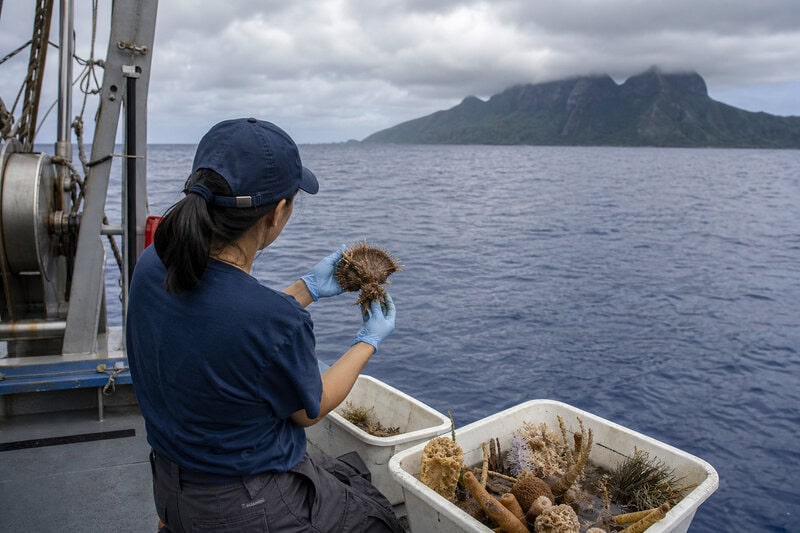
Baseline biodiversity surveys of the specific American Samoa lease blocks remain incomplete. Scientists cannot assess harm to species they have not yet documented. That is not an abstract concern — it is a foundational methodological problem that the court’s ruling implicitly surfaces. A biological opinion built on incomplete species inventories cannot honestly certify that mining will not jeopardize listed species, because the full roster of affected species is not yet known.
Population connectivity — how deep-sea species reproduce, disperse larvae, and potentially recolonize disturbed areas — is poorly understood for abyssal communities. Recovery timeline models carry very wide uncertainty bands, as acknowledged in a 2022 review published in Science of the Total Environment. That uncertainty is not a reason for complacency; it is a reason for caution, because the downside risk is permanent ecological loss.
Mining equipment does not confine its damage to the area it directly contacts. Sediment plumes generated by nodule-harvesting machines can travel hundreds of kilometers, smothering filter feeders and disrupting chemosynthetic communities — organisms that derive energy from chemical reactions rather than sunlight — well outside the direct mining footprint. Studies conducted in the Peru Basin through the long-running DISCOL experiment documented this plume behavior, though its full implications for the geology and oceanography of the American Samoa zone have not yet been extrapolated.
The honest scientific position, as stated by the Deep-Ocean Stewardship Initiative, is that humanity is being asked to make irreversible decisions about ecosystems it has barely begun to inventory. That is not advocacy dressed as science — it is a straightforward description of the epistemic situation, and it is the situation federal regulators must now confront directly.
The Ruling’s Ripple Effect: What Comes Next
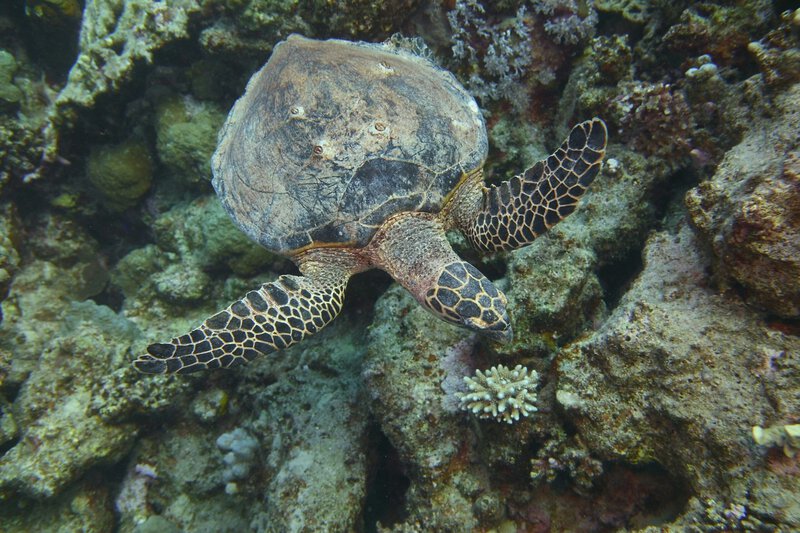
NMFS must now either conduct a legally compliant biological opinion — one that honestly addresses impacts on endangered sea turtles, marine mammals, and deep-sea corals listed under the ESA — or the lease sale cannot move forward. Environmental law experts have described the ruling as narrow in its technical holding but broad in its practical implication: agencies cannot use phased authorizations as a tool to avoid hard questions about irreversible environmental harm.
Industry proponents argue the ruling creates regulatory uncertainty that disadvantages U.S. companies relative to state-owned enterprises in countries that face no equivalent judicial oversight, a tension Congress will likely be asked to address through legislation. That pressure is real, but it does not alter the legal requirement. The Endangered Species Act does not contain a geopolitical exception.
Scientists and conservation organizations argue this legally mandated pause is an opportunity. A properly resourced baseline survey of the American Samoa abyssal zone could resolve critical unknowns and either validate or invalidate the assumption that mining can be conducted with manageable ecological cost. The International Union for Conservation of Nature has called for a moratorium on deep-sea mining until sufficient baseline data exist and robust regulatory frameworks are in place — a position that now carries renewed legal salience in the U.S. context.
The deeper question the ruling forces into public view is whether any biological opinion could honestly conclude that industrially scraping million-year-old nodule ecosystems poses no jeopardy to species dependent on them — and whether the law, applied faithfully, permits that conclusion without evidence that does not yet exist. That question is now squarely before federal regulators, and the answer they give will shape the future of deep-sea mining in U.S. waters for decades to come.