VentureStar
Concept Led By: NASA
Companies Involved: Lockheed Martin & BF Goodrich
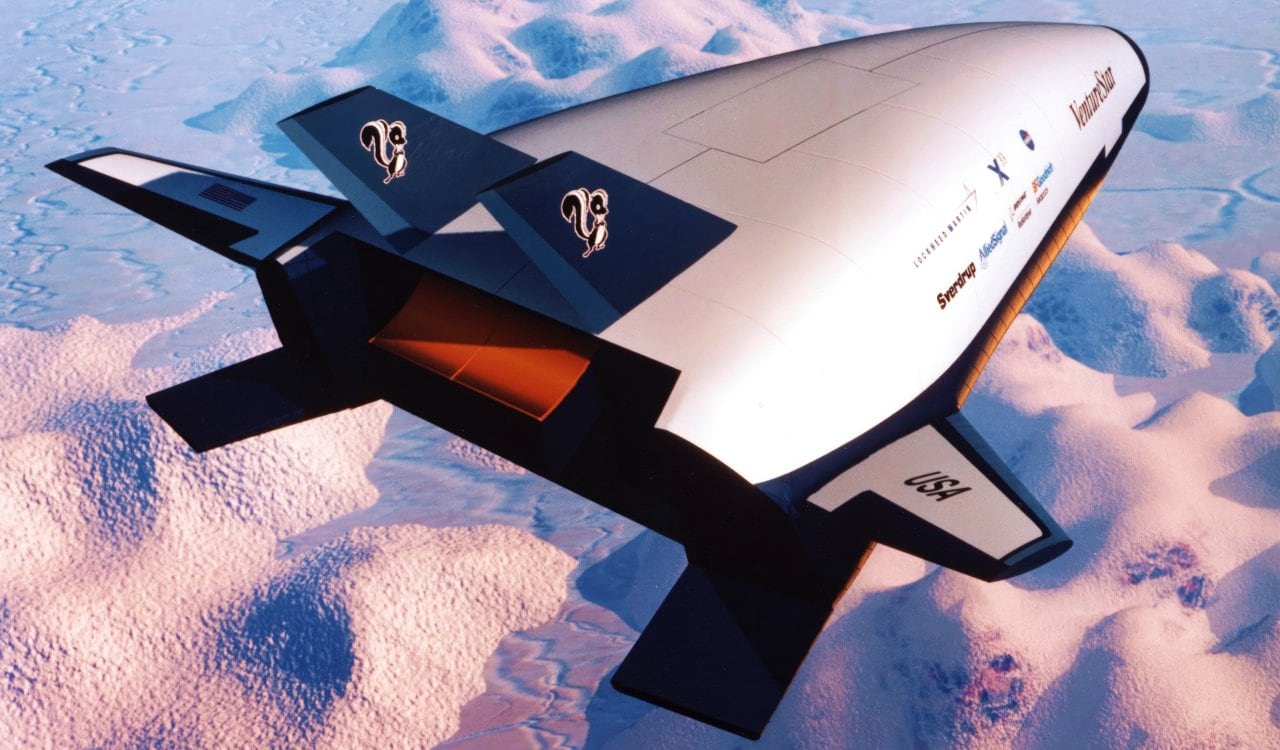
This SSTO reusable launch system was proposed by Lockheed Martin, and funded by the United States government. The Space Shuttle was great but NASA felt they could do better, which would result in developing a reusable spaceplane that could launch satellites into orbit. Doing so at a fraction of the cost compared to the (then) current Space Shuttle. They needed an uncrewed launcher capable of carrying passengers as cargo. Known as VentureStar, this spacecraft was set to have a wingspan of 68 feet and a length of 127 feet. It was also going to weigh around 1000 tons or 2.2 million pounds.
As you can tell, VentureStar’s intended design was to be the first commercial SSTO vehicle, also the first to launch vertically but return to Earth as an airplane. Flights on VentureStar would have been leased by NASA as needed too. How did this never get off the ground? It mostly came down to failures with the X-33 subscale technology demonstrator test vehicle. After several years of trying and many failures with the X-33 later, funding was canceled by 2001. The X-33 was a less costly demonstrator of the much larger VentureStar. The issue is if Lockheed Martin couldn’t get the X-33 right…VentureStar could never work as one of NASA’s go-to spacecraft designs.