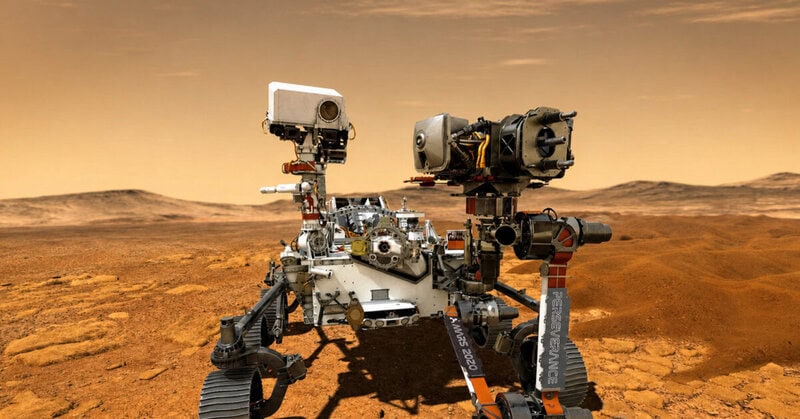
Dozens of sealed titanium tubes are sitting on the Martian surface right now, holding rock cores that could answer one of the most profound questions in human history: was Earth ever alone in harboring life? NASA is now launching a fresh effort to bring those samples home — and the scientific community is watching closely to see whether a restructured approach can succeed where an earlier, costlier plan could not.
The Most Valuable Rocks in the Solar System Are Sitting on Mars
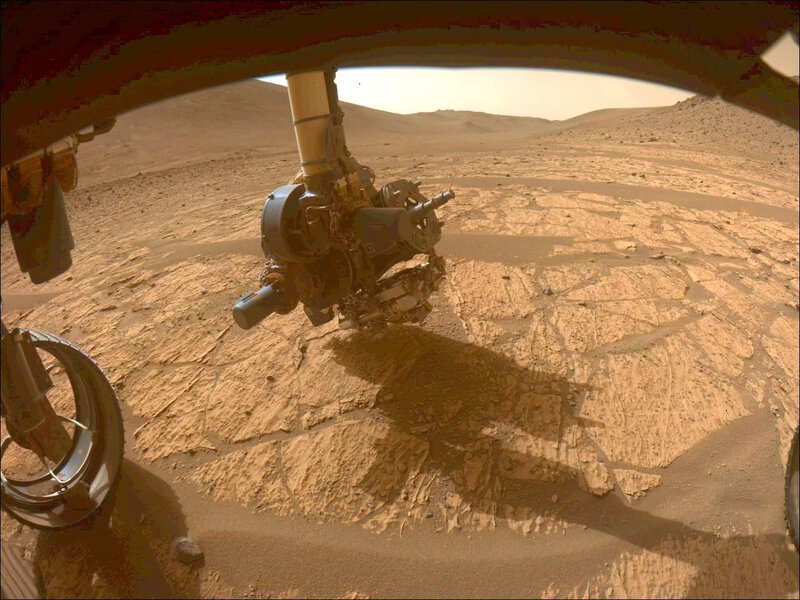
NASA’s Perseverance rover has spent years methodically drilling into the Martian surface inside Jezero Crater, an ancient lake bed and river delta system where conditions for microbial life could plausibly have existed billions of years ago. Each core sample has been carefully sealed inside a small titanium tube, deposited on the surface or stored aboard the rover, and catalogued with extraordinary precision.
But collecting the samples was always only half the mission. Getting them back to Earth is an entirely different — and far more complicated — undertaking. Now, NASA is kick-starting a fresh initiative called the Perseverance Sample Retrieval Architecture (PSRA), a reimagined framework designed to finally close the loop and deliver those tubes to waiting scientists on Earth.
If it succeeds, the effort would bring home the most scientifically significant extraterrestrial cargo ever retrieved — material that no robotic instrument on Mars, however sophisticated, is equipped to fully analyze on its own.
What Perseverance Has Already Found — and Why Earth Laboratories Are Still Needed
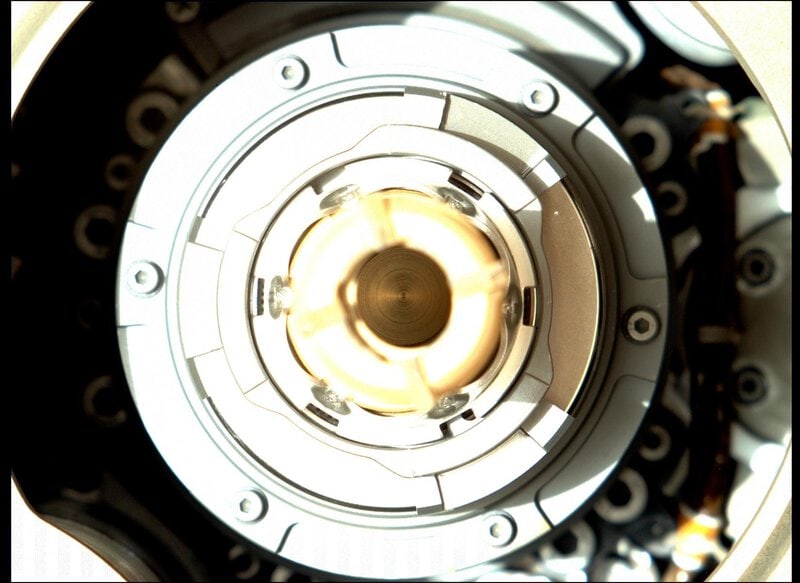
Since touching down in February 2021, Perseverance has collected an impressive and diverse set of Martian rock samples. The collection spans both igneous and sedimentary material, representing billions of years of Martian geology. Some samples come from ancient volcanic flows that reveal the early thermal history of the planet; others come from layered sedimentary rock where fine-grained minerals could have trapped and preserved signs of ancient biology.
Perseverance carries onboard instruments capable of detecting chemical signatures and imaging rock textures in remarkable detail, and those instruments have already returned significant data. But there is a hard ceiling on what any rover can accomplish remotely. Confirming a biosignature — a molecular marker unambiguously produced by living organisms — requires the kind of precise, multi-technique laboratory analysis that only exists in specialized facilities on Earth. Mass spectrometers, isotopic analyzers, and electron microscopes operated by expert geochemists cannot be replicated at rover scale with current technology.
Every month the Mars rock samples collected by Perseverance sit in their titanium tubes on the Martian surface is another month that one of the most important open questions in planetary science goes unanswered.
The Original Plan — and Why It Hit a Wall
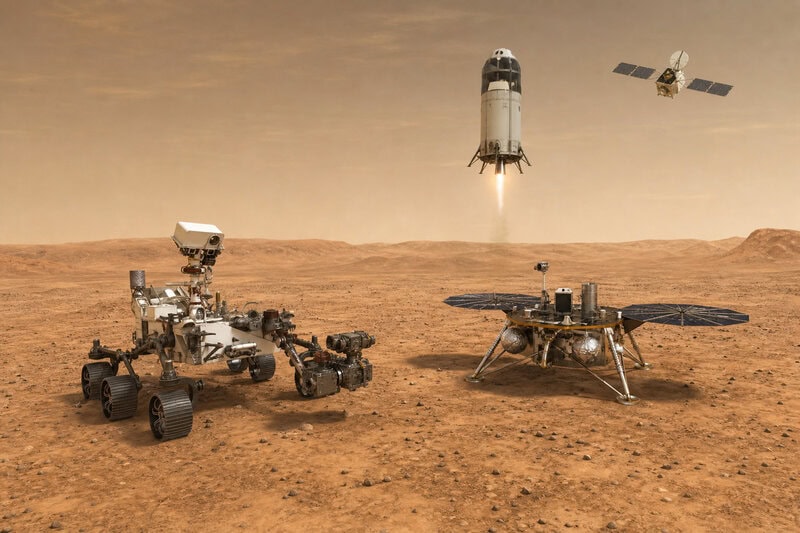
The path to returning Martian samples was not always this uncertain. In September 2022, NASA and the European Space Agency (ESA) formally approved a joint architecture built around three sequential missions: Perseverance as the sample collector, a dedicated Sample Retrieval Lander to gather the tubes and launch them into Mars orbit, and an Earth Return Orbiter to capture the sample container and ferry it back to Earth.
It was an ambitious and technically coherent plan. It was also, as an independent review board determined, unaffordable as designed. Cost estimates for the original architecture climbed well beyond $10 billion, and schedule projections pushed the earliest possible Earth return past 2040. That combination triggered a mandatory review, and in 2024 NASA paused development to rethink the approach from the ground up.
Agency leadership made clear that the scientific goal had not changed. What required an overhaul was the roadmap to reach it. As reporting on NASA’s new look at Mars sample return has noted, the agency is explicitly seeking a path that is both technically credible and fiscally realistic within foreseeable budget constraints.
The PSRA: A Leaner, More Flexible Comeback Strategy
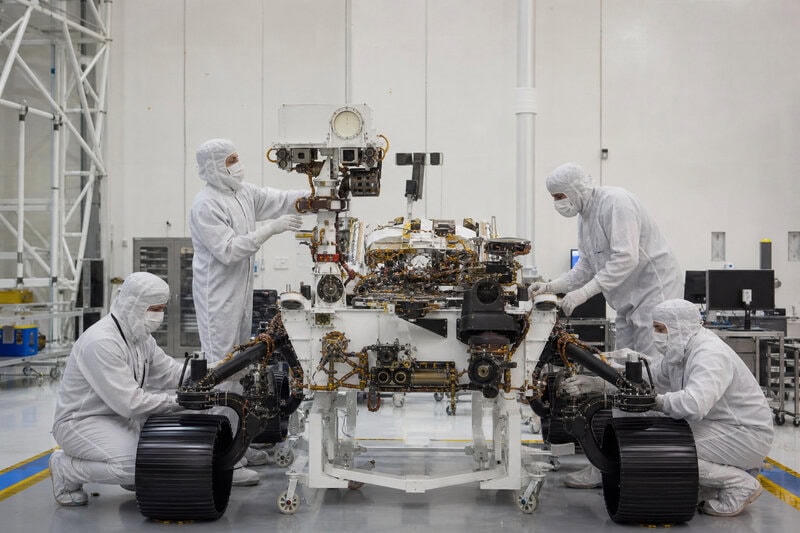
The Perseverance Sample Retrieval Architecture represents a significant philosophical shift in how NASA is approaching the problem. Rather than a single, monolithic campaign designed entirely in-house, the PSRA opens the retrieval challenge to industry partners and international collaborators, inviting fresh engineering concepts that can take advantage of commercial aerospace capabilities that did not exist when the original plan was written.
Early concepts under consideration include smaller, purpose-built landers and modular mission elements that could be developed and flown more independently, reducing the risk that a single cost overrun or technical delay cascades across the entire program. The goal is a framework flexible enough to absorb new technology and new partners as the architecture matures toward a final design.
NASA’s renewed push to bring Mars samples home reflects a broader trend in planetary science: leveraging the commercial space sector to accomplish missions that would have required purely government infrastructure just a decade ago. Whether that approach can deliver the cost savings and schedule improvements the program needs remains to be demonstrated.
When Will Mars Samples Return to Earth?
This is the question scientists and space enthusiasts most want answered — and the honest response is that a confirmed target date does not yet exist under the new architecture. Under the original NASA-ESA plan, the target was the mid-2030s. After the cost review and program pause, independent analysts shifted realistic estimates toward the late 2030s or early 2040s.
The PSRA process is specifically intended to identify a credible path that could compress that timeline while keeping costs within bounds that Congress and international partners can sustain. Timing is further complicated by an unavoidable astronomical constraint: favorable launch windows between Earth and Mars open only roughly every 26 months. Delayed decisions do not cost months — they cost years.
NASA has not yet announced a confirmed launch date under the new architecture. The next major public milestone is expected to be a down-selected mission concept, narrowing the field of competing approaches to a leading candidate. That decision is anticipated within the coming year, and it will set the pace for everything that follows. More detail on the current status of competing concepts can be found at coverage of NASA’s new Mars sample return effort.
What Happens When the Samples Actually Arrive on Earth
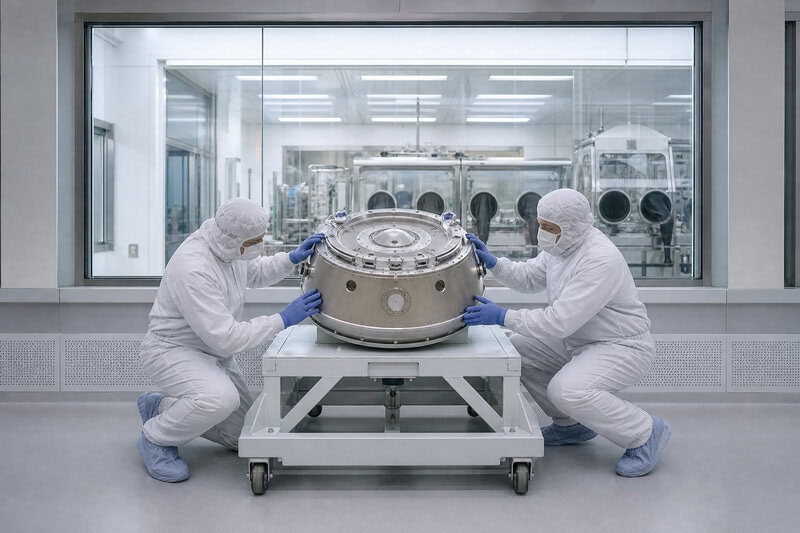
When the sample capsule eventually re-enters Earth’s atmosphere, it will not simply be delivered to the nearest university geology department. The returned material will arrive sealed inside a biocontained canister and will be transported to a specially built Sample Receiving Facility — a laboratory unlike any that currently exists, designed to handle extraterrestrial material under strict planetary protection protocols that prevent both contamination of the samples and any theoretical risk posed by unknown Martian material reaching the terrestrial environment.
Inside that facility, researchers from institutions around the world will study the samples for ancient microbial fossils, complex organic chemistry, and isotopic signatures that speak to the earliest chapters of planetary formation — chapters Mars and Earth shared before their geological histories diverged dramatically. The findings could reshape understanding of when and where the building blocks of life first emerged in the inner solar system.
Critically, archived portions of each sample will be preserved untouched for future researchers equipped with instruments not yet invented. This is precisely the logic that has made Apollo lunar samples so enduringly valuable more than half a century after the Moon landings — scientists continue to extract new discoveries from rocks brought home in 1969 using analytical techniques that did not exist at the time of collection.
Why This Mission Is Worth the Wait — and the Price
The question of whether Mars ever hosted life is arguably the most consequential open question in modern science. A single confirmed biosignature in returned Martian rock would not merely add a data point to a planetary science database. It would fundamentally alter humanity’s understanding of its place in the universe, demonstrating that life is not a singular accident confined to one world.
Beyond the biology, a successful Mars Sample Return mission would demonstrate the full round-trip capability — landing on another planet, collecting material, launching from that planet’s surface, and returning safely to Earth — that any future human mission to Mars will also require. It is, in a meaningful sense, a critical technical rehearsal for crewed interplanetary exploration.
NASA’s decision to launch the PSRA rather than quietly shelve the program is itself significant. As documented in the history of the NASA-ESA Mars Sample Return effort, this program has survived budget pressures, changing administrations, and profound engineering challenges before. The agency is not abandoning the scientific goal. It is recalibrating — carefully, and under real fiscal pressure — to find a path that can actually be executed. The tubes are waiting on Mars. The question is how soon humanity will be ready to go and get them.