
A new analysis of commercial salmon feed ingredients found PFAS precursor compounds at concentrations up to twice as high as the legacy “forever chemicals” that most regulators have spent decades monitoring. That gap in measurement suggests scientists and food safety agencies may have been capturing only a fraction of the actual chemical burden entering one of the world’s most widely consumed farmed fish — and for people who eat farmed Atlantic salmon regularly, the implications are only beginning to be understood.
What PFAS Are and Why the ‘Forever Chemical’ Label Matters
Per- and polyfluoroalkyl substances — PFAS — are a family of more than 10,000 synthetic chemicals built around an exceptionally strong carbon-fluorine bond, one of the most stable chemical linkages in organic chemistry. That stability is precisely why PFAS resist breakdown: in soil, water, animal tissue, and the human body, these compounds persist far longer than almost any naturally occurring molecule, earning them the informal label “forever chemicals.”
Within this vast chemical family, scientists draw a critical distinction between two categories. Legacy PFAS — compounds such as PFOS (perfluorooctane sulfonic acid) and PFOA (perfluorooctanoic acid) — have been largely phased out of manufacturing in the United States and Europe over the past two decades and are the primary targets of existing regulatory monitoring programs. PFAS precursors are a separate category: newer or intermediate compounds that are not themselves legacy PFAS but can transform into them once inside a living organism through ordinary metabolic processes. Because regulatory testing has historically focused on legacy compounds, precursors have largely escaped detection — which is why finding them at double the concentration of legacy PFAS in salmon feed ingredients is significant.
PFAS are not efficiently metabolized by most organisms, so they accumulate in fatty tissue with each step up the food chain, a process ecologists call biomagnification. A predator that eats many smaller organisms — or a human who eats fish regularly — can carry a body burden of PFAS far higher than the surrounding environment would suggest. The U.S. Environmental Protection Agency, the European Food Safety Authority, and the World Health Organization have all classified certain PFAS as substances of concern for human health, linking long-term exposure in epidemiological studies to effects on immune function, thyroid regulation, and cancer risk. All three agencies emphasize that dose and duration of exposure matter greatly, and that quantifying risk at low dietary concentrations remains an active area of scientific investigation.
What the New Study Found: Contamination Across the Feed Supply Chain
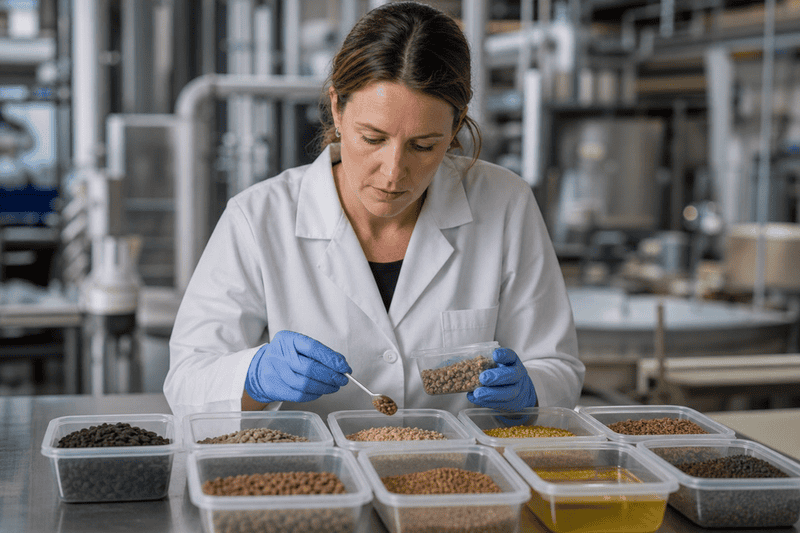
A recent study analyzing major salmon feed ingredients detected PFAS in fishmeal, fish oils, plant oils, and plant proteins — establishing that contamination is not confined to a single ingredient class but is distributed across both marine-derived and terrestrial-derived components of modern aquafeeds. That breadth is one of the study’s most consequential findings, because it forecloses the simpler narrative that swapping one ingredient category for another would solve the problem.
Among all ingredients tested, fishmeal carried the highest PFAS concentrations. That result is consistent with what scientists already understand about fishmeal’s production: it is a concentrated product derived from wild-caught forage fish — small pelagic species such as anchovies and herring — that have bioaccumulated PFAS from ocean water and marine sediment throughout their lives. Concentrating those fish into meal compresses and intensifies whatever chemical load they carried. The detection of measurable PFAS levels in plant-derived ingredients was described by the researchers as noteworthy, because terrestrial agricultural inputs are not typically considered a primary PFAS vector in aquaculture.
The study’s most novel contribution, however, is the precursor finding. PFAS precursors were detected at concentrations exceeding legacy PFAS by up to two-fold, suggesting that standard regulatory monitoring — historically built around a narrow list of well-characterized legacy compounds — may be capturing only a portion of the true PFAS load entering the salmon feed supply chain. As the peer-reviewed literature has already established, fishmeal is a recognized source of per- and polyfluoroalkyl substances in aquafeeds and farmed seafood; this study adds quantitative weight to that concern and extends it to the underexamined domain of precursor chemistry.
From Feed to Fish to Fork: How PFAS Move Through the Aquaculture System

The transfer pathway from feed ingredient to dinner plate involves several biological steps that compound the complexity. PFAS present in feed ingredients are ingested by salmon, absorbed through the gut lining, and partitioned into various tissues according to their chemical structure. Some PFAS preferentially accumulate in the liver; others concentrate in muscle tissue — the portion of the fish that reaches consumers’ plates. This tissue-specific partitioning means that the total PFAS content of a feed does not translate straightforwardly into the PFAS content of an edible fillet.
Precursor compounds complicate the picture further. Once inside the fish, certain PFAS precursors can be biotransformed into more stable legacy PFAS through metabolic processes the fish cannot suppress. A salmon fed a diet containing predominantly precursor compounds may therefore still accumulate legacy PFAS in its muscle tissue — an internal chemical conversion that makes feed-level measurements an incomplete predictor of what ultimately reaches consumers. Research examining PFAS in feed and farmed seafood has identified this biotransformation pathway as a key reason why precursor concentrations in feed deserve regulatory attention on their own terms, not merely as stand-ins for legacy compounds.
Feed formulation trends add another layer of relevance. Over the past two decades, the aquaculture industry has deliberately reduced its reliance on fishmeal and fish oil, substituting plant proteins and plant oils in part to ease pressure on wild forage fish populations. That reformulation strategy has genuine environmental benefits. However, the detection of measurable PFAS levels in plant-derived feed ingredients in the new study suggests the industry cannot assume that moving away from marine ingredients eliminates PFAS risk. Contamination appears to enter through multiple ingredient pathways simultaneously, not a single one that can be cleanly removed.
What is firmly established in the scientific literature is that PFAS transfer from feed to fish flesh occurs. What remains under active investigation are the precise bioaccumulation factors for PFAS precursors in Atlantic salmon raised under commercial farming conditions, and the degree to which precursor-to-legacy conversion happens in vivo at rates that materially affect concentrations in edible tissue.
The Human Exposure Angle: Seafood, Diet, and PFAS Risk

The feed-level findings connect to a separate but reinforcing body of epidemiological research. A Dartmouth-led study suggests that people who frequently consume seafood may face an increased risk of exposure to PFAS, adding an important human-health dimension to laboratory findings about feed contamination. The researchers cautioned, as scientists routinely do with association-based findings, that further investigation is needed to establish causation and to quantify risk across realistic eating frequencies for different populations.
“Increased exposure” does not automatically mean “harmful exposure.” Regulatory thresholds for PFAS in food vary by jurisdiction and by specific compound. Most public-health agencies continue to recommend seafood as part of a balanced diet, citing its well-documented cardiovascular and cognitive benefits. The policy position of agencies such as the U.S. Food and Drug Administration and the European Food Safety Authority is not that seafood should be avoided, but that monitoring frameworks need to improve so that regulators and consumers have more precise information on which to base decisions.
Researchers do identify certain populations as warranting closer attention. Individuals who rely on seafood as a primary protein source multiple times per week — including some coastal and Indigenous communities whose traditional diets are seafood-centered — may accumulate PFAS more rapidly than average consumers. Environmental justice researchers have noted this disparity in the broader PFAS exposure literature, observing that the populations most nutritionally and culturally dependent on seafood are often those most affected by contamination in aquatic food chains.
It is also worth distinguishing farmed from wild salmon on this question. The new research focuses specifically on aquafeed ingredients, making its findings most directly relevant to farmed Atlantic salmon. Wild salmon encounter PFAS through their natural prey and through ocean water and sediment — a different and not fully comparable exposure profile. Scientists have noted that parallel investigation of wild salmon PFAS burdens, using analytical methods that include precursor screening, is similarly overdue.
What Regulators and the Industry Are — and Are Not — Doing
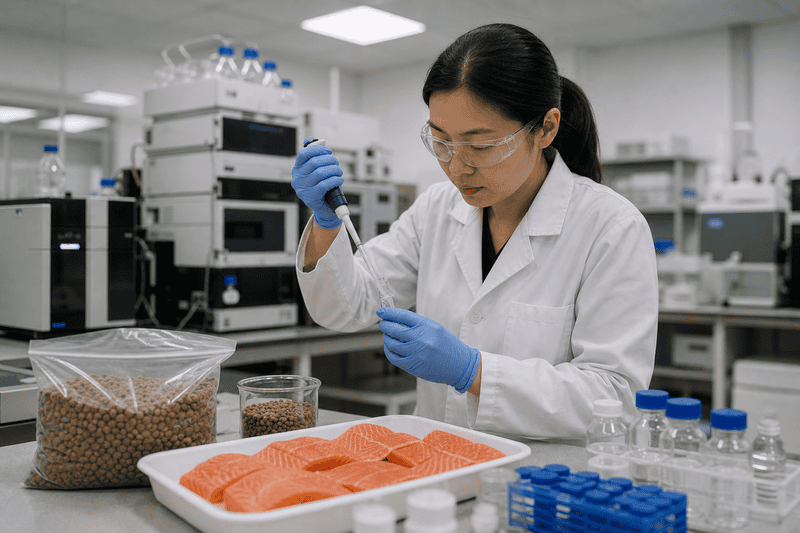
The precursor finding exposes a structural gap in existing food-safety monitoring. Most regulatory programs test for a defined list of legacy PFAS compounds whose chemistry and toxicology are relatively well characterized. When PFAS precursors appear at up to twice the concentration of legacy compounds in salmon feed ingredients, those precursors largely pass undetected through frameworks not designed to screen for them. Food safety scientists have increasingly called on regulators to shift from compound-specific testing toward compound-class-wide PFAS screening — an approach that casts a wider analytical net but requires substantially more sophisticated laboratory infrastructure and analytical expertise.
On the industry side, some major salmon farming companies have begun voluntary PFAS testing programs and supplier audits in response to growing scientific and consumer attention. As of early 2025, however, no binding international standard for PFAS in aquafeed ingredients existed, leaving monitoring largely inconsistent across producers and jurisdictions. A farm operating under stringent European Union food safety rules faces meaningfully different de facto requirements than one in a jurisdiction with no PFAS-specific aquafeed guidance whatsoever.
Eliminating PFAS from fishmeal — the most contaminated ingredient class identified in the study — presents genuine logistical challenges. One option is sourcing forage fish from ocean regions with lower ambient PFAS contamination, but identifying, certifying, and reliably supplying those regions at commercial scale is both geographically constrained and expensive. Another approach is accelerating the transition to alternative protein sources such as insect meal, single-cell proteins derived from microorganisms, or algae-based oils. Each of these alternatives has shown promise in reducing dependence on marine-derived ingredients, but researchers note that the PFAS profiles of these novel ingredients are themselves still being characterized — meaning the industry would be substituting one partially understood contamination picture for another rather than achieving a clean solution.
Multiple research groups and food safety authorities have called for expanded, compound-class-wide PFAS screening of both aquafeed ingredients and the farmed fish products derived from them. That call represents an emerging scientific consensus that the current monitoring regime is insufficient given the breadth and variety of PFAS chemistry now documented in the feed supply chain.
What Consumers Should Take Away
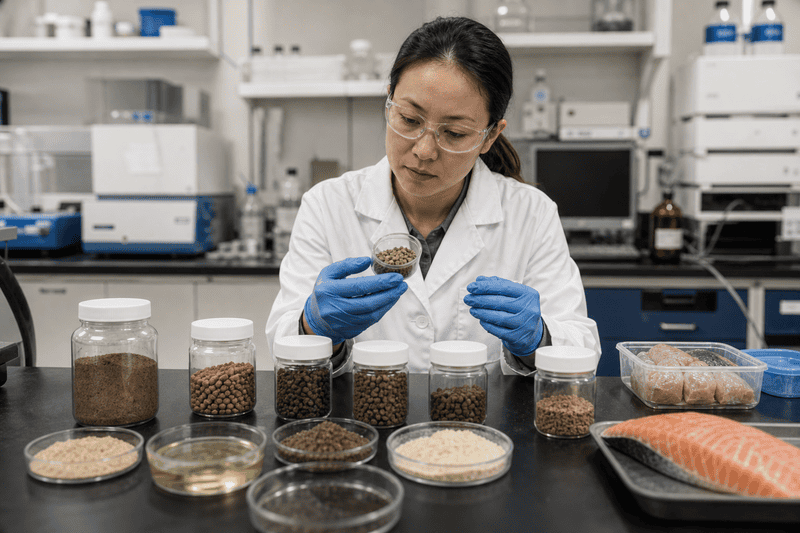
Several things are now established by the evidence. PFAS — including both legacy compounds and precursors — are present across major salmon feed ingredient categories, with fishmeal carrying the highest concentrations. Contamination is not limited to marine-derived ingredients but extends to plant-derived ones as well. Precursor compounds, which standard regulatory monitoring largely fails to detect, were found at up to twice the concentration of legacy PFAS in the feed ingredients studied.
What remains under active scientific investigation is how much of that chemical load transfers to edible salmon tissue, at what concentrations it reaches consumers under typical dietary patterns, and how precursor biotransformation inside the fish affects the final outcome in edible flesh. Those are not trivial questions, and answering them requires the kind of retail-level fillet testing that has not yet been conducted at scale.
Current evidence does not support abandoning farmed salmon. It remains a nutrient-dense, widely accessible protein source with a well-established record of cardiovascular and other health benefits at population scale. What the evidence does support is consumer interest in producer transparency around PFAS testing, and scientists broadly recommend dietary variety — rather than eliminating any single protein source — as the most practical risk-reduction strategy available to individuals while research and regulatory frameworks catch up to the chemistry involved.
The most significant near-term development to watch for is studies that measure PFAS, including precursor compounds, directly in farmed salmon flesh as it is sold at retail, rather than only in feed ingredients at the factory level. That step would allow regulators and consumers to move from theoretical exposure estimates to actual dietary exposure data — making meaningful risk assessment possible across a range of eating frequencies and realistic portion sizes for the first time.
The discovery of PFAS precursors at concentrations exceeding legacy compounds in salmon feed is not a cause for alarm, but it is an unambiguous signal that scientists, regulators, and the aquaculture industry have been working from an incomplete map of a chemical problem that is measurably present in the food supply. Completing that map is now a matter of clear scientific and public-health priority.