
On the morning of September 1, 1859, British astronomer Richard Carrington was sketching sunspots through his telescope when two intensely bright white patches of light erupted from the Sun’s surface and vanished within minutes — the first scientifically recorded white-light solar flare. The flare was followed by an extreme geomagnetic storm that slammed into Earth, setting telegraph wires ablaze, sparking auroras visible as far south as Cuba, and bewildering a world that had no framework to explain what had just happened. More than 160 years later, scientists still cannot fully explain what makes these rare, brilliant outbursts work. A newly funded NJIT Ph.D. researcher is now taking direct aim at that gap.
What Makes a White-Light Solar Flare Different
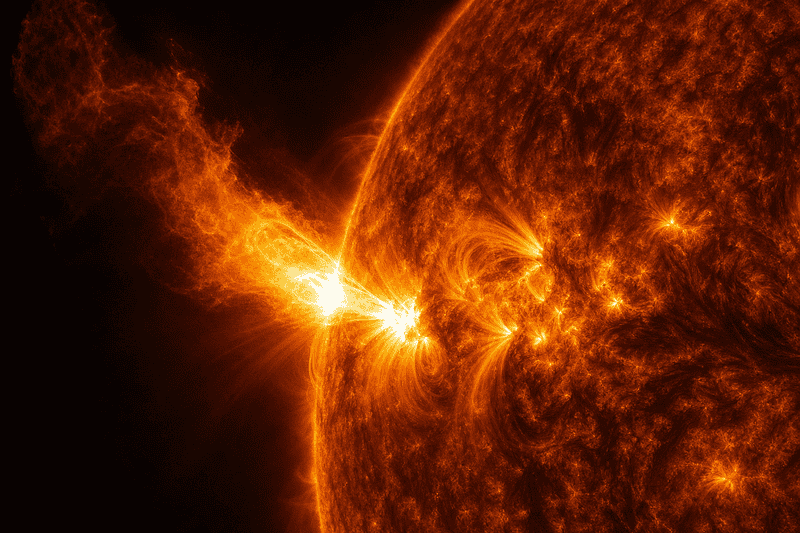
A solar flare is a sudden, intense burst of electromagnetic radiation released when magnetic energy stored in the Sun’s atmosphere is rapidly converted into heat, light, and accelerated particles. The physical engine behind this process is called magnetic reconnection: when oppositely directed magnetic field lines in the solar corona snap together and reconnect, they release enormous amounts of stored energy in a fraction of the time it takes to brew a cup of coffee.
NOAA and NASA classify solar flares on a logarithmic scale — A, B, C, M, and X — where each letter represents an X-ray output roughly ten times greater than the one before it. An X-class flare is the most powerful category. But flare class alone does not determine whether an event becomes a white-light solar flare. Some X-class flares produce no detectable white-light emission at all, while a handful of M-class flares have crossed the threshold. The classification system measures X-ray output, not the specific physical conditions that drive visible-light production.
What makes a white-light flare categorically different is precisely that visible-light surge. The vast majority of flares are detected only in X-ray or ultraviolet wavelengths, invisible to the human eye and observable only with specialized instruments. A white-light flare, by contrast, emits a burst of optical light intense enough to be briefly detectable against the already overwhelming luminosity of the solar disk itself — roughly analogous to noticing a candle flame inside a searchlight beam. Producing this visible emission requires that energy from the flare penetrate deep into the Sun’s lower atmosphere, a dense layer called the photosphere, heating it to produce what physicists call continuum emission across the visible spectrum.
Scientists broadly agree that energy travels downward from the corona during a flare, carried either by beams of accelerated electrons or by thermal conduction. What they do not agree on — and what peer-reviewed literature continues to debate — is which mechanism dominates in white-light flares specifically, and why only certain events reach the photosphere with enough energy to produce optical emission at all.
Why White-Light Flares Are So Hard to Catch — and to Explain
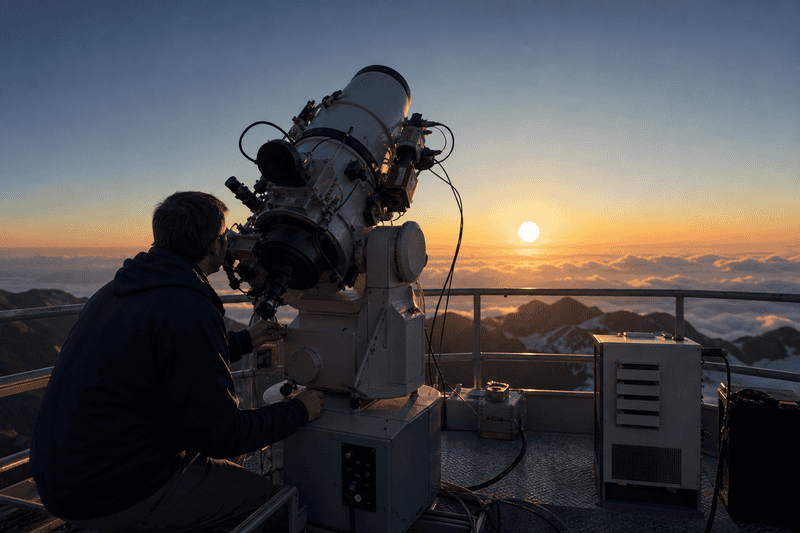
Detecting a white-light solar flare has historically required both specialized instrumentation and considerable luck. Because the brightness increase occurs against the full glare of the solar disk, even a substantial surge in optical output can appear as only a fractional change in total luminosity. Carrington’s 1859 detection was itself an accident of circumstance — he happened to be watching at precisely the right moment with the right equipment. Modern space-based solar observatories have improved detection rates, but white-light flares still represent a small fraction of all recorded flare events, making statistical analysis difficult.
The deeper scientific puzzle is not just observational but theoretical. Standard models of energy transport in solar flares predict that beams of accelerated electrons should deposit most of their energy high in the solar atmosphere, in a region called the chromosphere, well above the dense photosphere. The photosphere is optically thick — meaning it absorbs and re-emits radiation rather than letting it pass through freely — and reaching it with enough energy to produce visible continuum emission requires overcoming substantial resistance. Yet white-light flares demonstrably do exactly that, which means either the standard models are incomplete, or some additional mechanism is at work.
Two competing explanatory frameworks have emerged. The first proposes that beams of high-energy electrons travel all the way down to the lower chromosphere and upper photosphere, depositing their energy directly through collisions with the dense plasma there. The second — called radiative backwarming — suggests that intense X-ray and ultraviolet radiation generated higher in the atmosphere heats the photosphere indirectly, from above. Observational data gathered over recent decades have not conclusively favored either model, leaving the question genuinely open in a way that is unusual for a phenomenon first recorded in the nineteenth century.
Resolving this debate matters far beyond academic heliophysics. Energy-transport physics in white-light flares is directly relevant to space-weather forecasting, because these are among the most energetic events the Sun produces. It is also relevant to the study of flares on distant stars: when astronomers observe stellar flares, visible-light emission is often the only detectable signal available, making white-light flare physics the interpretive lens through which stellar activity is understood.
The NASA FINESST Award: Funding the Next Generation of Solar Researchers
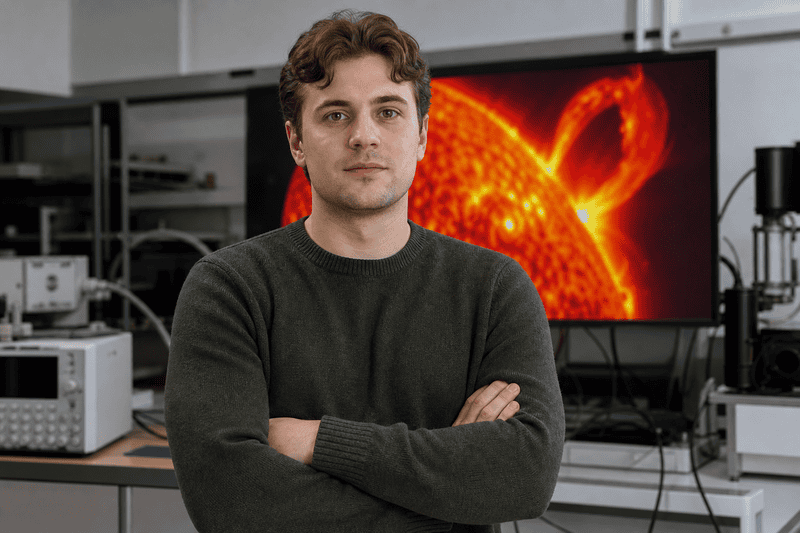
Into this contested scientific landscape steps a new investigator. An NJIT Ph.D. researcher has been awarded a NASA Future Investigators in NASA Earth and Space Science and Technology (FINESST) award specifically to investigate the physical mechanisms behind white-light solar flares — placing this unresolved problem at the center of a formally funded, student-led research program.
The FINESST program is a competitive NASA grant initiative that funds graduate student-led research proposals across five scientific domains: Astrophysics, Earth Science, Heliophysics, Planetary Science, and closely related fields. What distinguishes FINESST from conventional research assistantships is its emphasis on student-driven scientific agendas. Rather than simply supporting work defined by a faculty advisor, FINESST recipients propose and lead their own original investigations, positioning early-career scientists as principal drivers of inquiry. This structure is intentionally suited to high-risk, high-reward questions — precisely the profile of an open problem like white-light flare energy transport.
The award situates this research within NASA’s Heliophysics priority area, reflecting the agency’s institutional recognition that understanding extreme solar events is essential to both fundamental science and national infrastructure resilience. That this grant went to an NJIT researcher reflects the university’s established strength in solar physics. NJIT physics professor Bin Chen received the 2023 Karen Harvey Prize from the American Astronomical Society for significantly advancing the understanding of solar flares — an honor awarded annually to a researcher who has made a substantial early-career contribution to solar physics. The presence of prize-winning faculty expertise in flare research creates exactly the environment in which ambitious graduate investigations can take root.
What the Research Will Actually Do

At a conceptual level, the NJIT investigation is expected to combine high-resolution solar observations with detailed numerical modeling to disentangle the competing energy-transport mechanisms described above. Modern solar observatories — including NASA’s Solar Dynamics Observatory, which has monitored the Sun continuously in multiple wavelengths since 2010, and the Daniel K. Inouye Solar Telescope in Hawai’i, which provides the highest-resolution images of the solar surface ever obtained — now generate multi-wavelength, high-cadence datasets that did not exist even a decade ago. This observational richness gives the current generation of researchers an empirical window into white-light flare physics that Carrington could not have imagined.
The diagnostic strategy works by comparing timing and structure across different types of emission simultaneously. If electron beam bombardment drives the white-light signal, the visible emission should appear in close temporal and spatial alignment with signatures of energetic electrons detected in hard X-ray and microwave wavelengths. If radiative backwarming is the dominant mechanism, the heating pattern and timing will look systematically different, reflecting the indirect path by which upper-atmosphere radiation reaches the photosphere. Comparing these observational fingerprints against numerical model predictions can, in principle, identify which scenario better describes real flare behavior.
A confirmed energy-transport model for white-light solar flares would carry consequences well beyond solar physics. Space-weather forecasting algorithms could be updated to better identify which flares are likely to reach white-light intensity, improving warning times for satellite operators and power-grid managers. The model would also provide a physical template for interpreting energetic flares observed by missions studying stellar activity around distant stars — directly informing assessments of whether planets orbiting those stars could sustain conditions hospitable to life.
From the Sun to Space Weather: Why This Research Has Real-World Stakes
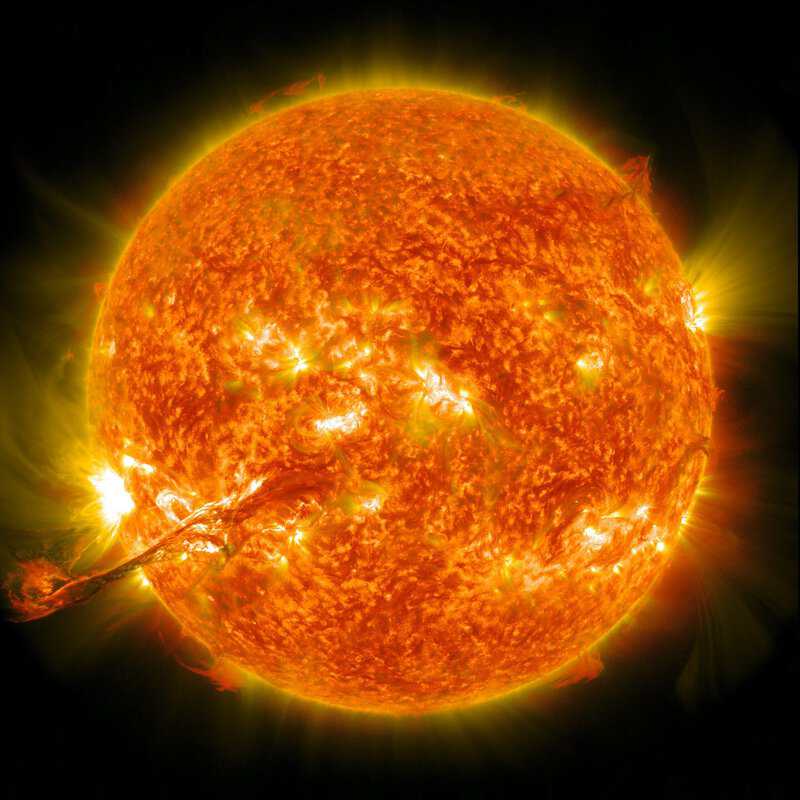
The 1859 Carrington Event remains the historical benchmark for extreme solar activity, and its modern implications are sobering. A comparable geomagnetic storm today could cause severe damage to power and communications infrastructure, disabling satellites, disrupting electrical grids, and degrading GPS systems that underpin everything from aviation navigation to financial transaction timing. The populations most at risk would include not only specialized industries but ordinary people dependent on hospital equipment, food supply chains, and emergency services.
Current space-weather models can detect that a large flare has occurred within minutes of its peak X-ray emission, and they can estimate the likely arrival time of any associated coronal mass ejection at Earth. What they cannot yet reliably do is forecast a flare’s peak intensity before it occurs, or predict whether a given event will cross the white-light threshold — the very uncertainty this research program aims to reduce. Improving that predictive capability even modestly could extend warning windows from minutes to hours, potentially allowing power operators to implement protective measures before the most damaging geomagnetic currents arrive.
The stakes extend beyond Earth entirely. Astronomers studying planets orbiting M-dwarf stars — small, cool red stars that are the most common type in the galaxy and that flare frequently and intensely — use white-light flare observations as the primary proxy for estimating the radiation environment those planets experience. Intense flare activity can strip away planetary atmospheres over geological timescales and bombard surfaces with ultraviolet radiation hostile to the chemistry of life. The physical understanding developed from studying solar white-light flares thus feeds directly into the scientific framework used to evaluate which exoplanets might genuinely be considered habitable.
The Biggest Open Questions — and What Answers Would Mean

Three questions stand out as the ones the heliophysics community most urgently needs answered. First: what energy-transport mechanism — electron beam bombardment, radiative backwarming, or some combination — dominates in white-light solar flares? Second: why do only certain large flares produce white-light emission while energetically comparable events do not, and what physical threshold separates the two populations? Third: does white-light flare physics operate by the same principles on other types of stars, or do different stellar environments produce fundamentally different emission mechanisms?
As of this writing, none of these questions has a settled scientific answer. Despite more than 160 years of observation since Carrington’s accidental sighting, no consensus has emerged on the dominant emission mechanism — a reminder that even the star at the center of our solar system, studied by thousands of researchers across generations, still holds deep and consequential secrets.
The NJIT FINESST project does not stand alone. It joins a growing international effort converging on the white-light flare problem from multiple directions simultaneously, using data from the Inouye Solar Telescope’s unprecedented resolution, ESA and NASA’s Solar Orbiter spacecraft observing the Sun from novel vantage points, and the Parker Solar Probe sampling the solar environment closer to the Sun than any previous mission. When independent research teams using different instruments and methods approach the same unresolved question, the probability of a breakthrough rises substantially.
If the coming decade of coordinated, multi-instrument solar observation delivers the data researchers anticipate, the mechanism behind white-light solar flares — first glimpsed by a Victorian astronomer who had no way of knowing what he was seeing — may finally yield a rigorous physical explanation. That explanation will not just satisfy scientific curiosity. It will make the modern world measurably more prepared for the next time the Sun decides to put on a show.