
On June 10 and June 12, 2025, NASA’s X-59 experimental aircraft reached Mach 1.4 — roughly 924 miles per hour — at an altitude of approximately 55,000 feet, validating for the first time in actual supersonic flight the precise profile its engineers designed it to fly. Those two numbers are not about speed records. They are about whether the shock waves an aircraft generates at that specific combination of velocity and altitude can reach the ground quietly enough to give regulators a scientific basis for reconsidering a rule that has been on the books since 1973.
What the X-59 Is — and Why It Exists
The X-59 is a purpose-built quiet supersonic research aircraft developed by NASA and Lockheed Martin Skunk Works under NASA’s Quesst mission (Quiet SuperSonic Technology). The program’s goal is not to set speed records or prototype a passenger jet. It is to generate the acoustic and community-response data needed to give regulators a scientific foundation for reconsidering the U.S. Federal Aviation Administration’s ban on commercial supersonic flight over land — a prohibition in place since 1973 and unchanged ever since.
That ban was a direct consequence of the Concorde era. During test corridors in the 1960s and early 1970s, supersonic overflights produced thunderous double-crack booms that rattled windows, startled livestock, and generated thousands of noise complaints. The FAA’s response was categorical: no overland commercial supersonic flight. The rule has remained untouched because, until now, no aircraft existed that was specifically engineered and instrumented to challenge the acoustic assumptions underlying it.
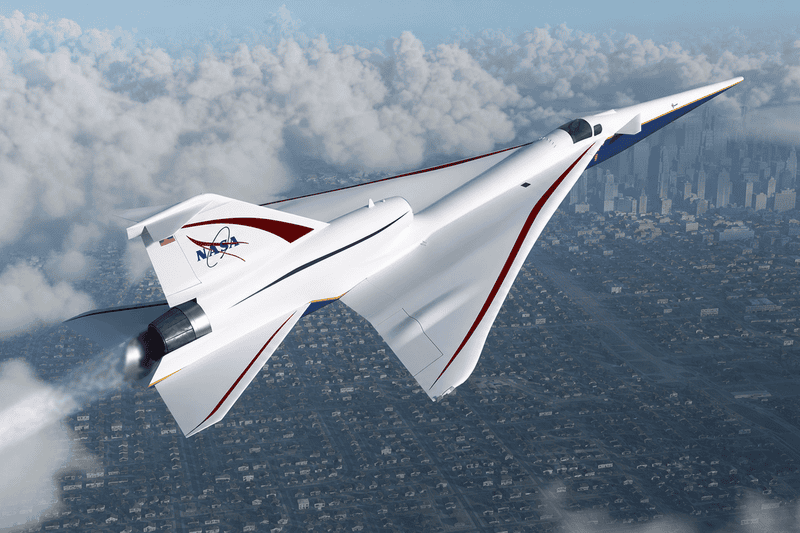
The X-59 is approximately 99 feet long, with an unusually elongated nose accounting for nearly a third of its total length. That shape is not aesthetic. It is the central engineering innovation of the entire aircraft, designed from the ground up to manipulate how shock waves form, propagate, and ultimately reach the ground.
The Physics of a Sonic Boom — and How Shape Changes the Equation
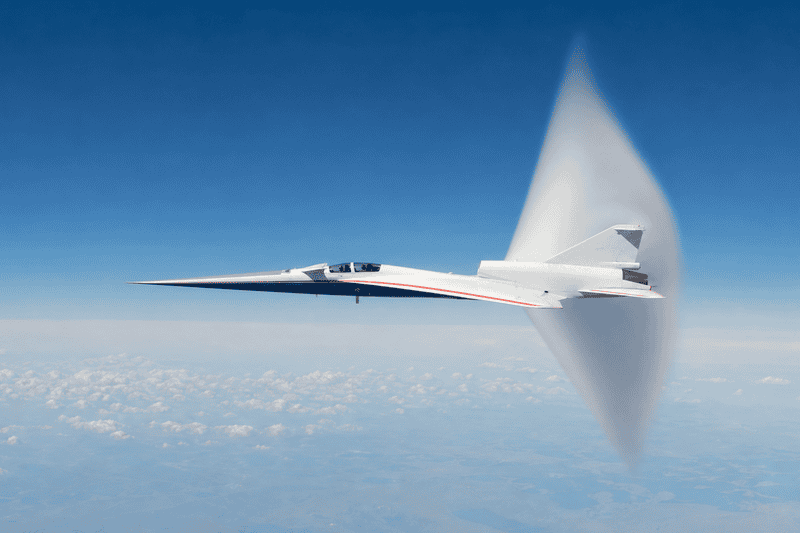
A sonic boom is not a single event that occurs when an aircraft “breaks” the sound barrier. It is a continuous phenomenon. Whenever an aircraft flies faster than the speed of sound, it generates a Mach cone — a cone of compressed air that trails the vehicle continuously. Two primary shock waves, one originating at the nose and one at the tail, propagate outward and downward from that cone. When they reach the ground, they arrive in rapid succession as the characteristic double-crack most people associate with supersonic flight.
The intensity of that ground-level event is governed by several interacting variables: the aircraft’s speed, its altitude, atmospheric conditions such as temperature and humidity gradients, and — most critically — how quickly those two shock waves merge as they travel downward. On a conventional supersonic aircraft with a blunt, compact fuselage, the nose and tail shocks coalesce quickly into a single steep-fronted pressure wave of high overpressure. The ground receives that energy all at once, which is precisely what makes the boom so jarring.
The X-59’s defining engineering insight, developed through decades of NASA computational fluid dynamics research, is that a highly elongated and carefully contoured airframe forces those same nose and tail shocks to remain separated far longer as they propagate downward. By the time they reach the ground, they have spread out, lost energy, and arrive as a gentler, more gradual pressure rise — what NASA describes as a “low boom” with a predicted ground-level signature of approximately 75 PLdB (perceived level in decibels), a unit calibrated to human hearing sensitivity across frequencies. NASA characterizes that level as roughly comparable to the sound of a car door closing.
Altitude is not incidental to this calculation. At 55,000 feet, shock waves must travel a far greater vertical distance to reach the ground than they would from a typical cruising altitude of 30,000 feet. That extended path gives the waves more distance and time to weaken and disperse before reaching any surface observer. The 55,000-foot figure is engineered into the X-59’s operational design precisely because it is a load-bearing number in the acoustic prediction models that underpin the entire Quesst mission.
What the June 2025 Flights Actually Demonstrated
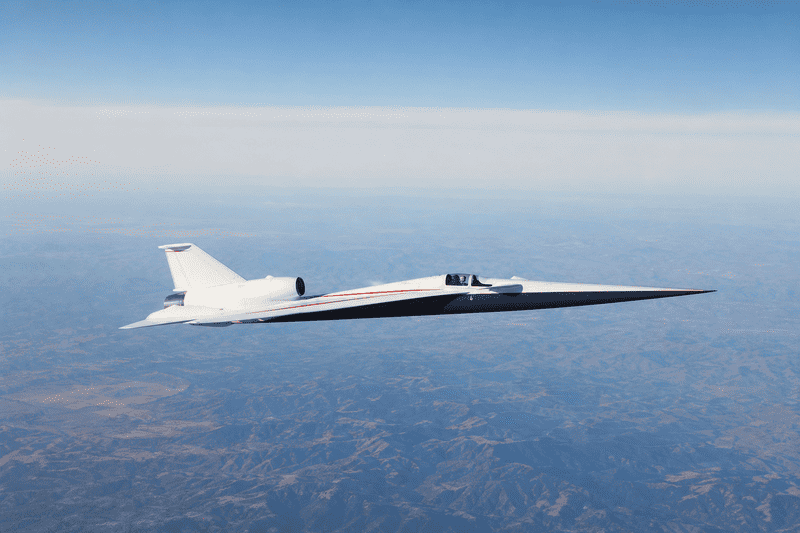
According to NASA’s Instagram post on the June 10 flight, the X-59 achieved “the exact profile needed for upcoming community overflight testing” — meaning the aircraft demonstrated sustained, controlled flight at Mach 1.4 and 55,000 feet simultaneously, not merely passing through those conditions momentarily during a climb or acceleration. NASA’s post on X confirmed a second milestone flight on June 12, reinforcing that the flight envelope had been validated across multiple sorties rather than in a single run.
That repetition matters in experimental aviation. A single data point can reflect instrument anomalies, unusual atmospheric conditions, or pilot technique. Confirmation across separate flights is the standard by which a test program distinguishes a repeatable, characterizable result from a one-time occurrence. The acoustic prediction models that underpin the Quesst community survey methodology are calibrated specifically to the Mach 1.4 and 55,000-foot combination; altering either variable changes the predicted ground-level boom signature, which would undermine the validity of the survey data those models are designed to interpret.
These flights do not yet constitute the community overflight phase of the Quesst mission. They establish, for the first time in actual flight rather than simulation, that the aircraft can reliably and repeatedly produce the acoustic conditions that the mission’s ground-measurement sensor networks and community survey instruments are designed to capture. As AIN Online reported, the X-59 has now reached its intended mission performance — a threshold the program needed to cross before community overflights could responsibly proceed.
How NASA Will Measure Public Perception — Not Just Decibels

The scientific architecture of the Quesst mission involves a methodological shift that sets it apart from conventional aircraft noise testing. Rather than measuring only the physical sound pressure level of the X-59’s boom, NASA will also survey residents in overflown communities about their subjective experience, using structured questionnaires designed to produce statistically usable data on what level and character of sonic boom the public finds acceptable.
This human-response component is central to the regulatory argument NASA is building. Current FAA rules governing overland supersonic flight were written around a binary: boom or no boom, acceptable or prohibited. What regulators and the International Civil Aviation Organization (ICAO) need to write a performance-based standard — one that permits quiet supersonic overland flight below a defined annoyance threshold — is not just a physics measurement but a quantified relationship between acoustic level and community response. Physical decibel readings alone cannot supply that relationship.
NASA plans to fly the X-59 over multiple geographically and demographically varied U.S. communities. That design choice is deliberate. Background noise environments differ substantially between urban and rural settings, and community sensitivity to aircraft noise can vary across populations. A single-site test would leave open the question of whether results were location-specific rather than generalizable. Ground-based acoustic sensor arrays deployed during each overflight will record the actual boom signatures, allowing researchers to correlate the physical measurement with the subjective survey response at the same time and place.
The resulting dataset — acoustic measurements paired with community-response surveys from multiple sites — is what NASA intends to deliver to the FAA and ICAO as the evidentiary foundation for a formal rulemaking proposal. NASA itself does not set aviation regulations; it provides the science. The regulatory decision rests with the FAA domestically and with ICAO for international standards.
What This Means for Commercial Supersonic Travel — and What It Does Not
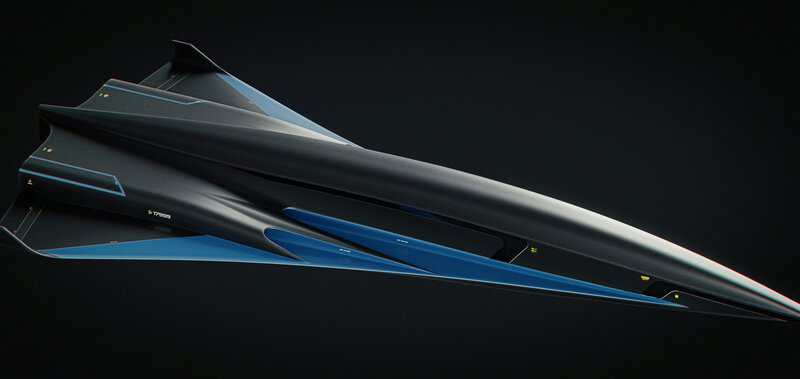
Several private companies are actively developing commercial supersonic passenger aircraft. A successful Quesst outcome leading to revised FAA overland rules would meaningfully expand viable route networks for those aircraft. Under the current prohibition, any supersonic commercial service must operate exclusively over water, which limits the practical speed advantage to transoceanic routes and significantly weakens the economic case for the technology.
It is important, however, to be precise about what the X-59 program can and cannot demonstrate. It can show that a purpose-built, carefully shaped supersonic aircraft produces a low ground boom at a specific speed and altitude under real atmospheric conditions. It cannot, by itself, prove that a full-size commercial airliner — carrying passengers, fuel, and cargo at economically viable scale — can achieve the same acoustic signature. Scaling the low-boom shaping principles from a 99-foot experimental aircraft to a commercial jet with a fundamentally different size, weight, and structural architecture remains an active and unsolved challenge in aerospace engineering. Neither NASA nor the broader research community has claimed otherwise, and readers should be skeptical of coverage that glosses over that distinction.
Regulatory change, even when supported by strong empirical data, moves slowly. FAA rulemaking processes typically span multiple years, and ICAO standard-setting requires international consensus among member states with differing noise-sensitivity policies and aviation priorities. Any commercial quiet supersonic overland service remains, even under optimistic assumptions, likely a decade or more away from passengers boarding a flight.
What the June 2025 flights represent is a concrete and meaningful transition: the Quesst mission has moved from theoretical modeling and computational prediction to empirical evidence collected in actual supersonic flight. That is the necessary first step in any data-driven regulatory argument, and it is a step that has now been taken for the first time.
What Comes Next for the Quesst Mission
With the Mach 1.4 and 55,000-foot profile confirmed as repeatable and controllable, NASA’s next phase involves the logistically complex work of preparing for community overflights. That includes identifying and coordinating with selected U.S. communities, conducting local government outreach, deploying and calibrating ground-based acoustic sensor arrays, and finalizing the survey methodology that will be used to collect resident responses.
The acoustic data gathered during those overflights will serve two purposes simultaneously. First, it will be compared against the X-59’s predicted boom signature to verify that the low-boom design performs in real-world atmospheric conditions — including turbulence, humidity gradients, and temperature inversions — as well as the computational fluid dynamics models predicted. That empirical validation of the models themselves carries independent scientific value regardless of any regulatory outcome.
Second, and more consequentially for the future of supersonic noise policy, the community-response data will form the core of a formal report to the FAA and ICAO. Beyond its immediate regulatory application, the deeper significance of Quesst may be methodological. The program is establishing a documented, repeatable framework — fly a known acoustic source over a community, measure the physical signature, survey community response, correlate the two — that could be applied to evaluate future supersonic aircraft designs well beyond the X-59 itself. If that framework proves robust across multiple communities and conditions, it becomes a durable tool for regulators and researchers alike. And in regulatory science, sound methodology tends to outlast the specific aircraft that inspired it.