
On a single launch attempt, a small startup founded by graduates of the Indian Institute of Technology Madras did something that nearly destroyed Elon Musk’s company before it could be done at all: it sent a rocket to orbit on the very first try, powered by an engine printed as one unbroken piece of metal. That achievement, by Chennai-based Agnikul Cosmos, sits at the intersection of additive manufacturing, liberalized space policy, and a global shift in who gets to build rockets. It deserves to be understood on its technical merits, not just its headline value.
SpaceX’s Painful Road to Orbit: Why the Bar Is So High
To appreciate what Agnikul accomplished, it helps to understand what SpaceX endured. The Falcon 1 — SpaceX’s first orbital launch vehicle — failed on its first three attempts, in 2006, 2007, and August 2008, before finally reaching orbit on September 28, 2008. That timeline is documented in SpaceX’s own mission archives and corroborated by NASA, which had a payload aboard the fourth and successful flight. By SpaceX’s own accounts, the company was within weeks of insolvency before that fourth launch succeeded. The Falcon 1 story is not ancient history — it is a precise record of how unforgiving orbital rocketry is, even for a team of exceptional engineers with serious capital behind them.
The difficulty is not arbitrary. Reaching orbit requires a vehicle to sustain extreme thrust for several minutes, manage the violent aerodynamic stress of max-q — the point during ascent where aerodynamic forces on the vehicle are greatest — execute a precise stage separation, and then continue accelerating the upper stage to approximately 7.8 kilometers per second. That is the velocity at which an object falls around Earth rather than back toward it. A single failed valve, an imprecise weld, or a software timing error anywhere in that sequence typically means total vehicle loss. The margin for error is, in engineering terms, vanishingly small.
SpaceX has since become the world’s dominant commercial launch provider, compounding almost eighteen years of operational experience since that 2008 success. That context makes the comparison with Agnikul more striking, not less. SpaceX built from four attempts to global dominance over almost two decades. What SpaceX needed four launches and the better part of a decade to achieve, Agnikul Cosmos accomplished on its first attempt — with a rocket engine manufactured as one continuous 3D-printed component.
Who Is Agnikul Cosmos?
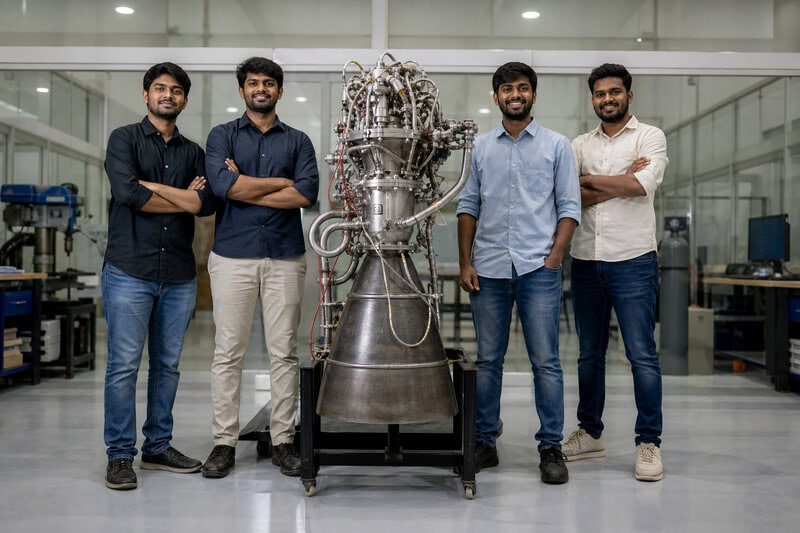
Agnikul Cosmos is a Chennai-based aerospace startup founded in 2017 and incubated at IIT Madras. It operates within India’s newly liberalized private space framework, which took shape after the Indian government opened the sector to private players in 2020 through the creation of IN-SPACe, the Indian National Space Promotion and Authorisation Centre. Before that structural change, private companies had no formal pathway to participate in India’s orbital launch industry.
The company’s launch vehicle is called Agnibaan, a small satellite launch vehicle designed to carry payloads of up to 300 kilograms to low Earth orbit. That payload class targets the fast-growing commercial small-satellite market, which research firm Euroconsult projects will require thousands of launches through 2030 as operators deploy broadband, Earth observation, and communications constellations. Agnikul is one of several Indian private launch startups — alongside Skyroot Aerospace, which conducted a suborbital test flight in 2022 — that have emerged since the 2020 policy shift.
India’s space economy is estimated by the Indian Space Association to be worth approximately eight billion dollars, with the government targeting growth to forty-four billion dollars by 2033, partly by enabling private launch providers to compete for international contracts. Agnikul’s first orbital success, captured at the moment of launch, represents a meaningful data point in that national ambition — though a single flight and a sustainable commercial business are two very different things.
The Real Headline: What a Single-Piece 3D-Printed Rocket Engine Actually Means
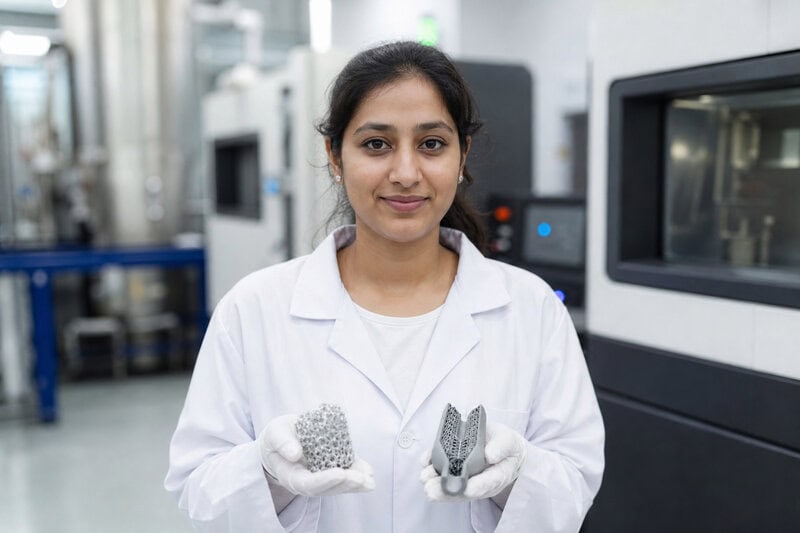
Additive manufacturing — commonly called 3D printing — is a process in which a digital design is built up layer by layer from powdered metal, typically a nickel superalloy in aerospace applications, fused by a high-powered laser. This contrasts with conventional manufacturing, which either machines components away from a solid metal block or assembles them from many individually fabricated and welded parts. In rocket engineering, both conventional approaches produce engines with hundreds of discrete components, each of which must be individually manufactured, inspected, assembled, and certified — and each joint or weld represents a potential failure point under the extreme temperatures and pressures of combustion.
Agnikul’s engine, called the Agnilet, is claimed to be the world’s first single-piece 3D-printed rocket engine. The entire combustion chamber, propellant injector, and nozzle assembly were printed as one continuous component, with no welds, fasteners, or joints in the critical hot-section structure. The engineering logic is straightforward: remove the joints and you remove the failure modes associated with them. You also dramatically reduce part count, which compresses manufacturing time and, in principle, lowers cost per unit.
That directional logic is supported by published research on additive manufacturing in aerospace from institutions including NASA’s Marshall Space Flight Center, which has investigated printed rocket components as part of its ongoing propulsion research programs. Other companies have pursued the same approach: Rocket Lab’s Rutherford engine uses 3D-printed components, and Relativity Space built its Terran 1 vehicle around additive manufacturing. But Agnikul’s claim of a fully single-piece engine — no multi-part assembly — represents a distinct step along that continuum, and one that has now been validated in flight.
It is important to be honest about what remains unknown. Additive manufacturing for flight-critical rocket components is still an emerging field. Independent, peer-reviewed data on the long-term reliability, thermal fatigue behavior, and reusability of fully printed engines operating at orbital-class performance levels is still accumulating. A successful first flight is meaningful evidence — but it is one data point, not a longitudinal reliability record. The engineering community will require multiple flights across varied conditions before consensus forms on whether single-piece printed engines can anchor a commercial launch cadence.
First-Attempt Orbital Success Is Genuinely Rare
Context matters to avoid both overstating and understating what Agnikul achieved. Orbital rocketry has historically been characterized by high early failure rates. New launch vehicles face significant failure probability on inaugural flights, with first-attempt orbital success being the exception rather than the rule across all spacefaring nations and eras. The United States’ Vanguard rocket failed spectacularly on its first launch attempt in 1957. Rocket Lab, a technically sophisticated and well-funded New Zealand-American company, experienced a first-launch failure before achieving orbit. Even among eventual successes, early failure is the norm.
It is also worth being precise about definitions. Suborbital flight — a high ballistic arc that returns to Earth without completing a full lap — requires substantially less energy and less precise engineering than true orbital flight. Reaching orbit means achieving and sustaining the velocity at which an object continuously falls around the planet rather than back toward it: approximately 7.8 kilometers per second at low Earth orbit altitudes. The two achievements are not comparable in difficulty, and Agnikul’s success pertains to the harder one.
First-attempt orbital success, for any rocket from any nation, represents a statistically uncommon outcome in the history of spaceflight — which is precisely why Agnikul’s result warrants serious technical attention, independent of national pride or commercial narrative.
India’s Policy Unlock: The Invisible Engine Behind the Rocket
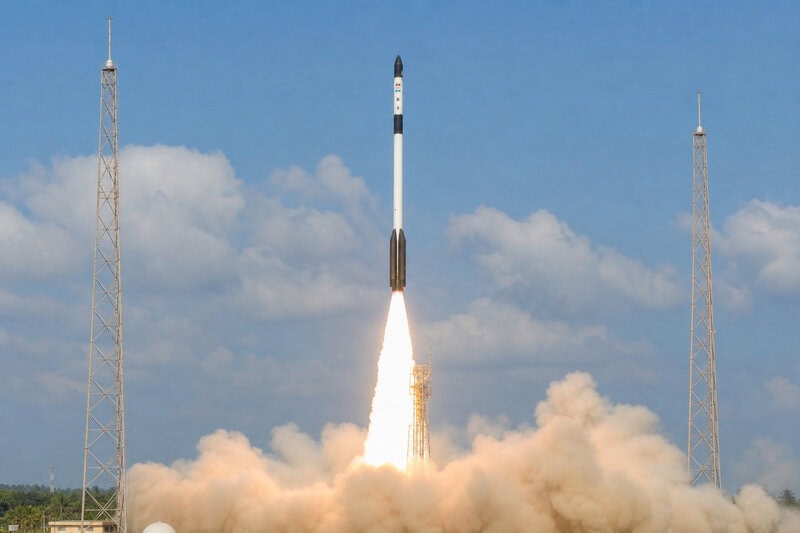
No rocket flies in a policy vacuum. The creation of IN-SPACe in 2020 was a structural intervention analogous in ambition to the U.S. Commercial Space Launch Act, which helped establish the regulatory conditions in which SpaceX and other American commercial launch providers could develop. Before IN-SPACe, India’s space activities were the exclusive domain of the Indian Space Research Organisation (ISRO), a government agency. Private companies had no legal framework through which to build, test, or launch orbital vehicles.
Following the IN-SPACe framework, Indian private space startups attracted significantly increased venture investment. The Indian Space Association reported that the sector drew over one hundred million dollars in private funding within two years of the policy change — capital that enabled hardware development timelines that would have been impossible through traditional government procurement cycles. ISRO itself has played an enabling role, providing Agnikul and other private startups access to its test facilities and technical expertise. ISRO Chairman S. Somanath has publicly described this as a deliberate strategy to build a self-sustaining commercial ecosystem rather than a competitor to the national agency.
A caveat is warranted here. Policy frameworks create conditions for competition; they do not guarantee market success. Agnikul will need to win international launch contracts in a market where SpaceX’s Falcon 9 holds an enormous cost and cadence advantage, and where Rocket Lab’s Electron has already established a track record in the small-satellite segment. Technical milestones and commercial viability are related but distinct achievements, and the distance between them is often where promising startups stall.
What This Tells Us About the Future of Getting to Orbit
Agnikul’s milestone, viewed alongside Rocket Lab, Relativity Space, and a growing cohort of small-launch startups across the United States, Europe, and Asia, suggests the orbital launch market is entering a phase of genuine technological pluralism. The barrier to entry remains immense — in capital, engineering talent, regulatory compliance, and raw physical difficulty. But it is lower than at any point in the history of spaceflight. Additive manufacturing is a meaningful part of that shift, because it compresses manufacturing timelines and reduces the specialized tooling that once made rocket production the exclusive province of large aerospace contractors.
The open questions that will determine real-world impact are specific and answerable over the next several years. Can a single-piece printed engine demonstrate the reliability needed for a sustained commercial launch cadence? Can Agnikul price Agnibaan competitively against established providers who benefit from years of amortized development costs? Can India’s regulatory framework evolve at startup speed? Each of those questions has a knowable answer — and the answers will arrive through launches, not press releases.
A single successful orbital launch, however technically impressive, does not yet constitute a commercial space company. SpaceX’s own history illustrates that the distance between first orbit and sustainable operations spans years of additional engineering, financing, and market development — and SpaceX had the advantage of U.S. government contracts and a domestic market of considerable scale. Agnikul is at the beginning of that road, not the end.
If Agnikul’s 3D-printed Agnilet engine performs reliably across multiple missions, it will offer the global launch industry something genuinely valuable: evidence that additive manufacturing can compress the cost and complexity of reaching orbit in a production context, not just a prototype one. That proof point matters regardless of which flag is painted on the rocket — and it is the reason the comparison between SpaceX’s four attempts and Agnikul’s one is worth taking seriously as an engineering story, not merely a national one.