
For the third time in under a decade, a confirmed interstellar object has ignited a global “alien spacecraft” news cycle — and for the third time, the scientific community has moved swiftly to walk it back. The pattern is almost clockwork now, and what it reveals about evidence standards, media amplification, and public trust in science is at least as consequential as anything the objects themselves could tell us.
What 3I/ATLAS Actually Is — and What It Is Not
3I/ATLAS is a confirmed interstellar object, meaning its hyperbolic trajectory demonstrates it originated outside our solar system. Detected in 2025, it drew immediate attention when a minority of researchers flagged certain trajectory characteristics as potentially inconsistent with purely natural behavior. That minority view was enough to set the familiar cycle in motion.
NASA responded publicly to claims that 3I/ATLAS is a spacecraft sent by an advanced alien civilization, stopping well short of endorsing that interpretation while affirming that the object’s interstellar origin is not in scientific dispute. Notably, NASA’s measured, non-committal tone was itself reported in some corners of the internet as a tacit admission of something extraordinary — which illustrates precisely the dynamic this piece is examining.
A controversial paper formally raised the probe hypothesis, drawing direct comparisons to similar claims made about the interstellar object ‘Oumuamua. Whether that lineage of argument represents a compelling recurring pattern or a recurring methodological error depends on whom you ask — but the broader scientific community has been consistent about which interpretation it finds better supported by the evidence.
Because 3I/ATLAS has now moved beyond useful observational range, the scientific debate has shifted from data collection to interpretation of incomplete data. That is a situation that historically benefits speculation far more than it benefits knowledge. Absence of further data is not evidence of concealment; it is a straightforward consequence of observing fast-moving objects with finite telescope time and finite research budgets.
The ‘Oumuamua Precedent: How the Template Was Set
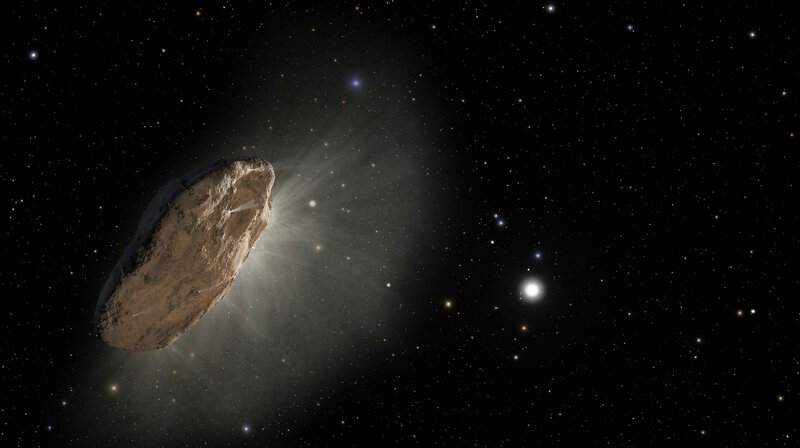
‘Oumuamua was the first confirmed interstellar object ever recorded passing through our solar system. Its unusual, elongated shape and anomalous non-gravitational acceleration — a deviation from the trajectory that gravity alone would predict — prompted Harvard astronomer Avi Loeb to publicly suggest an artificial, possibly alien, origin. The broader scientific community did not endorse that interpretation and still does not.
Researchers proposed several natural explanations for ‘Oumuamua’s anomalies, including outgassing of hydrogen ice and the possibility that the object was a fragment of a nitrogen-rich planetesimal sheared from a distant exoplanet. None of these explanations has achieved universal acceptance, but all are considered more parsimonious — that is, simpler and more consistent with established physics — than the spacecraft hypothesis. In science, parsimony is not a rhetorical preference; it is a methodological discipline. Invoking an entirely new and unprecedented category of phenomenon requires correspondingly stronger evidence than invoking known physical processes.
Snopes fact-checkers rated as false the claim that scientists warned an interstellar object was “most likely” or “certainly” an alien ship heading toward Earth — a vivid illustration of how a nuanced, explicitly hedged minority scientific argument transforms into definitive-sounding headlines through successive rounds of media amplification. The researchers involved said something cautious. The headlines said something categorically different. The public, entirely reasonably, was left confused about what science had actually concluded.
The ‘Oumuamua episode established a media template that 3I/ATLAS is now following almost step by step: unusual interstellar object detected, alien hypothesis floated by a credentialed minority, mainstream rebuttal issued, viral misinformation rated false. Independent analyses of these objects continue to note genuine anomalies worth sustained study — while simultaneously cautioning against leaping to the most extraordinary available conclusion simply because no mundane explanation has yet been confirmed.
Why Scientists Are Difficult to Convince — and Why That Is a Feature, Not a Bug
The scientific standard for extraordinary claims — sometimes summarized as “extraordinary claims require extraordinary evidence,” a formulation popularized by Carl Sagan — is not cultural conservatism or institutional defensiveness. It is a calibrated response to the long historical record of dramatic anomaly claims resolving into misidentified natural phenomena, instrumental artifacts, or reporting errors. The prior probability of any specific “alien spacecraft” claim being correct is, by that historical record, very low. That prior matters.
Skepticism about alien spacecraft interpretations among mainstream scientists is not categorical disbelief in extraterrestrial life. The majority of professional astronomers consider it statistically plausible — given the age and scale of the universe — that life exists elsewhere. What scientists resist is the specific inference that a poorly characterized observation constitutes evidence of an alien spacecraft. Those are very different claims, and conflating them is where a significant portion of public confusion originates and persists.
The evidentiary problem is partly an instrument problem. Many compelling UAP — Unidentified Aerial Phenomena, the term the U.S. government now uses formally in place of UFO — observations originate from military sensors designed for threat detection rather than scientific characterization. Those sensors frequently cannot distinguish a genuinely anomalous object from instrument artifacts, atmospheric optical effects, or misidentified human-made technology. Data that cannot rule out mundane explanations cannot responsibly be used to rule in an extraordinary one.
NASA’s own UAP independent study team, reporting in 2023, concluded that available data is insufficient to support any definitive statement about UAP origins. Critics framed this as a disappointment, or worse, as evasion. It was more accurately an honest accounting of the actual evidentiary situation — and the report’s constructive recommendations, including deploying better sensors, establishing open data-sharing protocols, and destigmatizing UAP reporting among military and civilian pilots, pointed toward strengthening future investigation rather than suppressing it.
Reading the NASA UAP Report Carefully
Criticism of the NASA UAP report frequently conflates two distinct questions: whether the report was shaped by institutional or political caution, which is a fair subject of debate, and whether the underlying data justified stronger scientific conclusions, which it did not. Treating those as the same question — assuming that bolder conclusions were available but withheld — is where much of the persistent frustration on both sides of this issue goes wrong.
The report’s most durable contribution may be methodological rather than revelatory. It argued that UAP should be treated primarily as a data-quality and sensor-calibration problem before being treated as a mystery-of-origin problem. That sequencing frustrates enthusiasts who want answers about what these things are. But it reflects sound scientific practice: you cannot answer the interesting question about the nature of an object until you have rigorously ruled out the uninteresting explanations, and ruling out uninteresting explanations requires better instrumentation than is currently available or consistently deployed.
Detailed independent analyses of objects like 3I/ATLAS reach comparable conclusions: the anomalies are real and scientifically interesting, the available data is incomplete, and the gap between “we cannot immediately explain this” and “therefore, alien technology” remains enormous. Acknowledging that gap honestly is not a cover-up. It is scientific literacy, and it deserves more credit than it typically receives in popular coverage.
What Would Actually Convince the Scientific Community
The question that journalists and the broader public rarely ask — but should — is not “why won’t scientists admit it?” but “what would scientists actually need to see?” The answer is more specific and more actionable than critics of scientific caution tend to assume, and articulating it clearly might help move these conversations forward.
To meet a defensible extraterrestrial evidence standard, a candidate piece of evidence would need to survive at least three distinct filters. First, a physical artifact, material sample, or signal that cannot be explained by any known natural process or human-made technology, even under adversarial scrutiny. Second, independent replication by multiple research teams using different instruments and different analytical methodologies, so that no single instrument artifact or researcher bias can account for the result. Third, peer-reviewed publication that withstands concerted efforts by other researchers to find alternative explanations — and those alternative explanations must fail.
A recovered material sample with isotopic ratios or engineered microstructures inconsistent with any known natural process or human manufacturing technique would represent genuinely compelling evidence — not definitive proof, but the kind of reproducible anomaly that would compel a serious, well-resourced scientific response. The broader scientific community would not ignore or suppress such a finding; it would pursue it with extraordinary intensity, because confirming the existence of extraterrestrial intelligence would be the most significant discovery in the history of science. There is no institutional incentive to suppress that.
A technosignature — a signal or physical property that encodes structured information in a manner inconsistent with known natural processes — would similarly clear the evidentiary bar. The ongoing SETI program has defined these criteria formally, and no candidate signal has yet survived scrutiny at that level. “Unexplained” and “extraterrestrial in origin” are not synonyms. The distance between those two words is where rigorous science lives and where premature conclusions go to cause lasting confusion.
The Real Cost of Repeated False Alarms
Each cycle of overstated alien spacecraft claims followed by scientific deflation carries a real and underappreciated cost. That cost is progressive erosion of the public’s capacity to calibrate uncertainty. People who feel repeatedly misled by breathless “alien” headlines tend to respond in one of two ways, both of which make genuine scientific inquiry harder: they overcorrect into reflexive dismissal of all anomalous observations, or they entrench into the conviction that mainstream science is actively concealing something. Neither response serves the actual investigation.
The scientists deflating these claims are not the villains of the story. They are doing exactly what scientific methodology requires of them. The more uncomfortable observation — the opinion this piece is willing to state plainly — is that science journalism, and the social media amplification that now precedes, accompanies, and long outlasts it, bears substantial responsibility for the persistent gap between what researchers carefully and conditionally say and what headlines confidently and incorrectly claim.
The genuinely open and important scientific question is not whether 3I/ATLAS or ‘Oumuamua are alien probes — the available evidence does not support that conclusion for either object. The genuinely open question is whether interstellar objects traverse our solar system frequently enough that, by the laws of large numbers and given the age of the galaxy, some fraction could conceivably be artificial in origin. That is a legitimate, serious, and properly framed scientific question. It deserves sustained, well-funded, methodologically rigorous investigation. It does not deserve viral hype cycles that consume public attention and credibility and leave behind nothing but residual confusion and hardened priors.
Until the evidentiary bar is met — specifically, concretely, and reproducibly met — the honest and intellectually serious position is the one NASA and the broader scientific community keep articulating and keep being criticized for: we do not yet know what these objects are, and “we do not yet know” is not a cover-up or a failure. It is the only accurate statement the evidence permits. It is also, if you are willing to sit with it, the beginning of real science — and it is considerably more interesting, over the long run, than a confident answer that the data cannot support.