
A college student from Murray State University recently stood at a launch site and watched a rocket — one carrying an experiment she helped wire, calibrate, and test — arc above Earth’s atmosphere on a real suborbital flight. It was not a simulation. It was not a scale model. It was a live NASA mission, and her fingerprints were on the science inside it.
What a NASA Suborbital Sounding Rocket Actually Does
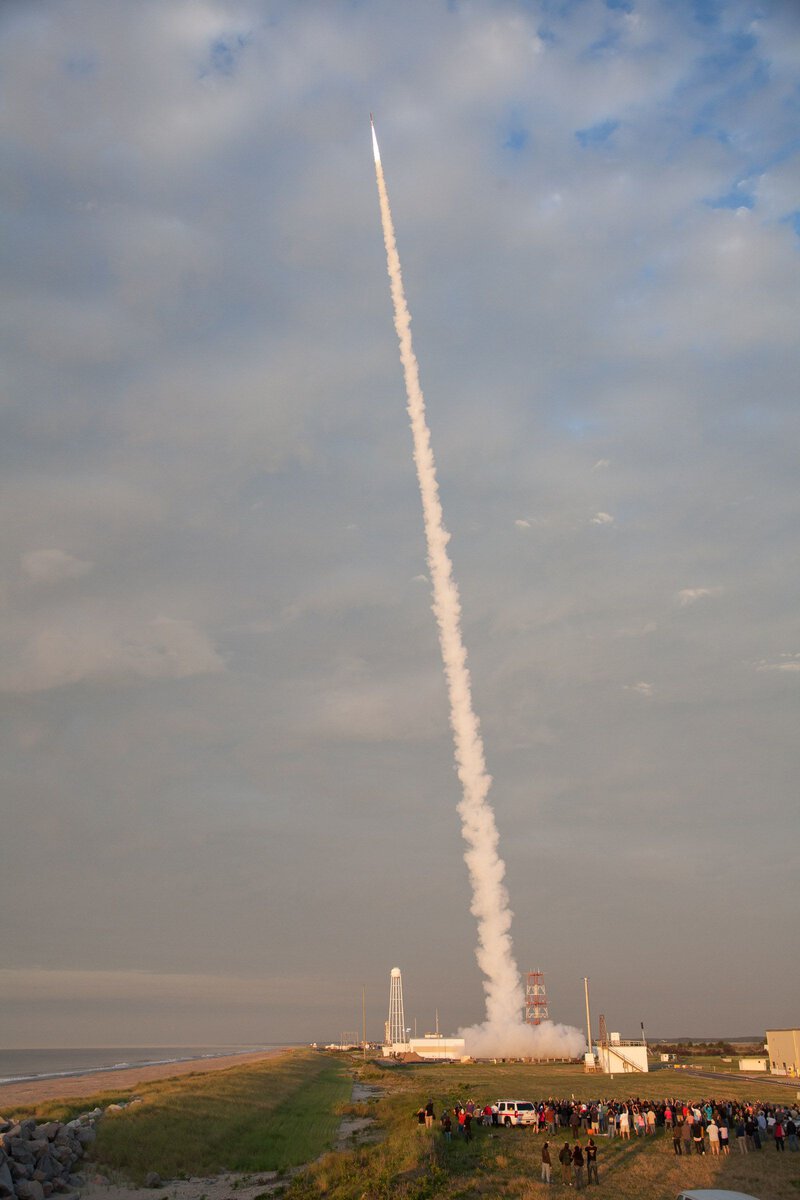
Before examining what happens inside these workshops, it helps to understand the vehicle at the center of them. A NASA suborbital sounding rocket is an uncrewed vehicle that launches vertically, exits the atmosphere briefly, and returns to Earth — the entire flight lasting only minutes. During that arc, onboard instruments measure acceleration, humidity, pressure, temperature, and radiation counts, generating a snapshot of the near-space environment that ground-based sensors cannot replicate.
Sounding rockets occupy a useful middle ground in the space hardware ecosystem. They are cheap enough to fly frequently, mechanically complex enough to demand genuine engineering discipline, and fast enough in their data-collection window to force student teams to design for reliability under extreme time pressure. Unlike orbital missions aboard the International Space Station or long-duration satellite programs — where experiments may run for months — a sounding rocket compresses the entire scientific return into a single flight lasting under fifteen minutes. Every sensor must work. Every connection must hold. There is no second chance during the flight itself.
NASA’s RockOn! Workshop, coordinated through NASA’s education outreach infrastructure, places student-built experiment modules aboard these flights. That designation matters: participants are not observers or assistants. They are co-investigators on a live mission, responsible for a canister of hardware that will leave the planet.
Inside the Workshop: What Students Actually Do
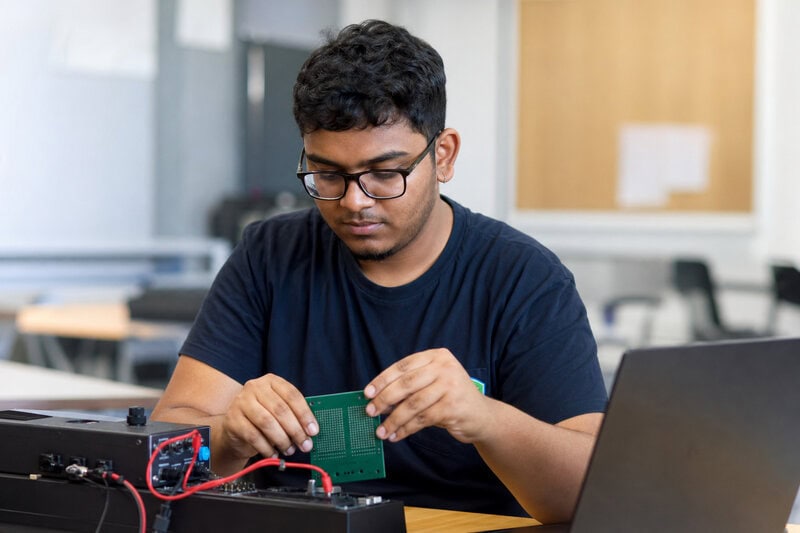
The experiential arc of a RockOn! workshop follows a compressed version of a full mission lifecycle. Students begin with classroom instruction covering sensor systems, power budgets, and data telemetry — the theoretical foundation that professional aerospace engineers spend years building. Within days, that instruction gives way to hands-on assembly of experiment canisters, the physical hardware that will eventually be integrated into the rocket stack.
The integration phase is where the workshop’s pedagogical logic becomes clearest. Teams encounter sensor calibration errors, wiring faults, and software anomalies during ground testing — not as manufactured teaching moments, but as the ordinary chaos of real hardware development. NASA mentors coach participants through root-cause analysis rather than simply correcting the problem. The student must find the fault, understand why it occurred, and verify the fix. That loop — failure, diagnosis, correction, verification — is identical to the process NASA engineers use on multi-billion-dollar missions. The scale differs; the discipline does not.
The geographic footprint of these workshops is itself significant. Montana Tech students and faculty participated in NASA’s RockOn! Workshop, with the university describing the experience as reaching “new heights.” Montana Tech is a regionally focused engineering institution in Butte — not a coastal research university with a decades-long NASA relationship. Its inclusion signals that NASA youth outreach is being extended deliberately to regional universities with strong engineering cultures, not concentrated in a handful of elite programs.
Saginaw Valley State University’s team participated in the RockOn! program as well, further illustrating the program’s scalability. When multiple regional universities across different states run parallel cohorts through the same hardware workflow and launch payloads on the same rocket, the program ceases to be an exception and begins to function as a pipeline.
The Science Students Are Actually Doing — and Why It Matters
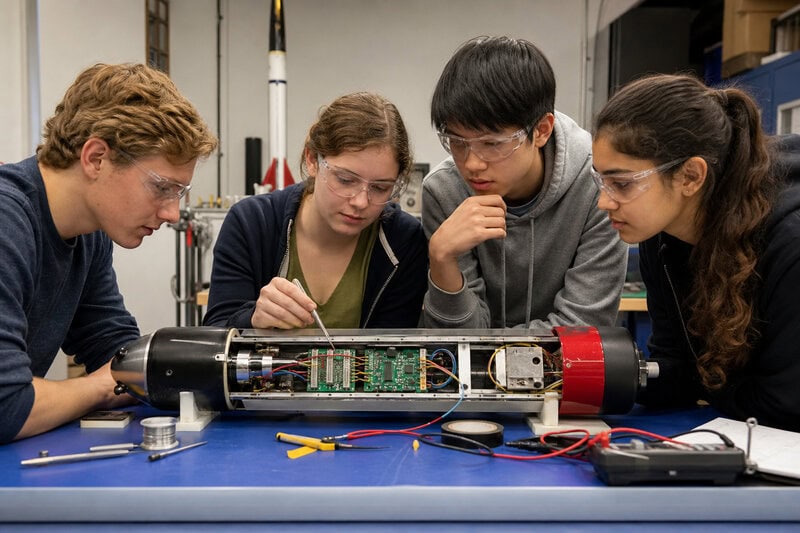
A NASA suborbital sounding rocket carries student-built experiments that measure acceleration, humidity, pressure, temperature, and radiation counts during a real flight above Earth’s atmosphere — producing scientific data, not a classroom simulation. That distinction is worth stating plainly, because the temptation to frame student workshops as primarily symbolic is understandable but incomplete.
The data collected during a RockOn! flight feeds into datasets that help researchers characterize the near-space environment. Student-built sensors contribute measurements that did not exist before that flight. Honesty requires a caveat here: the primary established value of these workshops is educational and workforce-development, not frontier scientific discovery. The data is real; its downstream research impact varies across programs and should not be overstated.
What is more clearly established is the pipeline function. NASA-funded student research programs give participants the opportunity to tackle real-world scientific challenges — and workshops like RockOn! function as entry points into that longer continuum. A student who has integrated a flight payload is a more credible applicant to a NASA-funded research position than one who has only completed coursework. The workshop does not guarantee the next step, but it makes the next step legible.
Why This Changes How Students Think About Space Careers
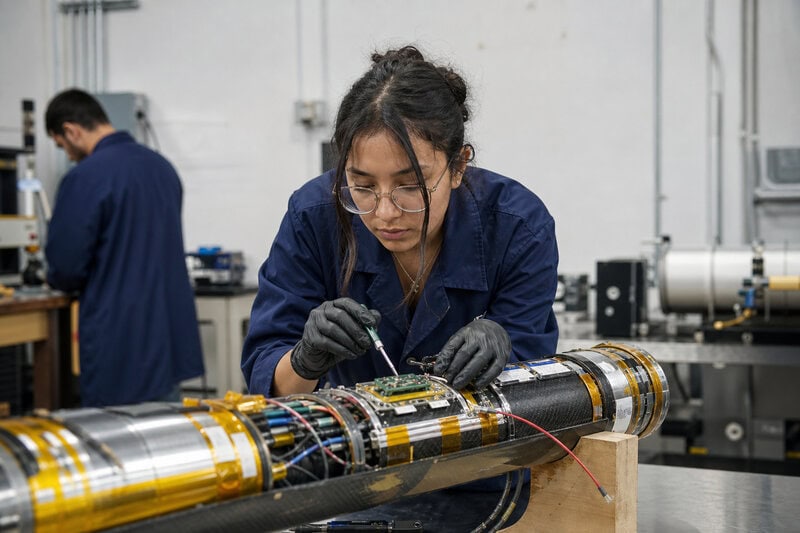
Students who have physically integrated an experiment onto a flight vehicle consistently report the same cognitive shift: abstract concepts become concrete in a way that lectures cannot replicate. Thermal management is no longer a textbook variable when a student has had to account for temperature swings during a rocket’s ascent. Signal noise is no longer an abstract statistical problem when a sensor returns corrupted data during a ground test and the student must find out why before the launch window closes. Power budgeting becomes viscerally real when a team realizes their canister will exceed its allocated draw and must redesign the circuit under time pressure.
This pattern — project-based learning producing deeper conceptual retention and stronger professional identity — is well-documented in STEM education research, and NASA’s program design rationale is consistent with it. The workshops are not structured the way they are by accident.
The credentialing effect is concrete and specific. Having launched a payload into space is a verifiable line on a résumé that distinguishes a candidate from one who completed equivalent coursework without the hardware experience. Program alumni cite this distinction when describing how they present themselves to employers or graduate programs. The experience is not just formative; it is legible to the people doing the hiring.
The superlative language students use after NASA workshops — describing the experience as “one of the best” they have had — consistently points to the same two factors: autonomy over a real system, and accountability for a real outcome. Both are rare in undergraduate education, where most laboratory work is structured to produce a predetermined result and the consequences of failure are limited to a grade. In a RockOn! integration session, the consequence of a wiring fault is a sensor that does not return data from above the atmosphere. That stakes structure changes how students engage.
The network effect compounds the individual benefit. When SVSU or Montana Tech participates in RockOn!, those institutions gain an ongoing relationship with NASA centers. Faculty develop contacts. Institutional agreements form. The next cohort of students at that university inherits a pathway that did not exist before their predecessors launched a payload. Individual opportunity scales into institutional infrastructure.
How to Actually Get Into a NASA Workshop or Program
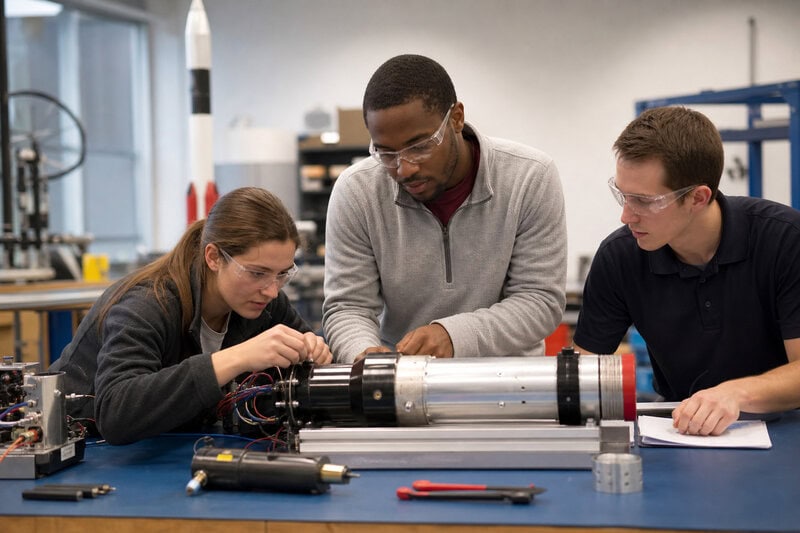
The verified pathway into RockOn! runs through institutional partnerships, not individual cold applications. NASA coordinates the program through community college and university agreements; prospective students should begin by contacting their institution’s STEM research office or engineering department faculty who hold existing NASA agreements. If a university does not yet have such a relationship, faculty can pursue them — Montana Tech and SVSU are examples of regional institutions that built exactly that kind of access.
It is worth distinguishing clearly between program types, because they serve different readiness levels and require different preparation:
- RockOn! Workshop: A hands-on hardware integration program for university students and faculty, resulting in a payload launched on a NASA sounding rocket. Access is typically through institutional partnerships.
- NASA-funded summer research positions: Competitive individual applications for students to work on real scientific challenges under NASA-affiliated researchers. These are more selective and typically require demonstrated coursework in physics, engineering, or computer science.
- NASA internships: Formal paid positions at NASA centers, with structured application processes and specific eligibility requirements. Application windows typically open six to nine months before the program date.
Prospective applicants should consult NASA’s official STEM engagement portal at nasa.gov/stem for current opportunities. Eligibility, deadlines, and program availability change annually, and the only reliable source for current program status is NASA directly.
Why NASA Invests in Student Workshops at All
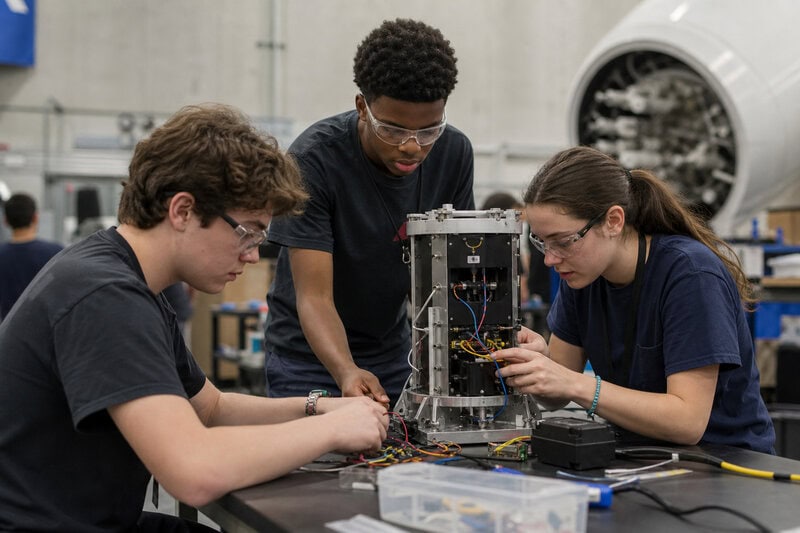
NASA’s education outreach mission is explicitly tied to workforce development. The agency needs engineers, scientists, and technologists — and the timeline is not abstract. As the Artemis program works toward returning humans to the Moon and commercial space partnerships expand, the demand for technically literate early-career workers is growing faster than traditional academic pipelines are producing them.
Workshops like RockOn! are part of a deliberate early-exposure strategy: get students handling real hardware, working through real failure, and contributing to real missions before they have completed their degrees. The theory — supported by STEM education research broadly, though long-term longitudinal data tracking NASA workshop alumni specifically into NASA careers remains limited — is that the moment of genuine contribution changes what students believe is possible for themselves.
When an MSU student helps build and launch a sounding rocket into space, the experience compresses years of abstract learning into a single verifiable moment. The sensor she wired measured radiation counts above Earth’s atmosphere. The data came back. The mission succeeded. NASA is betting that moment — concrete, irreversible, and genuinely hers — changes what she does next.
As programs like RockOn! demonstrate that they can scale across regional universities, the question of access and geographic equity in NASA youth outreach becomes increasingly consequential. A student at Montana Tech or SVSU who completes a RockOn! cohort has access to a career trajectory that did not formally exist for students at those institutions a decade ago. The pipeline is still young. Where it reaches — and whom it reaches — will matter.