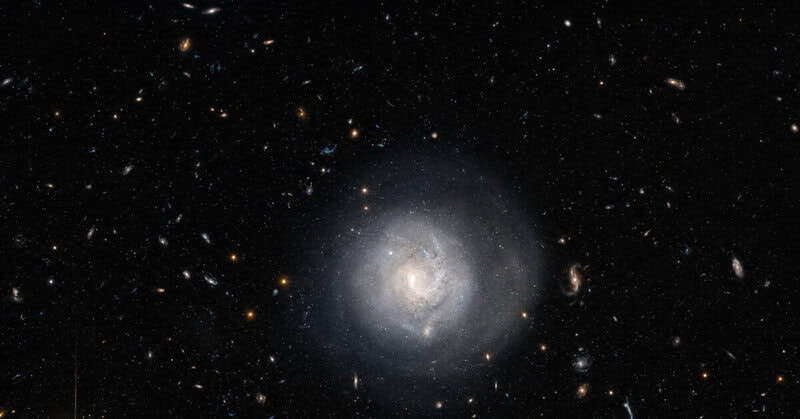
A new Hubble Space Telescope image of NGC 4394 stops the eye immediately: a luminous bar of densely packed stars cuts straight through the galaxy’s heart, and from each end, bright spiral arms curve outward in a near-textbook demonstration of barred spiral structure. The European Space Agency selected this portrait as an ESA/Hubble Picture of the Month, a designation reserved for images that clear an unusually high bar for both scientific value and public communication — a fitting standard for a galaxy whose defining feature has long been easy to overlook.
What the New Hubble Image Actually Shows
The image places NGC 4394 squarely at the center of the frame, allowing viewers to trace the galaxy’s full architecture from its innermost regions to the outer edges of its disk. At the core sits the bar itself — an elongated, roughly rectangular concentration of stars running through the galaxy’s nucleus and glowing with the warm, yellowish hue characteristic of older stellar populations. From each tip of the bar, two bright spiral arms unspool in graceful curves, their bluer coloration hinting at younger, more recently formed stars.
What distinguishes this Hubble image of NGC 4394 from earlier ground-based views is resolution. Ground-based telescopes contend with atmospheric turbulence — astronomers call this blurring effect “seeing” — which smears fine detail into an indistinct glow. Hubble, orbiting above Earth’s atmosphere, sidesteps that problem entirely. Individual dust lanes threading through the bar become visible as dark ribbons, and the transition between the bar’s older stellar population and the spiral arms’ younger stars can be traced in color alone, without any supplementary instrument. What was once a smudge in archival data is now a structured system with readable internal geography.
In the portrait, the galaxy’s distinct central bar and its flanking spiral arms are both resolved in a single field of view, offering a simultaneous look at a barred spiral’s two defining structural components. That combination in one sharp, unobstructed frame is precisely what makes the image more than a visual novelty.
Barred Spiral Galaxies: Defining the Structure
A barred spiral galaxy is one in which stars, gas, and dust have gravitationally settled into an elongated, bar-shaped region through the galactic center, rather than concentrating symmetrically around a point as in a classical spiral. NGC 4394 is a clean, well-defined member of this class, making it a useful reference object for astronomers studying galactic morphology.
The class is not exotic. Roughly two-thirds of all spiral galaxies — including our own Milky Way — are classified as barred spirals. NGC 4394 is therefore a representative example rather than an outlier, which is part of what makes a high-resolution portrait of it scientifically valuable: lessons learned here apply broadly across the spiral galaxy population.
The bar’s functional role is reasonably well understood. It acts as a gravitational conveyor belt, channeling gas from the outer disk inward toward the galactic center. That inflow can fuel star formation in the nuclear region and supply material to whatever resides at the galaxy’s core. This mechanism is supported by decades of observational research and by galaxy-formation simulations. What remains an active area of investigation is precisely how much any individual bar accelerates or, in some cases, quenches star formation over its lifetime. The gas-flow mechanism is established consensus; the net star-formation outcome for a specific galaxy like NGC 4394 is not yet settled.
NGC 4394: Location, Stellar Populations, and Geometric Clarity
NGC 4394 resides in the constellation Coma Berenices and is associated with the environs of the Virgo Cluster, placing it in a cosmologically nearby region of the universe that astronomers have used as a laboratory for galaxy studies for decades. Its relative proximity means Hubble can resolve structural detail that would be impossible to separate in more distant systems.
The color information encoded in the new image is itself scientifically meaningful. The bar’s older, yellower stellar population contrasts visibly with the bluer, younger stars tracing the spiral arms — a difference that reflects distinct episodes of star formation written directly into the galaxy’s light. Astronomers can use this color gradient as a first-order guide to where and when stars formed across the galaxy’s disk, before any spectroscopic follow-up is conducted.
As a morphological specimen, NGC 4394 offers unusual geometric clarity: the central bar and the spiral arms are both well-defined and spatially separated enough that their individual properties can be studied without one structure contaminating measurements of the other. That cleanliness is one reason the image earns its place in Hubble’s archive as more than a purely aesthetic object.
Why Hubble Remains the Instrument of Choice for This Kind of Portrait
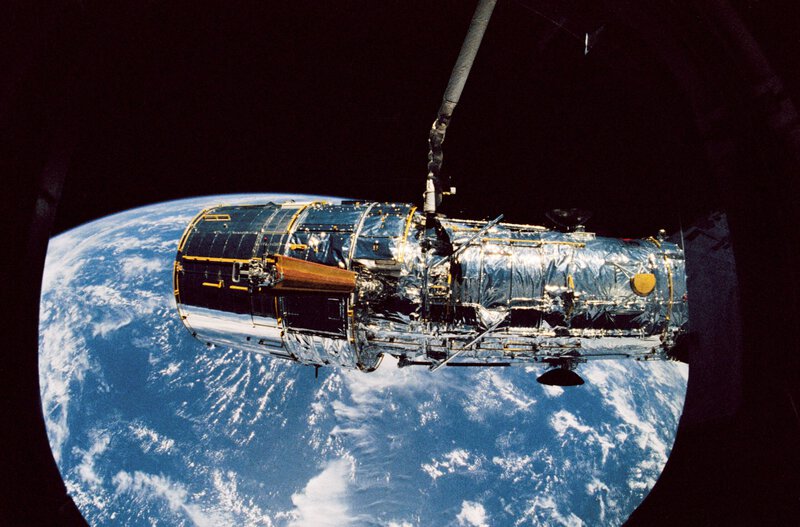
The instrumental case for Hubble’s continued relevance is straightforward. By operating in low Earth orbit, it avoids the atmospheric distortion that blurs ground-based images, enabling it to resolve fine structure in nearby galaxies with a consistency that no ground-based optical telescope can routinely match. For a target like NGC 4394, that sharpness is the difference between confirming a bar’s presence and actually studying its internal structure.
The ESA/Hubble Picture of the Month program curates images that satisfy both scientific relevance and communicative clarity simultaneously. NGC 4394’s selection signals that the image meets both standards, making it a credible entry point for researchers and a visually compelling object for public audiences. NASA has also highlighted the image through its own channels, underscoring cross-institutional recognition of its quality.
It is worth being precise about where next-generation observatories complement rather than replace Hubble. Infrared instruments aboard the James Webb Space Telescope can peer through the dust lanes that partially obscure NGC 4394’s bar in visible light, revealing embedded structures invisible to Hubble’s optical cameras. Hubble’s optical sharpness, however, still excels for mapping visible-light stellar populations across a galaxy’s disk — the kind of broad-field, high-resolution portrait exemplified by the new NGC 4394 image. The two observatories are more usefully thought of as complementary tools than as competitors.
What One Galaxy Teaches Us About Galaxy Evolution
Because bars are present in the majority of spiral galaxies, understanding how NGC 4394’s bar drives gas inflow and influences star formation helps astronomers build more accurate models of how disk galaxies — including the Milky Way — evolved over billions of years. Each well-resolved barred spiral galaxy is effectively a freeze-frame in a multi-billion-year film, and NGC 4394, as captured by Hubble, is an unusually sharp still.
One contested area deserves careful framing. Some galaxy-formation simulations suggest that bars are not permanent features: they may dissolve and reform over galactic timescales, responding to interactions with satellite galaxies, gas inflows, and the evolving mass distribution of the disk. Whether NGC 4394’s bar is in an early, mature, or declining phase is a question the new image alone cannot settle. The image confirms that the bar exists and is structurally prominent; it does not, by itself, reveal the bar’s age or dynamical history.
High-resolution Hubble imagery of NGC 4394 also feeds archival databases that researchers can mine independently of any single study. Photometric measurements of the bar and arms, morphological classifications, and comparisons with simulated galaxy populations drawn from cosmological models all benefit from imagery of this quality entering the public archive. The scientific value of the image extends well beyond its initial release.
Open Questions and What Future Observations Could Resolve
The most tractable next step for NGC 4394 research is follow-up spectroscopy. By measuring the Doppler shifts of emission lines from gas within the bar and spiral arms, astronomers could map the velocity field across the galaxy’s disk and test directly whether the bar is actively channeling material toward the galactic center, as theory predicts. The Hubble image identifies where to look; spectroscopy would reveal what is moving and how fast.
Multi-wavelength observations would add further layers. Radio observations could trace cold molecular gas — the raw fuel for star formation — across the bar and arms, while infrared imaging from James Webb could reveal star-forming regions embedded behind dust lanes that are opaque in visible light. Together, these data streams would transform NGC 4394 from a morphologically interesting object into a well-characterized case study in barred-spiral dynamics.
The current image confirms NGC 4394’s status as a well-structured barred spiral with clearly defined spiral arms emerging from each end of a prominent central bar. It raises, rather than closes, questions about the bar’s age, its current dynamical strength, and its precise influence on the galaxy’s ongoing star-formation rate. Those questions are tractable with existing and planned facilities; the image provides a high-quality starting point for pursuing them.
By featuring NGC 4394 as a Picture of the Month, ESA/Hubble has ensured that one of the cleaner examples of a barred spiral galaxy in Hubble’s archive is now accessible to both researchers and the public in its highest available resolution — a resource that will outlast the headlines and continue to inform galaxy science for years to come.