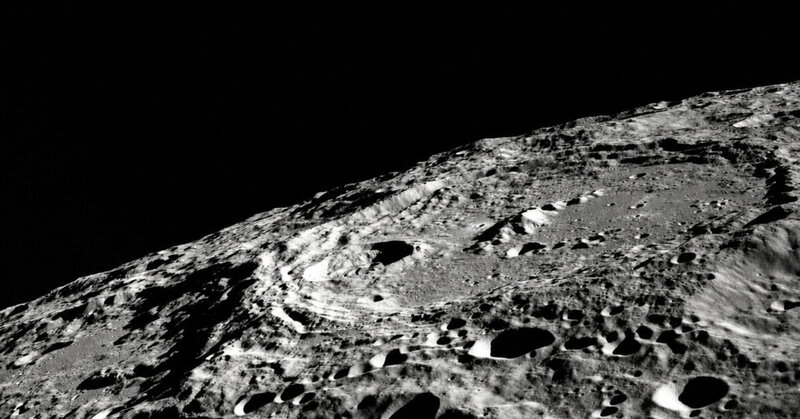
For the first time in the history of space exploration, ancient rocks from the Moon’s far side have been physically returned to Earth — material from a terrain that had never once yielded a sample, preserving a chemical record of the Solar System’s most violent era. What those rocks are now telling scientists is quietly dismantling one of planetary science’s most entrenched assumptions: that the inner Solar System was hammered by a single, catastrophic spike of asteroid impacts roughly 3.9 billion years ago.
A Theory Built on Half the Moon
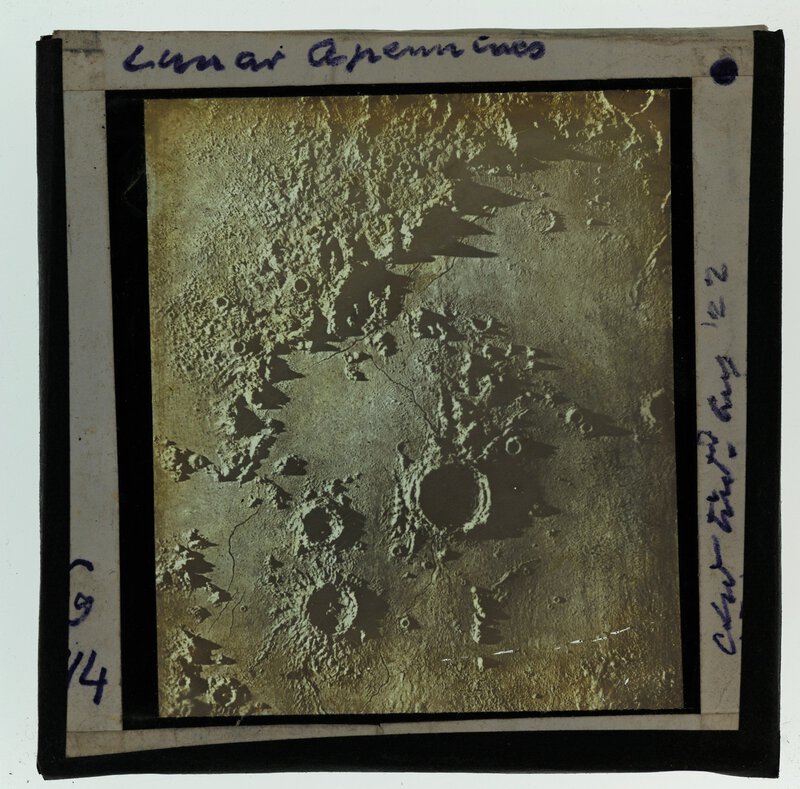
To understand why these new samples matter so much, it helps to understand the theory they are challenging. For decades, the dominant framework in planetary science held that the Moon — and by extension Earth — endured a sudden, intense barrage of asteroid and comet impacts in a geologically brief window around 3.9 billion years ago. Scientists named this event the Late Heavy Bombardment, and it became a cornerstone of how researchers reconstructed the early Solar System’s history.
The evidence for the Late Heavy Bombardment rested almost entirely on rocks returned by NASA’s Apollo missions, which landed on the Moon’s near side between 1969 and 1972. When researchers dated impact-melt rocks — stone that had been liquefied by the tremendous heat of collisions and then resolidified — those samples repeatedly pointed to a narrow age cluster around 3.9 billion years. That tight grouping was interpreted as the fingerprint of a discrete bombardment event: a relatively quiet period followed by a sudden, violent pulse of destruction.
Planetary scientists gave the phenomenon a theoretical backbone as well. The proposed mechanism involved gravitational instabilities among the giant outer planets, particularly a reshuffling of Jupiter’s and Saturn’s orbits that could have destabilized the asteroid belt and flung enormous quantities of debris inward toward the rocky planets of the inner Solar System. The model was elegant, internally consistent, and widely accepted — but it carried a significant structural weakness that some researchers had flagged for years. Every sample underpinning it came from a geographically clustered set of landing sites on a single hemisphere of the Moon.
That sampling constraint was not a minor caveat. It meant the entire Late Heavy Bombardment hypothesis — a claim about a Solar System-wide event — was being reconstructed from rocks collected within a comparatively small region of one face of one world. The far side of the Moon, geologically distinct and entirely unsampled, represented an obvious and largely unaddressed gap in the evidence.
The Far Side: A Different World, A Different Record
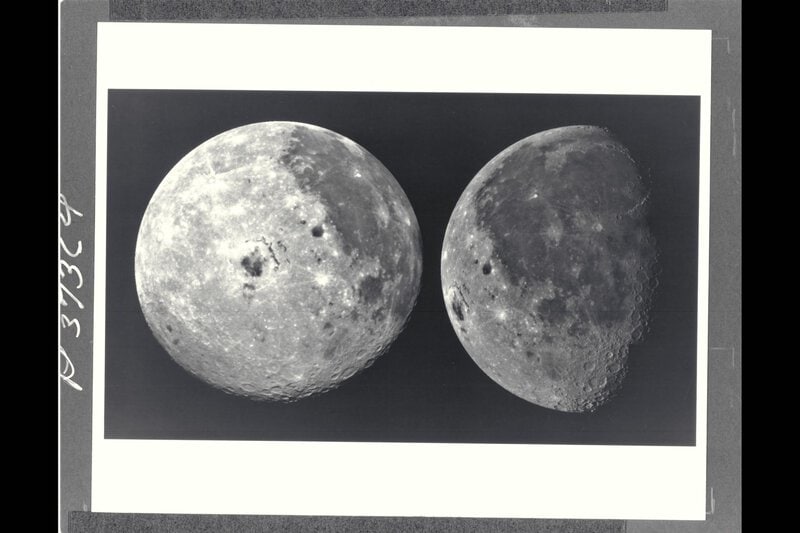
The Moon is tidally locked to Earth, meaning one hemisphere — the near side — perpetually faces our planet, while the far side permanently faces deep space. That asymmetry is not merely a navigational curiosity. The two hemispheres have distinct geological characters and different crustal compositions. The far side is dominated by ancient, heavily cratered highlands; the near side has large, dark volcanic plains called maria. If the Apollo samples were drawn exclusively from the near side, critics argued, the age distribution they recorded might reflect local geological conditions rather than a global — let alone Solar System-wide — bombardment event.
The practical barrier to testing that idea was formidable. Direct radio communication with a lander on the far side is physically impossible from Earth; the Moon itself blocks the signal. Reaching the far side with a sample-return mission required a relay satellite positioned in a stable orbit beyond the Moon — a complex engineering challenge that no space agency had successfully met for this purpose until China’s Chang’e lunar program did exactly that.
China’s Chang’e mission achieved what no previous program had: a sample return from the Moon’s far side, closing an evidentiary gap that had persisted since the Apollo era. According to researchers at Curtin University, who are among the international scientists analyzing the returned material, rocks from the unexplored far side of the Moon are already helping to rewrite lunar history. Every gram of Chang’e lunar far side samples is scientifically unprecedented — a second data point against which all previous lunar science can now be tested.
What the Far Side Rocks Are Showing: A Long Decline, Not a Single Spike
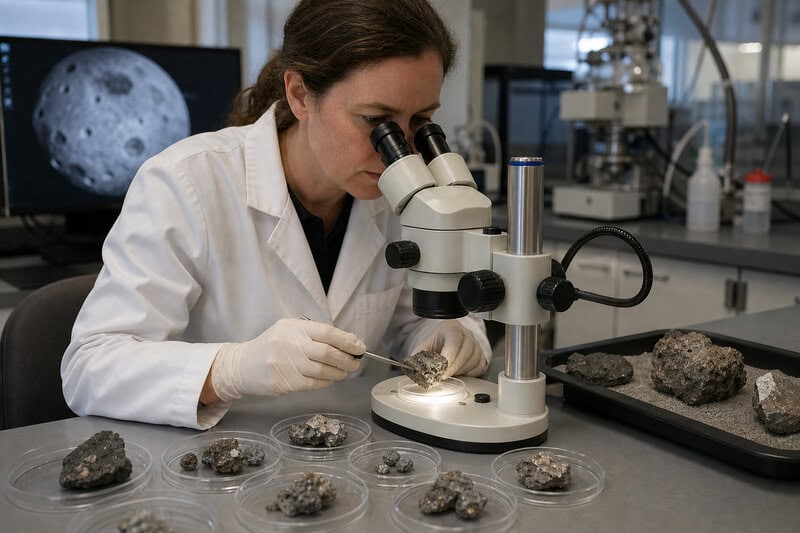
The core finding emerging from analysis of the lunar far side samples is both straightforward and consequential. Rather than clustering tightly around a single 3.9-billion-year horizon in the way that Apollo samples do, the ancient rocks from the far side suggest something different: bombardment gradually weakened over billions of years as the Solar System slowly cleared away the debris left behind from planetary formation.
As SciTechDaily reports, drawing on the latest research into these samples, the far side rocks are rewriting the picture of lunar history in ways that challenge the spike model at a fundamental level. Instead of a catastrophic pulse triggered by a discrete gravitational upheaval, the evidence is more consistent with a continuous, decaying rain of impacts — a Solar System methodically sweeping itself clean of leftover material over an extended period.
The mechanism behind this alternative picture is not exotic. After the planets coalesced roughly 4.5 billion years ago, an enormous inventory of leftover rocky material — planetesimals and debris from the protoplanetary disk — remained scattered through the inner Solar System in unstable orbits. Rather than one sudden gravitational event delivering all that material at once, the gradual-decline model envisions a natural, self-exhausting process: debris depleted steadily through collisions with planets and moons, and through gravitational ejection out of the Solar System entirely. The bombardment did not spike; it simply took a very long time to wind down.
What makes the far side data particularly significant is precisely its geological independence. Because the far side has a different crustal composition and a distinct impact history from the Apollo landing sites, the age distribution recorded in its rocks cannot easily be dismissed as a local artifact or a consequence of near-side sampling bias. Researchers emphasize that the far side samples represent a genuinely broader picture of lunar bombardment history — one that the near-side record alone was structurally incapable of providing.
Two Models, Two Different Solar Systems
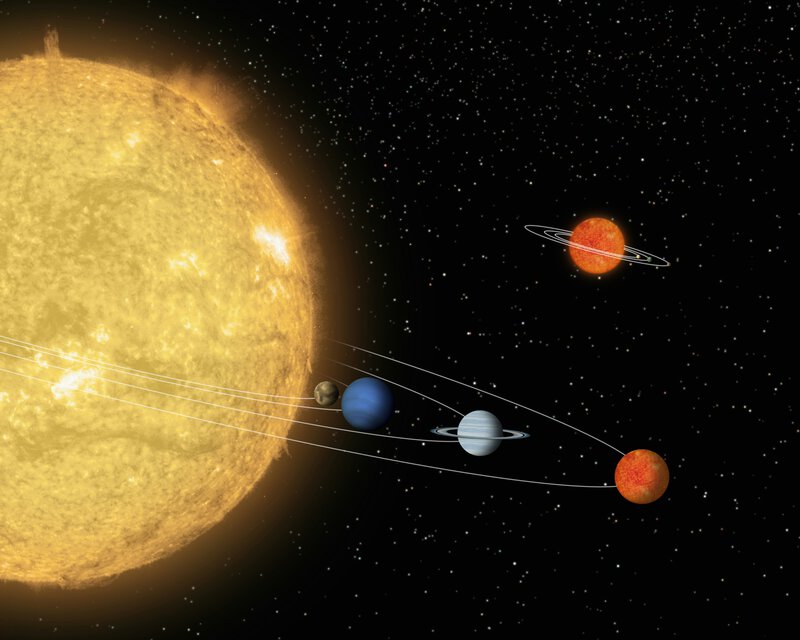
The difference between the spike model and the gradual-decline model is not merely a technical disagreement about lunar geology. The two interpretations describe fundamentally different early Solar Systems, with different dynamics and different consequences for every rocky world in the inner system.
The spike model requires a specific external trigger — a discrete event in which the giant planets migrated and destabilized the asteroid belt in a relatively short interval, delivering a concentrated barrage. The gradual-decline model, by contrast, requires no such trigger. It is consistent with a simpler picture in which the violence of the early Solar System was the natural consequence of planet formation itself, tapering off as the available supply of impactors was exhausted over geological time.
That distinction carries direct implications for the history of early Earth. Because the Moon and Earth occupy the same orbital neighborhood and share the same bombardment environment, revising the Moon’s impact history means revising Earth’s as well. If the bombardment was a long, slow decline rather than a sudden catastrophe, the window during which Earth’s surface was being severely disrupted by massive impacts may look significantly different from what models based on the spike hypothesis predicted.
The astrobiology implications are worth noting carefully, without overstatement. A prolonged but gradually declining bombardment could mean early Earth experienced longer stretches of relative calm between major impact events than the spike model implies. Scientists caution, however, that this does not resolve the broader question of whether impacts helped or hindered the origin of life — impacts can deliver organic molecules as well as destroy surface environments, and the relationship between bombardment and life’s emergence remains genuinely unresolved.
The Moon’s ancient rocks also serve as a proxy for worlds beyond Earth. Mars, Mercury, and the asteroid belt all bear cratered surfaces whose impact records have been interpreted partly through the lens of the Late Heavy Bombardment hypothesis. If the gradual-clearing model is confirmed, those records may require reinterpretation as well. The Moon functions as a kind of planetary impact clock — its surface preserved in low-erosion stasis in a way that Earth’s active geology long ago erased — and what it records applies, in principle, across the inner Solar System.
The Limits of What Is Known — And What Comes Next
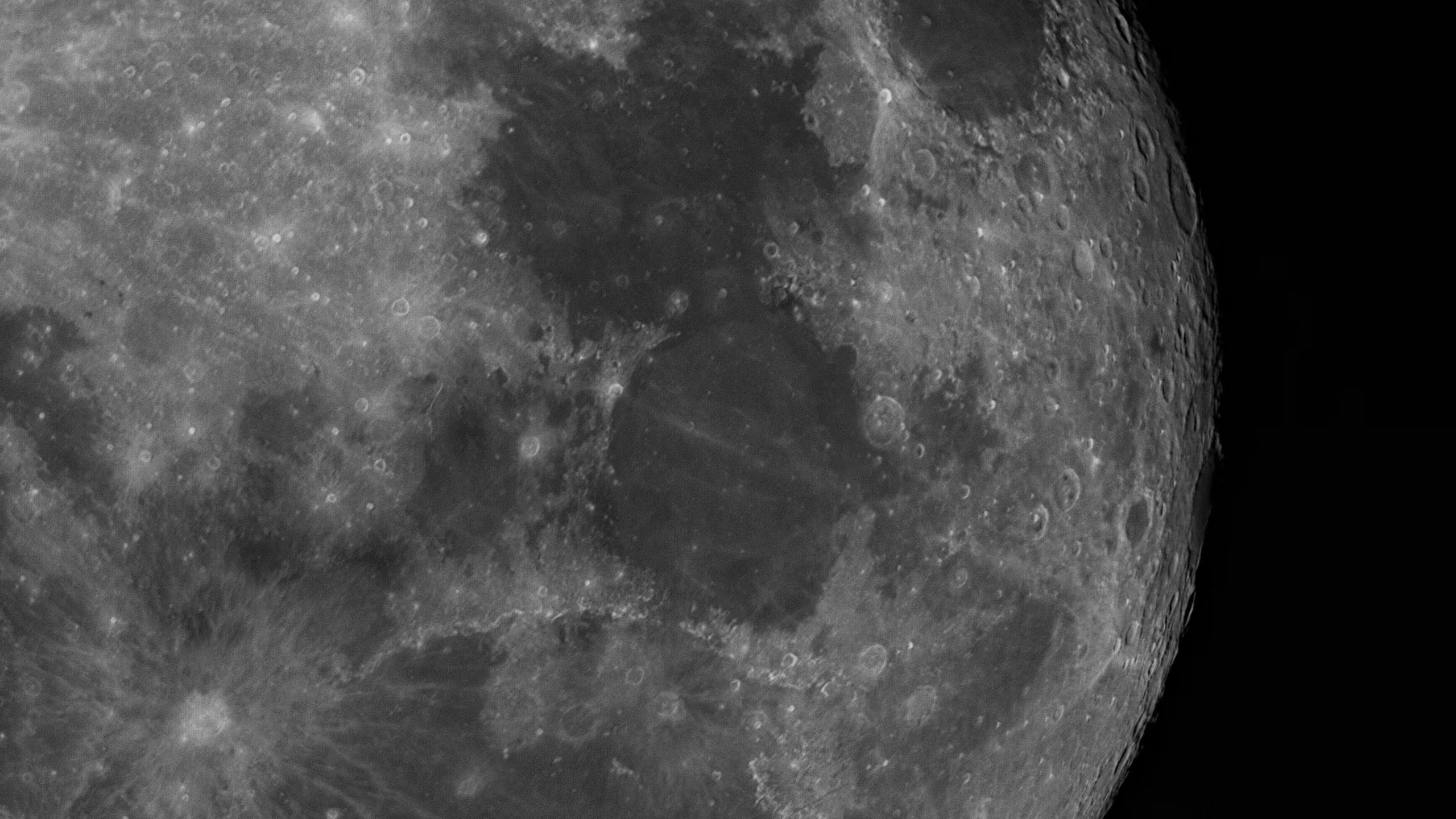
It is important to be precise about the current state of the science. The gradual-decline interpretation is compelling and grounded in genuinely new, geologically independent evidence, but the far side sample collection is still early-stage. A single mission’s worth of material from one landing region is not sufficient to fully reconstruct the bombardment curve. The scientific community will require additional sample analysis, independent replication by multiple research groups, and integration with crater-counting studies and meteorite age records before the gradual-decline model can be considered a new consensus.
Detailed geochemical analysis of the Chang’e samples is ongoing at multiple laboratories, with researchers dating individual mineral grains using radiometric techniques — methods that measure the decay of radioactive isotopes locked into crystals at the moment of formation — to build a precise age distribution that can be directly compared against the Apollo dataset. That comparison is the scientific work now underway.
The broader trajectory of lunar exploration also matters here. NASA’s Artemis program, international lunar lander initiatives, and China’s continuing Chang’e series all aim to return additional samples from diverse regions of the Moon. As research into even individual moon rocks — including material collected fifty years ago — continues to enhance our understanding of lunar history, each new cache of ancient material adds another data point to the global impact record. The more samples from more locations, the more precisely scientists can reconstruct when the Solar System’s violent early chapter opened, peaked, and finally closed.
The far side rocks have not yet rewritten textbooks. But they have done something arguably more important: they have introduced credible, well-sourced doubt into a theory that had gradually calcified from hypothesis into assumption. The Late Heavy Bombardment was never as firmly established as its near-consensus status implied — the Apollo sample set was always geographically narrow, and the theoretical models underpinning the spike hypothesis carried acknowledged uncertainties. The Moon’s far side — silent, ancient, and until recently entirely unsampled — has now given scientists the independent evidence needed to ask the question on genuinely global terms. The story of the Solar System’s violent past is still being told, one ancient rock at a time.