
Roughly 45 million years ago, a small, deer-like creature about the size of a raccoon waded into a prehistoric river in what is now South Asia — not to drink, and not to hunt, but to hide. The predators pursuing it could not follow beneath the surface, and that moment of desperation, repeated across countless generations, set in motion one of the most dramatic evolutionary transformations in the history of life on Earth.
A Distant Ancestor From the Shore
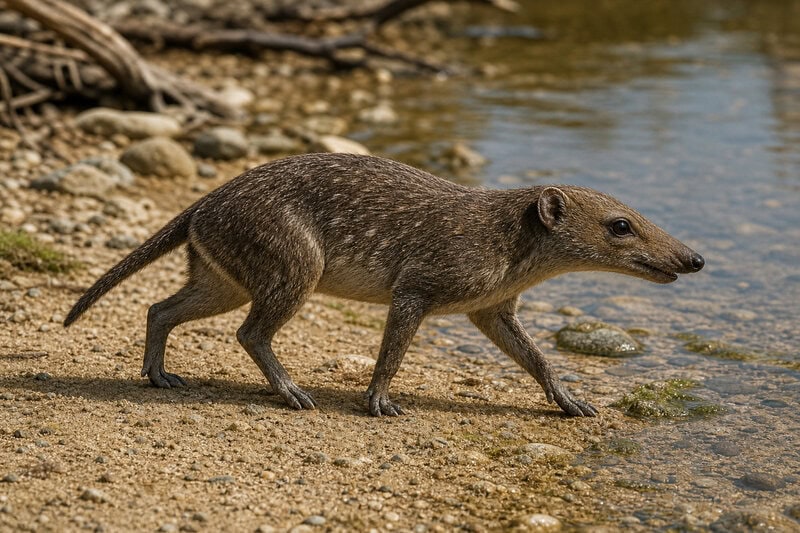
The animal in question is Indohyus — a name derived from Latin and Sanskrit roots meaning roughly “India’s pig” — an artiodactyl, meaning a hoofed mammal belonging to the same broad evolutionary order as deer, cattle, and hippos. Its fossilized bones were described in rigorous scientific detail by paleontologist J.G.M. Hans Thewissen and colleagues in a landmark 2007 paper published in the journal Nature, and the findings sent ripples through the paleontology community that have not stopped since. Indohyus is now considered a distant ancestor of whales — a sister taxon sitting just outside the cetacean lineage — and its discovery fundamentally reshaped scientists’ understanding of how land-dwelling mammals could, over tens of millions of years, become the largest animals ever to live on Earth.
The closest living animal to Indohyus is the water chevrotain, a small, semi-aquatic African ungulate that grazes near riverbanks and retreats beneath the surface when threatened. That comparison is instructive precisely because the water chevrotain is not a whale, and looks nothing like one. That is exactly what makes the evolutionary story connecting Indohyus to whale origins so arresting: the lineage that eventually produced blue whales and sperm whales began not with a powerful ocean predator, but with a nervous little herbivore trying to survive another day.
What Indohyus Actually Was — and Why Its Bones Tell a Watery Story
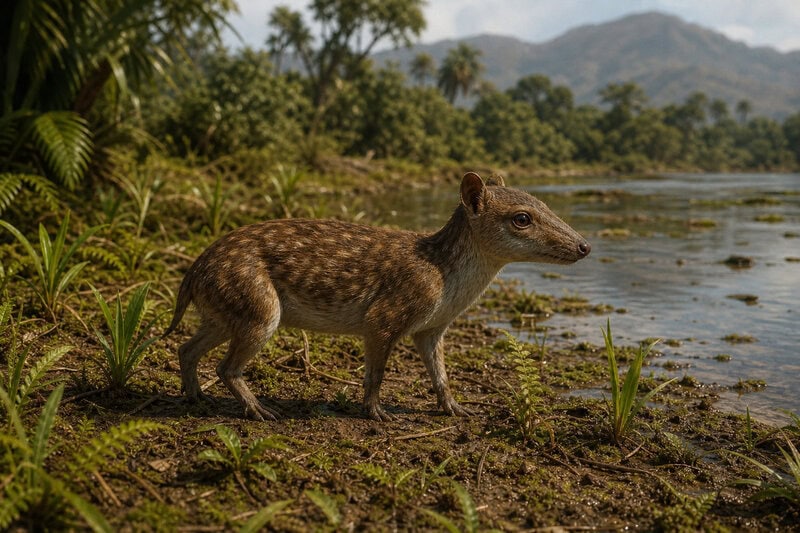
Indohyus weighed an estimated 10 to 15 kilograms, roughly comparable to a medium-sized dog, and by all available evidence it ate plants. It was a herbivore with no apparent need to pursue aquatic prey. It lived during the Eocene epoch — a warm geological period characterized by high sea levels and dense tropical forests — in the region that is now Pakistan and northwestern India. Nothing about its diet or its surface appearance announces “future whale ancestor,” which is precisely why the internal anatomy of its bones proved so revelatory.
The bones of Indohyus were unusually dense and thick-walled, displaying a condition paleontologists call osteosclerosis — a form of bone densification that functions like built-in ballast. The same adaptation appears in modern hippos, whose heavy bones allow them to walk along riverbeds rather than bob helplessly at the surface. In Indohyus, this skeletal architecture would have allowed the animal to sink and remain submerged with minimal muscular effort, staying hidden from terrestrial predators in the shallows and slow-moving rivers of its habitat. As analysis of the Indohyus fossil record confirms, this bone density is one of the most compelling anatomical arguments for a habitual semi-aquatic lifestyle.
The dietary evidence adds a further layer of precision. Stable-isotope analysis of Indohyus teeth, reported by Thewissen and colleagues in their 2007 Nature paper, revealed an oxygen-isotope signature consistent with regular time spent in fresh water — even though the creature’s diet remained terrestrial. In plain terms: the chemistry preserved in its teeth recorded the fresh water it was regularly submerging in, while food residues confirmed it was still eating land plants. This combination is critical evidence that Indohyus was wading and submerging habitually, not merely drinking at the water’s edge.
The implication for understanding whale origins is profound. Because Indohyus entered aquatic environments as a herbivore, the fossil record suggests that the earliest relatives of whales took to water for reasons entirely unrelated to finding food. An older scientific assumption — that proto-whales followed fish and other aquatic prey into the sea — does not hold up against the Indohyus evidence. Diet came later. Survival came first.
Fleeing Into the Water: The Predator-Avoidance Hypothesis
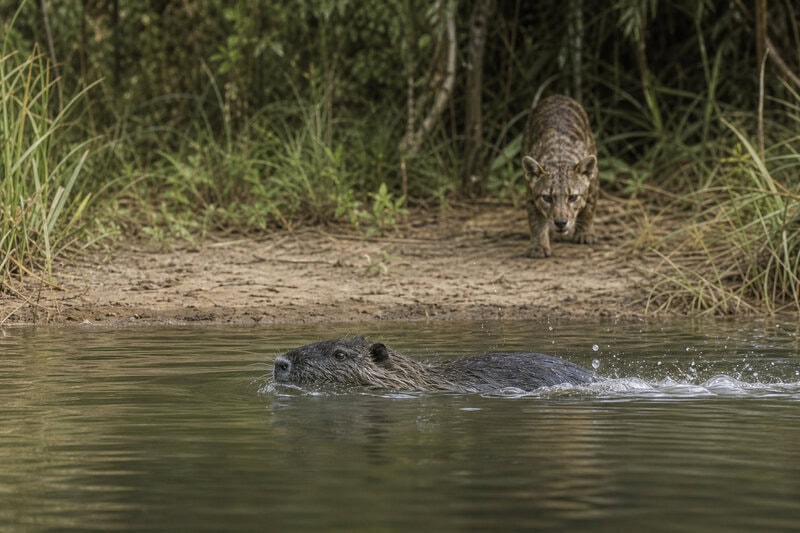
The leading scientific explanation for Indohyus’s semi-aquatic behavior is predator avoidance. In the Eocene ecosystems of South Asia, terrestrial carnivores posed a constant threat to a small, slow-running herbivore. Water offered a refuge those predators could not effectively penetrate. Natural selection would therefore have favored individual Indohyus animals that waded deeper, held their breath longer, and navigated submerged environments more efficiently — incrementally producing populations with a greater physiological commitment to aquatic life.
This is a well-documented example of what evolutionary biologists call exaptation — a process in which a trait that evolved for one purpose is later co-opted for an entirely different function. Indohyus’s dense bones first served predator escape; in later, more aquatic descendants, related anatomical changes became foundational to a fully aquatic existence. The trait did not change its function overnight. It was gradually refined by millions of years of selection pressure into something qualitatively new.
The predator-refuge model, supported by Thewissen’s research, represents the current scientific consensus on why the whale lineage first entered water. It is nonetheless important to distinguish consensus from certainty. Some paleontologists have noted that multiple selective pressures — including thermoregulation in warm, shallow environments and access to aquatic vegetation — may have acted simultaneously on early proto-whale populations. A single-cause explanation makes for a compelling narrative, but the actual evolutionary process was almost certainly more complex and multifactorial than any one hypothesis can fully capture.
The Fossil Timeline: From Indohyus to the First True Whales
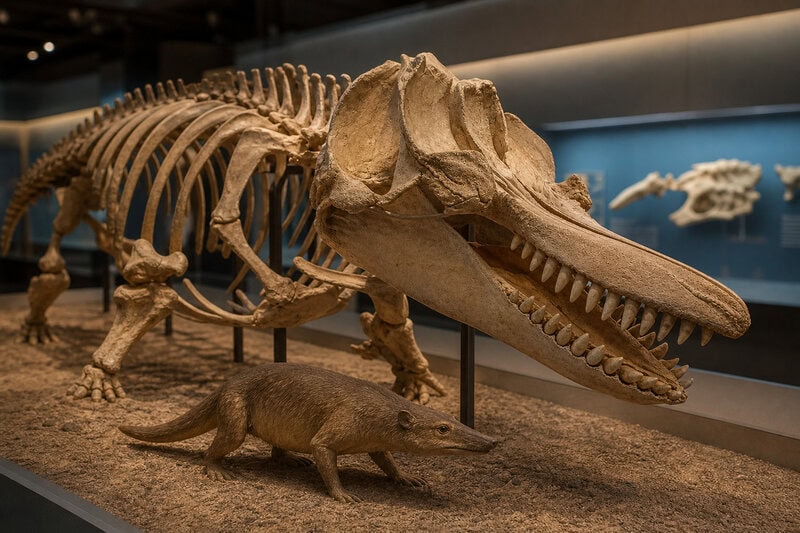
Understanding Indohyus requires placing it within the broader whale evolution timeline that paleontologists have painstakingly assembled from fossil discoveries across Pakistan, India, Egypt, and beyond. Pakicetus — often described as among the earliest known cetaceans, meaning members of the scientific order that includes all whales, dolphins, and porpoises — lived approximately 53 to 48 million years ago. Indohyus and Pakicetus were therefore rough contemporaries, inhabiting overlapping time periods in similar geographic regions.
Crucially, Indohyus is not itself a cetacean. It sits on a sister branch just outside the whale lineage, representing the closest known non-cetacean relative of cetaceans, and illuminating the kind of animal from which the group evolved. The distinction matters: Indohyus is not a direct ancestor but a close relative that shared a recent common ancestor with early whales, making it a uniquely informative window into cetacean origins.
The next major figure in this evolutionary sequence is Ambulocetus — whose name translates as “the walking whale” — which appeared roughly 48 to 47 million years ago. Compared to both Indohyus and Pakicetus, Ambulocetus displays dramatically more aquatic adaptations: shorter hind limbs, modified hands and feet, and a skeletal structure suggesting it moved through water with an undulating, otter-like motion. It could still move on land, but its center of gravity and musculature had shifted decisively toward the aquatic.
Across successive fossil species — Pakicetus, Ambulocetus, and later Rodhocetus — the fossil record documents a clear, stepwise series of changes: a progressive reduction in terrestrial locomotion paired with increasing aquatic specialization. Functional hind limbs shrank and eventually disappeared. The nostrils migrated from the tip of the snout toward the top of the skull, a precursor to the blowhole. The tail elongated and eventually developed flukes. This transitional sequence is among the most complete and well-documented macroevolutionary records in all of paleontology.
When Herbivores Became Ocean Predators: The Dietary Shift
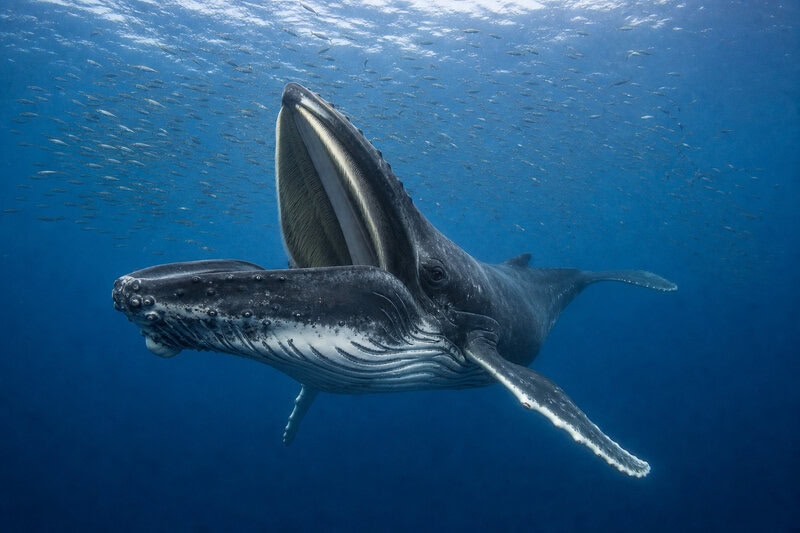
Modern whales present a striking dietary contrast to their evolutionary origins. Baleen whales filter enormous quantities of krill and small fish; toothed whales, including dolphins and sperm whales, are active, echolocating hunters of fish and squid. Yet their earliest relatives, including Indohyus, were plant-eaters with no aquatic diet whatsoever. The transition from herbivory to the apex marine predation seen in modern cetaceans represents one of evolution’s most dramatic dietary reversals.
The sequence supported by the fossil record proceeds logically, if slowly. Once proto-whales were spending increasing amounts of time in the water — initially for safety — opportunistic feeding on aquatic invertebrates, insects, and eventually fish would have become both available and advantageous. Natural selection then began favoring individuals whose jaws, teeth, and sensory systems were better suited to capturing prey underwater. By the time of Ambulocetus and the slightly later Rodhocetus, roughly 47 to 45 million years ago, tooth morphology and skeletal evidence suggest these animals were actively hunting aquatic prey.
It bears emphasizing that no individual animal “decided” to change its diet. What the fossil record captures is the statistical outcome of natural selection acting on variation within populations — individuals better at exploiting aquatic food sources survived and reproduced more successfully, generation after generation, until the population’s dietary profile had shifted entirely. The herbivore origin of the whale lineage was not a blueprint; it was a starting condition that selection steadily transformed.
Extinction and What Indohyus Left Behind
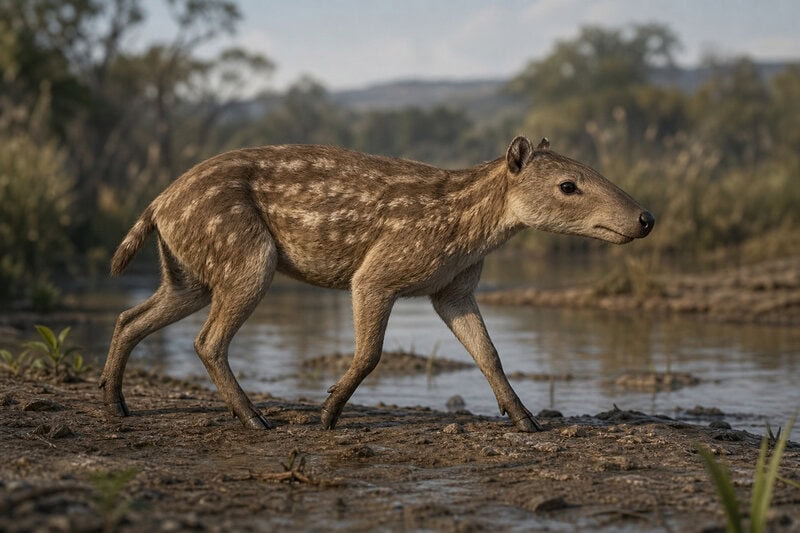
Indohyus itself did not survive indefinitely. The species faced extinction roughly 45 million years ago — a relatively brief window by geological standards, though more than sufficient to preserve the bone chemistry, skeletal architecture, and isotopic signatures that transformed cetacean paleontology. Its disappearance was not the end of the whale story; by the time Indohyus vanished, related lineages had already diversified into increasingly aquatic forms that carried the transition forward.
Paleontologists do not claim Indohyus as a direct-line ancestor of modern whales in a simple linear chain. Rather, it represents the ecological type, the anatomical grade, and the behavioral profile from which cetaceans evolved — a critical data point that filled a gap in cetacean origins that the fossil record had long left open. Its value lies precisely in being a near-relative: close enough to the ancestral whale lineage to reveal what that origin looked like, yet distinct enough to show that the transition to water was already underway in multiple related lineages simultaneously.
Thewissen’s research, conducted in collaboration with colleagues at Northeast Ohio Medical University and cited extensively across subsequent cetacean paleontology literature, is considered foundational to the modern understanding of whale evolutionary origins. The core findings have been independently corroborated by fossil discoveries in Pakistan, India, and Egypt, lending the conclusions a robustness that goes well beyond any single study or field season.
Why This Story Still Matters
Whale evolution is cited by evolutionary biologists as one of the clearest, most thoroughly documented examples of a major evolutionary transition ever discovered. The fossil record tracing cetacean origins — from Indohyus-like ancestors through Pakicetus, Ambulocetus, Rodhocetus, and eventually to fully aquatic forms — is complete enough to demonstrate large-scale anatomical change in granular, step-by-step detail. It serves as one of paleontology’s most effective empirical demonstrations that the fossil record can and does document macroevolutionary change with precision.
The Indohyus evidence, specifically, established a counterintuitive but well-supported conclusion: the ancestors of whales first entered water not to find food, but to escape danger. Habitat shifted before diet. The ocean giants of today followed a small, frightened plant-eater into a river. Evolution’s most spectacular return to the sea began not with ambition, but with fear.
What remains genuinely uncertain — and what keeps this field active — is the precise phylogenetic placement of Indohyus and the degree to which it represents a single lineage’s experience versus a broader pattern repeated across several related artiodactyl groups entering water during the Eocene. Future fossil discoveries in South Asia, where Eocene sediments remain incompletely surveyed, may refine or revise the picture in meaningful ways. The story of Indohyus is remarkable not only for what it has already revealed, but for how much it continues to provoke.