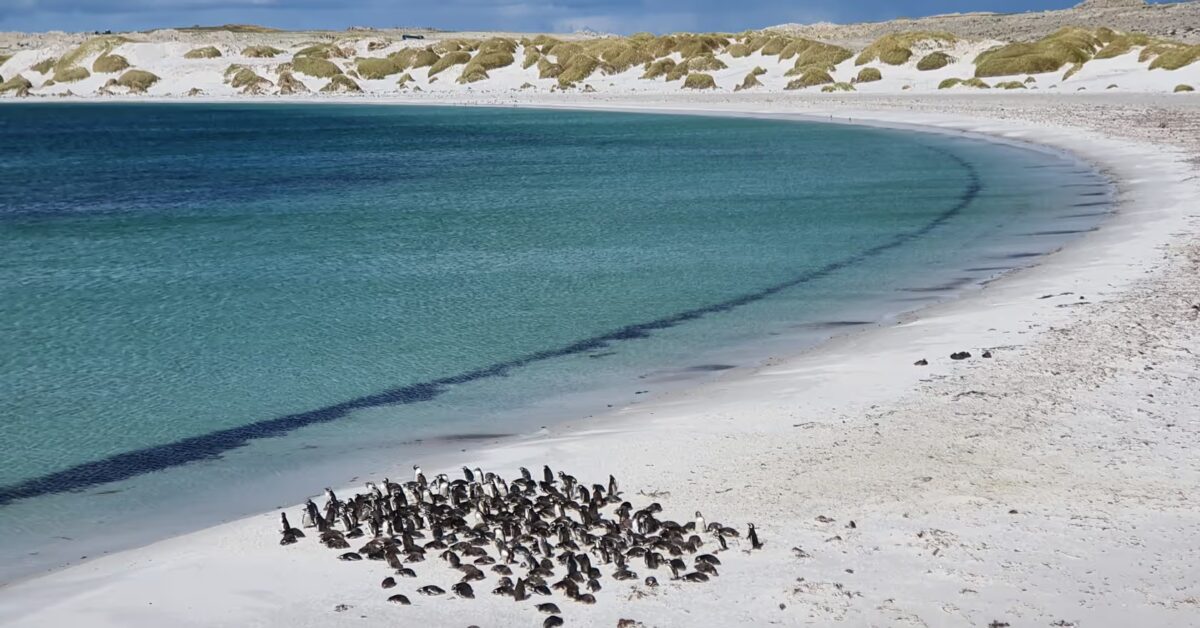
One breeding population of erect-crested penguins has held largely steady for decades. The other has collapsed by more than forty percent. On paper, those two numbers can mathematically cancel each other out — and that arithmetic quirk may be one of the most dangerous things to happen to this species in its entire evolutionary history.
One Species, Two Fates — and a Paradox That Could Get Them Killed on Paper
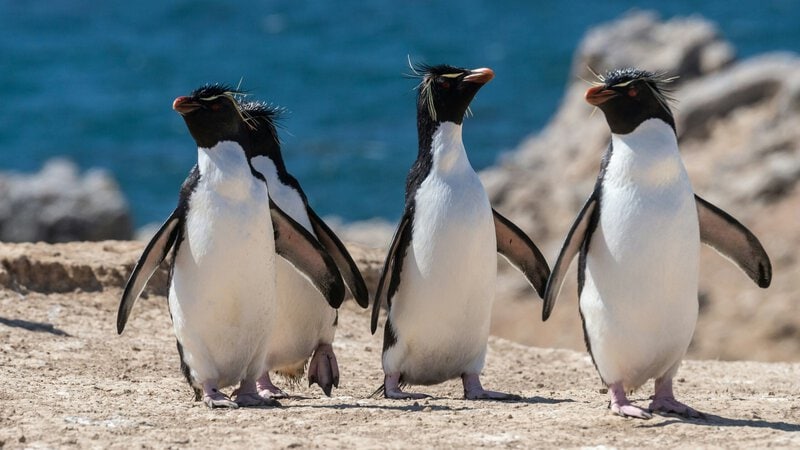
Researchers studying the erect-crested penguin have given an unsettling name to what they found: “Schrödinger’s Penguin.” The label, borrowed from the famous quantum mechanics thought experiment in which a cat is simultaneously alive and dead until observed, describes how a species can appear both endangered and not-endangered at the same time — depending entirely on which population data dominates the assessment. It is a striking illustration of how the tools scientists use to save endangered seabirds can, under specific conditions, produce a bureaucratic illusion of safety that leaves real animals in real danger.
The stakes are immediate. If a species’ global conservation status is downgraded because aggregate population numbers look acceptable, funding streams and legal protections can evaporate — even as one of only two known breeding populations spirals toward local extinction. For a bird that breeds nowhere else on Earth, local extinction is not a regional footnote. It is the deletion of half the species.
Meet the Erect-Crested Penguin: A Species Flying Under the Radar
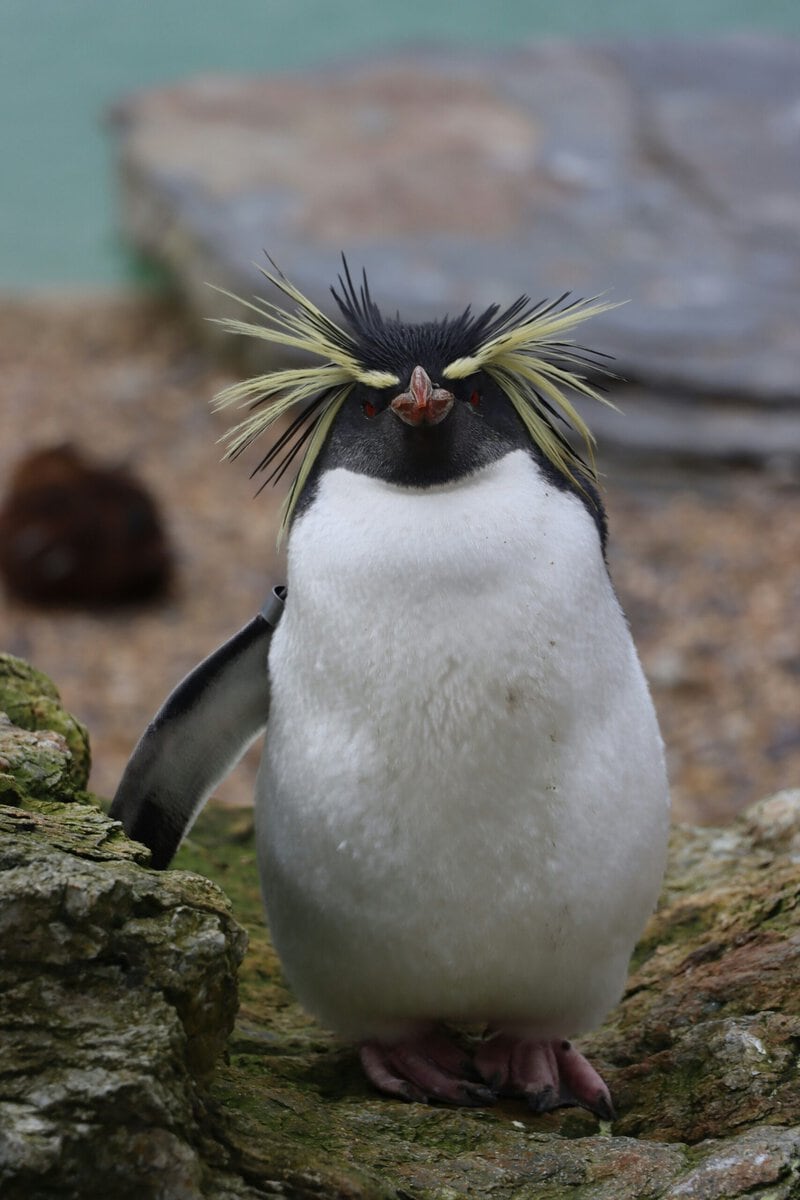
Eudyptes sclateri — the erect-crested penguin — is not a bird most people could pick from a lineup. It lacks the marquee fame of the emperor penguin and the viral appeal of the little blue penguin. What it has instead is an almost absurd degree of geographic restriction: the species breeds exclusively on New Zealand’s remote Antipodes Islands and Bounty Islands, two subantarctic outposts so isolated and inhospitable that sustained human presence there is essentially impossible.
That geographic confinement is precisely what makes the endangered penguin paradox so acute. With no other breeding sites anywhere in the world, each colony is irreplaceable. There is no source population waiting in the wings, no corridor through which recovering birds from a healthier location might replenish a struggling one. A failure at either island group cannot be offset by immigration from elsewhere — because elsewhere does not exist for this species.
The islands’ remoteness has historically made population monitoring sparse and episodic. Researchers studying these penguins in a systematic way found themselves working with incomplete baseline data — a problem that compounds every downstream conservation assessment. It was updated survey data from both colonies that first revealed the divergent population trends now at the center of the scientific debate: one population holding relatively stable, the other down by more than forty percent. That contrast, rather than resolving uncertainty, created an entirely new kind of it.
The Paradox Explained: How Saving Numbers Can Obscure Saving Animals
To understand why divergent population trends create a conservation crisis rather than simply a mixed picture, it helps to understand how global extinction risk is calculated. The IUCN Red List — the International Union for Conservation of Nature’s global ranking system, widely regarded as the authoritative standard for conservation status — evaluates extinction risk primarily at the species level, using species-wide population trends. When a stable population and a crashing one are folded into a single calculation, the crash can be statistically absorbed by the stability, producing an aggregate figure that obscures the emergency happening within it.
This is the mechanism behind “Schrödinger’s Penguin” as a formal shorthand: the species exists in a kind of assessment superposition, simultaneously endangered and not-endangered, until the data is disaggregated — split apart by population — and examined separately. Only then does the collapse become visible in the numbers.
It is important to be precise about what is established here and what remains contested. The population data showing sharply divergent trends between the two colonies is the established finding. What is actively debated among conservation scientists is whether current Red List criteria adequately capture the risk posed by subpopulation collapse — particularly for species with very few, geographically isolated breeding groups. This is an emerging methodological question, not a settled one, and the erect-crested penguin case is now being used in the scientific literature to illustrate why that question matters.
The tension is not unique to penguin science. Conservation biology has long grappled with the gap between species-level thinking, which provides a clean global headline number, and population-level reality, where the meaningful biological units — the actual breeding communities that can be lost or saved — operate. For most species, that gap is manageable. For a bird with exactly two breeding sites, it is potentially fatal.
The Egg That Never Hatches: A Clue Hidden in Plain Sight
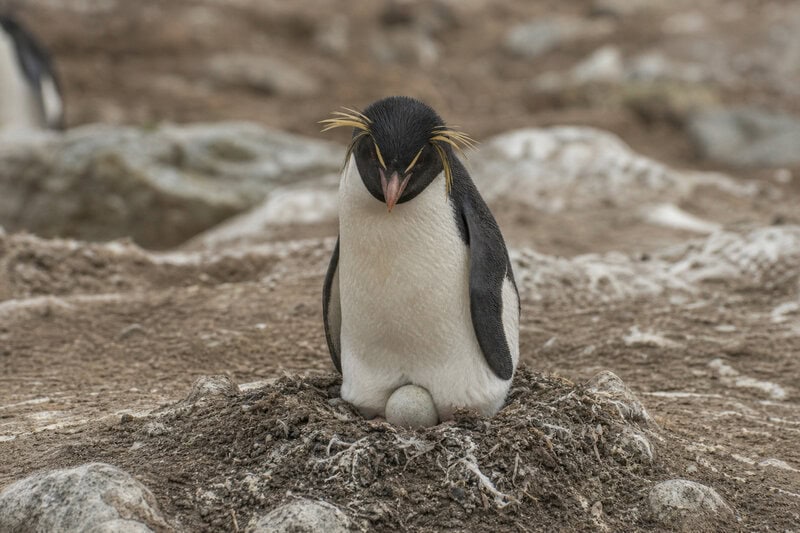
The erect-crested penguin’s biology adds another layer of complexity — and strangeness — to an already complicated picture. The species lays two eggs in sequence but consistently discards the first, investing all parental effort in the second. This behavior, known as obligate brood reduction, means the first egg functions as a biological backup that is never actually used. It is one of the more counterintuitive reproductive strategies in the bird world, and researchers have reanalyzed existing observational data on the behavior to refine earlier estimates of clutch success and chick survival rates.
That reanalysis matters for more than biological curiosity. Population models depend on accurate inputs: how many chicks are produced per breeding pair per season, how many survive to adulthood, and what the realistic rate of population recovery looks like after a decline. If historical observational data on this behavior was misread — if scientists underestimated or overestimated hatching success based on incomplete field observations — then baseline population estimates, and the trend calculations built on top of them, carry that error forward. The reanalysis both improves those estimates and honestly introduces new uncertainty into projections, which is itself an example of science self-correcting in real time.
The reproductive quirk also speaks directly to the species’ vulnerability. A penguin that functionally rears only one chick per pair per season has very limited capacity to rebound from population shocks. High-reproductive-rate birds can, in principle, recover from steep declines if the stressor is removed and conditions improve. For erect-crested penguins, the arithmetic of recovery is unforgiving: the forty-percent decline in one population is therefore far more alarming than the same percentage drop might be in a more reproductively flexible seabird — and that context is not automatically captured in species-level trend assessments.
Why Conservation Interventions Could Backfire
The sharpest edge of this paradox is what happens next. Scientists who counted penguins on these two remote islands and then confronted the implications of their data are now grappling with a scenario in which the aggregate population picture could lead assessors to assign a less severe global risk rating — downlisting the species, in conservation terminology. That change, even a temporary one while a status review is pending, can have concrete consequences.
Protected status under frameworks like the IUCN Red List and international agreements such as CITES — the Convention on International Trade in Endangered Species — triggers specific legal and regulatory safeguards: habitat protections, restrictions on human disturbance, eligibility for research funding, and barriers to commercial activity near breeding sites. When that status is reduced, some of those triggers switch off. For a species with only two breeding sites, losing legal protection at either location — even briefly — creates a window of vulnerability during which human disturbance, invasive predator incursion, or fisheries pressure can accelerate a decline that the aggregate numbers had made invisible.
Conservation biologists studying other seabird species have documented cases where premature downlisting preceded renewed population decline, suggesting this risk is not theoretical. The causal link between status changes and subsequent decline is an area of active scientific debate — establishing that a downlisting caused a decline, rather than merely preceded one, is methodologically difficult — but the pattern has been noted with enough frequency that researchers treat it as a genuine concern, not a speculative one. The erect-crested penguin situation is part of a larger seabird conservation backfire risk that the scientific community is watching carefully.
What Scientists Are Doing — and What They’re Arguing About
The primary research response to the paradox has been a call for disaggregated assessments — evaluations that treat each breeding population as a semi-independent unit, rather than folding both into a single species-wide number. This methodological shift would make the collapse at one colony visible in formal assessments, rather than allowing it to be absorbed by stability at the other. It remains controversial within conservation assessment bodies, however, and the counterargument is substantive.
Some researchers contend that fragmenting species-level assessments risks creating what might be called assessment inflation: if many subpopulations each receive high threat scores independently, the signal becomes harder to compare across the thousands of species that global conservation bodies must simultaneously prioritize. Resources are finite. A system that flags everything as critically urgent ultimately flags nothing effectively.
This is a genuine methodological dilemma, not a bureaucratic excuse. The challenge for assessment bodies is designing criteria that are sensitive enough to catch the erect-crested penguin situation without generating so many high-priority alerts that conservation funding becomes impossible to allocate rationally. No consensus solution currently exists, and the debate is ongoing in peer-reviewed literature.
What the new erect-crested penguin data definitively contributes, regardless of how that methodological debate resolves, is a cleaner and more recent population count for both colonies. Future trend analyses can now be anchored to a more reliable baseline — genuine scientific progress, even amid the paradox. The broader question of how conservation frameworks should handle species with very small numbers of geographically isolated populations remains open, and the erect-crested penguin case is now part of the literature that researchers cite when arguing for reform.
The Bigger Picture: What Penguins Reveal About How We Measure Extinction Risk
The erect-crested penguin paradox functions as a stress test for global conservation infrastructure. It reveals that the categories humans use to decide which animals receive protection were largely designed for a world of larger, more numerous, and more geographically distributed species. Applied to a bird with exactly two breeding colonies, a single-chick reproductive season, and no possibility of natural recolonization, those categories can produce outcomes their designers did not intend.
The problem is not confined to one outlier species. Eighteen of the world’s twenty-one penguin species are experiencing population pressure from climate change, overfishing, and habitat degradation. The assessment tools are being strained across the entire order, with population decline manifesting differently across species but consistently exposing the same structural tension between species-level frameworks and population-level reality.
Three compounding factors make the erect-crested penguin’s situation particularly instructive: the extreme geographic restriction of its breeding range, the low reproductive ceiling imposed by obligate brood reduction, and the near-total absence of long-term monitoring data that would allow scientists to distinguish a recent crash from a longer-term trend. Any one of those factors would complicate assessment. Together, they create a scenario in which standard conservation tools are operating well outside the conditions for which they were designed.
The paradox does not mean conservation science is broken. What it means is that for species with very few populations and very constrained reproductive capacity, the margin for assessment error is essentially zero — and scientists are racing to close that gap before the animals pay the price. Researchers say that naming and formally describing the paradox is itself a form of progress: a problem that has been articulated clearly can, at least in principle, be fixed. Whether the fix comes before the crashing population crosses a threshold it cannot return from is the question that remains unanswered — and urgent.