
Somewhere in rural Montana, a hiker with a broken ankle waits for a rescue that cannot come because her phone shows no signal. That scenario — familiar, preventable, and still routine across hundreds of millions of square kilometers of Earth’s surface — is the precise problem that three large satellites launching before dawn on August 5 are designed to make obsolete. At 3:42 a.m. ET on Wednesday, a SpaceX Falcon 9 rocket is scheduled to lift off from Space Launch Complex 40 (SLC-40) at Cape Canaveral, Florida, carrying BlueBird satellites 11, 12, and 13 for AST SpaceMobile into low Earth orbit. The engineering behind why those three satellites matter is more interesting than the launch schedule alone.
The Launch: A 96-Minute Window and a 3:42 A.M. Alarm
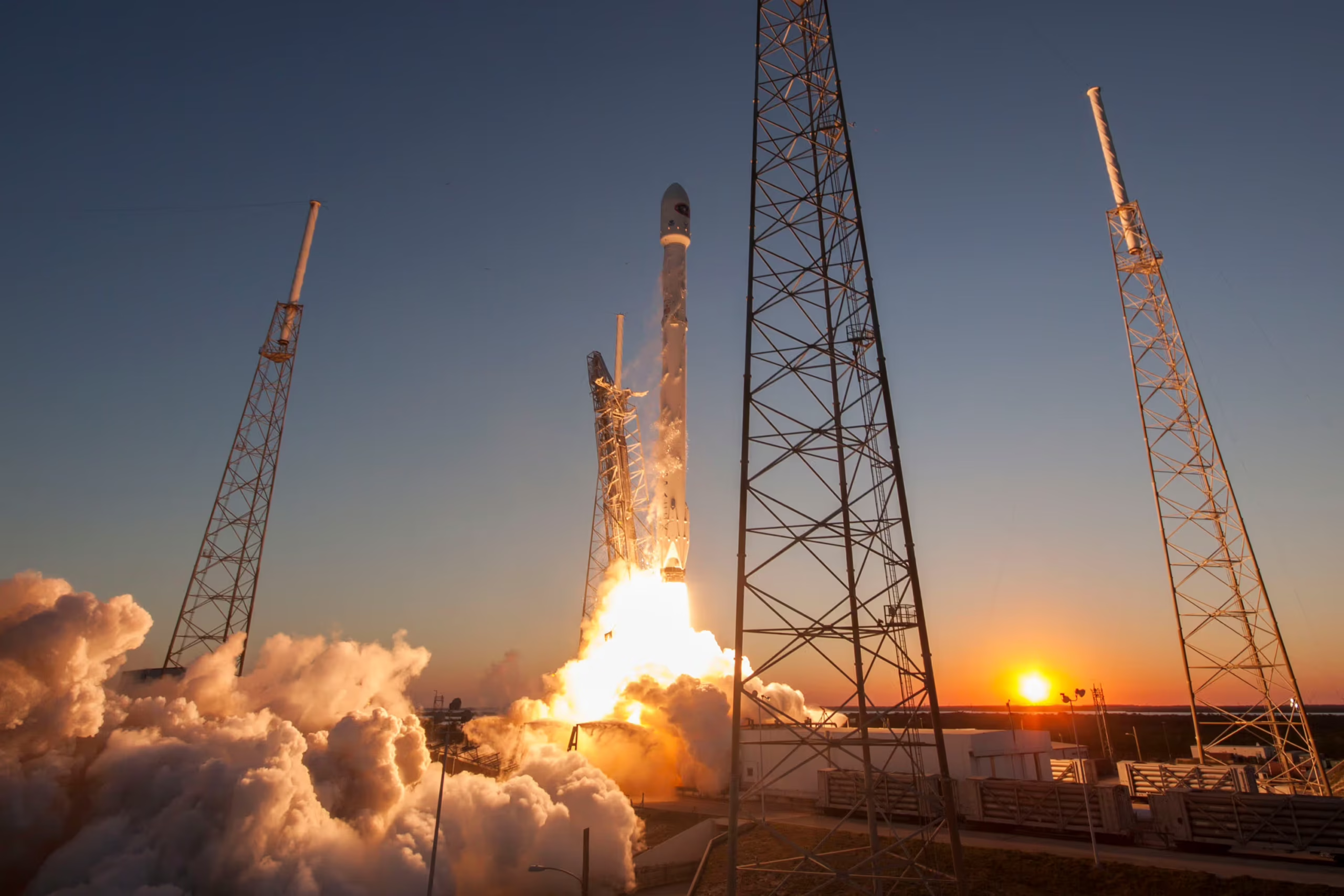
The mission, officially designated BlueBird 11-13, has a 96-minute launch window opening at 3:42 a.m. ET. After stage separation, the Falcon 9 booster will attempt a droneship landing in the Atlantic Ocean — a recovery maneuver now routine enough to be almost unremarkable, but one that keeps per-launch costs substantially lower than expendable alternatives by returning hardware to the flight rotation. Viewers who set an early alarm can watch the sequence live on AST SpaceMobile’s YouTube channel.
SpaceX’s official launches page lists the BlueBird 11-13 mission alongside a separate Starlink mission launching from SLC-4E in California — a small illustration of how rapidly low Earth orbit has become a crowded commercial frontier, with multiple operators sharing the same launch provider. Three satellites may sound modest against that backdrop, but AST SpaceMobile’s BlueWalker 3 prototype and BlueBird commercial satellites are reported as among the largest commercial communications arrays in low Earth orbit, according to AST SpaceMobile. That physical scale is not incidental — it is the central engineering reason direct-to-cell technology can work at all.
What ‘Direct-to-Cell’ Actually Means — and Why It Differs From Starlink
Direct-to-cell (DTC) is a satellite communication architecture in which a spacecraft acts as a cell tower in orbit, connecting directly to an ordinary, unmodified smartphone using standard LTE or 5G radio frequencies. No special handset, no dedicated satellite phone, and no clip-on antenna is required. A user’s existing iPhone or Android device receives the signal as if from a distant terrestrial tower.
This is fundamentally different from Starlink’s consumer broadband service, which requires a ground-mounted dish terminal costing hundreds of dollars that must be physically installed. DTC targets the billions of existing mobile devices already in people’s pockets, which is why its potential addressable market is substantially larger than dish-based satellite internet. The governing radio standard for most DTC deployments is Release 17 of the 3GPP specification — the 3rd Generation Partnership Project, the international body that sets global cellular standards — which formally extended LTE protocols to non-terrestrial networks (NTN), including satellites, for the first time. That standardization matters because it means DTC signals speak the same protocol language as every modern smartphone.
AST SpaceMobile’s approach uses spectrum already licensed to terrestrial carriers, so a subscriber’s data and calls route through their existing mobile carrier’s network even when the signal originates from a satellite hundreds of kilometers overhead. The satellite is, in that sense, an invisible infrastructure layer grafted onto a network the user already pays for.
The Physics Problem: Why Satellite Signals Normally Can’t Reach Your Smartphone
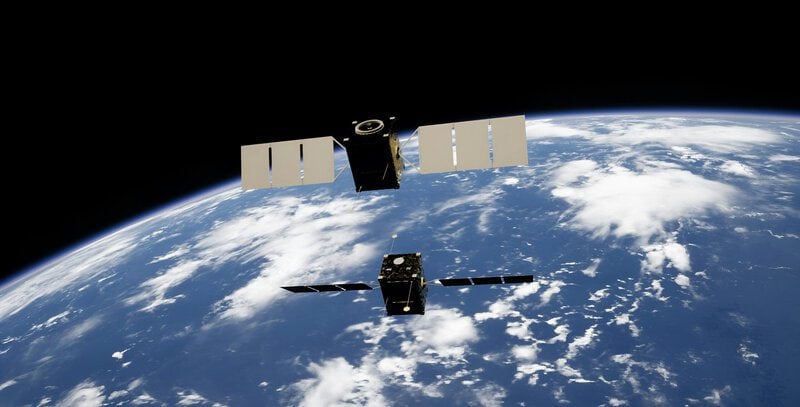
The reason direct-to-cell has taken so long to become commercially viable is a straightforward but demanding physics problem. A conventional cell tower operates at relatively close range — typically 1 to 35 kilometers from the devices it serves. A LEO satellite orbits at roughly 400 to 600 kilometers altitude. The signal must therefore travel 10 to 100 times farther, and radio signal power falls off with the square of distance — a relationship known as free-space path loss. By the time a satellite’s transmission reaches a phone on the ground, it has lost an enormous fraction of its original strength.
Smartphones compound the difficulty. Their antennas are small, omnidirectional, and engineered to receive low-power signals efficiently at close range from terrestrial towers — not from a fast-moving object hundreds of kilometers overhead. The power budget, as engineers describe the balance of transmitted versus received signal energy, simply does not close with an ordinary satellite and an ordinary phone unless something compensates for the distance penalty.
The solution that AST SpaceMobile pursues is a very large phased-array antenna mounted on the satellite itself. A phased array is a collection of individual antenna elements whose signals are combined and timed so that the resulting beam is electronically steerable — aimed at a precise point on the ground without physically moving the antenna. By concentrating transmit energy into a narrow, targeted beam rather than broadcasting in all directions, the satellite can deliver enough power to a phone’s existing antenna to establish a usable link. AST SpaceMobile’s BlueWalker 3 prototype, which validated the concept on orbit, deployed an array reported at approximately 64 square meters — roughly the footprint of a studio apartment. The production BlueBird satellites are described by the company as larger still, which is why aperture size is considered a key competitive differentiator in the direct-to-cell market.
How a BlueBird Satellite Mimics a Cell Tower From Space
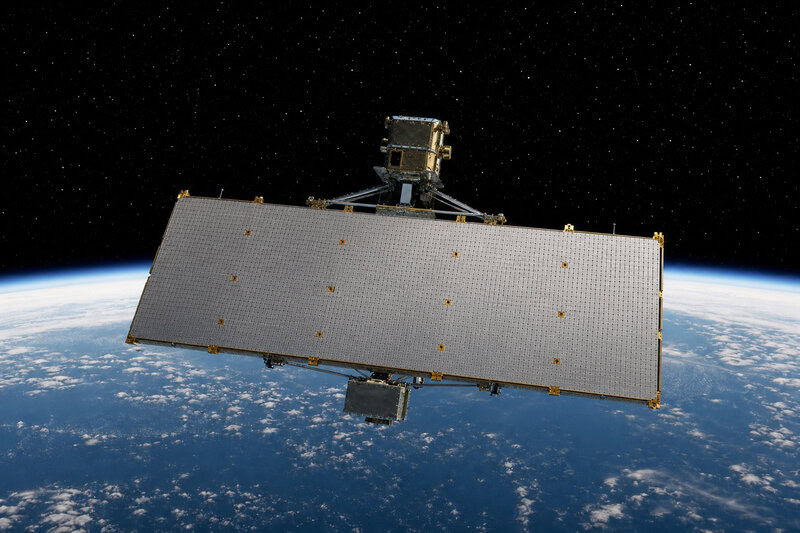
When a BlueBird satellite passes over a coverage area, its phased-array antenna electronically steers multiple simultaneous beams toward ground cells, each beam carrying LTE signals on frequencies licensed to AST SpaceMobile’s partner carriers. This technique — spatial multiplexing — allows a single satellite to serve multiple ground areas simultaneously, increasing total data throughput compared with a single broad-beam transmitter.
The satellite operates as a transparent relay, forwarding traffic between the phone and a ground station, called a gateway, which connects into the carrier’s core network. Latency is higher than a terrestrial tower, because the signal must travel hundreds of kilometers to orbit and back, but low enough for voice calls and text messaging — the primary initial use cases. Streaming high-definition video in a dead zone is not the near-term promise; making a 911 call or sending an emergency text message is.
Doppler shift presents another technical hurdle. A satellite moving at approximately 7.5 kilometers per second relative to a stationary phone creates a measurable frequency offset in the received signal, similar in principle to the changing pitch of a passing siren. The satellite’s onboard signal processing pre-compensates for this shift before transmission, a capability validated during AST SpaceMobile’s BlueWalker 3 trials, which the company reported achieved peak download speeds exceeding 10 Mbps in early tests. Handoff between satellites as they cross the sky is managed at the network level by the carrier’s core infrastructure, transparent to the user — the phone sees a persistent LTE connection, analogous to moving between overlapping terrestrial cells.
Dead Zones: The Problem BlueBird Is Built to Solve

The International Telecommunication Union (ITU) estimates that roughly 450 million people live beyond the reach of any terrestrial mobile network. The U.S. Federal Communications Commission (FCC) has documented persistent coverage gaps across rural, mountainous, and coastal regions that terrestrial infrastructure is unlikely to close economically — building a cell tower to serve a handful of users in a remote valley is not a business case that works for any carrier.
DTC coverage could provide a meaningful safety baseline in these gaps — not gigabit broadband, but enough bandwidth for text messages, emergency alerts, and voice calls. The FCC’s Supplemental Coverage from Space (SCS) rulemaking, finalized in 2024, created a regulatory pathway for exactly this kind of satellite-augmented terrestrial service. AST SpaceMobile has signed agreements with major carriers including AT&T, Verizon, and Rakuten, and has stated a goal of building a constellation large enough to provide near-continuous global coverage — describing a fleet of 60 or more satellites as ultimately necessary for continuous global service. BlueBirds 11 through 13 are incremental but concrete steps toward that threshold.
Contested Ground: Astronomy Concerns, Spectrum Questions, and Battery Reality
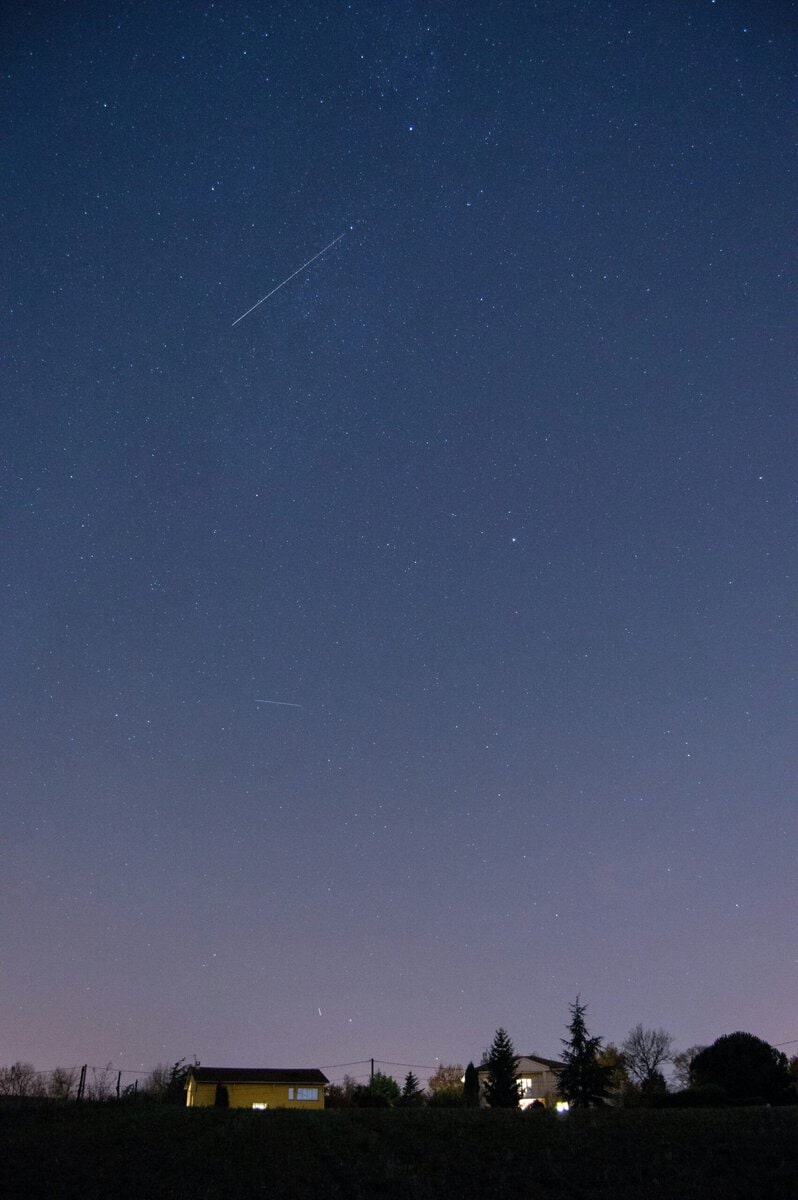
The same large antenna apertures that make BlueBird satellites effective communications platforms also make them optically bright. The American Astronomical Society (AAS) and the IAU Centre for the Protection of the Dark Sky have explicitly flagged large LEO communication arrays — including AST SpaceMobile’s vehicles — as sources of optical interference that can compromise ground-based telescope observations, particularly during twilight passes when satellites are sunlit while observatories below are in darkness. AST SpaceMobile has pursued mitigation measures including surface treatments designed to reduce reflectivity, but the issue remains an active concern within the astronomical community.
Spectrum coordination is a second area of genuine complexity. DTC satellites must share frequencies with terrestrial towers without causing harmful interference to mobile users on the ground or to adjacent satellite operators. The FCC’s SCS framework attempts to manage this balance through geographic and power constraints, but independent engineers have raised questions about whether those constraints will scale cleanly in dense urban environments — a question that only large-scale commercial deployment will answer conclusively.
Battery drain on handsets is a practical open question as well. Maintaining a link to a fast-moving satellite requires a phone’s radio to work harder than it does communicating with a stationary tower, because the device must continuously track a moving signal source. Real-world power consumption data from commercial-scale BlueBird deployments does not yet exist publicly, and the answer will matter to ordinary users deciding whether to leave DTC connectivity enabled by default.
What Comes Next: From Three Satellites to Global Coverage
BlueBirds 11, 12, and 13 bring AST SpaceMobile’s on-orbit commercial fleet to at least 13 satellites. Each satellite provides connectivity only during its roughly 10-minute pass overhead before moving beyond the horizon, which means that at current constellation sizes, coverage over any given location is intermittent rather than continuous — meaningful for emergencies, but not yet a substitute for a terrestrial network. A substantially larger fleet is required before the service becomes reliable enough for routine daily use.
SpaceX’s role as launch provider is worth noting in its commercial context: Starlink’s own DTC service, developed in partnership with T-Mobile, is a direct commercial competitor to AST SpaceMobile. That SpaceX continues to launch BlueBird satellites reflects how the launch market and the satellite services market remain functionally separate businesses at this stage of the industry, governed by contract rather than competitive loyalty.
Whether BlueBird-class direct-to-cell satellites ultimately eliminate dead zones or merely reduce them will depend on constellation scale, spectrum policy, device compatibility, and the economics of carrier partnerships not yet tested at commercial volume. But the physics are real, the regulatory pathway exists, and the August 5 launch is a measurable step toward a world where the phrase “no signal” — and the emergencies that phrase sometimes precedes — becomes genuinely rare.