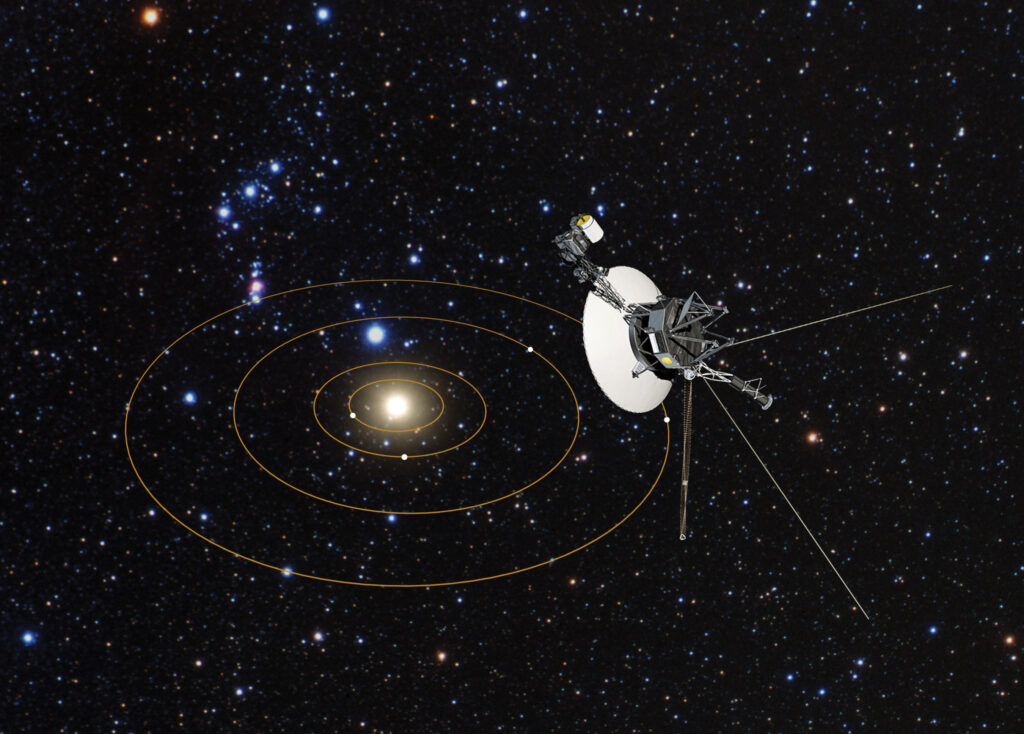
In 1977, NASA’s Voyager 1 and 2 spacecraft began their pioneering journey across the Solar System to visit the giant outer planets. Now, the Voyagers are hurtling through unexplored territory on their road trip beyond our Solar System. Along the way, they are measuring the interstellar medium, the mysterious environment between stars that is filled with the debris from long-dead stars. The NASA/ESA Hubble Space Telescope is providing the roadmap, by measuring the material along the probes’ trajectories as they move through space. Hubble finds a rich, complex interstellar ecology, containing multiple clouds of hydrogen, laced with other elements. Hubble data, combined with the Voyagers, have also provided new insights into how our sun travels through interstellar space.
Even robotic explorers like the Voyager probes experience time differently as they speed through deep space.
While these effects are far less pronounced than with near-light-speed travel, they’re still present—and measurable.
It’s another reminder that every object in motion is subject to the strange flow of time predicted by relativity.
Learn more at JPL.