
Deep in the forested hills of Pocahontas County, West Virginia, an enormous steel dish quietly sweeps the sky, listening for signals that no human ear could ever perceive — ripples in the very fabric of spacetime left over from the dawn of the universe. West Virginia University researchers, armed with nearly $6 million in National Science Foundation funding, are using one of the world’s most remarkable scientific instruments to chase answers to one of humanity’s oldest questions: how did everything begin?
The Green Bank Telescope: A Giant Ear on the Universe
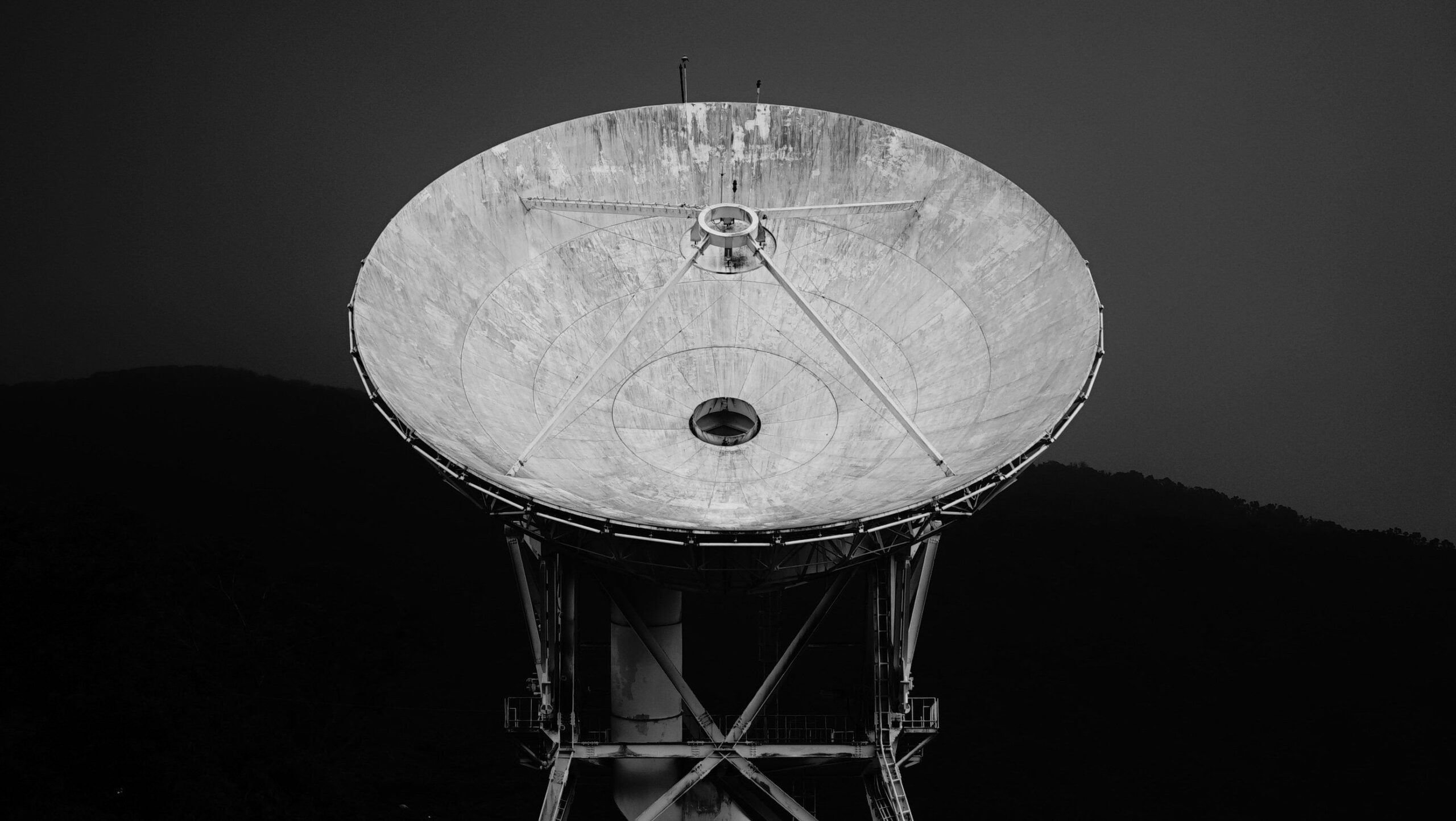
The Green Bank Telescope is the world’s largest fully steerable radio telescope, a distinction that carries genuine scientific consequence. Standing over 480 feet tall and weighing nearly 17 million pounds, the dish can pivot to observe most of the celestial hemisphere above it, tracking cosmic targets with extraordinary precision across both night and day.
Its location in Pocahontas County is no accident. The surrounding Allegheny Mountains and the federally designated National Radio Quiet Zone shield the telescope from the radio-frequency interference that saturates modern life — Wi-Fi networks, cell towers, broadcasting transmitters. That enforced silence translates directly into scientific sensitivity. The GBT can detect whisper-faint signals from sources billions of light-years away precisely because the electronic noise of human civilization is kept at arm’s length.
The telescope is also a remarkably versatile instrument. Researchers use it across disciplines spanning chemistry, physics, radar receiving, and astronomy. Its combination of sheer collecting area and the freedom to point at nearly any target overhead makes it uniquely powerful for the kind of long, patient, repeated observations that gravitational-wave research demands.
Gravitational Waves: Ripples From the Beginning of Time
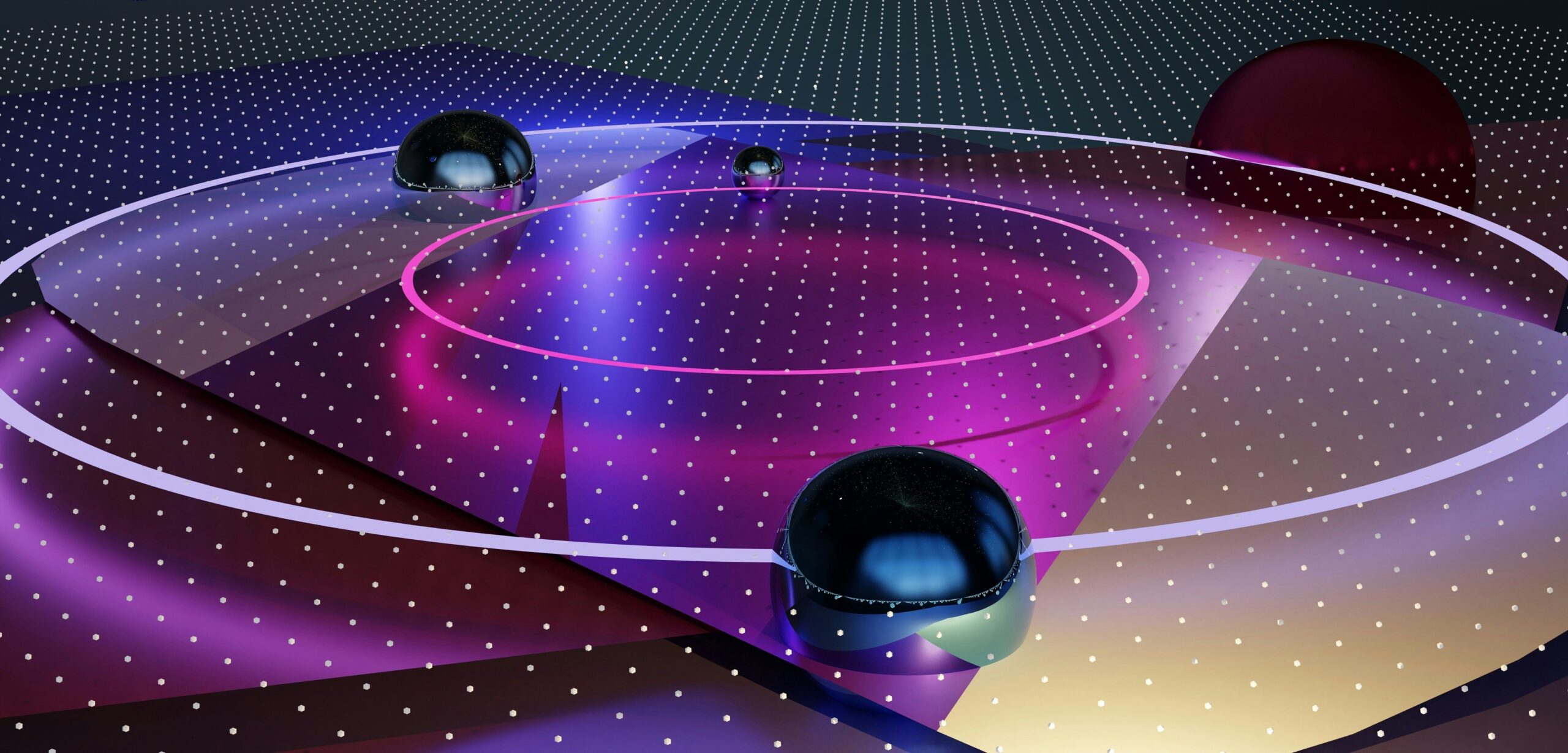
Gravitational waves are distortions in spacetime itself — tiny stretches and compressions in the invisible fabric that structures the cosmos. Albert Einstein predicted their existence more than a century ago as a consequence of his general theory of relativity, but humanity did not directly detect them until 2015, when the LIGO collaboration registered the faint shudder produced by two merging black holes more than a billion light-years away. That discovery earned the Nobel Prize in Physics in 2017 and opened an entirely new way of observing the universe.
What makes gravitational waves so scientifically precious is precisely what makes them so difficult to detect: they pass through matter almost completely undisturbed. Unlike light, which can be absorbed, scattered, or blocked by gas and dust, gravitational waves carry their information across cosmic distances without alteration. They are, in a meaningful sense, the universe’s most reliable messengers.
WVU researchers are targeting a particularly ancient and diffuse variety: the gravitational-wave background thought to pervade all of space. This is not the signal from a single dramatic event like colliding black holes. Instead, it is a low, constant hum — a superposition of gravitational waves generated by countless sources across cosmic history, potentially including processes that unfolded mere fractions of a second after the Big Bang itself. Detecting it would be the equivalent of recovering the universe’s oldest surviving recording.
Pulsars: Nature’s Cosmic Clocks
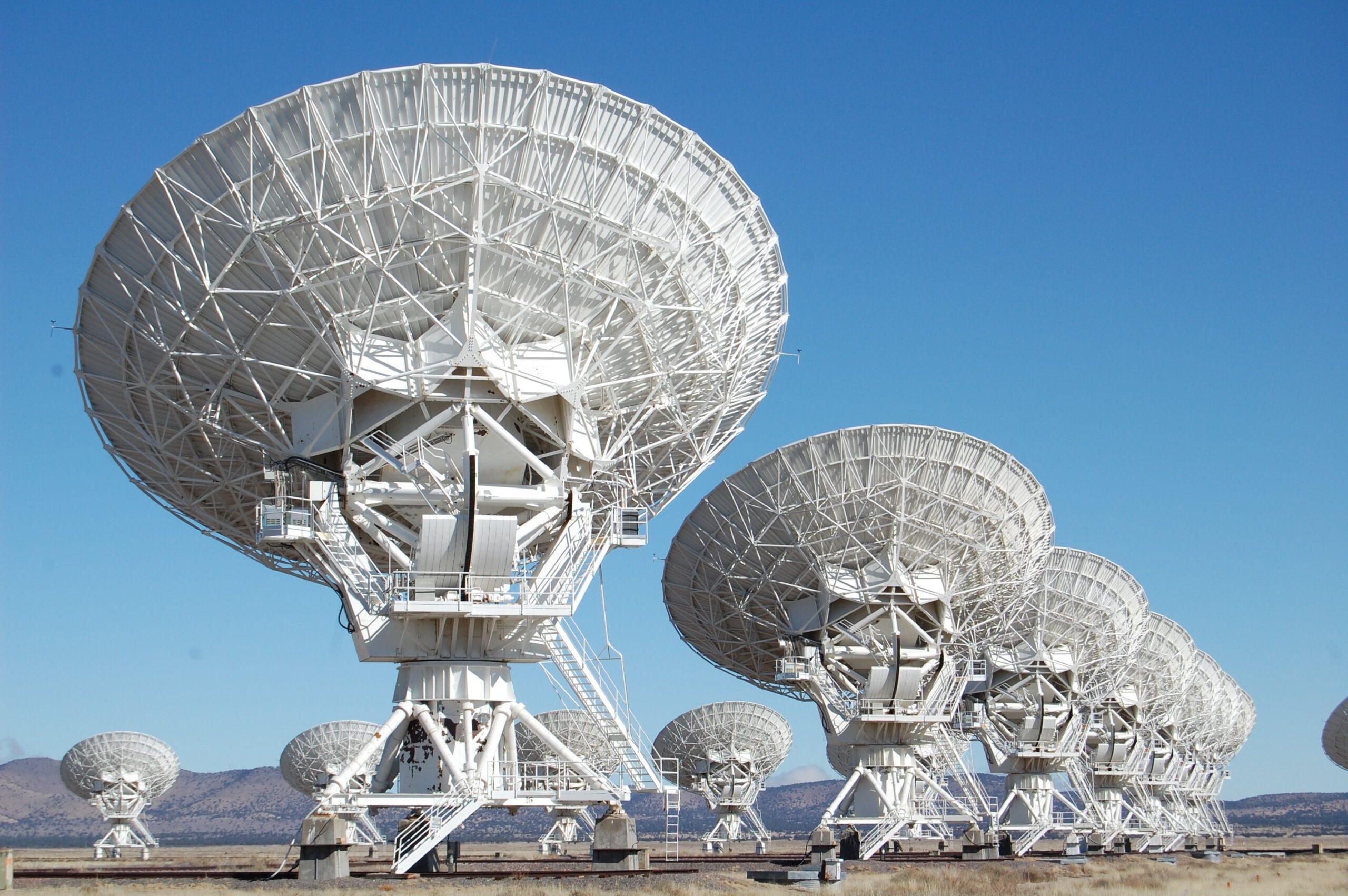
To detect something as subtle as the gravitational-wave background, scientists need a detector on a truly cosmic scale. The technique WVU researchers employ turns the Milky Way galaxy itself into a gravitational-wave observatory.
The approach relies on pulsars — rapidly rotating neutron stars that emit narrow beams of radio waves as they spin. Because they rotate with extraordinary regularity, pulsars function as natural clocks of almost unrivaled precision. The Green Bank Telescope monitors these pulsars, collecting their radio pulses with the sensitivity required to detect even tiny timing irregularities.
Those irregularities are the key. When a gravitational wave passes between Earth and a pulsar, it stretches or compresses the space the radio signal must cross, causing the pulse to arrive fractionally earlier or later than expected. By monitoring an array of pulsars spread across the sky — a configuration called a Pulsar Timing Array — researchers can look for the correlated timing shifts that would constitute the unmistakable fingerprint of a gravitational-wave background washing over the entire galaxy.
This technique requires years of painstaking data collection and an instrument sensitive enough to detect timing deviations measured in nanoseconds. The GBT, with its massive collecting area and ability to track individual pulsars across extended observing sessions, is among the most capable tools on Earth for exactly this work.
The $6 Million Investment and What It Unlocks
The nearly $6 million NSF grant supporting WVU’s gravitational-wave research is not simply a vote of confidence in a promising idea — it is a strategic investment at a pivotal moment in the science. Global pulsar timing collaborations have been accumulating evidence for years, and the field is approaching a threshold where a confirmed detection of the gravitational-wave background may be within reach.
The funding supports several interconnected pillars of the research effort:
- Advanced data analysis pipelines capable of sifting genuine gravitational-wave signatures from an ocean of noise
- Instrumentation development aimed at improving the GBT’s sensitivity and the quality of data it produces
- Sustained, long-baseline observing campaigns — the months- and years-long measurements that pulsar timing fundamentally requires
The investment also reinforces West Virginia’s growing identity as a center of frontier astrophysics, demonstrating that world-class fundamental science is not the exclusive province of large coastal research universities. Green Bank and Morgantown together form an unlikely but formidable hub for one of the most ambitious observational programs in modern astronomy.
What a Detection Would Actually Reveal
If WVU researchers and their collaborators succeed in confirming an early-universe gravitational-wave background, the implications would extend across both physics and cosmology. The conditions that existed in the universe’s first fractions of a second — temperatures and energy densities that dwarf anything achievable in a particle accelerator — left no light-based record that has survived to the present. But gravitational waves generated in that era could still be propagating through space today, carrying encoded information about that primordial environment.
A confirmed detection could illuminate exotic phenomena that current physics only theorizes about: cosmic strings, phase transitions in the fundamental fields of nature, or the dynamics of cosmic inflation — the period of rapid expansion thought to have shaped the large-scale structure of everything that exists. Such findings would both test and potentially challenge the standard cosmological model that has guided the field for decades.
In concrete terms, it would represent a chance to read the universe’s oldest surviving record — one written not in light but in the geometry of space itself.
A Quiet Valley and a Grand Question

There is something genuinely remarkable about the geography of this pursuit. One of humanity’s grandest scientific endeavors — probing the origin of the cosmos — is anchored in a radio-quiet hollow in rural West Virginia, far from the research campuses and technology corridors where cutting-edge science is typically assumed to happen.
The collaboration between WVU and the Green Bank Observatory also builds a research pipeline that trains the next generation of astronomers and data scientists within the state, extending the scientific legacy well beyond any single discovery. Every pulsar the GBT monitors and every timing measurement recorded adds another data point to humanity’s evolving understanding of the universe’s deepest structure.
The Green Bank Telescope has been listening patiently for decades. Now, with the tools, the funding, and the scientific moment aligned, the answer to one of the oldest questions in human history may finally be within earshot.