
Roughly 600 to 650 ceramic vessels lie undisturbed on the floor of the Aegean Sea, at a depth of 39 to 44 metres off the northern Cycladic island of Andros — a cargo so large and so intact that its discovery, announced by Greece’s Ministry of Culture, stands among the most significant ancient shipwreck finds in the region in recent years. The wreck has rested in silence for approximately 2,400 years, and it is only now beginning to yield the story of a vanished commercial world.
What Greek Archaeologists Found Off Andros
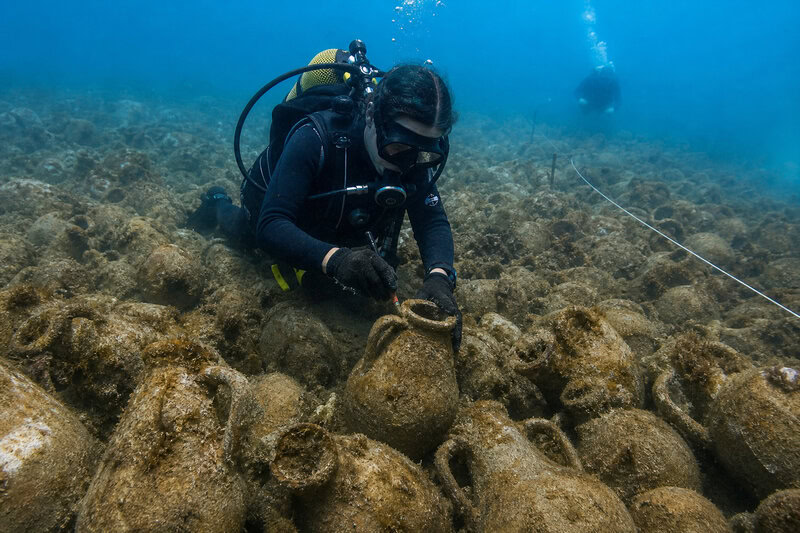
Greek archaeologists located the wreck in the waters off Andros, a Cycladic island positioned at the northern edge of the island chain in the Aegean Sea. The Ministry of Culture’s official announcement confirmed that the site contains an estimated 600 to 650 amphorae — the standardised ceramic shipping containers of the ancient Mediterranean — resting on the seabed in what appears to be a well-preserved arrangement. The announcement has been reported by multiple outlets, including Proto Thema and Greek Reporter.
The depth range of 39 to 44 metres matters for two reasons. It places the site within reach of advanced recreational and scientific divers equipped for deeper operations, making systematic study logistically feasible. More importantly, that depth appears to have been sufficient to protect the cargo from casual disturbance or opportunistic looting across more than two millennia — an unusual stroke of preservation that has left researchers with a remarkably complete picture of what the ship was carrying when it went down.
The cargo is composed entirely of commercial amphorae with pointed bases. That uniformity is itself a meaningful data point: a vessel carrying a single category of standardised shipping container strongly suggests a purpose-built merchant voyage rather than a mixed-goods coaster picking up miscellaneous local products at each port of call. The ship appears to have been engaged in bulk commodity trade at meaningful commercial scale.
Among the amphorae, researchers identified at least three distinct vessel types — a detail with direct implications for understanding how the cargo was assembled. Different amphora types reflect different production regions, meaning the ship did not simply load at a single port and sail. It aggregated goods from multiple points of origin, a practice well documented in the ancient world.
What Is an Amphora? Understanding the Cargo
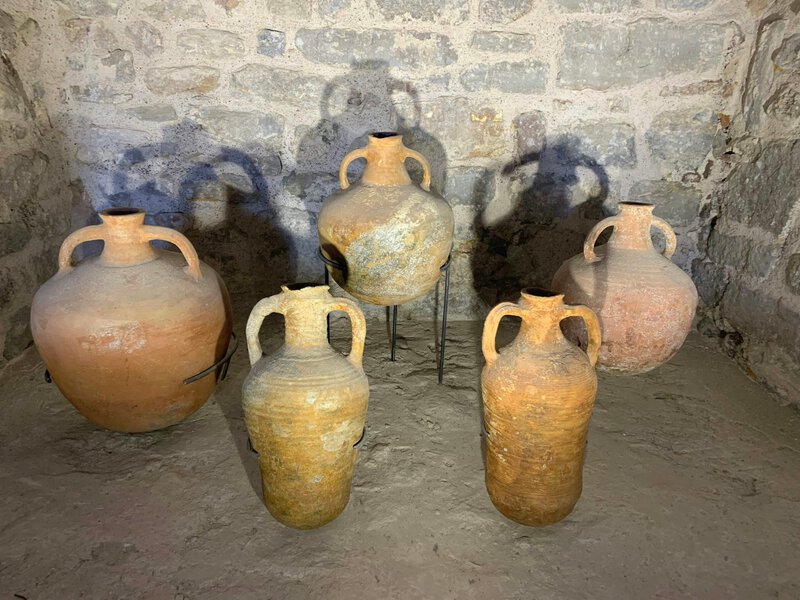
For readers unfamiliar with classical archaeology, an amphora (plural: amphorae) is a two-handled, narrow-necked ceramic vessel that functioned as the standardised shipping unit of the ancient Mediterranean world — roughly analogous in purpose to a modern barrel or intermodal container. Amphorae were produced in enormous quantities across Greece, Anatolia, and the wider Mediterranean basin, and were used to transport the most commercially important liquid commodities of antiquity: wine, olive oil, fish sauce, and grain.
The pointed base that characterises so many ancient amphorae often puzzles non-specialists. Far from being a design flaw, the tapered lower body served a practical function: it allowed vessels to be wedged upright into sand or gravel ballast, slotted into purpose-built wooden racks within a ship’s hull, or stacked in angled layers to maximise storage density and minimise movement in rough weather. The design was an engineered solution to keeping fragile, liquid-filled ceramic containers stable at sea.
The Andros amphorae date to the late 5th and early 4th centuries BC. That places the voyage, and the ship’s loss, in the turbulent decades surrounding and following the Peloponnesian War, the catastrophic conflict between Athens and Sparta that reshaped the political and economic geography of the Greek world. The timing has direct implications for interpreting which trade routes were active, which powers controlled key maritime corridors, and why merchants were moving goods along particular paths across the Aegean.
It is worth being precise about what is established and what remains under investigation. That pointed-base amphorae of this period were used to transport wine and olive oil is well-established consensus in classical archaeology, supported by decades of residue analysis and textual evidence. Which specific commodity filled each vessel aboard the Andros wreck — and in what proportions — remains a subject of ongoing analysis not yet confirmed by the Ministry of Culture’s announcement.
Reading the Cargo: Wine Routes From the Northern Islands and the Bosporus
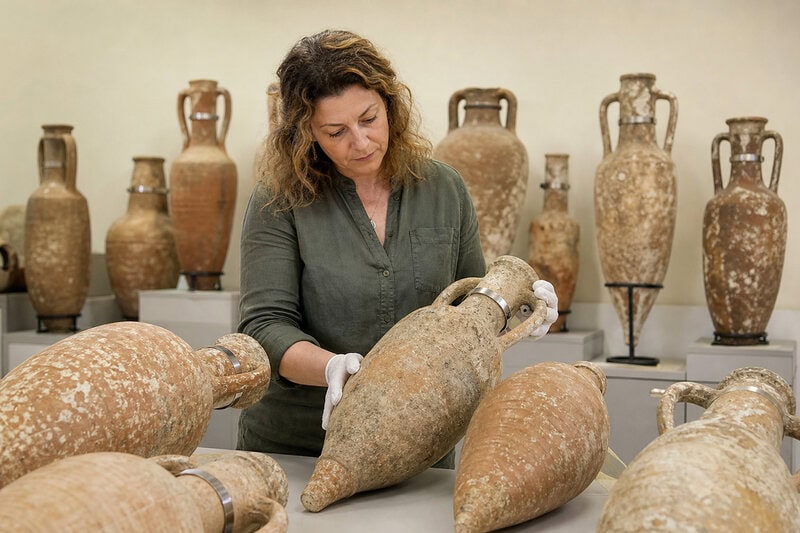
One of the most geographically striking details in the Ministry of Culture’s announcement is the apparent origin of the cargo: the northern Aegean islands and the Bosporus region. That geographic spread is encoded in the distinct regional amphora types identified among the wreck’s vessel styles, each of which carries the physical signature of a specific production centre.
Archaeologists identify amphora origins through a discipline called amphora typology, which combines analysis of a vessel’s shape and proportions, the mineral composition of its clay fabric, and any stamped or painted inscriptions on its surface. Each ancient wine-producing region developed recognisable vessel forms, and researchers can match recovered amphorae to specific centres of production with reasonable confidence — effectively reading the ancient equivalent of a shipping label baked into the ceramic itself. La Brújula Verde offers a detailed account of the cargo’s regional composition as reported from the official announcement.
The Bosporus connection deserves particular attention. Wine produced in and around the Black Sea coastal settlements was regarded as a premium commodity in the classical Aegean, traded across considerable distances to markets in mainland Greece and the broader Mediterranean. Its presence aboard this vessel alongside wines from the northern Aegean islands suggests one of two scenarios: the ship was completing a multi-port loading circuit, stopping at several production centres to aggregate a mixed-origin cargo; or it was acting as a redistribution vessel, consolidating goods at a staging port before carrying them on to a single large destination market. Both models are well documented in the ancient record, and the available evidence does not yet allow researchers to determine which applies here.
What remains firmly unestablished — and should be treated as such — is the ship’s ultimate destination, its home port, and the identity of the merchants or trading house that owned and operated it. Those questions will require further excavation, and potentially archival research in surviving classical-era documentary sources, before they can be responsibly addressed.
Why Andros? The Island’s Strategic Position in Ancient Aegean Commerce
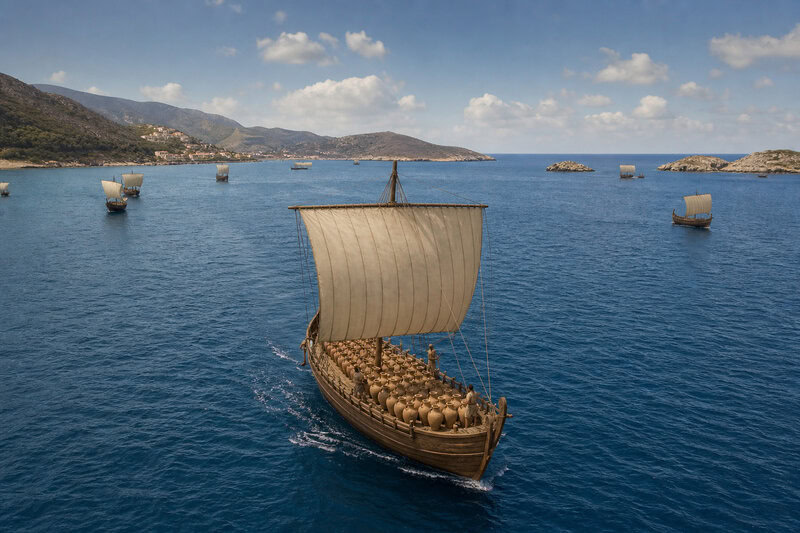
The location of the wreck is not geographically arbitrary. Andros occupies a strategically critical position at the northern end of the Cyclades, sitting at the narrowest natural crossing point between the Aegean mainland shipping lanes and the island chains extending southward and eastward toward routes leading to and from the Black Sea. For ancient mariners navigating by landmarks and prevailing winds, Andros was a natural waypoint — and its surrounding waters were correspondingly busy with commercial and naval traffic throughout the classical period.
The island itself had documented commercial and maritime significance in antiquity, and its waters have previously yielded evidence of ancient maritime activity consistent with Andros’s role as both a trading hub and a naval participant in the complex politics of the classical Aegean. A wreck at this location fits a recognisable pattern of vessels lost while navigating one of the Aegean’s more demanding passages.
One plausible hypothesis — unconfirmed pending full excavation data — is that the vessel was caught by the Meltemi, the powerful northerly wind that dominates Aegean weather patterns from late spring through early autumn and has been responsible for maritime losses in the region from antiquity to the present. The Meltemi can rise rapidly to gale force in the northern Cyclades, offering little warning to a heavily laden merchant ship with limited manoeuvrability. Whether wind, navigational error, structural failure, or some combination of factors sent this vessel to the bottom remains unknown.
For the field of underwater archaeology in the Aegean, the site adds meaningfully to a growing body of evidence from submerged classical-era wrecks. Taken together, these discoveries are allowing researchers to map ancient trade networks with increasing empirical precision, moving beyond what can be inferred from surviving texts alone. A contextual overview of the discovery is available via Divernet’s coverage of the announcement.
What This Wreck Reveals About Ancient Mediterranean Trade
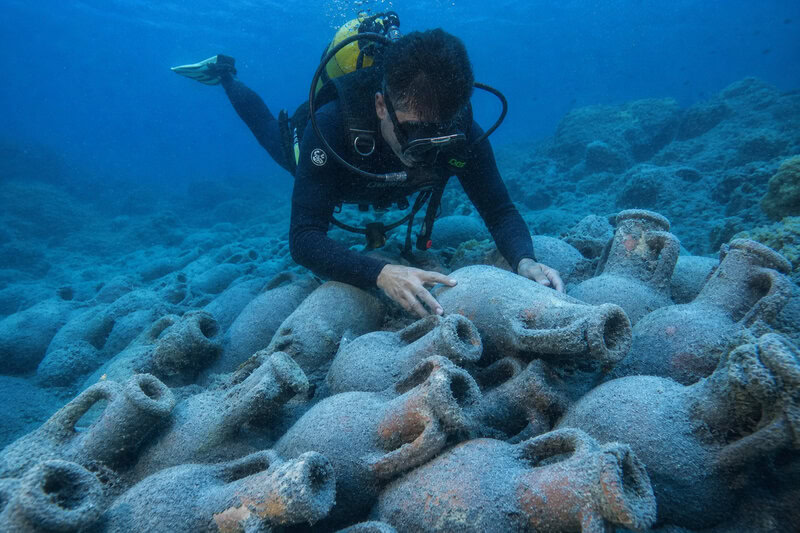
A cargo of 600 to 650 uniform amphorae is not the inventory of a small-scale coastal trader moving modest quantities of goods between neighbouring communities. It represents bulk commodity shipping — an operation implying merchants with significant capital, access to credit or commercial partnerships, reliable knowledge of distant markets, and the logistical capacity to source goods from multiple production regions and consolidate them for transport. This is a portrait of economic sophistication that complicates older historiographical narratives characterising pre-modern Mediterranean commerce as primitive or largely localised.
The multi-origin cargo — drawing from at least three distinct amphora-producing regions — is consistent with the tramping trade model extensively documented in classical-era papyri, maritime contracts, and the fragmentary remains of ancient commercial law. In this model, merchant vessels did not operate on fixed schedules between set ports, as modern container ships do. Instead, they moved opportunistically between harbours, buying where prices were low and selling where demand was high, accumulating mixed or complementary cargoes as they went. The Andros wreck offers a rare physical specimen of that system in action.
The late 5th to early 4th century BC date places this vessel in a post-Peloponnesian War economic landscape in which Athenian commercial dominance across the Aegean was weakening and new trade networks — centred on different island powers and continental trading cities — were being established. Historians of ancient Greek economics, not only archaeologists, will find the discovery potentially valuable as a data point in ongoing debates about how Aegean commerce reorganised itself in the decades following the war.
One distinction must be maintained carefully: it is an established fact, confirmed by the Ministry of Culture’s announcement, that the cargo is large, compositionally uniform, and multi-origin in its amphora types. It is a reasonable and well-grounded inference — but not yet a confirmed finding — that it represents a long-distance commercial voyage rather than a short coastal redistribution run. Full excavation may clarify which interpretation the physical evidence best supports.
Next Steps: What Excavation and Analysis Will Reveal
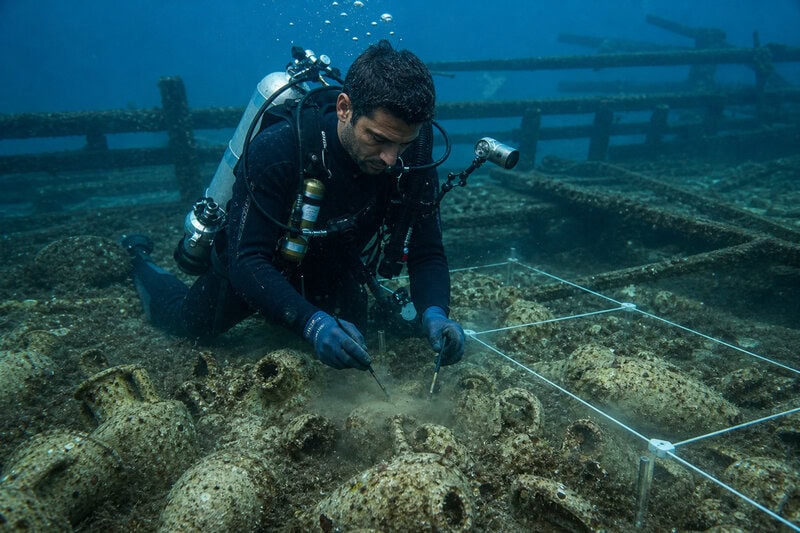
The Ministry of Culture’s announcement marks the beginning of a research process, not its conclusion. A formal scientific excavation — encompassing sediment sampling, analysis of any surviving hull timber, and systematic documentation of the amphora field — will be required before definitive conclusions about cargo contents, ship construction type, and voyage origin can be submitted for peer-reviewed publication.
The single most important next analytical step is likely residue analysis of the amphora interiors. Using gas chromatography to detect organic compounds preserved in the ceramic fabric — tartaric acid as a marker for wine, or characteristic fatty acids associated with olive oil — researchers can move from reasonable inference about what the vessels carried to direct chemical evidence. This is a standard and well-validated method in maritime archaeology that has resolved ambiguities in cargo identification on numerous comparable sites across the Mediterranean.
The Andros wreck takes its place within a broader and expanding corpus of Aegean underwater discoveries that, collectively, are reshaping the discipline of ancient Mediterranean trade studies. The field is moving steadily from a model grounded primarily in textual and documentary evidence toward one built on empirical, artefact-driven economic archaeology — with each new wreck adding resolution to the emerging map of how goods, people, and ideas moved across the ancient sea.
What Greece’s Ministry of Culture’s announcement makes clear is that the site is exceptionally well preserved, scientifically significant, and capable of yielding answers to questions about ancient trade, navigation, and commerce that no surviving text has yet been able to provide. The full story of this vessel, its crew, and the hundreds of containers it was carrying when it went down is only beginning to be told. Further details and photographs from the official announcement can be found at The National Herald’s coverage of the discovery.