
At Space Launch Complex 4E on California’s Vandenberg Space Force Base, a Falcon 9 rocket ignites and clears the pad — and in roughly nine minutes, 24 Starlink satellites are circling Earth at approximately 17,500 miles per hour, slotting into a geometric web that already spans thousands of nodes. That compressed timeline, repeated mission after mission, is what makes the Starlink 17-52 launch both operationally routine and quietly extraordinary.
What the Mission Designation Actually Tells You
The hyphenated label “Starlink 17-52” is not a marketing choice. The first number encodes the target orbital shell; the second identifies the flight sequence within that shell — the 52nd batch of satellites bound for shell 17. SpaceX engineers can read the mission’s positional intent directly from the name without consulting a separate manifest, a practical necessity when launches occur every few days across multiple sites and orbital planes simultaneously.
Starlink 17-52 also marks SpaceX’s 90th launch in this operational context, a milestone that illustrates how thoroughly batch-deployment spaceflight has been normalized. The central question worth asking is not simply whether the rocket lifted off on time, but what physically happens during those nine minutes between ignition and deployment — and why Vandenberg’s geography matters to anyone on Earth who might one day use a Starlink terminal.
Why Vandenberg? The Geography of Polar Orbits Explained
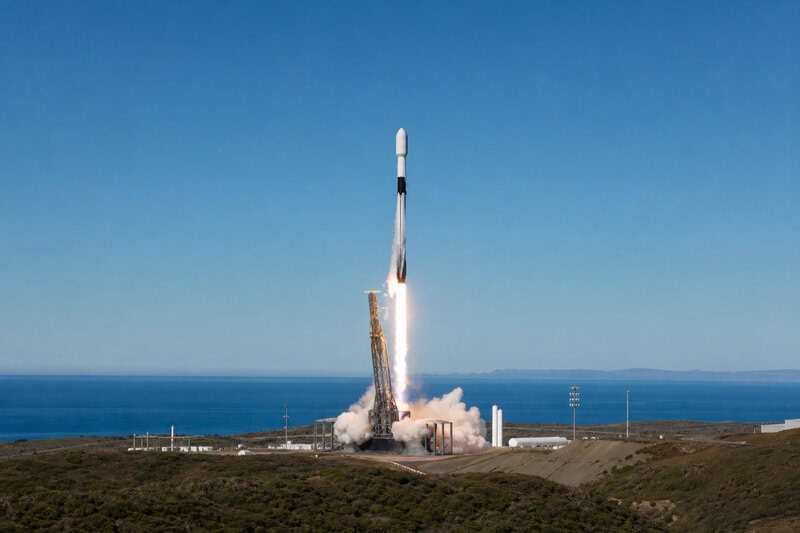
Orbital inclination — the angle between a satellite’s orbital plane and Earth’s equator — determines which latitudes a satellite can serve. Starlink shells designed to cover high-latitude regions, including Alaska, Canada, Scandinavia, and the southern cone of South America, require inclinations above roughly 53 degrees. Achieving those inclinations efficiently demands flying southward immediately after liftoff, away from populated land.
Vandenberg, at approximately 34.7 degrees north latitude on the California coast, faces open ocean to the south and west. That geography makes it the primary U.S. launch site for high-inclination missions. U.S. Space Force range safety documentation confirms that SLC-4E’s ocean-facing southern azimuth is the enabling factor: the rocket’s ground track crosses no populated landmass during the critical early ascent phase, satisfying safety regulations and downrange hazard requirements simultaneously.
Florida’s Kennedy Space Center, by contrast, launches eastward over the Atlantic, favoring lower-inclination equatorial and mid-latitude orbits. The two sites are architecturally complementary: Florida-launched Starlink batches populate mid-latitude shells; Vandenberg batches like Starlink 17-52 fill high-latitude shells that complete global coverage. Neither site alone could build the full constellation.
The Nine-Minute Ascent: Staging, Fairing Jettison, and Orbital Insertion
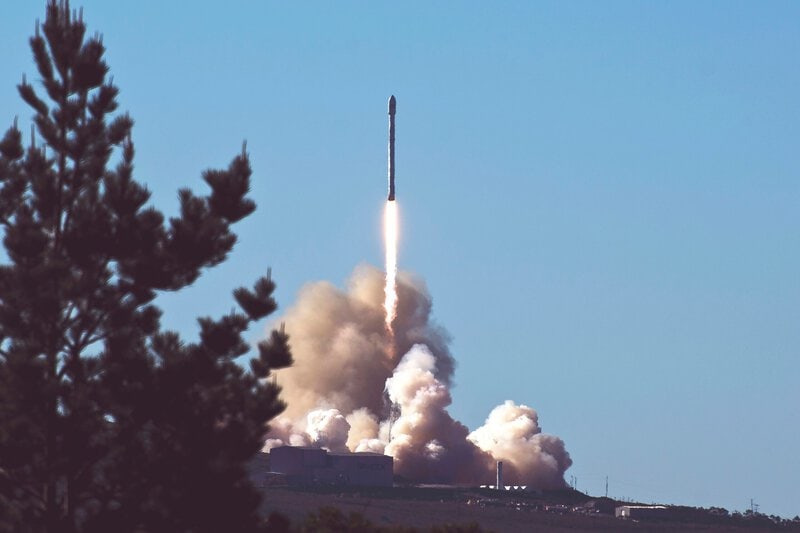
The Falcon 9’s first stage burns for approximately two and a half minutes, consuming most of its propellant to push the vehicle through the densest, most drag-intensive portion of the atmosphere. At staging, the first stage separates and begins its own return sequence while the second stage takes over.
The trajectory is not a straight vertical climb. The rocket tilts progressively during ascent, trading vertical velocity for horizontal velocity in a maneuver aerospace engineers call a gravity turn. Reaching low Earth orbit requires arriving at the target altitude — typically around 200 to 300 kilometers for an initial parking orbit — while simultaneously traveling at approximately 7.8 kilometers per second horizontally. NASA’s Glenn Research Center orbital mechanics resources note that reaching low Earth orbit requires roughly 30 times more energy than simply ascending to the same altitude vertically, which is why multistage rockets that shed empty mass remain the dominant engineering approach six decades after Sputnik.
The two-piece payload fairing — the aerodynamic nose cone protecting the 24 satellites during ascent — splits and jettisons once the vehicle climbs above approximately 120 kilometers, where atmospheric density drops low enough that aerodynamic heating is no longer a structural concern. Above that altitude there is effectively no air to cause thermal or mechanical stress, and the fairing’s mass becomes dead weight the mission no longer needs to carry.
The second stage then completes a vacuum burn to reach the precise parking orbit. At engine cutoff, the stack — second stage plus 24 stacked satellites — is in free fall around Earth, which is the technical definition of orbit: falling continuously while moving fast enough to keep missing the ground.
Deployment Mechanics: How 24 Satellites Fan Out from a Single Stack
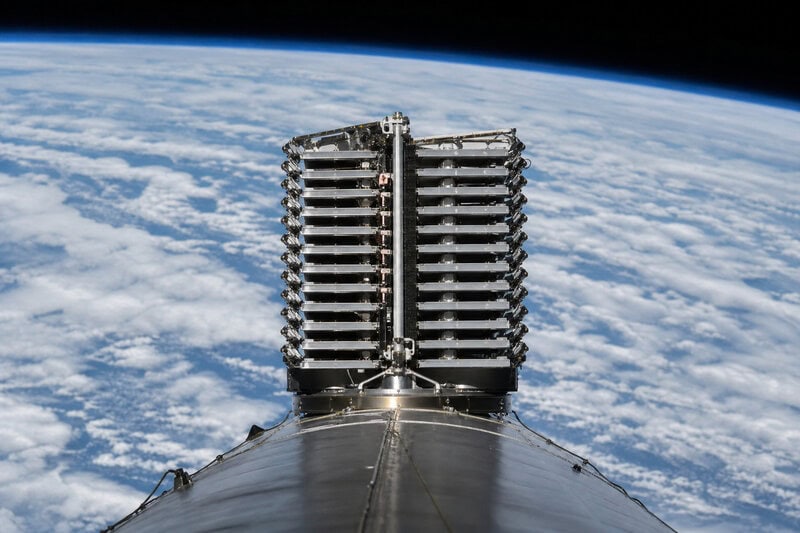
The Starlink satellites ride to orbit stacked flat in what engineers informally describe as a “deck of cards” configuration — a single compact unit mounted atop the second stage. After a brief coast phase that allows the stack to reach the correct orbital position for release, the entire batch is ejected as a unit. Small spring-loaded mechanisms impart gentle separating velocities, and the 24 satellites begin to drift apart.
What happens next unfolds over weeks, not minutes. Each satellite carries a krypton-fueled Hall-effect ion thruster — a form of electric propulsion that ionizes krypton gas and accelerates the resulting ions to generate thrust far more efficiently than chemical rockets, though at much lower thrust levels. Over several weeks, each spacecraft independently uses its thruster to raise from the approximately 290-kilometer deployment altitude to its designated operational slot, typically around 550 kilometers for first-generation Starlink satellites.
The low deployment altitude is intentional: if a satellite fails immediately after release and cannot maneuver, atmospheric drag at 290 kilometers will naturally deorbit it within months, limiting debris accumulation in a way that a failure at 550 kilometers would not.
The choreography of 24 satellites raising simultaneously — without colliding with each other or with the roughly 25,000 tracked objects already in orbit — requires active conjunction analysis. The European Space Agency’s Space Debris Office has documented that SpaceX performs predictive conjunction screening during this post-deployment phase, issuing ground commands for thruster pulses when close-approach risks exceed defined probability thresholds.
One dimension of that choreography has drawn scrutiny from the astronomical community. Researchers publishing in Nature Astronomy in 2023 documented that large batch deployments at low altitude create transient optical brightness events — streaks and flares appearing in long-exposure telescope images — that can compromise ground-based sky surveys conducted during the weeks-long raise phase. SpaceX points to its VisorSat and DarkSat coating programs as mitigation measures. Independent observers affiliated with the International Astronomical Union’s Centre for the Protection of the Dark and Quiet Sky have noted that the coatings meaningfully reduce but do not eliminate the interference, particularly for wide-field survey instruments like the Vera C. Rubin Observatory.
The Scale of What 24 More Satellites Actually Means
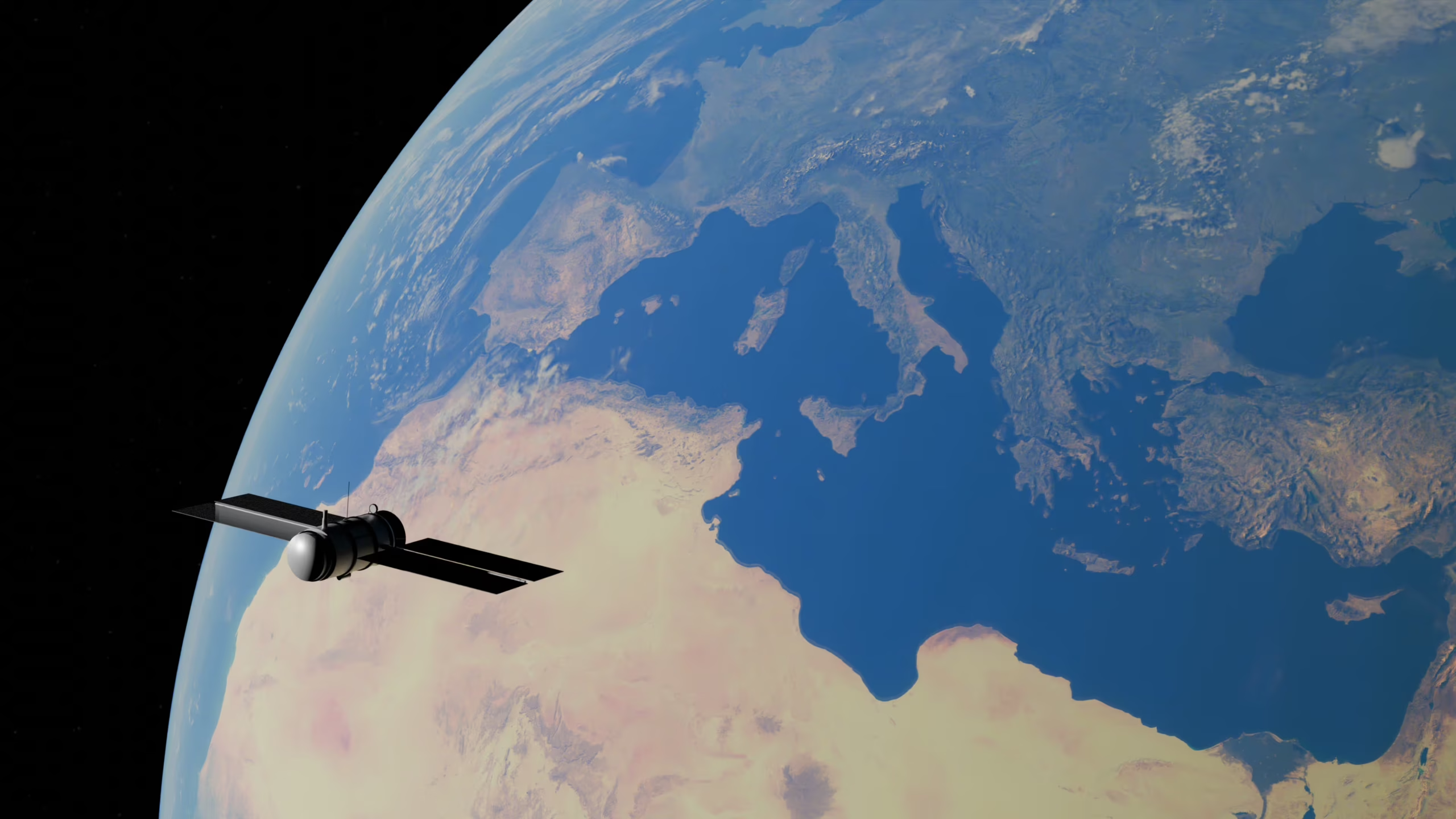
As of mid-2025, the Union of Concerned Scientists Satellite Database records more than 6,000 active Starlink satellites, making the constellation by far the largest operational satellite network in history and representing more than half of all active satellites in Earth orbit. The scale is not arbitrary engineering ambition — it follows directly from coverage geometry.
A single Starlink satellite at 550 kilometers altitude has a ground footprint — the area on Earth’s surface from which it is above the horizon — of roughly 1,000 kilometers radius. Continuous, seamless global coverage requires hundreds of satellites distributed across multiple orbital planes, timed so that as one satellite sets below the horizon, another rises to take its place. Each batch launch fills specific positional slots in that geometric web, and the mission designation tells engineers exactly which slots Starlink 17-52 is meant to occupy.
The FCC has authorized SpaceX to operate up to 12,000 Starlink satellites, and SpaceX has filed applications for a second-generation constellation of up to 30,000. The International Telecommunication Union is coordinating those applications alongside spectrum and orbital slot requests from other nations’ planned systems — a process of negotiating access to finite radio frequencies and orbital geometry on a global scale.
It is established scientific consensus that megaconstellations introduce new collision-risk dynamics in low Earth orbit. What remains actively debated among researchers at institutions including the Aerospace Corporation and ESA’s Space Debris Office is the precise long-term probability of collision cascades — the Kessler syndrome scenario in which debris from one collision triggers additional collisions — as constellation sizes approach the tens of thousands of satellites that multiple operators have filed to deploy. The Secure World Foundation’s 2024 Global Counterspace Capabilities report describes this as one of the defining unresolved governance questions in commercial space.
The Reusability Factor: What the Booster’s Return Reveals About Launch Economics
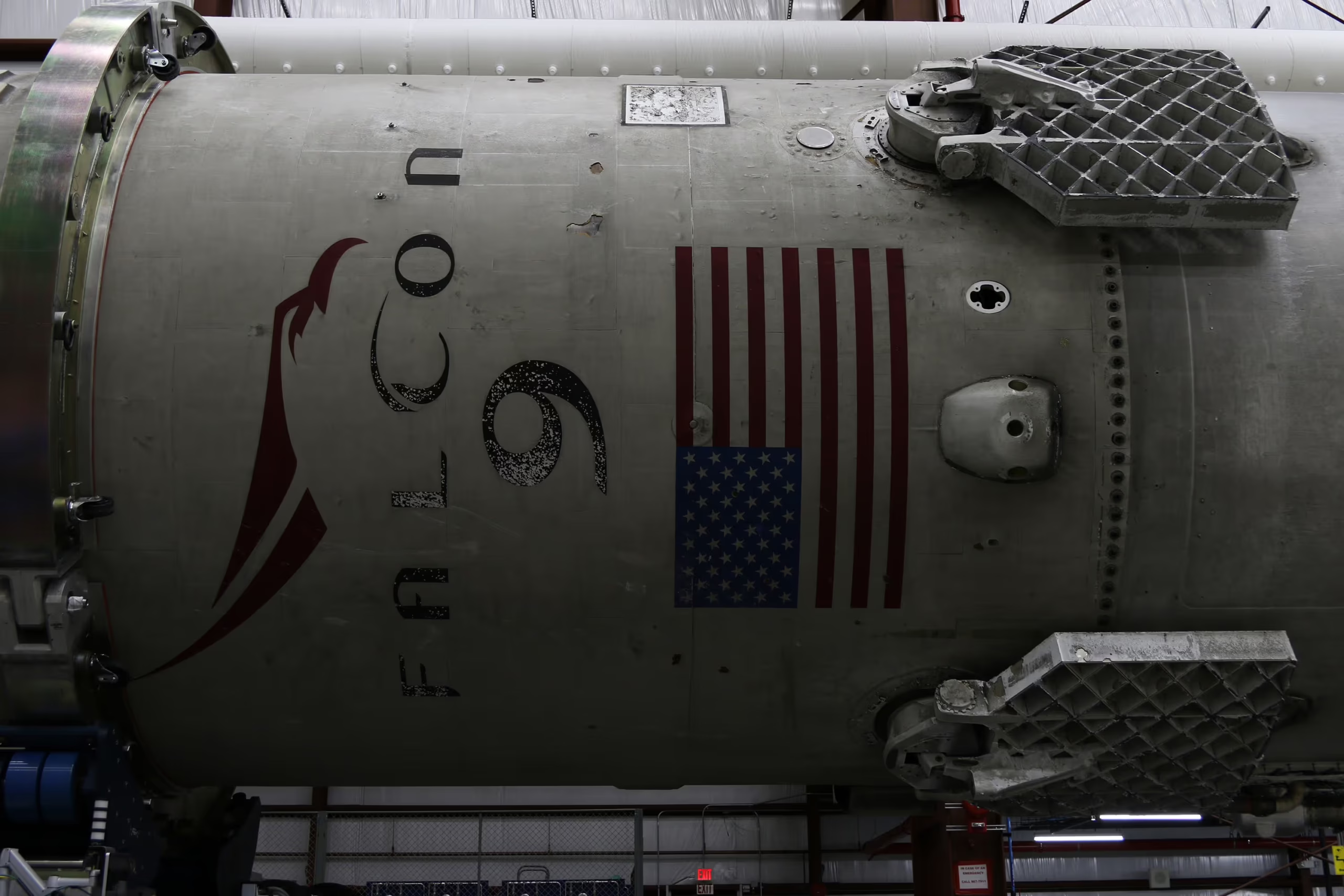
While the second stage completes satellite deployment, the Falcon 9 first stage is executing a separate mission entirely. Depending on the trajectory and payload mass, it either performs a boostback burn and returns to the launch site or continues downrange for a drone-ship landing at sea. Either way, the most expensive single component of the rocket is recovered rather than discarded.
The economic logic becomes clear once the numbers are considered. Falcon 9 first-stage boosters have flown more than 20 missions apiece on multiple airframes. Spreading the capital cost of a single booster across that many flights reduces the per-launch cost contribution of the first stage to a fraction of its manufacturing price, with only refurbishment and propellant costs added for each reuse. That cost structure is what makes the launch cadence that megaconstellation construction demands economically feasible — and it explains why SpaceX’s launch pace has accelerated markedly since 2020 rather than plateauing.
The Thursday morning launch that put Starlink 17-52’s 24 satellites in orbit followed a delay from an earlier window — a constraint that is structural, not incidental. Launch windows for high-inclination orbits are typically just minutes long, dictated by the intersection of Earth’s rotation and the target orbital plane. Miss the window and the geometry no longer aligns; the next opportunity is generally 24 hours away. At the cadence SpaceX is now operating, even a one-day slip ripples through a tightly packed manifest of subsequent missions.
With Starlink 17-52 adding 24 more nodes to a constellation already reshaping global connectivity, the nine-minute flight from Vandenberg’s SLC-4E is less a discrete event than a single iteration in an ongoing, algorithmically planned buildout. Researchers tracking orbital sustainability, radio astronomers defending sky access, regulators balancing spectrum equity, and the billions of people in underserved regions who might eventually connect through these satellites are all, in different ways, watching the same launch and asking fundamentally different questions about what it means.