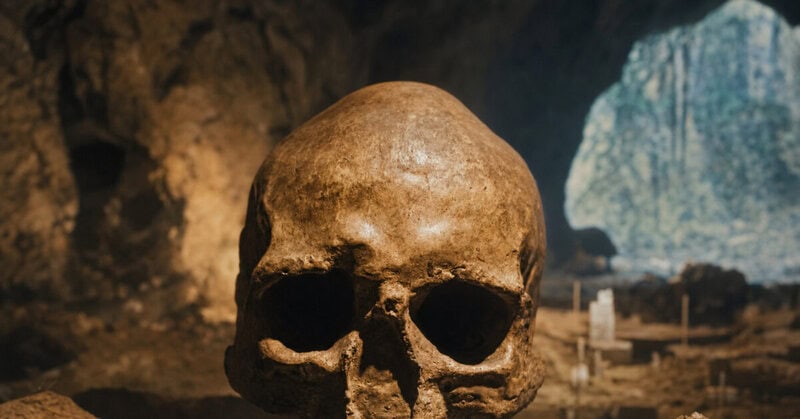
When researchers analyzed teeth recovered from two cave sites in southern China, they found something that rewrites one of paleoanthropology’s most settled timelines: Homo erectus — a species long thought to have vanished from mainland Asia before modern humans fully emerged — was still alive there between 324,000 and 184,000 years ago, roughly 100,000 to 200,000 years later than the scientific community had accepted. At the younger end of that window, our own species was already dispersing across continents.
A 200,000-Year Miscalculation
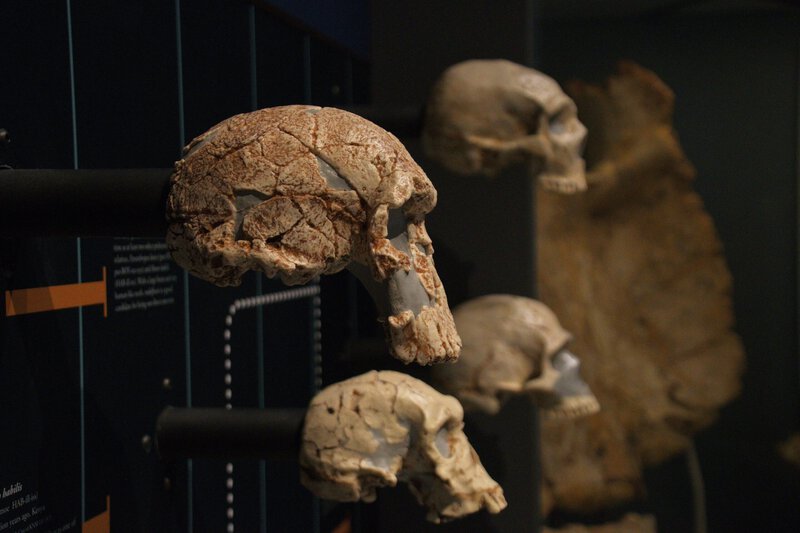
To appreciate what that correction means, consider the scale: 200,000 years is approximately the entire span of Homo sapiens‘ existence. The previous estimate of when Homo erectus disappeared from mainland Asia was not off by a rounding error — it was off by the equivalent of all of modern human history. New fossil evidence reported in a peer-reviewed study places the species’ survival in southern China within a firmly dated range of 324,000 to 184,000 years ago, a conclusion derived from modern dating techniques applied to dental remains recovered from the two cave sites.
This is not a minor revision to a footnote. It is a fundamental change to one of the most consequential timelines in the story of human evolution — one that reframes how long different human species shared the planet, and whether the story of our own origins was quite as solitary as the textbooks have suggested.
Who Was Homo Erectus?

Homo erectus, Latin for “upright man,” was a hominin species that first appeared in Africa roughly 2 million years ago. It became the first known human relative to leave Africa and spread across Asia and into parts of Europe, leaving fossils from the Georgian Caucasus to the Indonesian island of Java. According to the Natural History Museum, fossil evidence for the species spans more than 1.5 million years, making Homo erectus the longest-surviving hominin species in the scientific record. By comparison, Homo sapiens has existed for only around 300,000 years.
Paleoanthropology has long credited Homo erectus with capabilities that mark it as far more than a simple evolutionary stepping stone. Its brain was roughly two-thirds the size of a modern human’s. It manufactured stone tools with consistent technique. It is widely believed to have been capable of controlling fire. These are not the attributes of a marginal species clinging to existence; they are the hallmarks of a cognitively flexible animal that dominated large parts of the planet for an extraordinary duration.
The Evidence: What Two Caves in Southern China Revealed
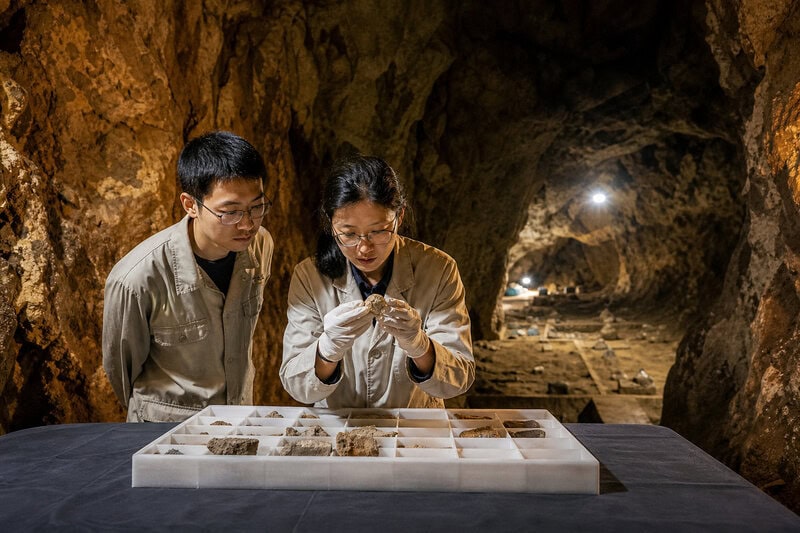
The revised survival dates rest on dental remains recovered from the two cave sites and subjected to radiometric and electron spin resonance dating methods. These techniques allow researchers to establish precise age ranges for hominin remains with considerably greater accuracy than older approaches permitted, and the peer-reviewed conclusion places the fossils firmly within the 324,000-to-184,000-year window.
Teeth are among the most valuable materials in the ancient fossil record for a straightforward reason: dental enamel is one of the hardest biological substances produced by any vertebrate, and it preserves far longer than bone under most burial conditions. This makes teeth disproportionately common in hominin fossil assemblages and disproportionately reliable for dating. When researchers recover teeth from a sealed cave context, they are working with some of the best raw material the fossil record can offer.
What made the southern China sites additionally significant was their environment. The caves were situated within what would have been dense tropical rainforest — a habitat starkly different from the open grasslands and savanna environments most commonly associated with early Homo erectus populations in Africa and East Asia.
Survival in the Rainforest: Why the Location Changes the Picture

Dense closed-canopy rainforest is an ecologically demanding environment. Food resources are distributed differently than on open grassland, navigation is more complex, and the foraging strategies that work on a savanna do not translate directly to a tropical forest understory. The presence of Homo erectus in this habitat — and not merely its presence, but its persistence there well into the period when anatomically modern humans were expanding across other parts of the world — suggests a degree of ecological adaptability that the older scientific consensus did not fully credit the species with.
National Geographic has reported that the rainforest survival evidence challenges the assumption that late Homo erectus populations in Asia had retreated or collapsed long before this period. Island Southeast Asia — most notably Java — had long been considered the primary last refuge for late-surviving members of the species. The new Chinese evidence suggests the mainland was also harboring the species far later than the fossil record had previously indicated, extending the known range of its final chapter both geographically and temporally.
This finding adds to a broader pattern of paleoanthropological revisions emerging from East and Southeast Asia. The region has become increasingly central to understanding late hominin diversity, repeatedly producing evidence that pushes back assumed extinction dates and expands assumed ranges. Southern China, in particular, is demonstrating that it holds a great deal of evolutionary history that earlier, less comprehensive sampling had missed.
What the Timeline Actually Shows — and What It Does Not
Some coverage of this discovery has drawn a vivid comparison: that Homo erectus was alive in China at roughly the same time our own species was creating cave paintings in Europe. That framing requires careful handling. The earliest securely dated cave art in Europe falls in the range of roughly 40,000 to 65,000 years ago. The younger boundary of the new Homo erectus survival date is 184,000 years ago. Those two figures do not overlap; there is no claim that a Homo erectus individual in China and a Homo sapiens artist in France were alive at the same moment.
What the new dates legitimately establish is something more precise and no less significant. Researchers at Macquarie University involved in the analysis have emphasized that the southern China dates place Homo erectus survival well into the period when anatomically modern humans had already dispersed out of Africa — a period once assumed to belong exclusively to our species on the broader Asian mainland. The timeline of hominin diversity was more crowded, and more recent, than the standard account allowed. That is the legitimate and significant point.
Whether Homo erectus and Homo sapiens ever encountered each other in Asia remains an open and actively debated scientific question. No confirmed evidence of direct interaction has been established. Ancient DNA analysis has demonstrated that Homo sapiens interbred with Neanderthals and Denisovans; whether any genetic exchange occurred with late-surviving Homo erectus populations is unknown, in part because no ancient DNA has yet been successfully recovered from Homo erectus fossils — the species predates the current limits of ancient genomics.
How This Changes the Story of Human Evolution
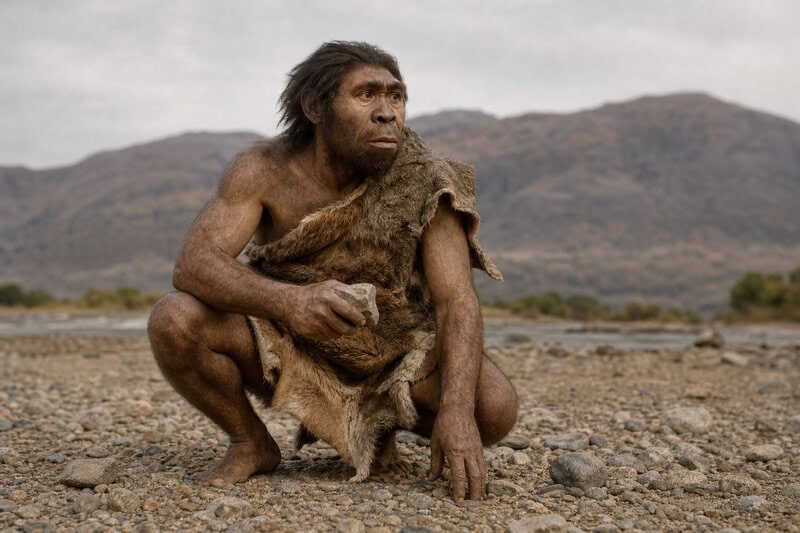
The traditional replacement model of human evolution holds that Homo sapiens spread out of Africa and, through a combination of competition and demographic expansion, replaced all other hominin species within a geologically short period. That model has been under sustained pressure for years, and the southern China evidence adds to the case against its simplest version. Homo erectus now joins Homo floresiensis — the small-bodied species of Flores island, which survived until roughly 50,000 years ago — and the Denisovans as documented examples of hominin lineages that endured into what was once considered exclusively modern human time.
The emerging picture is one of a world that was, for a surprisingly long stretch of deep history, home to multiple human species simultaneously. Some of those species interacted genetically, as the DNA record confirms for Neanderthals and Denisovans. Others may have persisted in isolated refugia — islands, rainforests, remote valleys — without ever making direct contact with expanding Homo sapiens populations. The late survival of Homo erectus in China is now supported by peer-reviewed evidence, but its full implications for hominin interaction and population dynamics are actively under investigation and should not be overstated pending further finds.
Nearly 2 Million Years: The Most Durable Human on Record
Homo erectus survived for nearly 2 million years in total — a tenure that dwarfs every other species in the hominin family tree. Its run from roughly 2 million years ago to at least 184,000 years ago spans multiple Ice Ages and the entire evolutionary radiation that produced Neanderthals, Denisovans, Homo floresiensis, and ultimately Homo sapiens itself. That the species persisted through all of it — across Africa, Europe, and Asia, in grasslands and now demonstrably in tropical rainforests — reflects genuine biological resilience, not a statistical accident of the fossil record.
The southern China teeth are the latest evidence that our picture of early human life is still being actively redrawn with each new excavation and each refinement of dating technology. The discovery does not simply shift a date on a timeline. It deepens the case that human evolution was a long, overlapping, and geographically complex process — one populated by multiple lineages persisting across vast stretches of time, and one that our species did not simply inherit by default when everyone else conveniently disappeared.