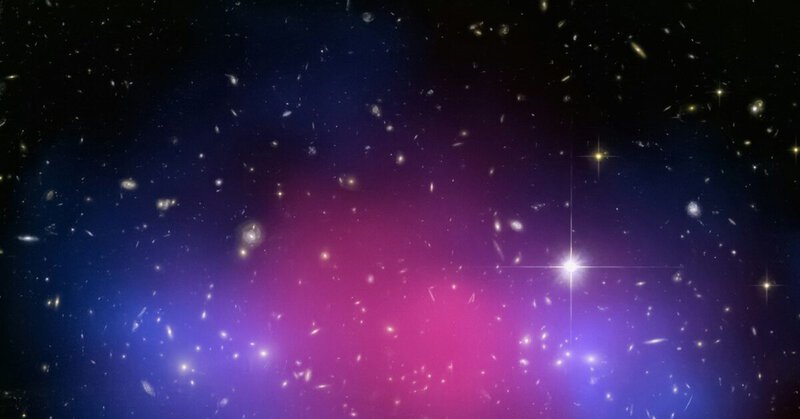
While scanning billions of distant galaxies for invisible dark matter, ESA’s Euclid space telescope spotted something far closer to home: a previously unknown comet drifting through our own solar neighborhood — an object the observatory had no instruments, protocols, or mission mandate to find.
What Is Dark Matter — and Why Build a Telescope to Chase It?
To understand why the comet discovery is so surprising, it helps to understand what Euclid was actually built to do. Dark matter is the invisible substance thought to make up roughly 27 percent of the universe’s total mass-energy content, according to the European Space Agency. It cannot be seen directly — it emits no light, reflects none, and absorbs none — but its gravitational fingerprints are unmistakable. Galaxies spin too fast for their visible mass alone to hold them together. Light bends too sharply as it passes around galaxy clusters. The vast web of cosmic structure — the filaments and voids that give the universe its large-scale shape — only makes mathematical sense if enormous quantities of unseen mass exist and exert gravitational influence across billions of light-years.
Yet for all the indirect evidence pointing to dark matter’s existence, no particle detector has ever directly confirmed a dark matter particle. Scientists have proposed a range of candidates — WIMPs (Weakly Interacting Massive Particles), axions, sterile neutrinos — but none has been definitively detected. That dark matter exists in some form represents the dominant scientific consensus; what it actually is remains one of the most actively debated questions in all of physics.
Euclid was designed to attack this problem from a cosmological angle. Rather than hunting individual particles, the telescope maps the shapes and positions of billions of galaxies spread across roughly 10 billion light-years of cosmic history. By measuring subtle distortions in those galaxy shapes — a technique called weak gravitational lensing, in which the gravity of dark matter bends light from background galaxies in characteristic ways — Euclid can chart where dark matter clumps, how it has evolved over time, and how it has influenced the universe’s large-scale architecture. It is, in essence, a dark matter cartographer, drawing maps of something that cannot be directly photographed.
How Euclid Works: A Survey Machine Built for Galaxies
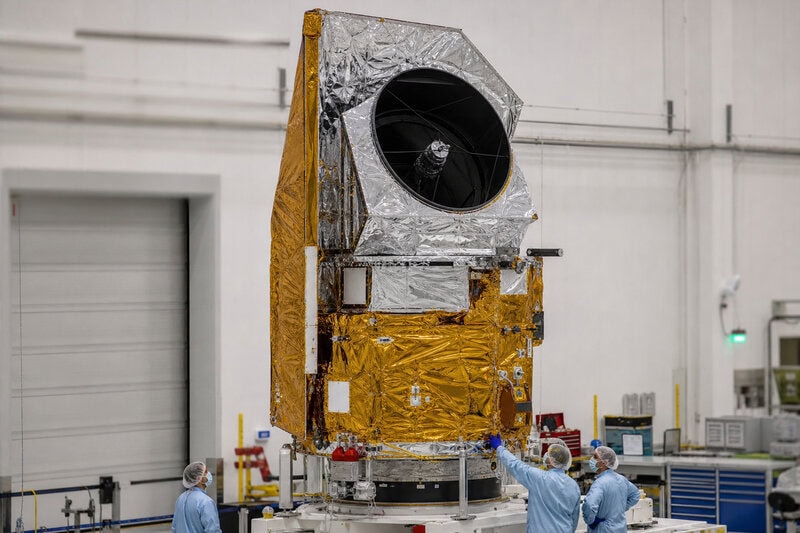
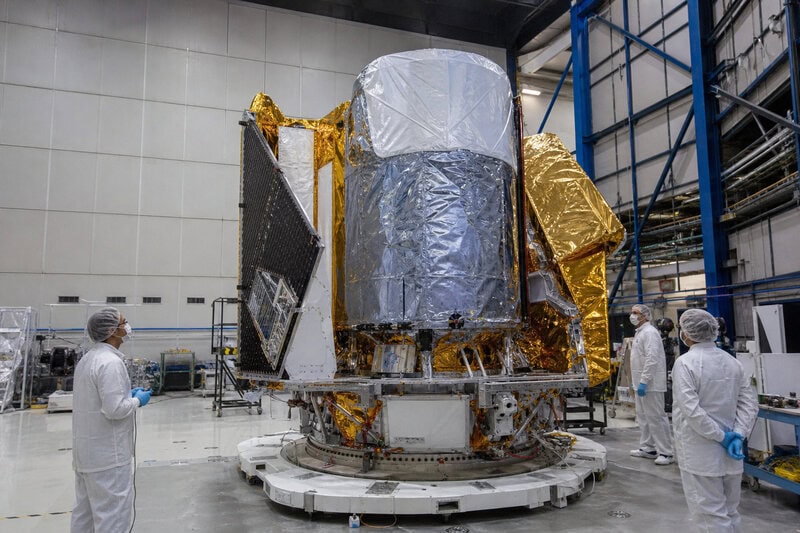
Euclid carries two primary instruments: a visible-light camera and a near-infrared spectrometer-photometer. Both are optimized for detecting the faint, static shapes of distant galaxies. ESA launched the telescope in July 2023, placing it in an orbit around the Sun-Earth L2 Lagrange point, approximately 1.5 million kilometers from Earth — a stable gravitational position that provides unobstructed, deep views of the cosmos.
The telescope’s survey strategy is built for statistical power, not precision tracking of individual moving objects. Euclid photographs enormous swaths of sky in rapid sequence, building up a mosaic of billions of galaxy images whose subtle shape distortions can be statistically analyzed to reveal dark matter’s gravitational influence. This cadence — wide-field imaging optimized for faint, distant, and essentially stationary targets — is almost the opposite of what astronomers use to detect comets, asteroids, and other solar system objects, which require time-resolved observations to distinguish their motion against the background of fixed stars.
Because solar system science was never part of Euclid’s design brief, the mission launched without a dedicated data pipeline for flagging or following up on moving objects. There was no automated system hunting for the characteristic streaks or positional shifts that betray a comet or asteroid crossing the field of view. That absence makes what happened next all the more striking.
The Unexpected Discovery: A Comet Hidden in the Survey Data

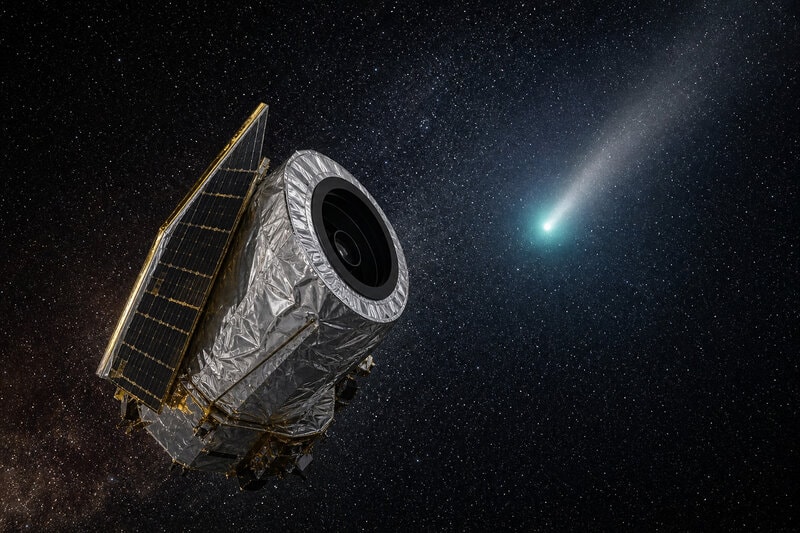
During its primary survey mission, Euclid captured image data containing a previously unknown comet — an object that appeared as an anomalous feature inconsistent with the static background of distant galaxies the telescope was cataloguing. ESA confirmed the detection, marking the first time Euclid had identified such an object. The find was entirely outside the scope of the mission’s scientific objectives and operational planning.
ESA’s Euclid telescope discovered the comet while conducting routine survey observations, according to reporting on the discovery. Because the find is recent and still emerging, full peer-reviewed characterization of the comet’s orbit, composition, and origin remains forthcoming. What is confirmed: a previously unknown comet was detected by a telescope that was not looking for one, using instruments not designed to find one, through a data pipeline that had no formal mechanism to flag one. What remains uncertain: the comet’s precise orbital classification, its family of origin, its physical properties, and whether Euclid will detect additional solar system objects as its survey continues.
For a sense of just how surprising this kind of find is, this short video captures Euclid accidentally detecting a comet while conducting its dark matter survey — a collision of cosmic scales, from the largest structures in the universe down to a single icy wanderer in our own backyard.
Why Serendipitous Discoveries Matter in Big Science
The history of astronomy is, in significant part, a history of finding things nobody was looking for. Pulsars — the rapidly rotating neutron stars that now serve as precision cosmic clocks — were discovered by radio astronomers hunting for quasars. The Hubble Space Telescope, launched primarily to resolve debates about the universe’s expansion rate, went on to transform our understanding of galaxy formation, supermassive black holes, and the age of the cosmos. Cosmic microwave background radiation, the faint afterglow of the Big Bang, was first detected by engineers troubleshooting what they believed was interference in a ground-based antenna.
Large survey missions are particularly fertile ground for serendipity because they generate enormous data volumes that inherently contain information across multiple scientific domains. A telescope mapping dark matter will, as a direct consequence of photographing large portions of the sky, also photograph asteroids, comets, supernovae, and transient events of every kind. The question is whether mission planners build the infrastructure to recognize and act on those accidental observations.
Euclid’s comet find raises exactly that practical question: should future versions of the survey pipeline include automated flagging systems for moving solar system objects? Doing so would transform an accidental capability into a formal secondary science stream, potentially making Euclid a contributor to planetary defense research, cometary science, and solar system population surveys — none of which appeared in the original mission agenda. The economics are compelling. Unexpected discoveries add scientific return on investment to missions that are already expensive to design, launch, and operate, reinforcing the case for wide-field survey architectures that cast a wide net even when the stated target is narrowly defined.
What This Means for the Dark Matter Hunt — and What Comes Next
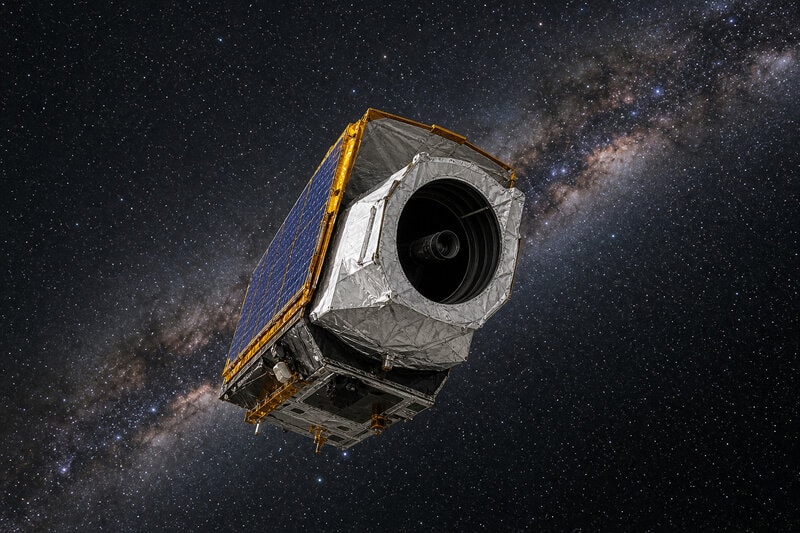
The comet discovery does not affect Euclid’s primary mission. The telescope continues its planned six-year survey, and ESA has indicated that core science objectives remain on track. Euclid’s cosmological results — expected to refine measurements of the universe’s large-scale structure, test competing models of dark energy, and constrain the properties of dark matter — will emerge from scheduled data releases, with the full dataset projected to reshape precision cosmology over the coming decade.
The surprise find is better understood as an illustration of Euclid’s scientific breadth than as a distraction from its headline goals. The same sensitivity and sky coverage that make the telescope a powerful dark matter cartographer also make it an inadvertent observer of phenomena across vastly different physical scales. That duality has historically made large space observatories among the highest-value scientific investments, delivering returns that extend well beyond their original design envelopes.
What remains genuinely unknown is extensive: how many additional serendipitous discoveries Euclid may make over its remaining mission lifetime; whether this particular comet has physical properties of special scientific interest; and, most fundamentally, whether dark matter will ultimately yield to any current or planned detection strategy. For anyone tracking the dark matter search, the honest summary is that the effort is active, the tools are unprecedented, and the field remains more defined by open questions than by settled answers.
The Bigger Picture: Science at the Edge of What We Know
There is a certain symmetry in Euclid’s situation. Dark matter was itself first identified through anomalies — galaxy rotation curves that did not add up, gravitational lensing stronger than visible mass could explain, structure formation that required invoking invisible mass to make sense. Nobody set out to discover dark matter; they set out to understand something else, and dark matter was what the data demanded. Now a telescope built to study that mystery is generating its own category of unexpected findings, a reminder that the universe does not organize itself around human research priorities.
The most productive scientific instruments have always had this quality: they reveal as much about what researchers were not looking for as about what they were. Euclid has already demonstrated, in its earliest operational phase, that even a narrowly focused mission can produce results across multiple scientific fields simultaneously. The comet discovered in its survey data is a small but telling data point in a longer story — one whose most significant chapter may turn out to be a finding that nobody has yet thought to predict.