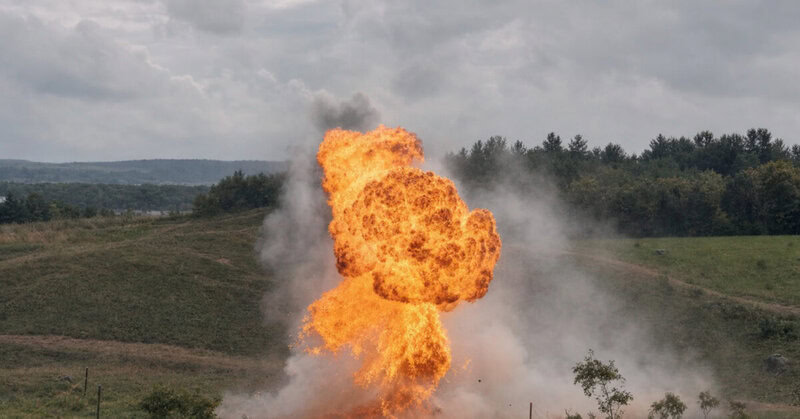
Five tons of degraded lead azide — a primary explosive sensitive enough to detonate from little more than friction or a sharp shock — sat in sealed barrels inside two fortified magazines at the Iowa Army Ammunition Plant in Middletown, Iowa, waiting for a planned Wednesday-morning detonation. To monitor what that controlled blast would release into the surrounding air and landscape, the federal government called in NASA: three research aircraft and an orbiting satellite instrument normally used to track pollution drifting across entire continents.
What Is Lead Azide, and Why Does “Degraded” Make It Especially Dangerous?
Lead azide — chemical formula Pb(N₃)₂ — belongs to a class called primary explosives. Unlike more familiar secondary explosives such as TNT, which require a separate initiating device to detonate, primary explosives are sensitive enough to fire from heat, friction, or mechanical shock alone. That extreme sensitivity is precisely why lead azide is used as the initiating charge inside detonators and blasting caps worldwide: a tiny amount sets off a much larger, more stable explosive train.
The word “degraded” sharpens the hazard considerably. The U.S. Army defines degraded primary explosives as materials whose chemical or physical breakdown has rendered their sensitivity profile unpredictable. In lead azide, degradation can alter crystal structure and produce lead-rich decomposition byproducts, both of which can increase mechanical sensitivity — meaning the threshold between safe handling and accidental detonation narrows in ways that are difficult to characterize precisely. Transporting five tons of such material along public roads or rail lines would carry risks that explosive-ordnance protocols consider unacceptable. Controlled, in-place detonation inside a secured facility, surrounded by purpose-built containment barriers, is therefore regarded as the safer disposal pathway.
According to reporting on the Army’s disposal plans, the lead azide was stored in barrels placed inside two explosive magazines at the Iowa Army Ammunition Plant, surrounded by blast-containment barriers that crews constructed over the summer specifically to direct the detonation’s energy and limit debris scatter. The Wednesday morning timing also reflects standard explosive-disposal practice: stable daytime atmospheric conditions generally produce more predictable vertical mixing of combustion plumes, aiding both safety planning and air-quality monitoring.
The Iowa Army Ammunition Plant: Built for Exactly This Problem
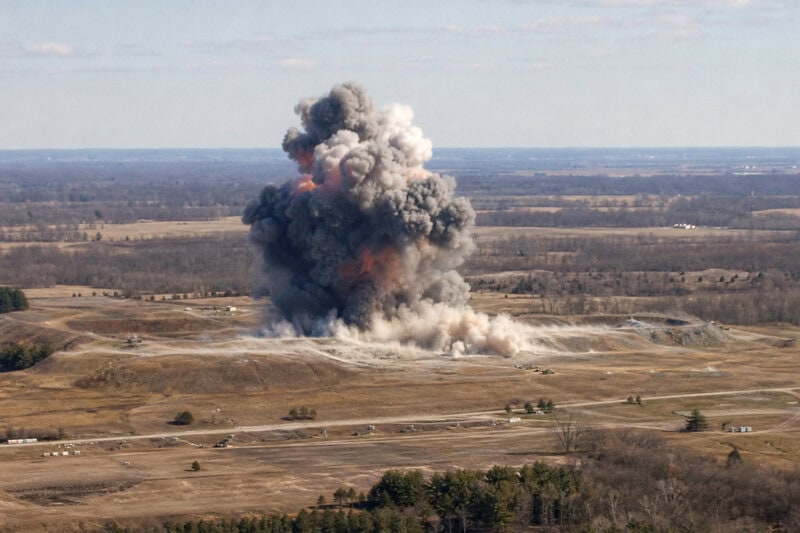
The Iowa Army Ammunition Plant (IAAAP) in Middletown, Iowa, is a government-owned, contractor-operated installation with a history of manufacturing and demilitarizing conventional munitions stretching back to World War II. Controlled detonations at IAAAP are conducted under permits coordinated with state and federal environmental agencies, which set thresholds for allowable air and soil contamination before, during, and after a disposal event.
The scale of the federal aerial response to this particular event signals how seriously agencies treat the airborne aftermath of a large-scale primary-explosive disposal, even a carefully controlled one. NASA’s involvement is not routine; it reflects a judgment that the combustion products from five tons of lead azide warrant the kind of high-fidelity atmospheric surveillance that only research-grade aircraft and satellite sensors can provide. Farmers and residents near the plant have raised concerns about what the blast might release into the agricultural landscape surrounding the facility, underscoring the public-health stakes that make independent monitoring valuable.
NASA’s Three Aircraft: A Layered Sampling Strategy

NASA deployed three distinct research platforms, each contributing a different layer of atmospheric data.
- P-3 Orion: A four-engine turboprop originally designed for maritime patrol, the P-3 is NASA’s primary atmospheric-chemistry workhorse. It can carry heavy instrument payloads at low altitudes for extended periods, making it well suited for direct, in-situ sampling of smoke and particulate plumes — flying through the actual cloud of combustion products to measure their chemical composition in real time.
- Gulfstream III (NASA Langley Research Center): Operating at higher altitudes than the P-3, the Gulfstream III carries remote-sensing instruments that measure trace gases and aerosol optical depth — a measure of how much sunlight airborne particles absorb or scatter. This standoff perspective allows scientists to characterize plume composition across a wider spatial footprint without flying directly through the densest part of the cloud.
- B200 King Air: The smallest and most agile of the three platforms, the B200 is frequently used by NASA for lidar (light detection and ranging) profiling. Lidar works by bouncing laser pulses off airborne particles and measuring the return signal, allowing scientists to map the vertical structure of a plume in three dimensions — essentially producing a cross-sectional image of how high and how deep the combustion cloud extends.
Together, the three aircraft create a complementary sampling architecture: low-altitude in-situ chemical sampling, mid-to-high-altitude remote sensing, and three-dimensional structural plume mapping. NASA deployed these research aircraft to collect environmental data for the federal response, with the combined dataset feeding directly into public-health advisories for surrounding communities.
TEMPO: The Satellite Eye Overhead
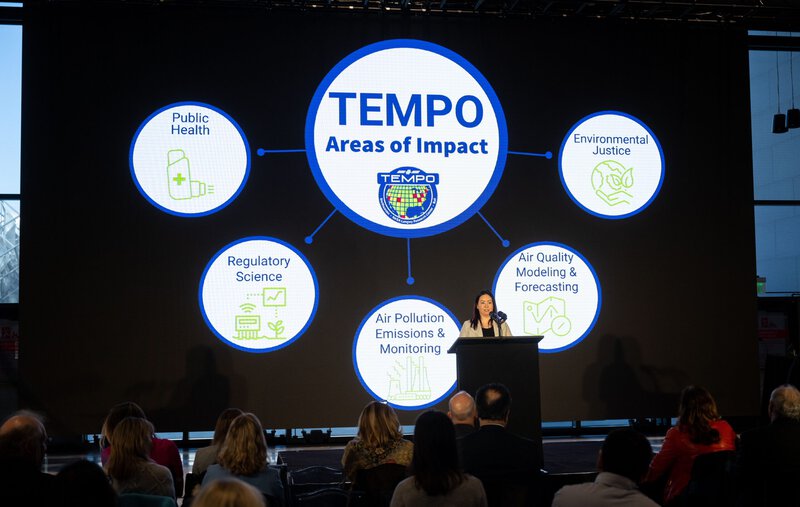
Complementing the aircraft is TEMPO — the Tropospheric Emissions: Monitoring of Pollution instrument — a geostationary satellite sensor that NASA describes as providing the first hourly, high-resolution air-quality maps across North America from space. Geostationary means TEMPO orbits at the same rate Earth rotates, keeping it fixed over the same portion of the continent rather than passing overhead once per day like older polar-orbiting satellites.
TEMPO measures concentrations of nitrogen dioxide, ozone precursors, formaldehyde, and other pollutants by detecting the specific wavelengths of sunlight they absorb — a technique called differential optical absorption spectroscopy, or DOAS. That hourly revisit capability is critical for following a detonation plume as shifting winds carry it across Iowa’s agricultural landscape, allowing regulators to watch the event unfold in something close to real time rather than reconstructing it after the fact from a single daily snapshot.
Data from TEMPO can be cross-validated against the aircraft measurements in near-real time, giving federal and state agencies an unprecedented pairing of wide-area satellite surveillance with ground-truth chemical sampling for a single disposal event. NASA’s agency leadership has emphasized the measured, science-driven nature of the monitoring effort, pushing back on comparisons to large-scale nuclear or industrial disasters while acknowledging that rigorous data collection is warranted.
What the Sensors Are Actually Looking For
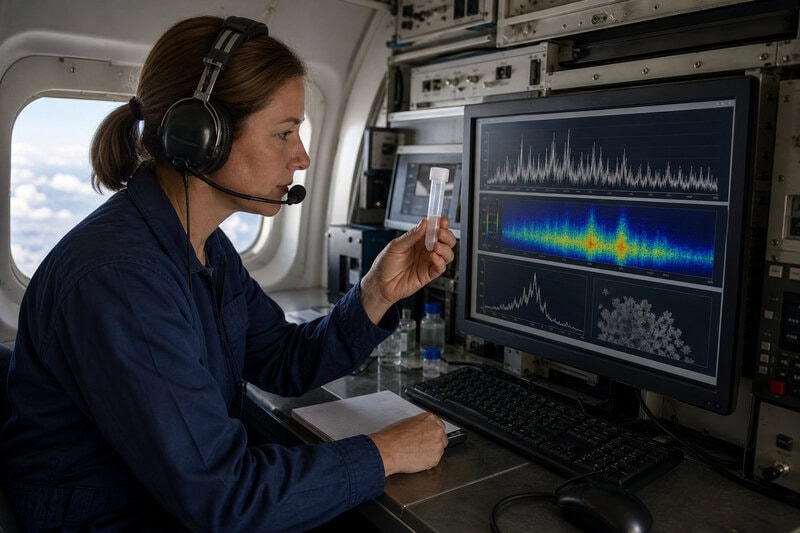
The combustion chemistry of lead azide disposal produces several categories of concern for public health and environmental regulators.
Lead particulates. Detonating lead azide releases lead into the air. Lead is a neurotoxin for which the U.S. Centers for Disease Control and Prevention has identified no safe level of exposure, particularly in children. The quantity and particle-size distribution of lead released — and how far wind carries those particles before they settle onto soil and crops — are primary questions NASA’s instruments are designed to answer.
Nitrogen oxides. As the azide anion (N₃⁻) rapidly oxidizes during detonation, it produces nitrogen oxides, commonly written NOₓ. Nitrogen oxides are regulated under the Clean Air Act as precursors to ground-level ozone and fine particulate matter, and elevated concentrations can irritate the respiratory system even at distances well removed from the detonation site.
Fine particulate matter and combustion byproducts. Combustion of the storage barrels, any organic packaging material, and secondary reaction products can generate fine particulate matter smaller than 2.5 micrometers in diameter — known as PM2.5 — along with carbon monoxide and volatile organic compounds (VOCs). PM2.5 is particularly concerning because particles at that size penetrate deep into lung tissue and are linked to cardiovascular as well as respiratory harm.
NASA’s aircraft carry instruments specifically designed to distinguish these compounds from background atmospheric chemistry. Aerosol mass spectrometers can identify the chemical fingerprint of lead-bearing particles against ordinary dust, while chemiluminescence NOₓ analyzers quantify nitrogen oxide concentrations with high precision.
A key variable scientists will assess is completeness of combustion. A full detonation converts most of the lead azide’s nitrogen to N₂ gas, which is inert and makes up roughly 78 percent of Earth’s atmosphere. Incomplete combustion leaves reactive nitrogen compounds and potentially unburned lead azide residue in the soil and air — a significantly worse environmental outcome that the multi-aircraft dataset is well positioned to detect.
The Chernobyl Comparison and What It Gets Wrong
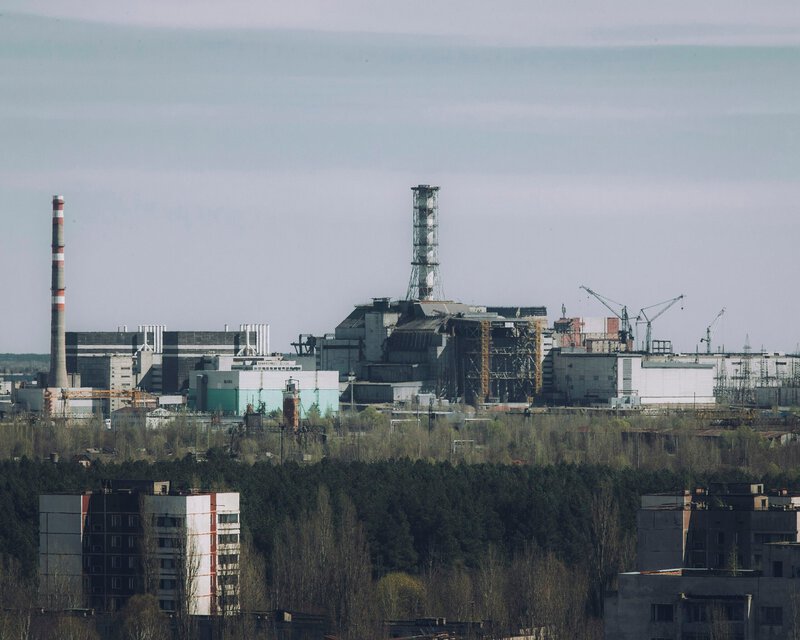
Some public commentary has compared the Iowa detonation to large-scale nuclear or industrial catastrophes. NASA’s leadership has called such comparisons irresponsible, and the underlying chemistry supports that assessment. Lead azide is a conventional chemical explosive; it produces no radioactive fallout, no nuclear chain reaction, and no dioxin-generating combustion of chlorinated compounds. The genuine hazards — localized lead contamination and nitrogen oxide emissions — are real and warrant serious monitoring, but they are bounded in geographic scale and amenable to standard remediation methods in ways that nuclear accidents are not. Accurate public communication about what the blast actually releases is itself part of what the NASA monitoring mission is designed to enable.
Why This Mission Matters Beyond One Iowa Field
The U.S. military manages large inventories of aging primary and secondary explosives at facilities across the country. Decisions about how to dispose of degraded stocks — and how to monitor the environmental consequences of that disposal — have implications for communities living near ammunition plants from coast to coast.
The Iowa event is being watched as a potential template for how federal agencies can deploy NASA’s airborne and satellite assets to provide real-time environmental accountability during large-scale disposal operations. NASA’s involvement reflects a broader interagency framework in which the agency’s Earth-science capabilities — originally built for climate and atmospheric research — are increasingly applied to acute environmental events, from wildfire smoke tracking to industrial chemical emergencies.
The combined aircraft-and-satellite dataset from Middletown will be preserved for scientific review, with the potential to inform EPA risk models for future lead azide disposal events and help regulators set more precise public-notification radii based on observed plume behavior rather than conservative worst-case estimates alone. For communities near demilitarization sites across the country, the Iowa mission demonstrates that high-fidelity environmental monitoring of controlled detonations is technically achievable — a finding that could meaningfully strengthen public trust in what has historically been an opaque disposal process.