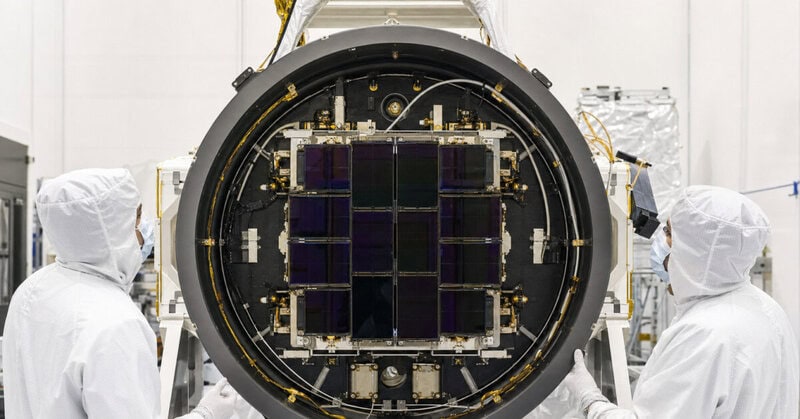
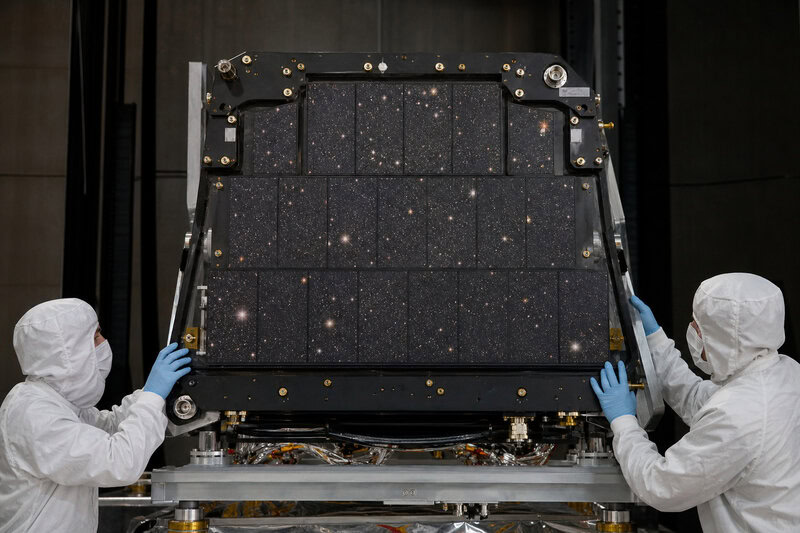
NASA’s Nancy Grace Roman Space Telescope has completed a critical synchronization milestone, bringing all 18 detectors of its primary camera into unified alignment so they lock onto guide stars simultaneously — a direct prerequisite for science-grade observations at the scale the observatory was designed to deliver. A single Roman image will cover a patch of sky roughly 100 times larger than anything the Hubble Space Telescope could capture in one shot. That promise is now measurably closer to reality.
One Camera, 18 Detectors, and a View Hubble Was Never Built to Match

The Wide Field Instrument (WFI), Roman’s primary science camera, packs 300.8 megapixels across 18 detectors, producing a combined field of view of approximately 0.28 square degrees. For comparison, Hubble’s field of view covers roughly 11 square arcminutes. The practical consequence is not marginal: surveys requiring Hubble years of continuous observing can, in principle, be completed by Roman in hours. That is a categorical difference in what a space observatory can accomplish within a finite mission lifetime.
Roman carries two headline instruments. The Wide Field Instrument is the mission’s workhorse — a 300.8-megapixel camera built for multiband imaging and spectroscopy across enormous swaths of sky. The Coronagraph Instrument is a technology demonstrator with a narrower but no less significant purpose: suppressing the blinding glare of individual stars so the telescope can detect far dimmer objects in their immediate vicinity, including orbiting planets and circumstellar dust disks.
The synchronization milestone moves the Nancy Grace Roman Space Telescope from an engineering integration project into an almost-operational observatory. Each achievement in this phase brings the mission incrementally closer to a launch that the scientific community has anticipated since the observatory was first recommended as a top priority in NASA’s Astro2010 decadal survey.
What ‘Getting in Sync’ Actually Means — and Why It’s Hard
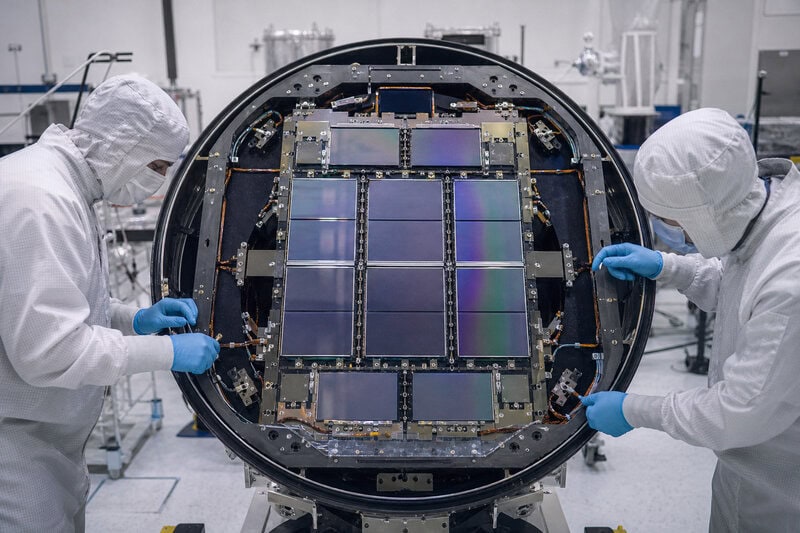
The synchronization challenge is conceptually straightforward but technically demanding. Each of the WFI’s 18 detectors sees a slightly different slice of sky. For them to function as a single continuous focal plane — the configuration required for science — they must be calibrated to behave identically and simultaneously. Any misalignment at the seams between detectors would smear or duplicate data, corrupting the seamless mosaics that Roman’s survey programs depend on.
Guide-star locking adds another layer of complexity. Space telescopes stabilize their pointing by tracking bright reference stars; the control system uses those stars as fixed anchors against which any drift is measured and corrected. For a mosaic detector array spanning 18 chips, every detector must agree on the same positional solution at the same moment. That demands precise timing and sophisticated software coordination across the entire focal plane simultaneously — not a trivial engineering achievement.
This milestone is distinct from earlier hardware tests, which verified individual detectors in isolation. The synchronization step confirms that all 18 detectors perform as an integrated 300.8-megapixel system — the actual configuration that will collect data in orbit. Without that coherence, Roman’s core science programs are simply not executable. The WFI must function as one instrument, not 18 independent cameras operating in parallel.
The Coronagraph Opens Its Eyes — a Separate but Historic First
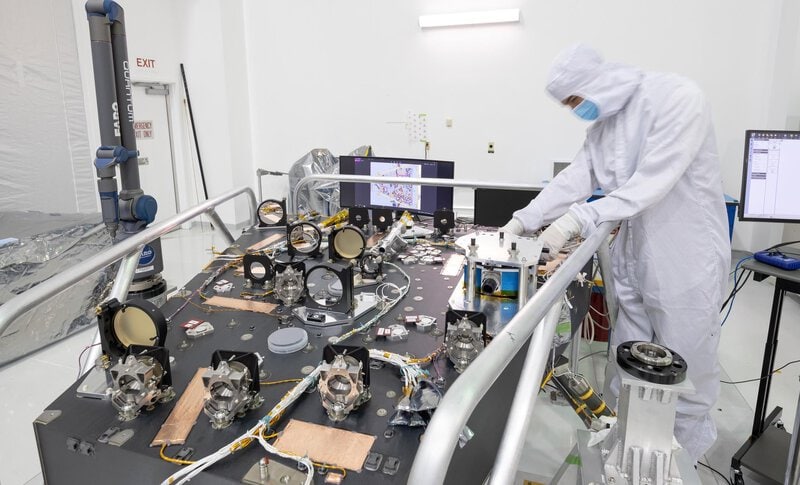
On September 22, the Roman Space Telescope’s Coronagraph Instrument opened its eyes to cosmic light for the first time, marking the instrument’s functional debut. The event was confirmed by researchers involved in the mission and reported by Caltech, one of the institutions contributing to Roman’s science program.
A coronagraph works by blocking the overwhelming glare of a star — analogous to holding your hand in front of the sun to see the surrounding sky — allowing a telescope to detect far dimmer objects in close proximity. Without that suppression, starlight drowns out anything orbiting nearby, including planets many orders of magnitude fainter.
NASA designates the Coronagraph as a technology demonstrator rather than a primary science instrument. Its principal goal is to validate new starlight-suppression techniques in the actual environment of space, where thermal stability and mechanical vibration differ meaningfully from laboratory conditions. Success in that role could directly inform the design of future missions dedicated to imaging Earth-like exoplanets. One important qualifier applies: the instrument has opened its eyes to cosmic light, but a full evaluation of its performance against design specifications is ongoing. That functional debut is not the same as a confirmed achievement of final performance targets — a distinction worth preserving as the mission matures.
Roman vs. Hubble: Scale, Speed, and What the Comparison Actually Means
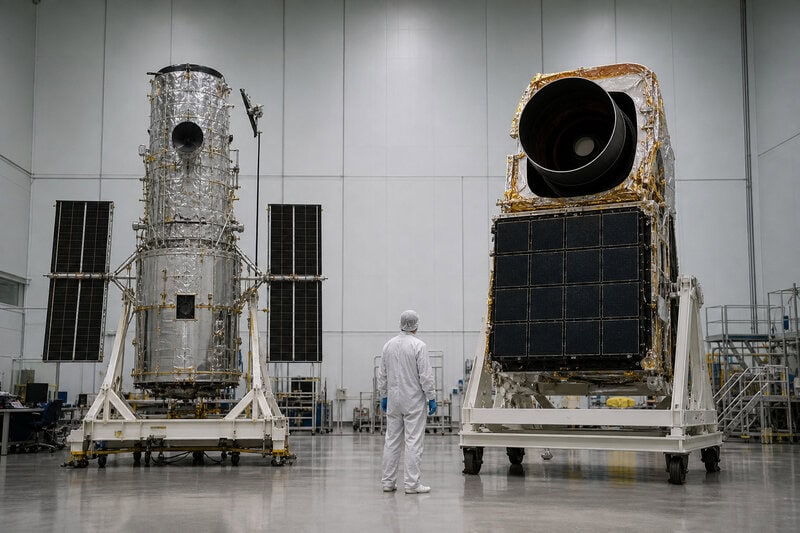
The Roman-versus-Hubble comparison is frequently cited and genuinely illuminating, but it deserves careful framing. The 100-times-larger field of view reflects a difference in mission design philosophy, not a declaration that Roman is a superior telescope in every dimension. Hubble was built for deep, narrow imaging of individual targets — a capability that produced some of the most scientifically productive observations in the history of astronomy. Roman is optimized for wide-area statistical surveys of billions of objects. The two approaches serve complementary science goals, and the astronomical community expects to use both in concert.
What Roman inherits from Hubble is significant: a 2.4-meter primary mirror of comparable diameter and resolution comparable to Hubble’s in infrared wavelengths. Roman produces sharp images. It simply spreads that sharpness across a vastly wider canvas. The practical result is that Roman can observe billions of galaxies over its mission lifetime — a dataset scale unreachable with a narrow-field telescope regardless of how long it observes, because the sky itself presents more targets than a small field of view can accumulate in any realistic timeframe.
The Science Waiting on the Other Side of Launch: Dark Energy and Standard Candles
The central cosmological target of the Roman Space Telescope is dark energy — the force that scientific consensus, supported by multiple independent lines of evidence, confirms is driving the accelerating expansion of the universe. Roman will probe dark energy by measuring the precise distances and three-dimensional distributions of billions of galaxies across cosmic time, mapping how the large-scale structure of the universe has evolved in ways that reflect dark energy’s influence on its growth.
One of Roman’s key measurement methods involves Type Ia supernovae — stellar explosions that burn at a known intrinsic brightness and therefore function as what astronomers call “standard candles.” Because their true luminosity is known, measuring how bright they appear from Earth directly reveals how far away they are. Comparing those distances across a range of cosmic epochs reveals how fast space has been expanding between us and them, tracing the history of cosmic acceleration with high precision. Roman will capture the light of these explosions across an unprecedented volume of the universe.
An important distinction applies here. That dark energy exists and drives the accelerating expansion of the cosmos is established scientific consensus — not a hypothesis under serious challenge. What dark energy fundamentally is remains one of the most contested open questions in physics. Whether it corresponds to Einstein’s cosmological constant, a dynamic field that changes over time, or something outside current theoretical frameworks is unresolved. Roman is designed to sharpen the observational constraints on that question, not to definitively answer it.
None of these surveys are achievable until the 18 detectors operate in precise synchronization — which is exactly why the recent alignment milestone is a direct prerequisite for Roman’s core science mission, as the Space Telescope Science Institute, which will support Roman’s science operations, has emphasized in its mission planning.
Where Roman Stands on the Road to Launch
Instrument synchronization and the Coronagraph’s first light are late-stage integration achievements, placing the observatory in an advanced phase of pre-launch preparation. Following instrument-level synchronization, mission teams typically proceed to full observatory-level testing — including thermal-vacuum trials that simulate the temperature extremes of space and end-to-end verification of the data pipeline that will process raw detector output into usable science products — before the spacecraft ships to its launch site.
NASA has not publicly confirmed a final launch date in the verified record as of this writing. Space telescope schedules have historically been subject to revision due to technical complexity and budgetary factors. The synchronization milestone is genuine progress, but it is not a countdown confirmation. Readers tracking the mission’s schedule should follow official NASA communications rather than treating pre-launch achievements as proxies for a fixed launch date.
The investment the milestone represents is substantial. The Nancy Grace Roman Space Telescope is a flagship-class NASA mission — the highest tier of space-science priority — reflecting the scientific community’s judgment, expressed through both the Astro2010 and Astro2020 decadal surveys, that wide-field infrared surveys are among the highest-value investments in astronomy today.
Why This Telescope Carries a Name Worth Knowing
Nancy Grace Roman was NASA’s first Chief of Astronomy and an instrumental figure in making the Hubble Space Telescope a programmatic reality at a time when space-based optical astronomy was far from guaranteed. The agency named this observatory in her honor — a choice that signals the institutional and scientific lineage connecting the two missions across generations of astronomers.
The clearest summary of Roman’s purpose is also the most important corrective to casual reporting: the Nancy Grace Roman Space Telescope is not a replacement for Hubble. It is a purpose-built wide-field survey machine designed to answer questions about dark energy, dark matter distribution, and exoplanet populations at a statistical scale no previous observatory could reach. It was conceived to do something Hubble was never designed to do, and it complements rather than supersedes the observatory that inspired its name.
When Roman’s 18 synchronized detectors begin sweeping the sky in earnest, every hour of observation will add more survey area than Hubble accumulated across many years of comparable work — not because Roman is a more capable telescope in every sense, but because it was designed, from the mirror outward, to see wide. The synchronization milestone and the Coronagraph’s first light are real, verifiable steps forward. The science they will eventually enable is extraordinary in ambition, and the observatory is, by NASA’s own account, almost ready to deliver it.