
For blind and low-vision musicians learning to play the violin or cello, one of the most fundamental obstacles is not the instrument itself — it is the way the instrument has always been taught. A new study from Indiana University Bloomington faculty is among the first to treat that gap not as an individual hardship to be overcome, but as a design problem that science can systematically address.
A Teaching System Built Around Sight
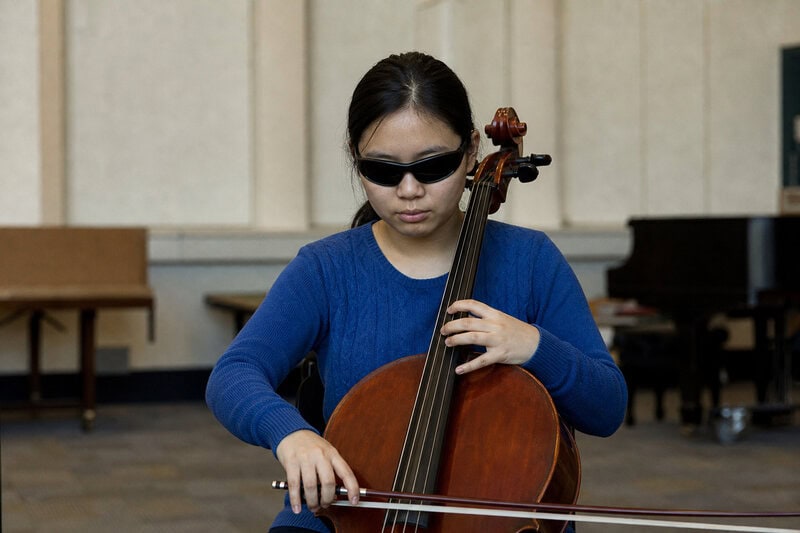
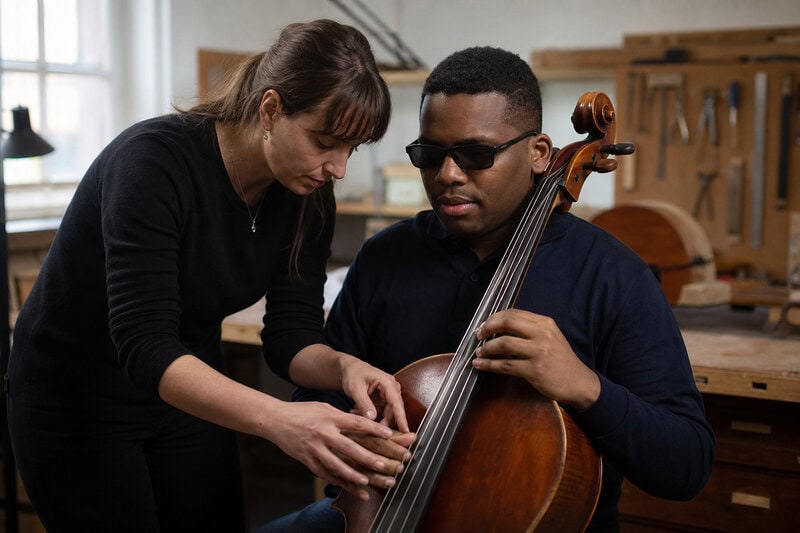
Bowed string instruments — violin, viola, cello — occupy a uniquely difficult category of physical skill. Unlike a piano, where notes correspond to discrete, spatially fixed keys, a bowed string instrument has no frets and no position markers. Correct intonation depends entirely on the player’s trained sense of exactly where each fingertip lands on the neck, a placement that shifts with every position change. Bowing adds a second layer: the angle, speed, and pressure of the bow against the string must all be coordinated simultaneously. Conventional pedagogy resolves this complexity largely through visual demonstration — the teacher models, the student watches and imitates.
That assumption runs so deep it is rarely named, let alone questioned. As the paper Designing for What Cannot Be Seen: Supporting String Instrument Learning for Blind and Low-Vision Musicians frames it: bowed string instruments demand fine-grained bodily coordination that is typically taught through visual demonstration. That structural mismatch has left blind and low-vision (BLV) musicians navigating a system not designed for them for as long as formal string pedagogy has existed.
The distinction matters both scientifically and practically. It shifts the central question from “can blind people learn string instruments?” — they demonstrably can, and many have built distinguished careers — to “what does evidence-based, accessible design for this specific learning context actually look like?” That second question is the one the Indiana University research sets out to answer.
What the Indiana University Study Found

The study, available under the title Supporting Embodied String Learning for Musicians with Blindness and Low Vision, centers on the personal adaptations that BLV string musicians already use and synthesizes them into a framework for future technological and pedagogical design. Researchers found that BLV learners develop highly sophisticated tactile and proprioceptive strategies — drawing on the felt sense of bow pressure, finger placement, and the physical resonance of the instrument vibrating in the hand and body. These strategies are functional and often highly refined. They are also largely invisible to the existing ecosystem of teaching tools, which neither document nor amplify them.
Proprioception — the nervous system’s continuous, real-time sense of the body’s own position and movement — is the primary cognitive channel BLV musicians rely on when visual demonstration is unavailable. This is not a workaround unique to blind learners; proprioception is a well-established mechanism in motor learning research, fundamental to how any skilled physical action is encoded and retrieved. What the Indiana University study argues is that string pedagogy has not caught up with what motor science already knows: that non-visual channels can carry the full weight of complex physical skill acquisition when they are deliberately and systematically engaged.
The paper draws a critical distinction between adaptations that individual musicians have improvised on their own — an emerging, loosely documented body of knowledge — and design interventions that could be built systematically into instruments, applications, or pedagogical methods. The authors treat the gap between these two categories as urgent. Importantly, they do not claim to have closed it: the study is framed explicitly as a research agenda and design scaffold, directionally significant but early-stage, rather than a finished solution.
The Role of Touch and Sound in Learning to Play
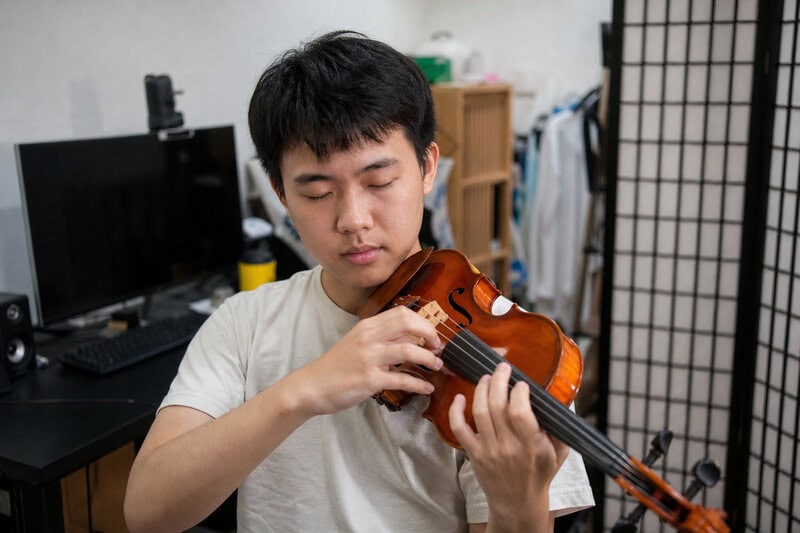
Haptic feedback — touch-based information, whether from the instrument itself, a teacher’s guiding hand, or a technological device — can substitute for or supplement visual modeling. This principle underlies a growing body of accessible music technology research. A systematic literature review of music technology for blind and low-vision users, published through the ACM Digital Library, provides a comprehensive map of this field, spanning notation tools, composition software, and performance aids.
The review’s most consequential finding is also its most sobering: the vast majority of existing music-accessibility technology has been designed for music reading — converting notation into tactile or audio formats — rather than for the physical act of playing an instrument. The motor-learning side of string education, the part that involves coordinating a bow arm, placing fingers on an unmarked neck, and sensing intonation through touch and sound, has been almost entirely unaddressed by current tools. Accessible music education has not lacked for good intentions. It has lacked systematic, user-centered science applied to the right problems.
Auditory feedback is also a primary learning channel for BLV musicians. Training the ear to detect intonation errors and bow-sound qualities can partially compensate for the absence of visual modeling — a principle experienced string teachers working with blind students have long applied informally. The Indiana University authors note, however, that this remains an area where more rigorous empirical study is needed before strong design recommendations can be made.
Specific Gaps the Research Exposes
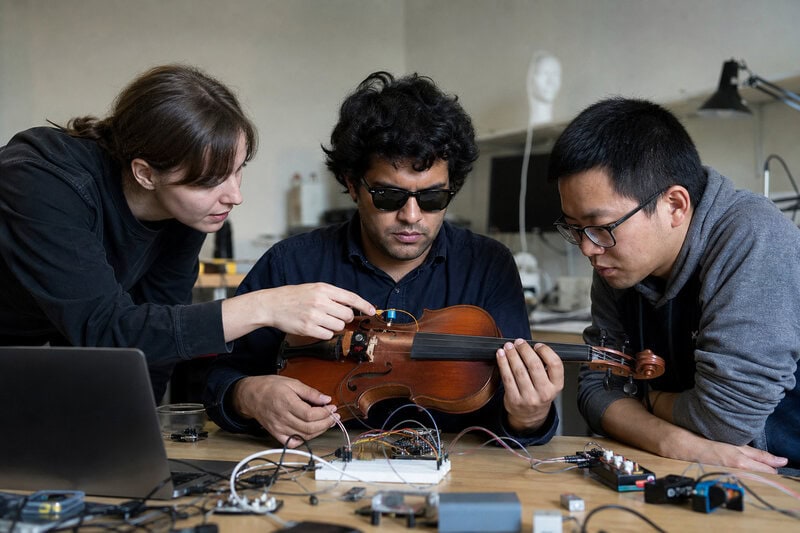
The ACM systematic review identifies several concrete gaps the field will need to address:
- A near-absence of tools providing real-time physical feedback during live instrument performance, as distinct from score reading or composition.
- The rarity of BLV musicians being involved as co-designers of accessibility technology, rather than as test subjects evaluated after the fact.
- Limited longitudinal research on what helps BLV learners improve their playing over time, as opposed to studies measuring only immediate, short-term outcomes.
- Fragmentation across the existing literature, with few studies building on one another toward a shared conceptual framework.
That last point is precisely what makes the Indiana University work significant. Rather than producing another isolated prototype, the study attempts to establish shared language and a shared framework — the prerequisite for cumulative scientific progress in any domain. It is worth being clear about scope: the study draws primarily on qualitative data from BLV musicians about their existing strategies. It does not present controlled trials of new tools or pedagogical methods. What it offers is a rigorous foundation from which such trials can be designed.
Where the Field Goes from Here
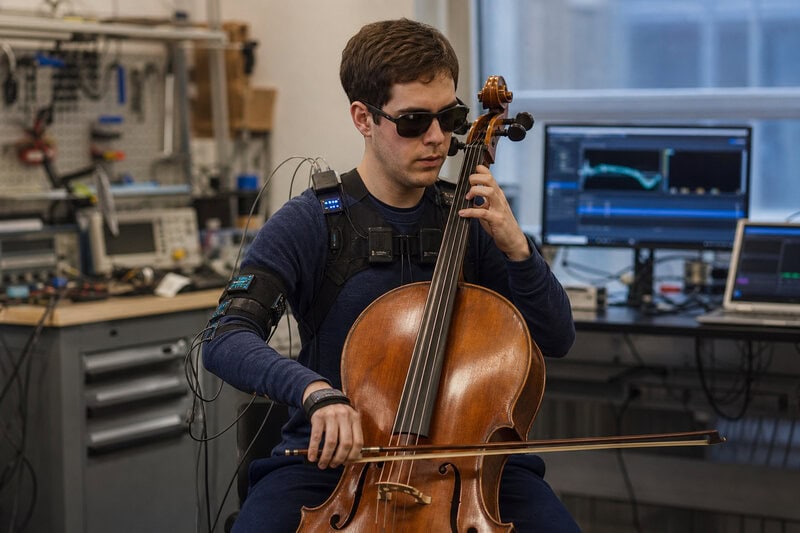
The Indiana University paper outlines several future design directions grounded in the adaptations BLV musicians already use. These include haptic augmentation of instruments — devices that translate bow position or finger placement into touch-based signals the player can feel in real time — structured tactile notation systems for fingering maps, and pedagogical frameworks that explicitly train proprioceptive awareness from the first lesson rather than treating it as a fallback when visual demonstration fails.
A recurring theme in both the arxiv paper and the ACM review is participatory design: the methodological principle that BLV musicians must be active collaborators in building these tools, not passive recipients. This standard has become increasingly common in accessibility research broadly but has been inconsistently applied in music contexts. Both bodies of work treat it as non-negotiable — not only as an ethical matter, but as a practical one, since the sophisticated informal adaptations BLV musicians have developed are precisely the knowledge base that useful technology needs to encode.
What remains genuinely uncertain, and what the authors openly acknowledge, is how scalable any of these interventions will be across the full spectrum of visual impairment, musical genre, learner age, and prior training. These variables have rarely been studied in combination. The field’s next challenge is moving from proof-of-concept adaptations documented in individual cases toward controlled, replicable research designs capable of establishing what works, for whom, and under what conditions — a standard the Indiana University authors explicitly call for.
Why This Matters Beyond Music
Accessible string instrument learning is a narrow domain. But the design principles it forces into the open — how to encode complex motor skills through non-visual channels, how to build feedback systems that work with proprioception rather than around it, how to center disabled users as co-designers rather than edge cases — have direct implications for accessible sports coaching, physical rehabilitation technology, and any domain where skilled physical learning has historically defaulted to visual imitation.
The principle at stake is a broad one: that physical skill learning should not be structurally dependent on visual demonstration. The publication of a systematic literature review on BLV music technology alongside a targeted study from Indiana University faculty signals that the academic community is beginning to treat blind and low-vision music learning as a legitimate, fundable research area rather than a niche concern. That shift typically precedes real-world implementation at scale.
For more on the study and its reception in the music world, The Violin Channel’s coverage of the Indiana University research provides useful context.
Neither the Indiana University study nor the ACM review claims to have solved the problem that blind musicians have navigated alone for generations. What they represent is something more foundational: the credible beginning of a scientific effort to solve it — systematically, collaboratively, and with the people most affected placed at the center of the work.