
A star just 79 light-years from Earth is spinning so fast — roughly 96% of the velocity at which centrifugal force would overcome gravity entirely — that it has physically deformed itself into a squashed, bulging shape measurably different at its poles than at its equator. That star is Regulus, the brightest point of light in the constellation Leo, and its extreme rotation is only the beginning of what makes it one of the most scientifically remarkable objects in the nearby sky.
A Star on the Edge of Self-Destruction
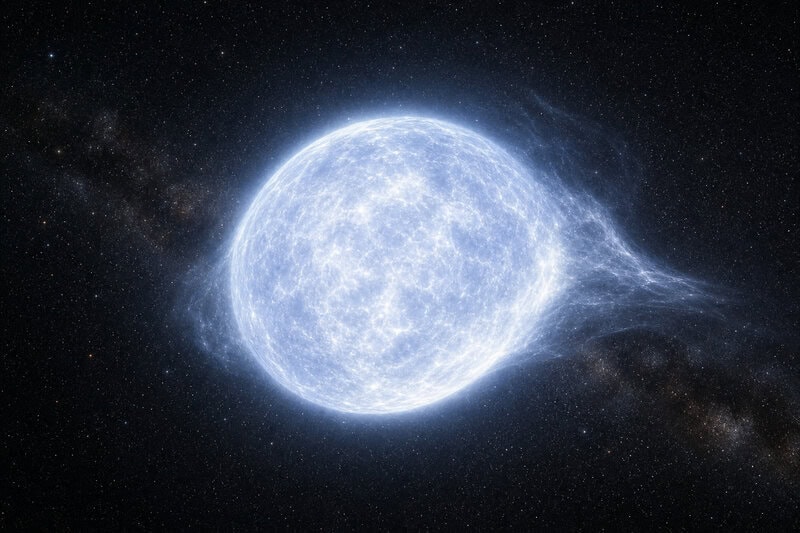
Interferometric measurements from the CHARA Array confirmed that Regulus rotates at approximately 96% of its critical velocity — the threshold beyond which centrifugal force would overpower the star’s own gravity and tear material away from its surface. To put that rotation rate in concrete terms: Regulus completes one full rotation in approximately 15.9 hours. Our Sun, by comparison, takes roughly 25 days to complete a single rotation at its equator.
The physical consequences of that spin are dramatic and directly measurable. Centrifugal force pushes equatorial material outward while the poles are comparatively compressed, producing a shape astronomers describe as an oblate spheroid — a sphere flattened at the top and bottom and inflated around the middle. For Regulus, this deformation is severe: its equatorial radius is estimated to be approximately 32% larger than its polar radius. A single star does not have one size. It has at least two, depending on where you measure it.
That physical deformation cascades into nearly every other unusual feature Regulus displays, from its lopsided surface temperatures to the mystery of how it came to spin so furiously in the first place.
The Little King: Name, Location, and Night-Sky Basics
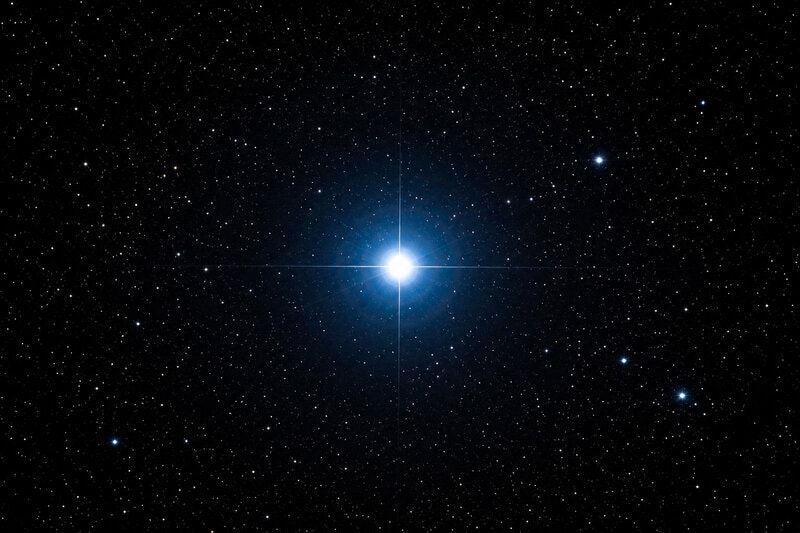
Regulus carries the Bayer designation α Leonis, or Alpha Leonis, marking it as the dominant star in Leo — one of the most recognizable constellations along the zodiac, the band of sky through which the Sun, Moon, and planets appear to travel over the course of a year. Its Latin name means “little king,” a diminutive of rex, and the royal symbolism attached to it stretches back through medieval European astronomy, ancient Greek star-lore, and Babylonian sky-watching traditions.
Regulus ranks 21st in brightness among all stars visible from Earth — a position that, combined with its location along the zodiac, ensures it is familiar to casual observers and professional astronomers alike. It sits approximately 79 light-years away, meaning the light reaching your eye tonight left Regulus in the mid-twentieth century. Close on a cosmic scale, yet distant enough to underscore that Regulus operates under conditions with no parallel in our own solar system.
Because Regulus lies within about half a degree of the ecliptic — the Sun’s apparent annual path across the sky — it is visible to observers across North America, Europe, and Asia for much of the year. It is also one of only a handful of first-magnitude stars that the Moon regularly occults, passing directly in front of the star and briefly extinguishing its light. Those events are scientifically useful: astronomers exploit them to study the precise shapes and sizes of asteroids and other bodies that occasionally cross between Regulus and Earth. EarthSky describes Regulus as the heart of Leo the Lion — remove it from the constellation’s outline and the figure loses its center of gravity.
Blue-White and Blazing: What Kind of Star Is Regulus?
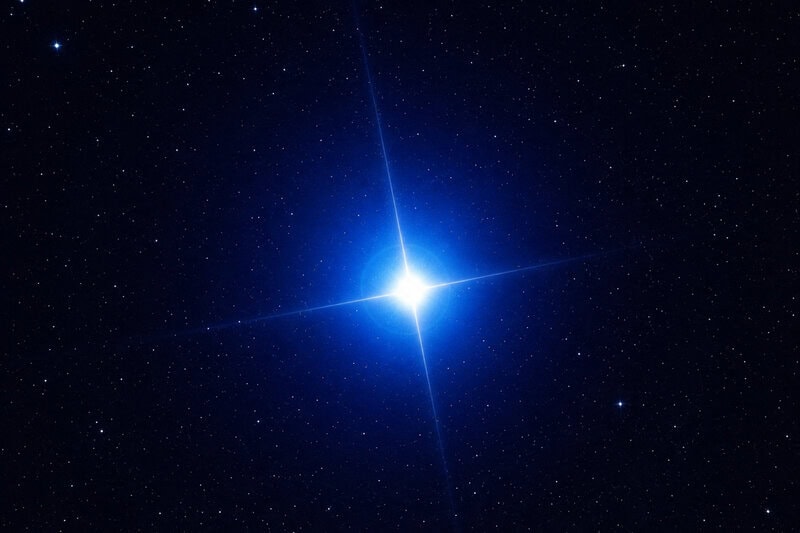
Regulus A is classified as a B7 main-sequence star — meaning it is currently in the long, stable hydrogen-fusing stage of its life. The Sun is also a main-sequence star, but the comparison ends there. Regulus A is estimated at roughly 3.5 times the Sun’s mass and about 3.1 times its polar radius, making it a considerably more powerful and shorter-lived object.
Its blue-white color is a direct readout of surface temperature. Polar surface temperatures on Regulus are estimated at roughly 10,000 to 12,000 Kelvin — well above the Sun’s surface temperature of approximately 5,778 Kelvin. Hotter stars emit more of their light at shorter, bluer wavelengths, which is why Regulus appears blue-white rather than the yellow-white of the Sun.
Regulus is also catalogued as a variable star, meaning its brightness fluctuates measurably over time. That variability is at least partly a consequence of its rapid rotation and the uneven distribution of heat it creates across the star’s surface — a connection that makes Regulus particularly useful for testing theories about how rotation shapes stellar behavior. StarWalk’s guide to Regulus provides additional detail on its classification and observational history.
The Physics of Spin: Why Rotating Fast Reshapes a Star
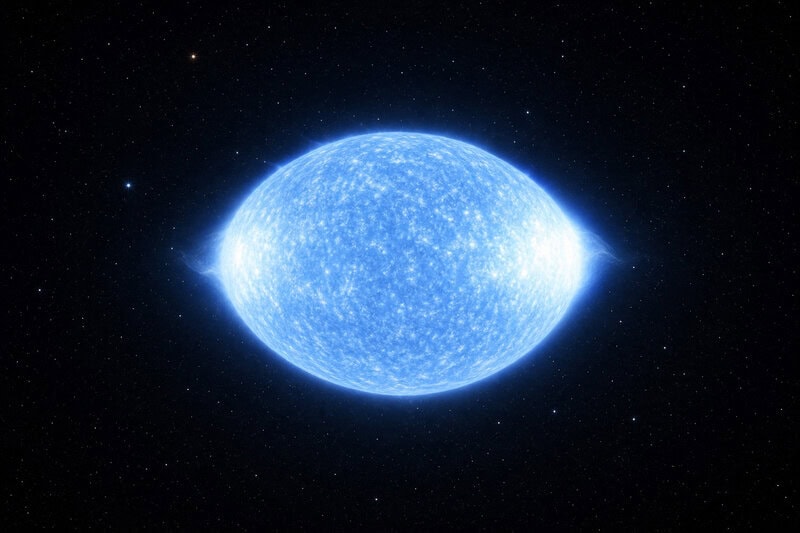
When any object rotates, material at its equator experiences centrifugal force — the outward push produced by circular motion — acting in opposition to gravity. For slowly rotating objects like the Earth or the Sun, that force produces only a modest equatorial bulge. For a star spinning at 96% of its critical velocity, the effect is transformative.
The equatorial bulge of a rapidly rotating star sits physically farther from the hot nuclear core than the flattened poles do. Because it is farther from the energy source, the equatorial material is cooler and radiates less energy per unit area than the poles. This effect is called gravity darkening, and it was first described theoretically in the early twentieth century. For Regulus, the pole-to-equator temperature difference is estimated at several thousand Kelvin — meaning a single star effectively hosts two distinct thermal environments simultaneously, with its poles blazing hotter and brighter than its dimmer, cooler equatorial band. The CHARA interferometry team confirmed this effect observationally for Regulus, providing one of the clearest real-world demonstrations of gravity darkening ever recorded.
The implications extend beyond Regulus itself. Extreme oblateness forces astronomers to revise standard models used to predict how stars age and die, because spin rate influences how a star’s interior layers mix, how long its fuel supply lasts, and what kind of remnant it eventually produces. Regulus functions, in this sense, as a stress test for stellar physics.
A Court of Hidden Companions: The Multiple Star System
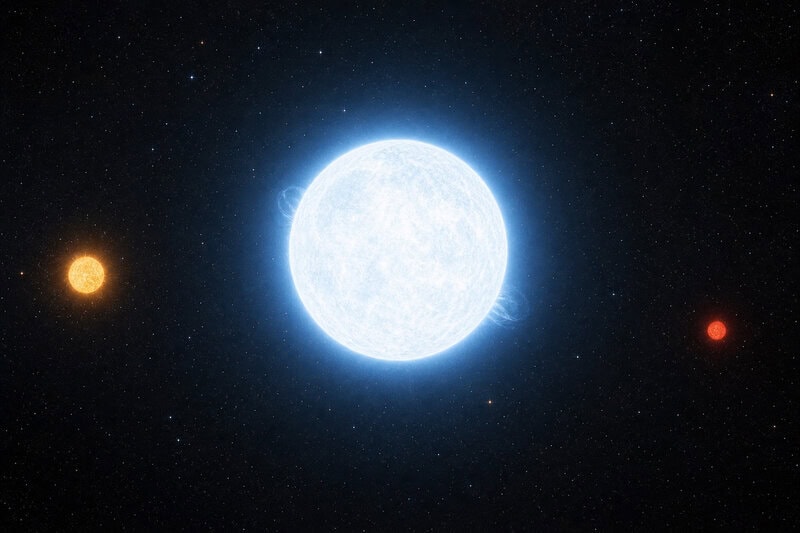
Regulus is not a single star but a gravitationally bound system of at least three confirmed stars, with Regulus A serving as the dominant primary. The outer pair — designated Regulus B and Regulus C — are a K-type and M-type star respectively, meaning they are cooler, redder, and far less massive than Regulus A. These two stars orbit each other at a separation of roughly 100 astronomical units, and that pair, in turn, orbits Regulus A at an estimated separation of several thousand astronomical units. The system is gravitationally linked but spread across an enormous volume of space. TheSkyLive’s profile of Alpha Leonis provides current observational data on the system’s geometry.
The most scientifically compelling question surrounding the system is straightforward to state but difficult to answer: how did Regulus A acquire such extreme spin? Stars are not born rotating at 96% of their critical velocity. The leading hypothesis is that Regulus A was spun up by mass transfer — it gravitationally stripped material from a former close companion star, and the angular momentum carried by that infalling material accelerated its rotation to near-breakup speed. The companion that donated this mass would, over time, have evolved into a dim white dwarf — a stellar remnant so faint that it has not yet been directly detected.
If that white dwarf companion is eventually confirmed, it would recast Regulus A as a star that consumed enough mass from a neighbor to push itself to the physical edge of self-destruction. That remains a well-supported hypothesis under active investigation, not an established fact.
Regulus and the Zodiac: Where Science and History Converge

Ancient Babylonian astronomers identified Regulus as one of four “royal stars” — alongside Aldebaran, Antares, and Fomalhaut — believed to guard the four quadrants of the sky. That tradition persisted through Persian, Greek, and medieval Islamic astronomy, accumulating centuries of symbolic weight. The name “little king” is no accident; Regulus was considered a star of power and portent by cultures that had no telescope, no spectroscope, and no concept of stellar rotation. They simply noticed it was brilliant, steady, and positioned along the path of the Sun and planets.
Modern astronomy has given that ancient prominence precise scientific meaning. Regulus’s position within approximately 0.5 degrees of the ecliptic makes it one of the most geometrically significant stars along the zodiac. It serves as a reference point for astrometric surveys and a prime target for occultation studies, in which the Moon or a passing asteroid briefly blocks its light and allows astronomers to map the occulting body’s shape with high precision. The Old Farmer’s Almanac offers a practical guide to locating Regulus in the night sky for observers who want to find it directly.
What Happens Next: Regulus’s Uncertain Future
Regulus A is estimated to be only a few hundred million years old — young by stellar standards — but its relatively high mass means it burns through hydrogen fuel far faster than a star like the Sun. It will likely exhaust that fuel and evolve off the main sequence within roughly a billion years, eventually expanding into a giant star before collapsing into a compact remnant.
Its extreme rotation complicates predictions significantly. Rapidly rotating stars mix their interior layers differently from slow rotators, which can alter the composition of material they eventually shed and change the nature of their final remnants. A fast-spinning star does not simply live and die on the same schedule as a slow one — rotation is a variable that threads through every stage of its evolution.
More speculative possibilities hinge on whether a white dwarf companion is confirmed. Under certain conditions, renewed mass exchange between Regulus A and a white dwarf — should one exist — could theoretically contribute to the conditions for a Type Ia supernova, one of the most energetic events in the universe. Current evidence does not support that outcome as a prediction; researchers treat it as a physically plausible scenario requiring further observation, not a forecast.
What is not speculative is Regulus’s value as a nearby laboratory. Its rapid rotation, measurable oblateness, multiple companions, variable brightness, and ecliptic position combine to make it one of the most scientifically productive stellar targets accessible from Earth. The Stellar Catalog’s entry on Alpha Leonis compiles the technical parameters underlying that profile. The little king earns its title not through mythology alone, but through the sheer density of physics packed into a system just 79 light-years away.