
Odysseus had himself lashed to the mast of his ship not because he lacked courage, but because he understood, with unusual clarity, that his own mind could not be trusted within earshot of the Sirens. Homer composed that scene roughly 2,700 years ago, and it endures not as fantasy but as an uncommonly precise description of what music can actually do to a human brain — a description that modern neuroscience is only now catching up to.
What Ancient Greek Music Actually Sounded Like
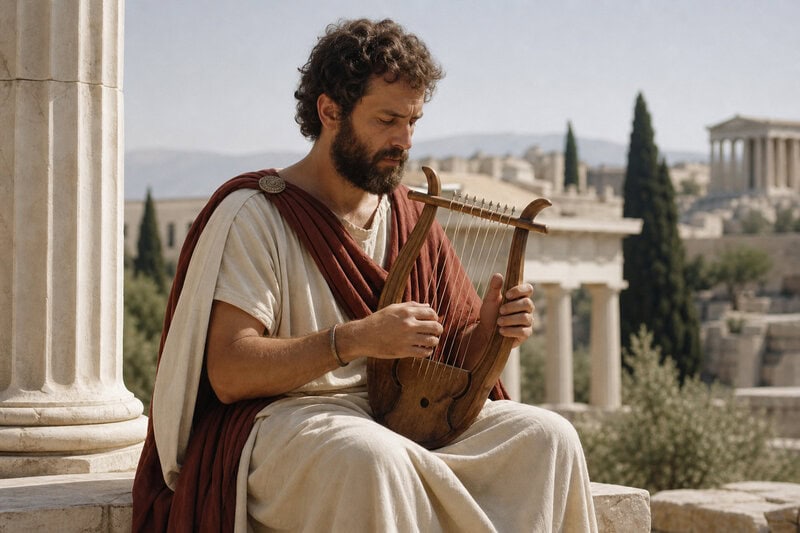
Fewer than 60 complete or partial pieces of ancient Greek musical notation have survived to the present day. They exist on stone inscriptions and papyrus fragments, forming an extraordinarily thin evidential thread connecting the modern world to a rich performance tradition that shaped Western intellectual history. Among the most studied are the Seikilos epitaph — a short song inscribed on a grave marker, dated to roughly the 1st or 2nd century CE, and considered the oldest fully surviving notated song — and the Delphic Hymns, carved into the walls of the Athenian Treasury at Delphi around 128 BCE. Scholars at institutions including Oxford’s Faculty of Music have spent decades learning to decode the notation system those fragments preserve.
What that system reveals surprises most people encountering it for the first time. Ancient Greek music did not use the major or minor scales that underpin virtually all Western music familiar to contemporary listeners. Instead, it employed a system of modes — distinct patterns of whole steps, half steps, and, crucially, intervals even smaller than a half step, called microtones — each named after a Greek region or people: Dorian, Lydian, Phrygian, Mixolydian. Ancient theorists including Plato and Aristotle described each mode as producing a characteristic emotional state in the listener, a concept they called ethos. The Phrygian mode, for example, was associated with ecstatic, destabilizing excitement; the Dorian with martial steadiness and restraint.
Reconstruction projects, including work led by classicist Armand D’Angour at Oxford, suggest that when these modes are performed on replicated ancient instruments — particularly the aulos, a double-pipe reed instrument capable of producing microtonal intervals — the resulting sound is closer to chant or early medieval plainchant than to anything a modern audience would label “classical.” To contemporary ears, it carries an unfamiliar quality, because the microtones fall in gaps between the keys of a modern piano. Listeners in informal tests conducted alongside such reconstruction projects have reportedly described the results as both deeply unsettling and, paradoxically, difficult to disengage from — a reaction that ancient Greek music theorists would have recognized immediately and that neuroscientists today can begin to explain.
It is essential, however, to be precise about what reconstruction can and cannot achieve. Ancient Greek music was fundamentally a performance tradition — melody inseparable from the natural rhythms of spoken poetry, passed between performers through practice rather than scores — and so every reconstruction is an informed scholarly interpretation rather than a definitive recovery. Researchers themselves consistently emphasize this distinction. The goal, as scholars affiliated with the European Music Archaeology Project have noted, is historically plausible approximation, not time travel.
Homer’s Sirens: What the Text Actually Says — and What It Doesn’t

Homer’s Odyssey, Book XII, is careful about what it includes and conspicuously silent about what it leaves out. The Sirens do not promise Odysseus pleasure in any simple sense. They promise him knowledge: they tell him they will reveal “all that comes to pass on the fertile earth.” Their lure, as classicists have argued, is fundamentally epistemic — an offer of total understanding — as much as it is sonic. This nuance is frequently lost in modern retellings, which tend to reduce the Sirens to seductive voices rather than the bearers of an irresistible intellectual temptation.
What Homer never specifies is what instrument the Sirens play, what mode their song employs, or how, precisely, it is structured. The text gestures at effect rather than mechanism. What musicologists can say is that the Homeric epics were themselves performed to the phorminx or kithara — forms of the ancient Greek lyre — and that the performance tradition underlying Homeric epic song likely used the Dorian or Mixolydian mode. D’Angour’s Oxford reconstruction of lines from the Iliad demonstrated that the poems’ quantitative meter — dactylic hexameter, the rhythmic backbone of both epics — itself encodes a rhythmic musical template, suggesting the Siren scene was always meant to be heard and experienced in the body, not merely read on a page.
Underlying all of this is a concept the Greeks called mousikē, which had a far broader meaning than the English word “music” implies. Mousikē was an indivisible unity of melody, poetry, rhythm, and dance. The Sirens’ power in the ancient imagination was therefore not melody alone but the simultaneous convergence of all those forces — a total sensory and cognitive event. Plato’s Republic treats this convergence as a genuine political danger: the wrong musical modes, he argues, could destabilize the individual soul and, through that, the city-state itself. Ancient audiences encountering the Siren scene were not reading adventure-story peril; they were receiving a serious philosophical warning about the limits of rational self-governance under the pressure of organized sound.
The Neuroscience of Why Music Can Override Rational Thought

The ancient Greeks had no imaging technology, no vocabulary for dopamine, and no formal neuroscience. What they did have was centuries of careful observation about how music behaves in human beings, and their conclusions were, in several important respects, accurate. Modern neuroscience has confirmed the core of what the ethos doctrine intuited: music is not processed by the brain as a neutral sensory input. It activates the brain’s dopaminergic reward pathways — the same circuits involved in the anticipation of food, sexual pleasure, and addictive substances. Research published in Nature Neuroscience has documented measurable dopamine release at moments of musical anticipation and at the moment of resolution, a phenomenon sometimes described as “chills” or by the French-derived term frisson.
The mechanism behind this response has been explored in depth by neuroscientist and music researcher David Huron of Ohio State University, whose work proposes that music’s power derives substantially from its relationship to the brain’s predictive systems. The brain, Huron argues, is constantly making predictions about what sound will come next, based on prior exposure and internalized pattern recognition. Music sets up those predictions and then either satisfies them — producing pleasure — or deliberately violates them — producing a heightened state of arousal and anticipation that is itself rewarding. A skilled musical performance, ancient or modern, can sustain that loop of tension and release for extended periods, creating a state the listener finds genuinely difficult to exit voluntarily.
Translated back into Homeric terms: the Sirens’ song was irresistible not because it was supernatural but because it was optimized — whether by mythological design or Homer’s poetic intuition — to exploit exactly these mechanisms. Odysseus’s ropes are, in neuroscientific language, an external override of a hijacked reward system. The scene functions as a thought experiment about what happens when the brain’s predictive and dopaminergic machinery is captured by an input powerful enough to override conscious choice.
Researcher Stefan Koelsch at the University of Bergen has further demonstrated that music affects not merely emotional states but measurable physiological parameters: heart rate, respiration, and cortisol levels all shift in response to music in ways that are at least partially consistent across subjects. Odysseus’s physical struggle against the ropes — his muscles straining, his entire body engaged in the effort to resist what his auditory cortex was processing — is therefore not dramatic excess but a plausible metaphor for a documented bodily phenomenon.
What remains genuinely contested is the question of universality. The dopamine-music link is well established, but why some music feels more compulsive to some people, whether any acoustic configuration reliably produces irresistibility across different individuals and cultures, and whether the specific features of ancient Greek modal music would produce neurologically distinct responses compared to modern Western tonal music — these questions remain open. No scientific consensus on a universal “Siren formula” currently exists, and researchers are appropriately cautious about overstating what the current evidence supports.
How Scholars Are Reconstructing Ancient Music
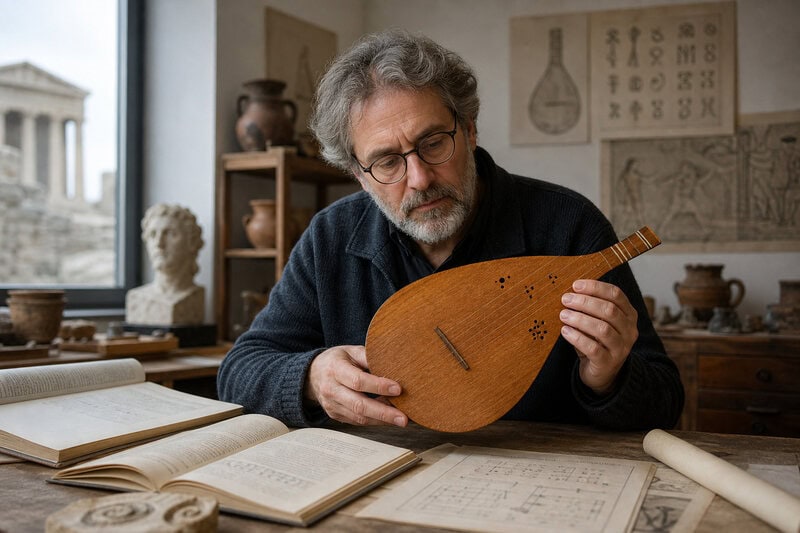
The methodology of ancient music reconstruction is more rigorous — and more technically demanding — than popular accounts often suggest. Scholars working in this area typically combine several distinct lines of evidence simultaneously. Philological analysis of notation symbols preserved in manuscripts and inscriptions provides the raw data. Study of ancient music-theory treatises — particularly those of Aristoxenus, a student of Aristotle who wrote the earliest surviving systematic treatment of Greek musical scales, and Ptolemy, the 2nd-century CE mathematician and astronomer who also wrote extensively on harmonics — supplies the theoretical framework for interpreting those symbols. Experimental archaeology, using instruments reconstructed from surviving descriptions and iconography, tests whether the theoretical intervals are physically producible. Acoustic modeling software allows researchers to analyze the spectral properties of reconstructed scales in ways that go beyond what the human ear can easily distinguish.
D’Angour’s Oxford-based work on Homeric epic song demonstrated this methodology in practice. By combining the quantitative meter of dactylic hexameter with reconstructed modal scales performed on period-appropriate instruments, his team produced a version of Homeric poetry that argued, persuasively to many classicists, that the Iliad and Odyssey were composed to be sung — that the music and the poetry were never meant to be separated. The implications for how we understand the Siren scene are considerable: a passage designed to be performed in a specific modal framework, to an audience that believed those modes had physiological and psychological effects, is a different kind of artistic object than the silent text on a page.
Digital humanities programs, including those at King’s College London, have developed computational tools to analyze the acoustic properties of reconstructed ancient scales and to design controlled listening experiments exposing contemporary subjects to ancient modal patterns. This represents a genuine methodological frontier: for the first time, it is becoming possible to test empirically whether the emotional and physiological responses ancient Greeks described match what modern listeners actually experience when exposed to historically plausible approximations of ancient sound. The results of such experiments are preliminary, but the research direction is significant. Public curiosity about what ancient Greek music actually sounded like has grown substantially as reconstructed performances have circulated online, creating an unusually broad audience for what is, at root, a technical scholarly project.
Ancient Wisdom, Modern Science, and the Music We Cannot Resist

Cross-cultural research on musical emotion has begun to offer partial empirical support for what the Greeks described as ethos doctrine — the idea that specific modal structures produce specific emotional states. Studies examining listeners across unrelated musical cultures have found that certain scale structures, particularly those involving minor thirds and falling melodic contours, reliably elicit sadness or longing at rates above chance. This suggests at least a partial biological basis for the emotional effects of modal choice — not the rigid, mode-specific prescriptions Plato proposed, but a looser, statistically real relationship between melodic structure and affective response that the Greeks were, in broad strokes, correct to identify.
What remains genuinely unknown is how a modern brain would respond to the full sonic experience of ancient Greek mousikē — melody, poetry, rhythm, and physical performance combined, in the microtonal modal system the ancient world used. Would it feel more or less compulsive than the music streaming platforms now deliver algorithmically, tuned by engagement data to maximize the same dopaminergic loops the Sirens exploited by mythological design? That is not a rhetorical question. It is, increasingly, a research question, and the next decade of work at the intersection of ancient music reconstruction and cognitive neuroscience may begin to provide experimental answers.
The contemporary relevance extends beyond the academic. The neural mechanisms that led ancient Greek theorists to warn about dangerous modes — and that led Homer to imagine a hero requiring physical restraint to survive an encounter with optimized music — are the same mechanisms that underlie the design of streaming-platform recommendation algorithms, advertising sound design, and the looping audio formats native to short-video platforms. Modern culture has built industrial-scale Sirens, and most of us navigate them without ropes.
The Sirens were never purely fictional. They were Homer’s formalization — drawn from an oral tradition that had spent generations observing human responses to sound — of something every person has experienced: a piece of music that feels physically impossible to walk away from. That the Greeks understood this phenomenon as a force requiring literal, bodily restraint says something important about how seriously they took the power of organized sound on the rational mind. The Odyssey‘s Siren scene endures not because ancient Greeks believed in monsters, but because Homer, with startling accuracy, described what it feels like when music stops being something you listen to and starts being something that listens to you.