Section 2: John Endler’s Guppy Coloration Experiments and the Balance Between Sexual and Natural Selection
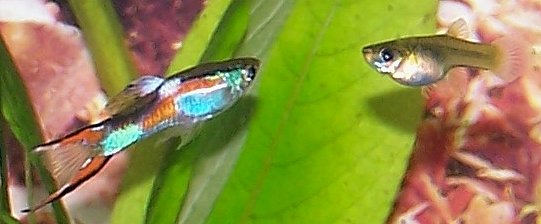
In the 1970s, evolutionary biologist John Endler conducted pioneering studies on the coloration patterns of guppies (*Poecilia reticulata*) in Trinidad, providing profound insights into the interplay between sexual and natural selection. His research demonstrated how environmental factors, particularly predation, influence the evolution of physical traits within populations.
Endler’s fieldwork focused on guppy populations inhabiting streams with varying levels of predation. He observed that in areas with high predation pressure, male guppies exhibited less vibrant colors and smaller spots, likely as a camouflage adaptation to evade predators. Conversely, in regions with low predation, males displayed more vivid colors and larger spots, traits that are attractive to females and favored by sexual selection. This variation suggested a trade-off between the benefits of attracting mates and the risks of increased visibility to predators. (pbs.org)
To further investigate this phenomenon, Endler conducted a controlled experiment by transplanting guppies from a high-predation environment to a low-predation environment. Over approximately two years, or about 15 guppy generations, the transplanted males evolved more conspicuous coloration patterns, aligning with the traits observed in the local low-predation population. This rapid shift provided compelling evidence that environmental changes can drive evolutionary adaptations in response to varying selective pressures. (evolution.berkeley.edu)
Endler’s research also highlighted the role of visual conditions in the effectiveness of sexual signals. He found that guppy color patterns are more conspicuous to conspecifics during courtship and less so when predators are present, indicating that coloration serves dual purposes: attracting mates and avoiding predation. This dual function underscores the complex nature of evolutionary adaptations, where traits can evolve to fulfill multiple roles depending on environmental contexts. (researchgate.net)
Through his meticulous studies, Endler illuminated the dynamic balance between sexual and natural selection in shaping the evolution of guppy coloration. His work has had a lasting impact on evolutionary biology, offering a clear example of how environmental factors can influence the development of physical traits within populations. (pbs.org)