Section 1: Thomas Hunt Morgan’s Fruit Fly Experiments and the Chromosomal Theory of Inheritance
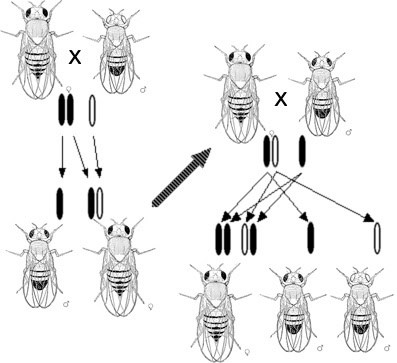
In the early 20th century, Thomas Hunt Morgan conducted groundbreaking experiments with the fruit fly *Drosophila melanogaster* that provided compelling evidence for the chromosomal theory of inheritance. Prior to Morgan’s work, the mechanisms of heredity were not fully understood, and the role of chromosomes in transmitting genetic information was a subject of debate.
Morgan’s journey into genetics began in 1908 when he established his laboratory at Columbia University, often referred to as the “Fly Room.” He chose *Drosophila melanogaster* for its suitability in genetic studies due to its short generation time, ease of cultivation, and the presence of easily distinguishable traits. These characteristics made fruit flies an ideal model organism for genetic research.
In 1910, Morgan observed a male fruit fly with white eyes, a deviation from the typical red-eyed phenotype. Intrigued by this anomaly, he bred the white-eyed male with a red-eyed female. The first generation (F1) produced all red-eyed offspring, suggesting that the red-eye trait was dominant. When these F1 individuals were interbred, the second generation (F2) exhibited a 3:1 ratio of red-eyed to white-eyed flies. However, an unexpected pattern emerged: all the white-eyed flies were male. This observation led Morgan to hypothesize that the gene responsible for eye color was located on the X chromosome, a sex chromosome in fruit flies. (embryo.asu.edu)
Morgan’s hypothesis was further supported by subsequent experiments. He crossed red-eyed females with white-eyed males and observed that the F1 generation consisted entirely of red-eyed offspring. Interbreeding these F1 individuals resulted in F2 progeny with a 3:1 ratio of red-eyed to white-eyed flies, with all white-eyed individuals being male. These findings provided strong evidence that the gene for eye color was indeed located on the X chromosome, confirming the chromosomal theory of inheritance. (embryo.asu.edu)
Morgan’s work extended beyond the discovery of sex-linked traits. He and his colleagues, including Alfred Sturtevant, Calvin Bridges, and Hermann Joseph Muller, conducted extensive studies on genetic linkage and recombination. They observed that genes located close together on the same chromosome tend to be inherited together, a phenomenon known as genetic linkage. This discovery provided insights into the physical arrangement of genes on chromosomes and laid the foundation for the field of genetic mapping. (en.wikipedia.org)
The significance of Morgan’s experiments was recognized with the award of the Nobel Prize in Physiology or Medicine in 1933. His work not only elucidated the role of chromosomes in heredity but also established *Drosophila melanogaster* as a pivotal model organism in genetics. The methodologies and principles developed in his laboratory continue to influence genetic research today. (en.wikipedia.org)
In summary, Thomas Hunt Morgan’s experiments with fruit flies provided definitive evidence for the chromosomal theory of inheritance. By demonstrating that specific genes are located on chromosomes and that these chromosomes segregate during reproduction, Morgan’s work transformed our understanding of genetics and heredity.