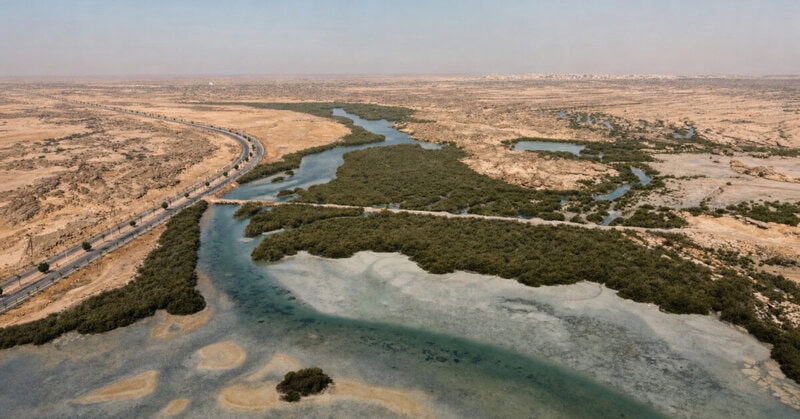
Roughly 100 million years ago, a warm, shallow tropical sea called the Tethys Sea stretched across what is now the Arabian Peninsula, teeming with microscopic marine organisms whose remains would slowly transform into the most geopolitically consequential substance on Earth. Today, Saudi Arabia sits atop the legacy of that vanished ocean — approximately 17% of the world’s proven crude oil reserves — and that geological inheritance is precisely why one nation can walk into a room of nearly 200 countries at COP31 and bring climate talks to a standstill.
One Ancient Sea, One Modern Superpower
Between roughly 65 and 150 million years ago, the Arabian Peninsula lay beneath the Tethys Sea, a nutrient-rich body of water teeming with phytoplankton and zooplankton. When these organisms died, they sank into oxygen-poor sediment at the seafloor, where the absence of oxygen slowed their decay. Over millions of years, layer upon layer of organic material accumulated, was buried, and was slowly transformed under heat and pressure into the hydrocarbons that now fuel the global economy.
According to the U.S. Geological Survey (USGS), the Middle East’s petroleum system is exceptional because three rare conditions converged simultaneously: massive organic deposition, rapid burial under oxygen-poor sediment that preserved organic matter rather than allowing it to decompose, and a thick, impermeable cap of carbonate and evaporite rock that sealed the hydrocarbons in place for tens of millions of years. Each condition alone is relatively common in Earth’s geological history. All three occurring together, at the same time and place, in the right proportions, is not.
The Arabian Plate’s slow, geologically stable drift added a fourth advantage. Unlike oil-bearing regions subjected to intense volcanic activity or the kind of deep faulting that fractures reservoir rock and allows hydrocarbons to escape, the Arabian Plate functioned as what geologists describe as a passive continental margin — a near-perfect geological vault. Oil systems elsewhere on Earth have been cracked open and drained by tectonic violence. Saudi Arabia’s were not.
The result is Ghawar, the world’s largest conventional oil field. According to Saudi Aramco’s 2019 IPO prospectus, Ghawar produces an estimated 3.8 million barrels of crude oil per day. It sits atop the Arab-D formation, a Jurassic-age carbonate reservoir deposited roughly 160 million years ago — a sponge-like limestone that accumulated oil migrating upward from even older source rocks below.
The Kerogen Kitchen: How Dead Plankton Becomes Crude Oil
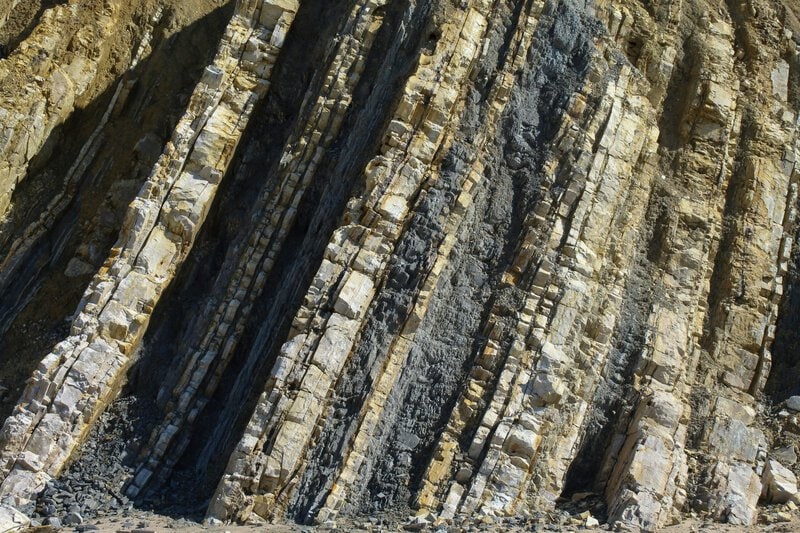
The transformation from dead marine organisms to crude oil follows a process that petroleum geologists have mapped in careful detail. When organic-rich sediment is buried to depths of roughly two to four kilometres and exposed to temperatures between 60°C and 120°C — a zone petroleum geologists call the oil window — a waxy organic polymer called kerogen undergoes a process known as catagenesis, or thermal cracking, breaking apart into the lighter hydrocarbon chains that constitute crude oil.
The U.S. Energy Information Administration (EIA) explains that catagenesis unfolds over millions of years. There is no meaningful human timescale on which petroleum reservoirs can be replenished, making them, by any practical definition, a finite and non-renewable resource. The geological conditions that created Saudi Arabia’s reserves — the specific ocean chemistry, water temperature, burial depth, and tectonic quiescence — cannot be engineered or artificially accelerated.
Saudi Arabia’s reservoirs benefited from an unusually thick organic-rich source rock — the Hanifa and Tuwaiq Mountain formations — that generated hydrocarbons over an extended geological window. Those hydrocarbons migrated upward into the porous Arab-D limestone, held under pressure and sealed by impermeable cap rock above. Because that cap rock remains so intact and reservoir pressure so high, Saudi wells historically require far less energy-intensive extraction than shale or deepwater sources. Saudi Aramco reported a carbon intensity of 10.7 kg CO₂-equivalent per barrel in its 2022 Sustainability Report, compared to a global average closer to 20 kg — a distinction the kingdom frequently invokes in climate negotiations, though one that addresses only extraction-phase emissions rather than the combustion that generates the overwhelming majority of petroleum’s lifecycle carbon.
Reserves, Estimates, and the Politics of Underground Numbers
Saudi Arabia officially claims proved reserves of approximately 267 billion barrels, a figure reported to OPEC and cited by BP’s Statistical Review of World Energy 2023 — representing roughly 17% of global proved reserves. That number carries a significant methodological caveat.
Proved reserves are partly an economic and political declaration, not purely a geological measurement. They represent oil recoverable under current technology and price conditions. Critically, OPEC quota allocations have historically been tied to reported reserve size, creating incentives for member states to report generously — a concern raised by independent analysts including those at the Oxford Institute for Energy Studies. The true geological figure may differ from the officially declared one, in either direction.
What is less contested is the broader pattern. Emerging research, including work published in the journal Nature Energy, indicates that global conventional oil discovery rates have been declining since the 1960s. The geological endowment that Saudi Arabia commands — the specific coincidence of source rock, reservoir, cap rock, and tectonic stability — is genuinely difficult to replicate elsewhere on Earth. That scarcity is not a political narrative; it is a geological reality. And it translates directly into diplomatic leverage.
COP31 Deadlock: Where Geology Meets Geopolitics

The COP28 agreement reached in Dubai in 2023 marked the first time a UN climate accord explicitly called for a “transition away from fossil fuels” — a phrase that took three decades of climate diplomacy to achieve. At COP31, a coalition of around 130 countries sought to enshrine that same language in the final agreement, aiming to build on rather than retreat from the Dubai breakthrough. Saudi Arabia and its allies successfully prevented any further progress on that language, arguing that countries should retain flexibility in choosing how to reduce emissions.
The COP31 summit stalled simultaneously on two fronts: the fossil fuel phaseout text and climate finance commitments to developing countries — a twin deadlock that observers described as the talks “unravelling.” The European Union rejected a final deal that omitted fossil fuel language, leaving the COP28 phrase as the current high-water mark of international climate ambition rather than a foundation to build upon.
The simultaneous collapse on climate finance is not a secondary storyline. Developing nations — many of them acutely vulnerable to climate impacts — arrived at COP31 demanding that wealthier, historically high-emitting countries scale up financial support for adaptation and loss and damage. When that parallel negotiating track also broke down, the bloc of climate-vulnerable states lost any incentive to offer concessions on fossil fuel language in exchange for a broader deal. The two deadlocks fed each other, hardening positions across the room and narrowing the space for compromise that veteran climate negotiators typically rely on in final hours.
Saudi Arabia’s negotiating posture reflects a genuine structural dilemma that is as much fiscal as ideological. According to the International Monetary Fund (IMF), the country derives over 70% of government revenues from oil exports. For Riyadh, aggressive phaseout language in a binding international accord is not an abstract diplomatic setback — it is a potential threat to state solvency. That economic dependency, rooted in geological fortune, shapes every calculation Saudi negotiators bring to the table.
It is worth noting that Saudi Arabia does not act alone. Russia, Iran, and several Gulf states share broadly aligned interests in preserving maximum flexibility on fossil fuel language. The framing of a singular Saudi veto, while dramaticaly useful, understates the breadth of the bloc resistant to phaseout commitments — and overstates the ease with which a differently worded resolution might otherwise have cleared consensus.
The Intergovernmental Panel on Climate Change (IPCC) Sixth Assessment Report states with high confidence that limiting global warming to 1.5°C requires global CO₂ emissions to reach net zero by around 2050, implying roughly a 95% reduction in unabated coal use and significant reductions in oil and gas. A landmark 2015 study published in Nature by McGlade and Ekins calculated that meeting even a 2°C target would require leaving approximately one-third of global oil reserves, nearly half of gas reserves, and over 80% of coal reserves unburned — implying that the majority of Saudi Arabia’s proven reserves are, under aggressive climate scenarios, what analysts call “stranded” or “unburnable” assets. For a state whose sovereign wealth and social contract depend on monetising those reserves, that calculation is existential in a way that climate communiqués rarely acknowledge plainly.
The Carbon Math: What Geology Cannot Change
Saudi Arabia has pointed to carbon capture and storage (CCS) — the sequestration of CO₂ underground after burning fossil fuels — as a potential pathway for continued oil use compatible with climate goals. The IPCC acknowledges CCS as a potential mitigation tool, but notes that it remains expensive, unproven at the scale required, and cannot substitute for supply-side reductions in high-emission scenarios. There is a geological irony here: the same tectonic stability that preserved Saudi Arabia’s oil for 160 million years also makes the Arabian Peninsula a theoretically promising site for CCS storage, an emerging area of research flagged by the USGS — though one that remains far from commercial deployment at meaningful scale.
The structural economics of energy are shifting in ways that complicate Saudi Arabia’s long-term position, even if the pace remains slower than climate science demands. The International Energy Agency (IEA) reported in its 2023 World Energy Outlook that global clean energy investment surpassed fossil fuel investment for the first time, reaching approximately $1.7 trillion. Saudi Arabia’s own Vision 2030 plan includes substantial investment in solar power and green hydrogen — an acknowledgment, at the national planning level, of the geological limit that COP negotiators are simultaneously trying to encode in international law. Analysts at the King Abdullah Petroleum Studies and Research Center (KAPSARC) have documented the tension between Saudi Arabia’s domestic diversification strategy and its international negotiating posture, a contradiction that grows more visible with each successive climate summit. The kingdom is, in effect, hedging against a future it is simultaneously trying to delay.
The COP31 stalemate leaves both the science and the diplomacy in an uncomfortable holding pattern. The practical consequence is not merely diplomatic frustration. Each year without strengthened phaseout commitments is a year in which new fossil fuel infrastructure is financed, permitted, and built — infrastructure with operational lifespans of decades that will outlast any single negotiating round. The gap between what the IPCC says is physically necessary and what the consensus process can deliver is not closing. At COP31, it widened.
The 160-million-year process that filled Saudi Arabia’s reservoirs operated on timescales and under conditions that no human institution can replicate or accelerate. The IPCC’s conclusions about finite carbon budgets are not a political position — they are a physical boundary condition written in thermodynamics and atmospheric chemistry. The ancient Tethys Sea did not intend to give one nation outsized influence over the planet’s climate future. But 100 million years of quiet geology, it turns out, has consequences that are very much still unfolding — and a multilateral process built on consensus has, so far, found no reliable mechanism for resolving them.