
Between 1969 and 1972, NASA’s Apollo missions returned 842 pounds (382 kilograms) of lunar material to Earth — samples that geologists at the Lunar Sample Laboratory in Houston still study today under nitrogen gas to prevent contamination. According to House of Heat, the rumored UNDEFEATED x Air Jordan 5 OG SP “Moon Fossil” (style code JF3394-001) is slated for a February 18, 2027 release at $230. The colorway name, it turns out, is far more scientifically precise than sneaker marketing usually manages to be — and understanding why requires a brief detour into planetary geology.
What the Rumored Release Actually Looks Like
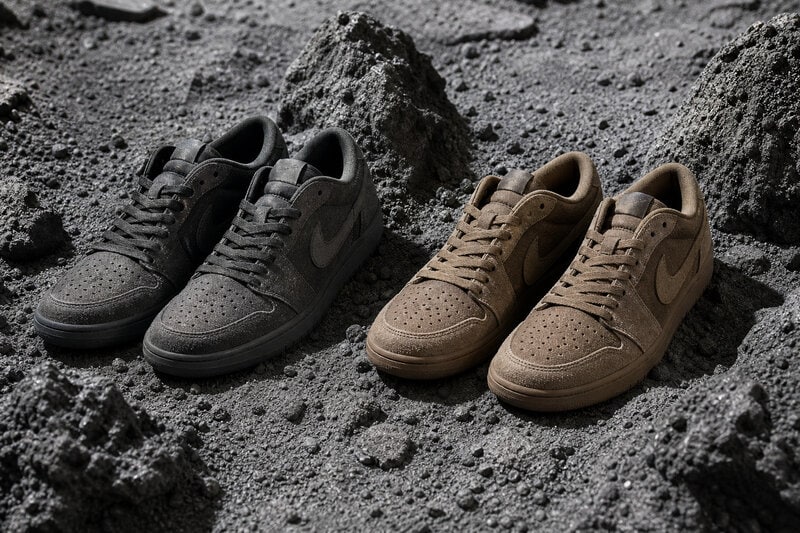
Early imagery surfaced via community posts showing the “Moon Fossil” colorway rendered in muted gray-black tones consistent with lunar mare terrain. The shoe arrives alongside a second colorway, the “Light Chocolate” (style code JF3394-200), with both rumored for the same February 18, 2027 date at $230. Style-code specifics are documented at Sneaktorious’s release information page, and confirmed details can be tracked through Air Jordan release date listings. All release details remain rumored at this stage and are subject to change.
What Moon Rocks Actually Look Like: A Geologist’s Field Guide
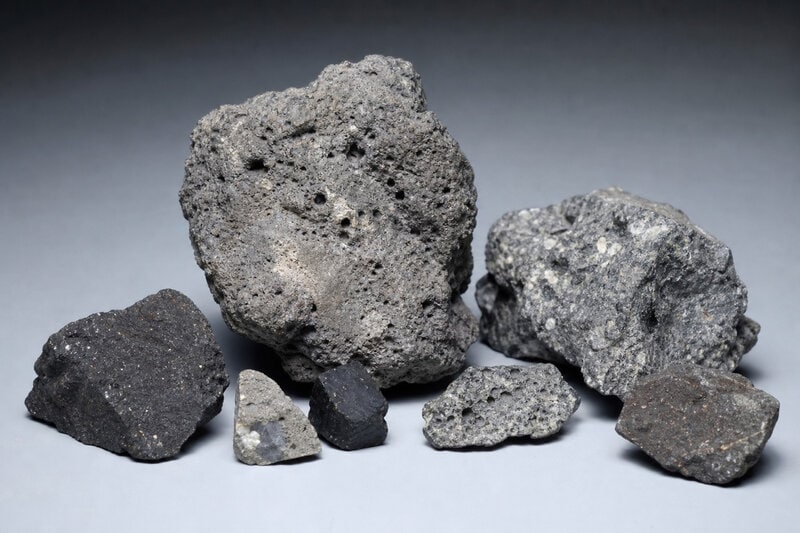
Popular imagination tends to picture moon rocks as smooth, uniform gray spheres. The reality documented by the Lunar and Planetary Institute (LPI) is considerably more dramatic. Apollo lunar samples fall into three broad categories: mare basalts (dark, fine-grained volcanic rocks formed in ancient lava floods), highland anorthosites (pale, coarse-grained rocks from the Moon’s original crust), and breccias — fragmented material fused together under the enormous pressure of meteorite impacts. Each category carries a distinct color signature spanning charcoal black to ash gray to cream white.
The dominant gray-black tones visible in early looks at the “Moon Fossil” colorway most closely mirror mare basalts, which cover roughly 17 percent of the lunar surface. Their darkness derives from iron- and titanium-rich minerals — particularly ilmenite and pyroxene — documented extensively in NASA’s Lunar Sample Compendium. Up close, Apollo samples display a glassy, vesicular texture: pocked with tiny bubbles formed when dissolved gases escaped rapidly as magma cooled in a vacuum. Designers chasing a “lunar” aesthetic instinctively replicate this quality through matte, porous-looking materials, often without knowing the precise mechanism behind it.
Perhaps the most counterintuitive finding from Apollo sample science is that fresh lunar surfaces are, according to the LPI, “extraordinarily sharp and angular” at the microscopic scale. Because the Moon has no wind, no liquid water, and no biological activity, nothing rounds the edges of mineral grains over time. Earth rocks are softened by billions of years of erosion; moon rocks preserve their original geometry with a fidelity that has no terrestrial equivalent. The Moon looks soft and powdery from a distance. Physically, it is not.
The Science of “Lunar Fossils”: What Regolith Preserves That Earth Cannot
The word “fossil” in the colorway’s name deserves careful unpacking, because scientists use it in a specific, non-biological sense when discussing the Moon. Lunar scientists at NASA’s Johnson Space Center describe regolith grains — the loose, fragmented rock and dust blanketing the surface — as “time capsules” of early solar system conditions. The regolith is, in effect, a physical fossil record: a layer-by-layer archive of impacts, volcanic eruptions, and solar bombardment stretching back 4.5 billion years.
What makes this preservation possible is the Moon’s near-total geological stillness. It has no plate tectonics to recycle crustal material, no hydrological cycle to dissolve and redeposit minerals, and only a vanishingly thin exosphere in place of a protective atmosphere. A 2022 analysis published in Science Advances by Hu Sen and colleagues at the Chinese Academy of Sciences confirmed that impact-generated glass beads formed during the Late Heavy Bombardment — a period of intense meteorite activity roughly 3.9 billion years ago — remain structurally intact on the surface today. On Earth, rocks of equivalent age have been subducted, metamorphosed, or eroded beyond recognition.
Solar wind ions — streams of hydrogen, helium, and heavier charged particles emanating from the Sun — compound this preservation story. Over billions of years, these ions become physically implanted inside regolith grains, altering the optical properties of surface minerals through a process geologists call space weathering. Space weathering gradually darkens and spectrally reddens the uppermost lunar layer, producing a visual identity inseparable from deep time. This is the principal reason the lunar surface appears darker and more muted than fresh basalt would look in a laboratory: the Moon’s color is, quite literally, the accumulated signature of billions of years of solar exposure. The “Moon Fossil” name, whether by design or intuition, captures something real.
Apollo Sample Science: Fifty Years of Color and Texture Research
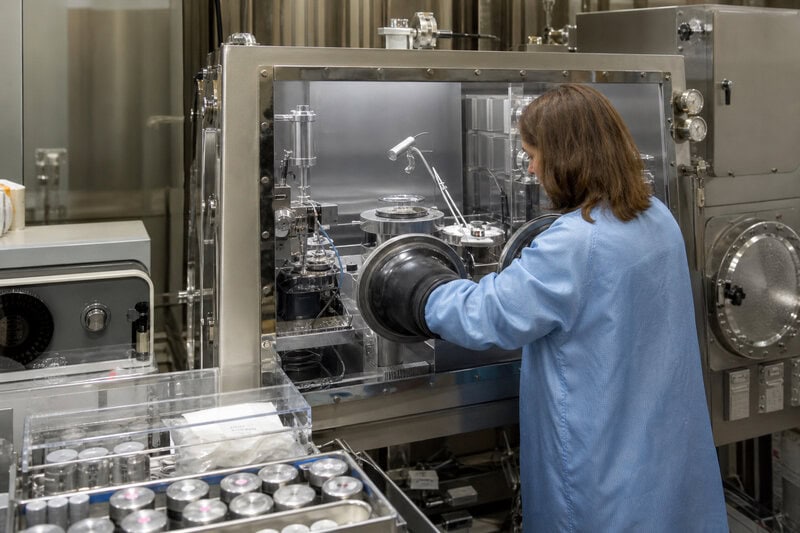
NASA’s Lunar Sample Laboratory Facility at Johnson Space Center in Houston currently curates the entire Apollo collection under nitrogen gas. Researchers must formally apply for access — a protocol that reflects how scientifically irreplaceable these 842 pounds of material remain more than half a century after collection.
Research on Apollo 11 and Apollo 12 mare basalt samples established that the Moon’s dark volcanic plains formed from magma oceans that crystallized between approximately 3.1 and 3.9 billion years ago. The mineral assemblages that crystallized from those magmas — especially ilmenite, a black iron-titanium oxide — give mare regions their characteristic charcoal hue, as documented in the LPI’s sample records. Highland anorthosite samples tell a different story. The famous “Genesis Rock,” retrieved by Apollo 15 astronauts David Scott and James Irwin in 1971, revealed that the Moon’s pale uplands are composed almost entirely of calcium-rich plagioclase feldspar. The Moon’s two-tone color palette reflects fundamentally different geological histories for its dark lowlands and bright highlands, not simply different degrees of surface weathering.
A landmark 2023 study by researchers at the Chinese Academy of Sciences, analyzing samples returned by the Chang’e-5 robotic mission, extended our understanding of lunar volcanism further still, confirming that volcanic activity continued until at least 2 billion years ago — roughly a billion years later than earlier Apollo-era estimates had suggested. The textures and colors that define the lunar surface are the product of processes operating across timescales that dwarf anything in the human record.
Lunar Surface Geology: Why the Moon Looks the Way It Does
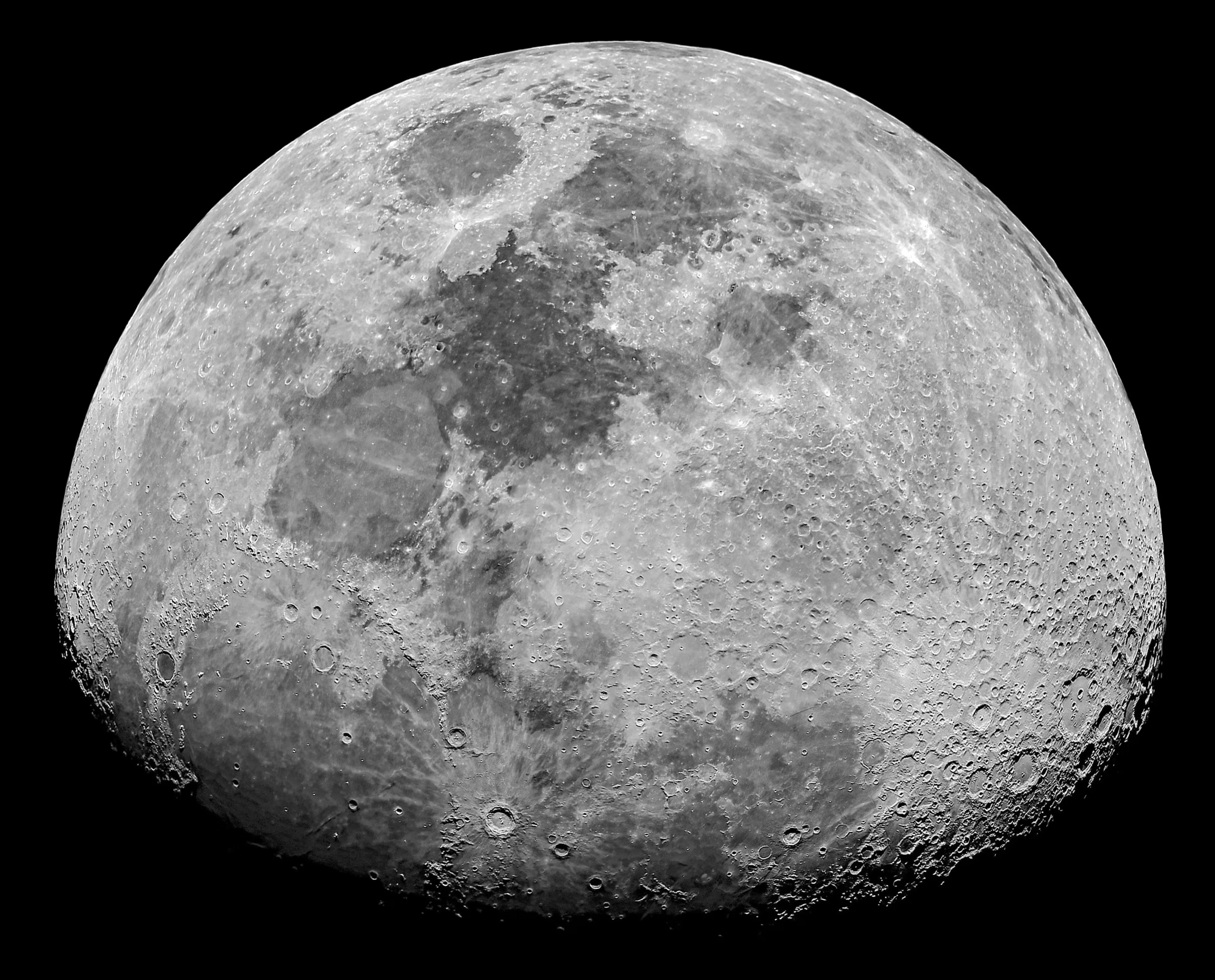
The Moon’s familiar gray-and-white appearance from Earth results from two competing optical effects: albedo (the fraction of incoming sunlight a surface reflects back) and phase angle (the geometric relationship between the Sun, the Moon, and the observer). Fresh impact craters appear brilliant white from Earth because they expose unweathered rock that space weathering has not yet had time to darken — a phenomenon well documented by NASA’s Lunar Reconnaissance Orbiter science team. Mare regions have an average albedo of roughly 0.07, meaning they reflect only about 7 percent of incoming sunlight, while highland regions average around 0.12. This difference aligns precisely with the mineral composition differences identified in Apollo samples, as recorded by the USGS Astrogeology Science Center.
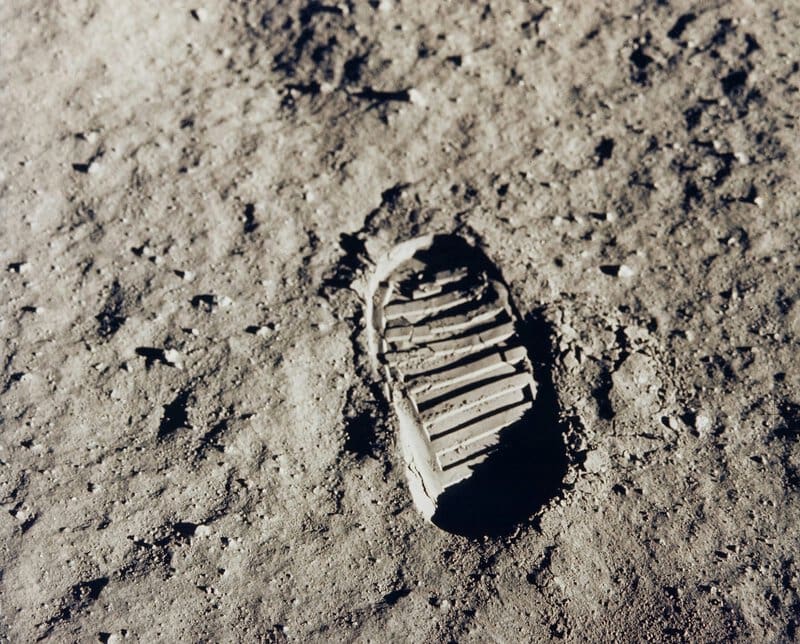
The surface itself is blanketed in regolith averaging 4 to 5 meters deep in mare regions and up to 10 to 15 meters deep in older highland terrain. This powdery layer — composed of glass beads, mineral fragments, and impact-fused clumps called agglutinates — gives the lunar surface its matte, non-reflective quality at human scales. NASA’s documentation of Apollo-era astronaut footprints illustrates the material’s paradoxical character: the prints sank only roughly 1 to 2 centimeters into the surface and are expected to persist for millions of years in the absence of any erosive forces. Visually soft and dusty. Physically sharp, abrasive, and cohesive.
From Geology to Design: How the Moon Fossil Colorway Maps Onto Lunar Science

Intentionally or not, the pairing of the dark “Moon Fossil” and the pale “Light Chocolate” colorways loosely maps onto the two dominant lunar color registers: dark mare basalt and pale highland anorthosite. Whether any designer consciously made that connection is beside the point; what matters is that the visual language of lunar geology is coherent enough that it appears even when not deliberately invoked.
The Air Jordan 5 silhouette, originally designed by Tinker Hatfield and released in 1990 with shark-tooth midsole detailing intended to evoke jet-fighter aggression, has proven particularly receptive to extraterrestrial reinterpretations. Its angular, mechanical geometry already reads as non-terrestrial in a way that rounder, more organic silhouettes do not. UNDEFEATED, a Los Angeles-based retailer with a track record of technically precise, understated colorwork, brings a design sensibility that aligns more naturally with lunar science’s actual palette — muted, mineral, and deliberately unglamorous — than with the fluorescent space-age aesthetics common in earlier moon-themed sneakers.
Why This Release Is Worth Watching Beyond the Hype Cycle
Timing adds a layer of context worth noting. NASA’s Artemis program aims to return humans to the lunar surface and collect new samples from the South Pole region by the late 2020s, meaning lunar geology is about to re-enter the public news cycle with considerable force. A moon-themed release in February 2027 lands at a moment when the scientific story behind its name will be independently newsworthy — whether or not that timing was calculated.
The most durable sneaker collaborations are those whose conceptual references bear scrutiny long after the hype dissolves. The geology of the lunar surface — with its 4.5-billion-year visual archive of impact, volcanism, and solar bombardment preserved in 842 pounds of rock sitting in a Houston laboratory — offers exactly that kind of deep, verifiable story. The Moon has been building its aesthetic for longer than Earth has had complex life. It did not need a collaborator.