
A Tyrannosaurus rex could exert a bite force of approximately 8,000 pounds per square inch, according to a 2017 study published in PeerJ by Gignac and Erickson — enough force to crush the hood of a modern SUV. That number is worth holding in mind while watching The End of Oak Street, the new creature feature in which Anne Hathaway and Ewan McGregor face a prehistoric invasion of their suburban neighborhood, because the film’s central joke — that the dinosaurs don’t want to meet the new residents, they want to eat them — turns out to be more scientifically grounded than it has any right to be.
When the Neighborhood Becomes the Hunting Ground
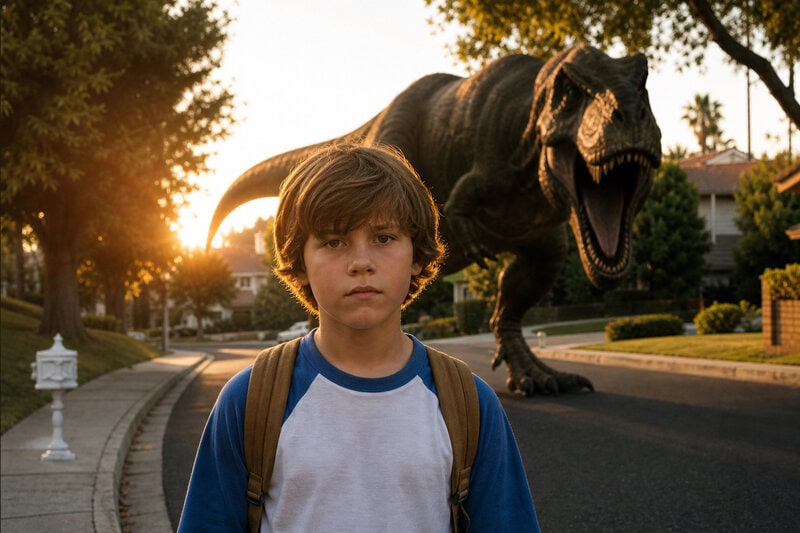
Set in 1980s suburbia, The End of Oak Street has drawn comparisons to Jurassic Park for its dinosaurs, its sense of wonder, and its constant, low-grade feeling of danger. Those comparisons are not merely flattering — they are instructive. Jurassic Park was praised by paleontologists for grounding its monsters in real behavioral science, depicting animals that operated according to ecological logic rather than pure movie-monster malice. Critics have noted that The End of Oak Street follows a similar instinct.
The film’s “stomping and chomping” chaos, often dismissed as the vocabulary of pure fantasy, actually reflects several emerging and established scientific consensus points about how large theropod predators behaved in their environments. The suburban setting, far from being arbitrary, replicates terrain features that paleontologists identify as favorable for ambush-capable predators. Dead-end streets, enclosed yards, and limited escape corridors are, from a predator’s perspective, genuinely useful geography.
What ‘Theropod’ Actually Means — and Why It Matters for Understanding Danger
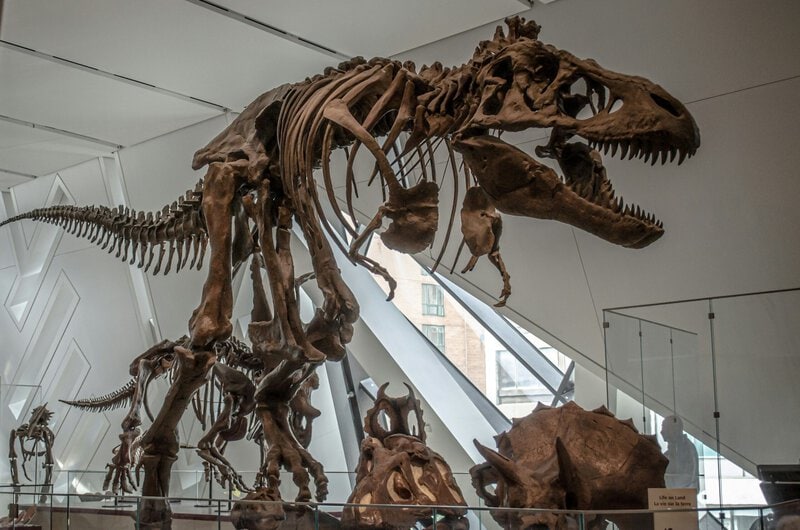
Theropods — from the Greek for “beast-footed” — are the bipedal, largely carnivorous dinosaur clade that includes T. rex, Velociraptor, and Spinosaurus. They also include every living bird, which makes theropods the most successful predator lineage in vertebrate history. That fact alone reframes how we should think about dinosaur predator behavior: these are not extinct curiosities but the direct ancestors of creatures children encounter daily.
The bipedal body plan carried a direct hunting advantage. Walking upright on two legs freed the forelimbs for grasping prey, a morphological trait the American Museum of Natural History links directly to the hunting efficiency of large theropods. It also meant these animals could accelerate quickly from a standing position, channeling muscular energy into forward movement rather than lateral balance.
Scientific consensus is firm that theropods were active, warm-blooded predators — not the sluggish, cold-blooded reptiles of older popular imagination. Where the science remains genuinely contested is the question of pack hunting. University of Alberta paleontologist Philip Currie has studied potential evidence for coordinated group behavior in species like Velociraptor, but definitive fossil evidence of coordinated group kills has not yet been established. Parents and educators discussing dinosaur behavior with children should draw that line clearly: some theropod behaviors are settled science, and some are still being actively debated.
The Science of the Stomp: How Large Predators Close Distance
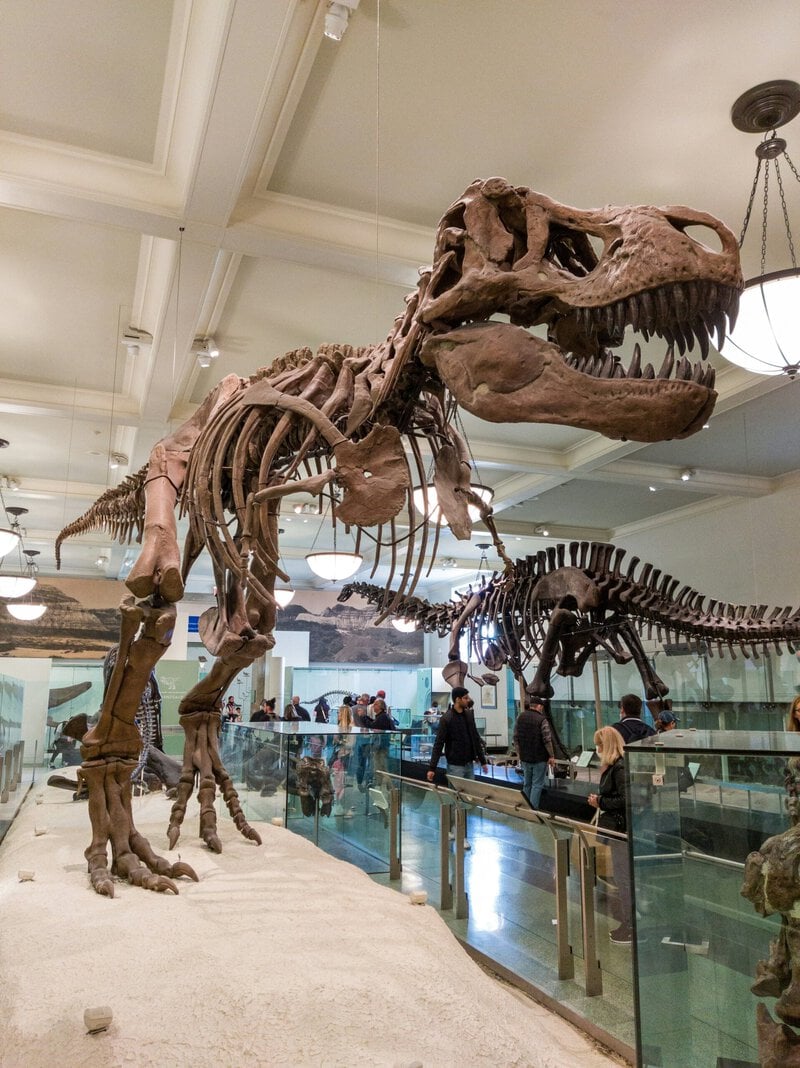
A 2021 biomechanical study from the University of Amsterdam, led by Pasha van Bijlert, used vertebral structure analysis to estimate T. rex‘s preferred walking speed at approximately 4.6 kilometers per hour — slower than a jogging child. That finding meaningfully reframes the classic movie trope of sprinting away from a tyrannosaur. The real danger was never sustained pursuit.
Sprint estimates from the same research tradition suggest large theropods could reach 17 to 20 kilometers per hour in short bursts, meaning the predatory threat lay in sudden, explosive closing of distance rather than endurance. That strategy mirrors documented behavior in modern large felids, per research from the Smithsonian’s National Zoo: the most dangerous moment is not the chase but the lunge from concealment.
The “stomping” descriptor in The End of Oak Street maps onto a real biomechanical reality. Animals above a certain mass threshold — roughly 6,000 kilograms for an adult T. rex — generate seismic ground vibrations detectable at range. Researchers at Oxford have documented this phenomenon in elephant locomotion, and the finding has been extrapolated to large dinosaur movement in the paleontological literature. A suburban neighborhood would have transmitted those vibrations efficiently through paved streets and compact soil.
For parents and children thinking through the scenario: the scariest thing about a large theropod in a neighborhood would not be its roar but its patience. Modern crocodilians — among the closest living relatives of non-avian dinosaurs alongside birds — are documented by the Florida Fish and Wildlife Commission as ambush specialists capable of remaining motionless for hours before striking. Genuine dinosaur danger is less about speed and more about stillness.
Chomping by the Numbers: Teeth, Jaws, and What Fossil Evidence Tells Us

T. rex teeth were serrated, banana-shaped, and up to 30 centimeters long. They were not designed to slice cleanly but to puncture and pull — a “grip and rip” feeding strategy confirmed by bite-mark analysis on Triceratops bones published in the Proceedings of the Royal Society B by Longrich and colleagues. The mechanics are less like a knife and more like a grappling hook.
Spinosaurus, increasingly prominent in popular culture after featuring in Jurassic Park III, operated on an entirely different predatory model. University of Portsmouth researcher Nizar Ibrahim’s 2020 paper in Nature demonstrated that Spinosaurus was a semi-aquatic ambush hunter, its cone-shaped teeth optimized for gripping fish rather than processing large terrestrial prey. That finding meaningfully complicates any “every big theropod hunts the same way” narrative — and is exactly the kind of nuance that good dinosaur science communication should convey.
Fossil evidence of healed bite wounds on herbivore bones — documented by the Black Hills Institute and cited in multiple peer-reviewed papers — confirms that some theropod attacks were survived by prey animals. Predators did not always press to a kill, possibly because of the injury risk that large, struggling prey presents. The parallel to documented lion predation studies from the Serengeti is striking: real apex predators are economical, not relentless.
One detail worth sharing with young audiences: a child’s instinct to freeze when frightened is actually biomechanically sound against motion-triggered predator vision. Cornell Lab of Ornithology research confirms this trait in modern raptors — hawks and eagles rely heavily on movement detection — and researchers hypothesize the same sensitivity applied to their theropod ancestors. Knowing that freezing has a real scientific basis can turn a fear response into a teachable moment about predator ecology. But that strategy has important limits, as the next section explains.
Senses and Strategy: How Theropods Would Have ‘Read’ a Suburb
Vision would have been the primary sense — and here the films diverge from the science in a consequential way. Theropod eye socket geometry, analyzed via computed tomography scans by Witton and colleagues at the University of Portsmouth, suggests large predators like T. rex had forward-facing eyes providing binocular overlap comparable to modern hawks. This directly contradicts the “vision based on movement” trope that Jurassic Park popularized — and means that holding perfectly still would not have been the reliable escape strategy the movies suggest. Children who absorb only the movie version of this detail are learning something scientifically inaccurate.
Smell would have been the secondary and possibly more powerful channel. The olfactory bulb ratio in T. rex endocasts — the natural internal casts of the braincase — studied by Witmer and Ridgely at Ohio University, is proportionally larger than in any living bird of prey. The implication is a sense of smell closer to a modern turkey vulture’s than to a hawk’s. A suburban environment’s layered mixture of cooking smells, garbage, lawn chemicals, and human scent would likely have been intensely stimulating to a large theropod predator navigating unfamiliar terrain.
Inner ear reconstructions published in the Journal of Neuroscience indicate theropods were most sensitive to low-frequency sounds, meaning the ambient hum of appliances, traffic, and power tools characteristic of a residential neighborhood could have masked a predator’s approach — or, conversely, drawn its investigative attention toward novel vibrations.
A critical caveat belongs here, and researchers including Lawrence Witmer explicitly make it: all sensory reconstruction is inferential, extrapolated from comparative anatomy and endocast data. No direct behavioral evidence survives the fossil record. Confident behavioral claims derived solely from skull morphology should be treated with appropriate scientific caution, and science communicators working with children should model that intellectual honesty.
What ‘The End of Oak Street’ Gets Surprisingly Right — and Where It Stretches
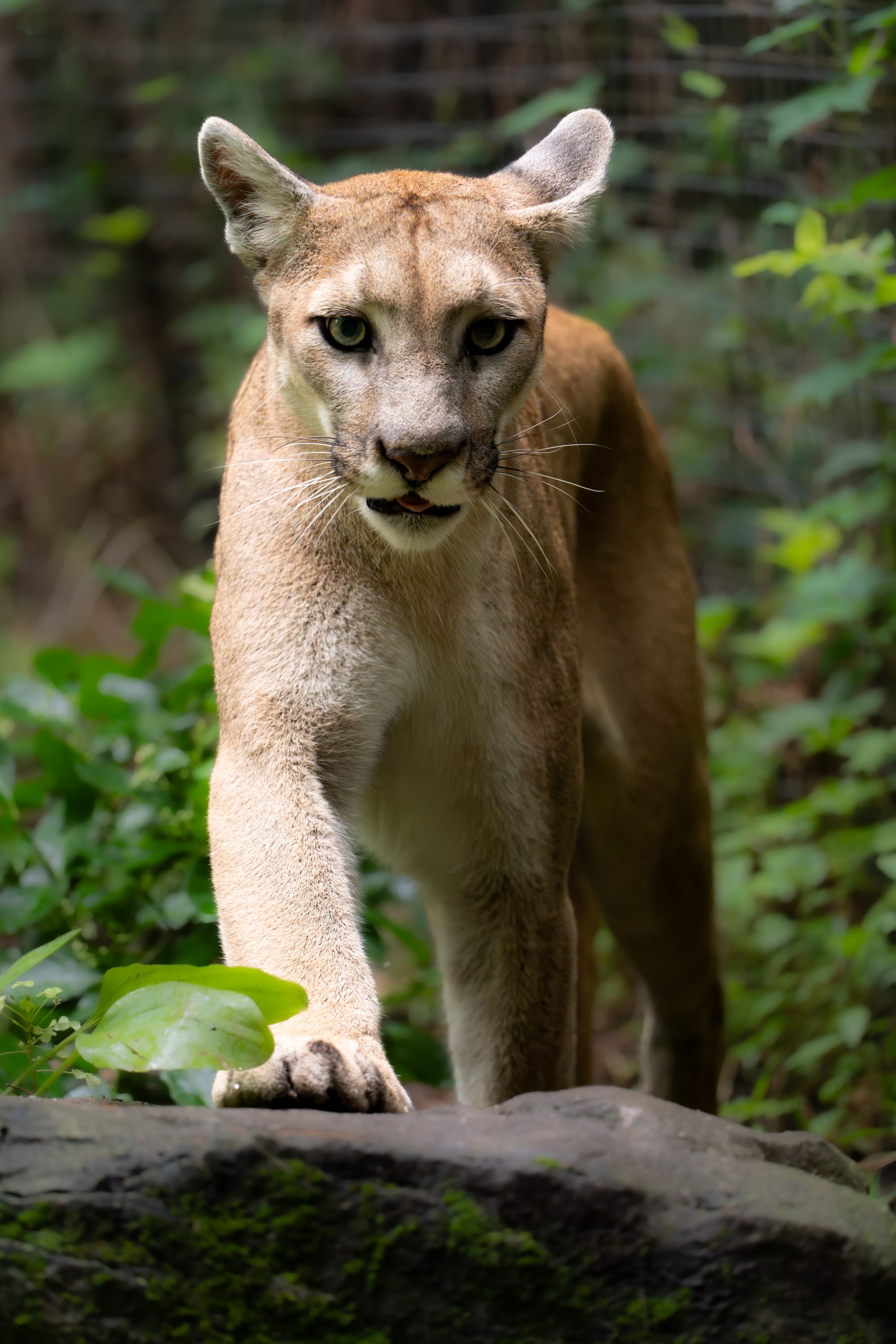
The film’s core premise — that dinosaurs would treat suburban humans as prey rather than as objects of curiosity — aligns with genuine scientific understanding. Large theropods were obligate carnivores with no evolutionary template for learned human avoidance. Modern apex predators like mountain lions and tigers that avoid human settlements have been shaped by millennia of human hunting pressure. A theropod would have had no such conditioning. From a purely ecological standpoint, a small, slow, ground-dwelling primate would have registered as prey.
The film’s 1980s suburban setting is scientifically apt in one underappreciated way. The era predates widespread traffic management, acoustic mitigation, and light-pollution reduction — conditions that behavioral ecologists at the Wildlife Conservation Society identify as among the factors most disruptive to large predator navigation in human-altered environments. A 1980s cul-de-sac would have been, by contemporary standards, a relatively low-sensory-interference landscape for a large predator orienting in unfamiliar terrain.
Where the film likely stretches scientific plausibility is in its creature-feature pacing. The coordinated, relentless pursuit implied by the genre is at odds with the energy-conservation foraging strategies documented across large modern predators and inferred for large theropods. Real apex predators hunt opportunistically and rest extensively, per research from the Max Planck Institute for Animal Behavior. A paleontologically accurate theropod invasion might involve a great deal of waiting punctuated by brief, catastrophic violence — compelling cinema of a different, slower kind.
The observation from the New York Times review that the movie “slyly undermines its formula” is worth taking seriously in this context. The most scientifically honest dinosaur media tends to be work that refuses pure monster-movie logic in favor of depicting animals behaving like animals. Jurassic Park‘s enduring scientific reputation rests largely on that choice, and The End of Oak Street earns its comparisons to that film precisely when it follows the same instinct.
Why This Matters for How We Teach Kids About Predator Science
Creature features like The End of Oak Street function as what science communicators at the National Science Teaching Association call “interest hooks” — emotionally engaging entry points that, when followed with accurate information, measurably increase retention of biological concepts in children aged 6 to 12. A child who has watched dinosaurs stomp through a suburban neighborhood is already primed to ask real questions about how those animals actually moved, sensed, and hunted.
The danger-and-wonder combination the film delivers mirrors a documented pedagogical principle. Research from the University of California, Berkeley’s Greater Good Science Center shows that awe — defined as the feeling of encountering something vast and not fully understood — enhances curiosity-driven learning in young audiences. Dinosaurs, correctly understood, are among the most reliably awe-inducing subjects in all of natural history.
Parents and educators can use the film’s “eat not meet” premise to open accurate conversations about predator ecology, food webs, and obligate carnivory — the condition of animals that must consume other animals to survive — without anthropomorphizing the creatures involved. Avoiding anthropomorphism is a key goal of the Next Generation Science Standards for life science education. A fast-paced creature feature, used deliberately, turns out to be a surprisingly effective tool for achieving it.
Three concrete questions worth raising with children after watching the film: Why didn’t the dinosaurs just leave when the humans made noise? (Discuss obligate carnivory and the absence of conditioned human avoidance.) Why did the T. rex seem to smell the characters before it saw them? (Discuss olfactory bulb size and comparative anatomy.) And why did waiting sometimes work — and sometimes not? (Discuss the limits of motion-based vision detection and the role of binocular forward-facing sight.) Each question connects a movie moment to a real scientific concept without requiring any additional materials.
Whether encountered in a suburban dinosaur thriller or in a paleontology classroom, the most durable lesson dinosaurs offer children is the same one good science always offers: the natural world operates on its own logic, one that rewards understanding over fear and curiosity over avoidance. The T. rex doesn’t care about the neighborhood watch. But understanding how it actually thought, sensed, and hunted is its own kind of protection — and a genuinely excellent reason to pay attention in science class.