
A football-sized crustacean sits motionless on the seafloor, more than a mile below the surface, and has not eaten in five years — yet by every measurable biological indicator, it is perfectly fine. The giant deep-sea isopod, documented by the National Oceanography Centre, endures pressures that would buckle steel, temperatures hovering just above freezing, and darkness so complete that no photon from the sun has ever reached it. It is not surviving in spite of these conditions. It has been shaped by them, over millions of years, into something that challenges nearly every assumption biologists once held about what animals require to live.
The Scale of What We Don’t Know
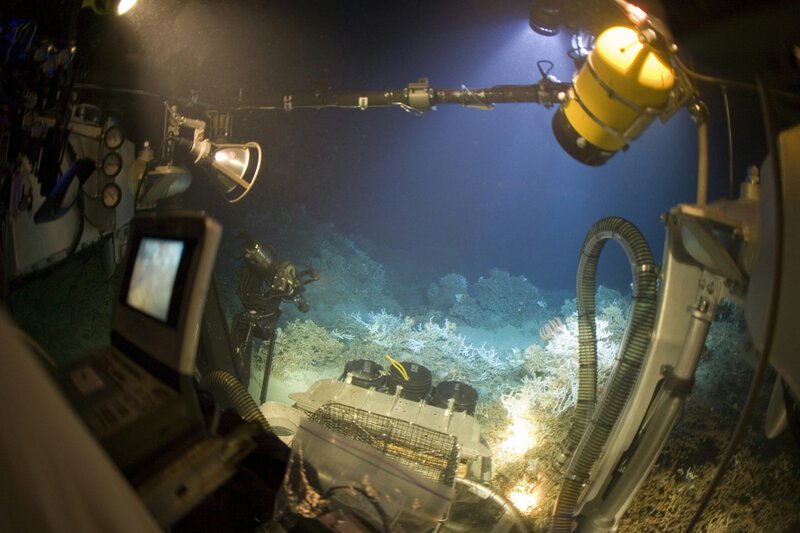
The deep sea — defined broadly as ocean water below 200 meters, where sunlight effectively disappears — covers more than 60 percent of Earth’s surface. Yet scientists estimate that fewer than 20 percent of its species have been formally described. That gap is not a minor administrative backlog. It means the majority of animal life on this planet remains unknown to science, persisting in conditions that, until recently, researchers assumed were incompatible with complex biology. The strange deep-sea creatures already documented are not curiosities at the margins of life. They are evidence that the rules governing survival are far more flexible than the surface world suggests.
This article is not primarily about bizarre appearances — the translucent bodies, the needle teeth, the bioluminescent lures. Those features are real and startling, but they are symptoms of something stranger and more consequential: radically alien physiology and biochemistry, evolved under stacked environmental pressures that would kill any surface organism within minutes.
The Problem With the Deep: Three Stacked Hazards
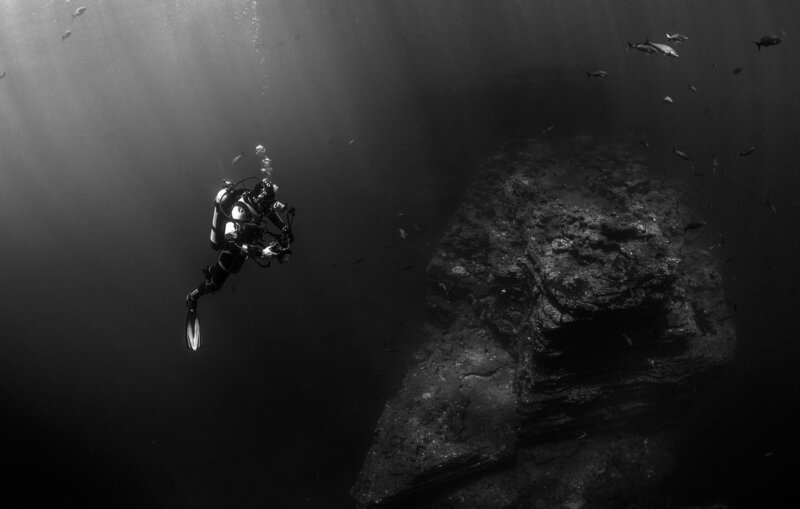
Surviving in the deep ocean means contending with three simultaneous and compounding challenges. First, hydrostatic pressure — the weight of water above — increases by roughly one atmosphere every ten meters. At 4,000 meters, the pressure exceeds 400 atmospheres, enough to collapse the air spaces in a human body instantly. Second, temperature across most of the abyssal plain averages between 2 and 4 degrees Celsius, slowing chemical reactions and demanding that enzymes function at rates that would render surface-adapted proteins nearly useless. Third, and most consequentially for the food web, there is no sunlight. Below the euphotic zone — approximately the top 200 meters of the ocean — photosynthesis is impossible.
Without photosynthesis, the foundation of nearly every terrestrial and shallow-ocean food web collapses. Deep-sea ecosystems run instead on two alternative energy sources: marine snow, the slow drift of decaying organic matter — dead plankton, fecal pellets, fragments of larger animals — that sinks from the surface over weeks; and chemosynthesis, a process by which certain bacteria convert chemical energy from hydrothermal vents or cold seeps into organic matter, bypassing sunlight entirely. These are thin, unreliable energy streams compared to the productivity of sunlit waters, and the animals adapted to them show the biological consequences of that scarcity in every aspect of their anatomy and behavior.
Layered on top of these three primary challenges are oxygen minimum zones — mid-depth regions where bacterial decomposition consumes dissolved oxygen faster than ocean circulation replenishes it, dropping saturation to levels lethal for most marine life. Certain sea cucumbers persist in these zones. The vampire squid, confirmed by the Marine Conservation Society as a genuine deep-sea resident, lives there permanently. How these animals manage oxygen scarcity is one of the central questions of deep-sea biology.
Seeing in the Dark: Radical Eyes, Bioluminescence, and the Barreleye’s Rotating Skull
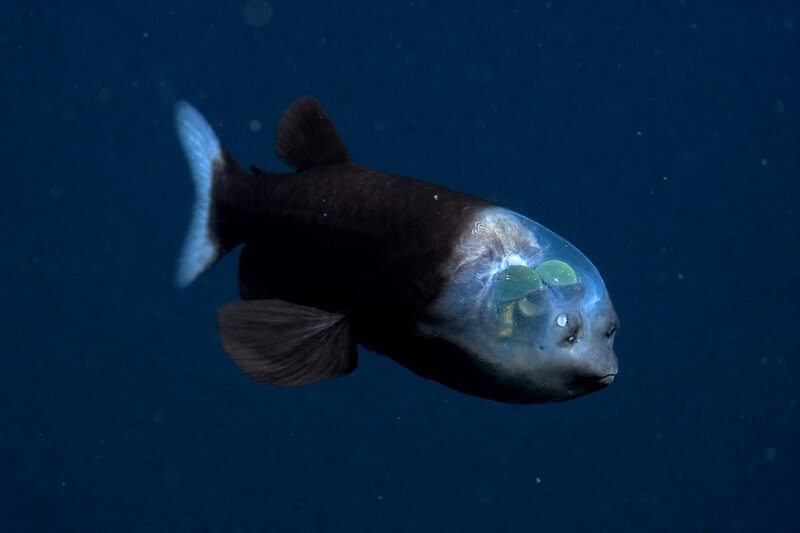
In a world without sunlight, vision does not disappear — it transforms. The barreleye fish (Macropinna microstoma) is one of the clearest demonstrations of how radically. Its most distinctive feature is a transparent, fluid-filled dome forming the outer surface of its head, housing a pair of tubular eyes that can rotate from a forward-facing position to an upward-facing one. This rotation allows the barreleye to spot the silhouettes of prey or predators against the faint downwelling light from above — a capability that surprised researchers at the Monterey Bay Aquarium Research Institute when they first captured clear ROV footage of the living animal in 2009. Specimens collected before that point had lost their transparent domes due to pressure change during retrieval, leaving scientists with an incomplete and systematically misleading picture of the fish’s anatomy for decades.
That observational problem runs deeper than a single species. By around 2022, MBARI’s ROVs had logged approximately 5,600 dives, repeatedly demonstrating that deep-sea animals can look radically different alive at depth than they do after collection at the surface. Pressure loss, temperature change, and the trauma of retrieval alter color, texture, and body shape in ways that gave museum-based taxonomy a distorted view of these creatures for most of scientific history. The barreleye is the most vivid example, but it is far from the only one.
Where eyes reach their limits, bioluminescence fills the gap. An estimated 76 percent of deep-sea animals produce their own light through luciferase-driven chemical reactions — a figure that makes the deep ocean, counterintuitively, one of the most light-active environments on Earth. The black seadevil anglerfish’s bioluminescent lure, dangling from a modified dorsal spine above its cavernous mouth, is among the most documented examples of predatory bioluminescence. The viperfish (Chauliodus sloani), documented by both the National Oceanography Centre and the Marine Conservation Society, uses photophores — specialized light-producing organs — along its belly, which may function to mimic bioluminescent prey and draw targets toward its fang-length teeth. Bioluminescence in the deep is not decoration. It is infrastructure.
Eating Almost Nothing: Metabolic Strategies From the Gulper Eel to the Giant Isopod
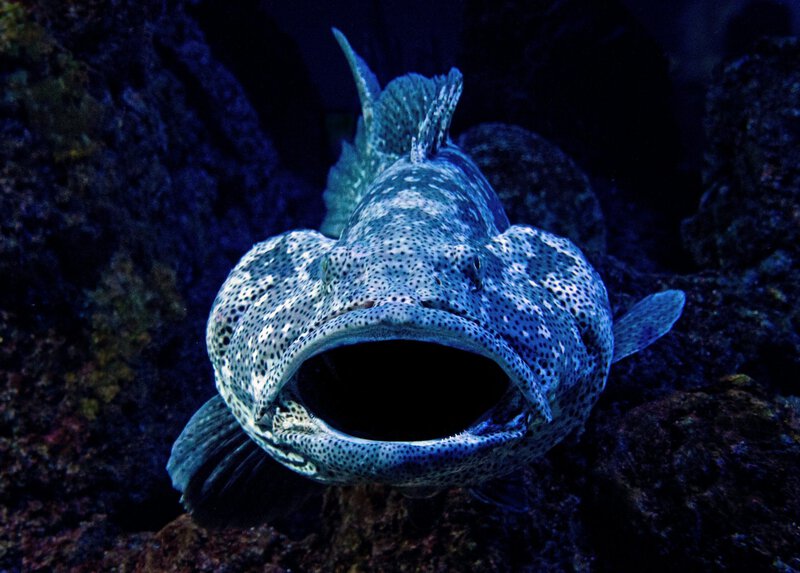
When food arrives in the deep ocean, it is often unpredictable in timing, enormous in size relative to what came before, and impossible to waste. Evolution has responded by producing some of the most extreme feeding architectures in vertebrate biology. The gulper eel (Eurypharynx pelecanoides) possesses a jaw that can unhinge and expand to engulf prey larger than its own body — an adaptation the Marine Conservation Society describes as one of the most extreme feeding structures among vertebrates. Its stomach stretches to accommodate whatever it captures, because the next meal may be weeks or months away.
The giant isopod handles scarcity differently. Rather than extreme physical capacity, it deploys metabolic depression — a scientifically documented ability to reduce its metabolic rate to a fraction of what surface-equivalent crustaceans require. This allows it to survive multi-year fasting periods between meals of fallen whale carcasses, known as whale falls, or other carrion that drifts to the seafloor. It is not simply a slow animal. It is an animal that has downshifted its biology to match the pace at which food arrives in its environment.
The hagfish represents yet another strategy. Research has documented that hagfish can absorb dissolved organic compounds directly across their body surface, supplementing digestion through the gut — a mechanism that blurs the conceptual boundary between eating and simply persisting in a nutrient-containing medium. Among the strange species from the ocean’s depths, the hagfish may be the one that most directly challenges the definition of feeding itself.
Morphological extremes driven by scarcity appear across the deep-sea fauna. The snipe eel’s impossibly elongated, filament-like body and the basket star’s fractal-branching arms both maximize surface area for capturing sparse prey particles drifting through the water column. These are not random variations. They are engineering solutions to the same fundamental problem: how to intercept enough energy to stay alive in a near-empty ocean.
Surviving Without Oxygen and Rewriting Respiration
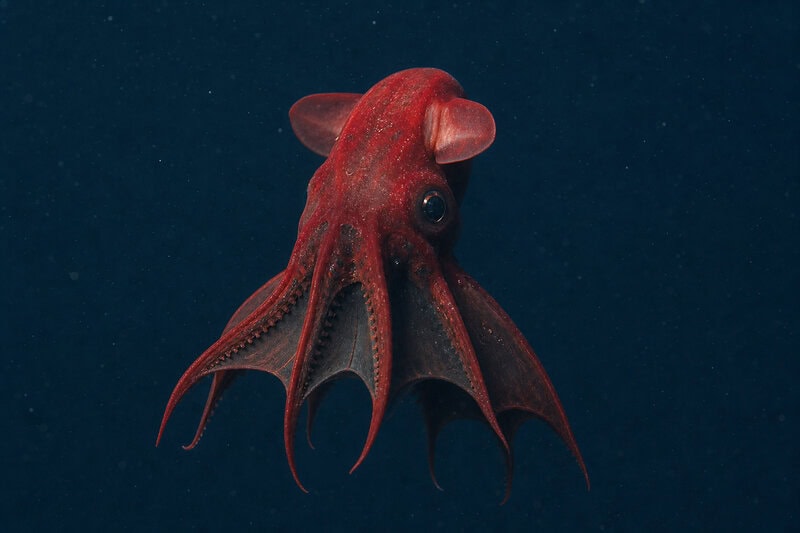
The vampire squid (Vampyroteuthis infernalis) is not, despite its name and appearance, a true squid or octopus. It occupies its own taxonomic order, Vampyromorphida, and lives permanently in the oxygen minimum zone, where dissolved oxygen can fall below 3 percent saturation — a level lethal to the vast majority of marine animals. Its survival there is biochemically enabled by hemocyanin, the copper-based oxygen-carrying molecule in its blood, which has an unusually high affinity for oxygen at low concentrations. This allows the vampire squid to extract enough oxygen from near-anoxic water to sustain slow, energy-efficient movement. The precise molecular mechanisms underlying this affinity remain an active area of biochemical research, and scientists caution against assuming that what has been documented in this species generalizes across deep-sea fauna in hypoxic environments.
Near hydrothermal vents, where superheated, chemically rich water erupts from the seafloor, an entirely different respiratory and nutritional economy operates. Yeti crabs (Kiwa species) farm chemosynthetic bacteria on their own bristled claws, waving them rhythmically in sulfide-rich vent plumes to maximize bacterial growth, then graze on those bacteria — making each crab, in effect, a living greenhouse that cultivates its own food source. This behavior, documented by deep-sea biologists, is one of the most striking examples of an animal actively managing its own microbiome as a survival strategy.
Whether certain deep-sea organisms in severely hypoxic sediments use anaerobic metabolic pathways analogous to those seen in parasitic organisms is an active area of investigation. Scientists involved in this research explicitly caution against over-generalizing from single-species findings to the broader deep-sea community, and no consensus has been established on the question as of publication.
Pressure, Proteins, and the Molecular Secrets of Survival

The most fundamental challenge of deep-sea life is invisible to the eye: the effect of extreme pressure on proteins. At the depths where many of the most unusual ocean creatures live, pressure physically unfolds and disables the proteins of surface-adapted organisms — a process called denaturation. Deep-sea species counteract this through two primary mechanisms. First, they produce pressure-stable variants of critical proteins, with structural differences that maintain function under compression. Second, many accumulate trimethylamine oxide (TMAO), a small organic molecule that physically stabilizes protein structure by counteracting the compressive force of water at depth. TMAO concentrations in deep-sea fish tissues tend to increase with depth — a pattern documented across multiple species and now considered one of the clearest molecular signatures of piezophily, or adaptation to high pressure.
The frilled shark (Chlamydoselachus anguineus), with its gill slits arranged in a pattern reminiscent of Paleozoic fossils and its sinuous, eel-like body, solves buoyancy under pressure using a liver dense with low-density lipids rather than a swim bladder — a solution that predates bony fish by hundreds of millions of years and avoids the structural vulnerabilities that air-filled chambers create at depth. Among truly bizarre deep-sea creatures, the frilled shark is notable less for its behavior than for being a living demonstration that some evolutionary solutions are so effective they require no revision across geological timescales.
The cookiecutter shark complicates the category of “deep-sea creature” in a different way. Despite being a documented deep-sea species, it migrates nightly toward the surface to bite plug-shaped chunks from much larger animals — whales, dolphins, and, on record, the sonar domes of submarines. It is a reminder that vertical migration blurs the boundary between deep-sea and surface ecology, and that life in the deep ocean is often not a fixed address but a dynamic, daily commute.
DNA repair in deep-sea organisms remains a genuinely contested research frontier. The general challenge of maintaining genome integrity under extreme chemical and physical conditions has prompted researchers to investigate whether deep-sea species possess enhanced or alternatively regulated repair pathways. No scientific consensus has been established on this question as of publication, and it should be understood as a hypothesis under active investigation rather than a documented adaptation.
What These Creatures Tell Us — and What We Still Don’t Know
Taken together, the documented biology of strange deep-sea creatures — from the dumbo octopus’s ear-like fins, which allow slow, low-energy propulsion, to the bobbit worm’s ambush predation launched from beneath the seafloor — demonstrates a consistent and consequential finding: the constraints that scientists once treated as universal requirements for animal life are, in fact, negotiable given sufficient evolutionary time and selective pressure. Life does not require sunlight. It does not require abundant oxygen. It does not require stable temperatures or moderate pressure. It requires only that the available conditions remain consistent enough for natural selection to operate across generations.
The observational gap remains vast. MBARI’s approximately 5,600 ROV dives represent a genuine scientific achievement, yet the total volume of the deep ocean means that even this dataset covers a fraction of accessible habitat. New species descriptions from deep-sea surveys continue to outpace formal taxonomic processing, and many animals captured on camera during ROV transects have not been formally described at all. The full catalog of documented deep-sea animal life represents a starting point, not a summary.
The most consequential open questions may extend beyond biology entirely. The biochemical strategies of deep-sea extremophiles — pressure-stable proteins, hypoxia tolerance, chemosynthetic energy extraction — are serious subjects of investigation in medicine, biotechnology, and astrobiology. NASA-affiliated researchers have identified the subsurface oceans of Jupiter’s moon Europa and Saturn’s moon Enceladus as candidate environments for life, and the hydrothermal vent ecosystems of Earth’s deep ocean serve as the primary empirical basis for those assessments. What survives at the bottom of Earth’s oceans is not merely scientifically interesting. It is the closest available model for what life might look like elsewhere in the solar system.
The blobfish offers a final, sobering perspective. Frequently cited as one of the most bizarre ocean creatures, it became a cultural icon of ugliness because deep-sea trawling dragged it to the surface, where the loss of pressure deformed its gelatinous, pressure-adapted body into the shapeless, drooping form most people recognize. In its actual habitat, it is an unremarkable-looking fish. The strangeness is not the animal’s. It is the artifact of human intervention — a reminder that the same extreme isolation that drove these adaptations also makes deep-sea ecosystems acutely vulnerable to disturbance. What humanity finds strange, it also has the power to destroy before it fully understands. Deep-sea mining operations, bottom trawling, and ocean warming now reach depths once assumed too remote to affect, and they are doing so at a pace that may foreclose the science before it can be completed.