
At roughly 22,000 Kelvin, Bellatrix burns hotter than almost any other star visible to the naked eye — yet that extraordinary heat is quietly accelerating a sequence of transformations that will eventually erase the blue giant entirely, long before the supernova explosion most people would predict as its ending.
Meet Bellatrix: Orion’s Overlooked Shoulder Star
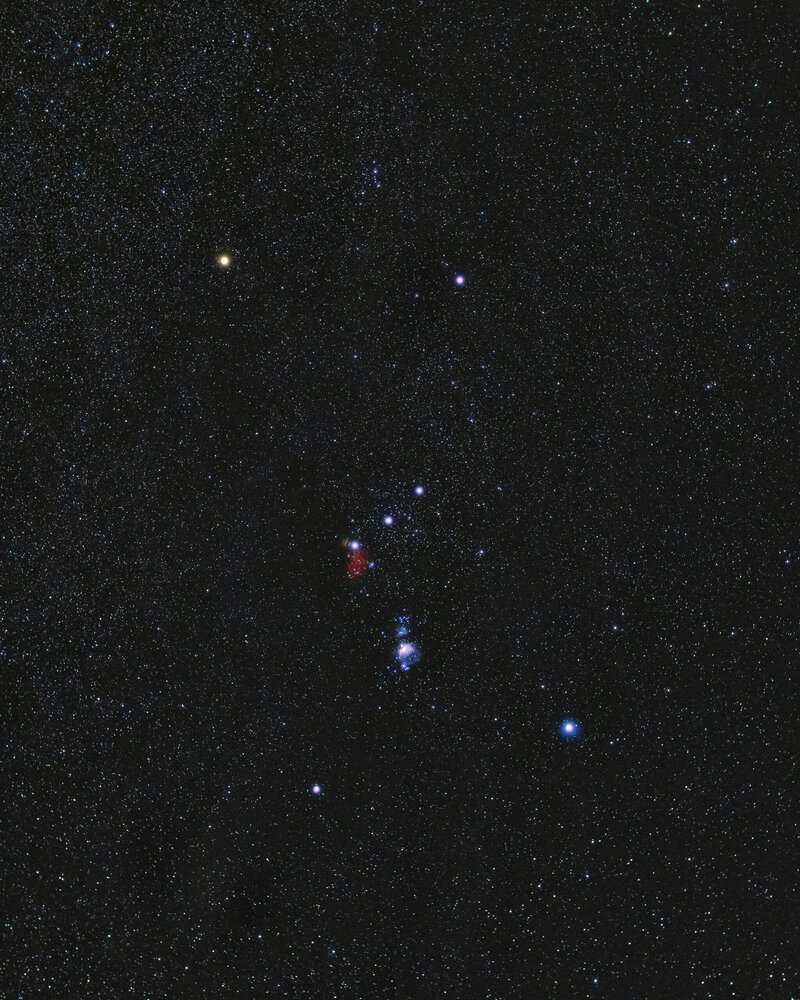
Formally designated Gamma Orionis under the Bayer system, Bellatrix marks the left shoulder of Orion the Hunter and holds the position of third-brightest star in the constellation. Depending on the photometric dataset used, it ranks either 25th or 26th among all stars visible from Earth — a minor discrepancy that reflects how Bellatrix’s confirmed variability complicates precise brightness measurements.
The name derives from the Latin for “female warrior.” Medieval astronomers also called it “the Amazon Star,” a title that persisted through centuries of sky-lore. Its practical importance was no less durable: Bellatrix is one of only 57 navigational stars codified in the Nautical Almanac and still used in celestial navigation today. Sailors and aviators have steered by its blue-white light for generations, unaware that the star guiding them is already deep into a slow-motion crisis.
Bellatrix occupies a uniquely instructive position in the sky because it shares a constellation frame with Rigel and Betelgeuse — two massive stars whose own impending fates have drawn intense scientific attention. That proximity on the sky, though not in physical space, gives researchers a rare comparative laboratory: three massive stars at detectably different stages of the same life cycle, all within a single constellation’s field of view.
What “Blue Giant” Actually Means — and Why It Matters
The spectral classification B2 III encodes two distinct and consequential facts. “B2” places Bellatrix among the hottest, most luminous stars accessible to the naked eye, with a surface temperature of approximately 22,000 Kelvin — hot enough that most of its energy pours out in the ultraviolet, with the blue-white glow perceived from Earth representing only the cooler tail of a far more energetic output. The Roman numeral “III” designates it a giant, signaling that it has already expanded beyond the compact main-sequence stage and is now burning hydrogen in a shell around an increasingly dense, inert core.
That distinction matters enormously. The main sequence — the stable hydrogen-fusing phase that defines a star’s long middle age — is effectively over for Bellatrix. Because luminosity scales steeply with a star’s mass, blue giants like Bellatrix radiate energy tens of thousands of times faster than the Sun, compressing what could be billions of years of stellar life into a few tens of millions. At approximately six times the Sun’s diameter, Bellatrix has already expanded past its original size, and its core has fundamentally changed — a change that sets the clock running on a sequence of further transformations.
For observers on Earth, none of this interior drama is visible. Bellatrix looks like a steady, sharp point of blue-white light. But stellar physicists reading its spectrum see a star that has crossed an internal threshold from which there is no return.
The Strange Transformation That Comes Before the Explosion
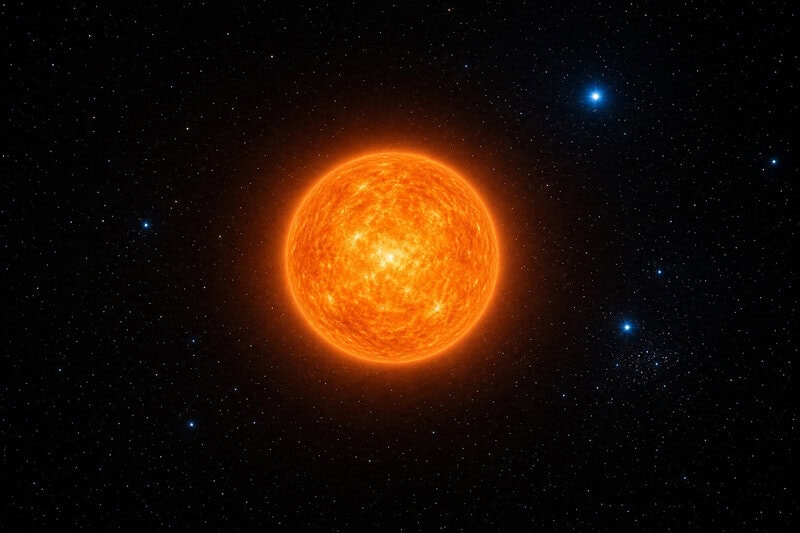
Here is the part of Bellatrix’s story that most popular accounts omit: the supernova is not next. According to the standard stellar-evolution framework, a star of Bellatrix’s mass class will not proceed directly from blue giant to explosion. Instead, it will first migrate across what astrophysicists call the Hertzsprung-Russell diagram — a map of stars plotted by temperature against luminosity — expanding dramatically and cooling to become a red supergiant. Its neighbor Betelgeuse currently occupies exactly that phase, which is why comparing Betelgeuse and Bellatrix side by side reveals the same story told at different speeds.
The red supergiant phase involves the star’s outer envelope expanding by factors of hundreds while its surface temperature drops below roughly 4,000 Kelvin. A star that currently emits blue-white light at 22,000 Kelvin would, after this transformation, glow deep red and span a volume that could swallow the inner planets of a solar system. Were Bellatrix to complete this transition tomorrow, it would be unrecognizable as the sharp navigational star it is today.
Emerging — and still contested — research complicates this picture further. Some stellar-evolution models suggest that stars in Bellatrix’s mass range may lose their outer envelopes through intense stellar winds before fully completing the red supergiant phase. If that happens, Bellatrix could explode not as the classic Type II core-collapse supernova associated with red supergiants, but as a stripped-core Type Ib or Ic supernova — an explosion with a different brightness profile, shorter duration, and a different remnant. The distinction is not cosmetic: it determines what, if anything, Bellatrix leaves behind.
Bellatrix’s confirmed variability — the slight, irregular fluctuations in its brightness over time — is consistent with the pulsational instability that stellar models associate with this pre-transition phase. These brightness variations hint at internal processes churning beneath the surface, though researchers are careful to note that variability alone does not pinpoint where exactly on the evolutionary timeline a given star sits.
The Supernova Endgame: What the Science Actually Says
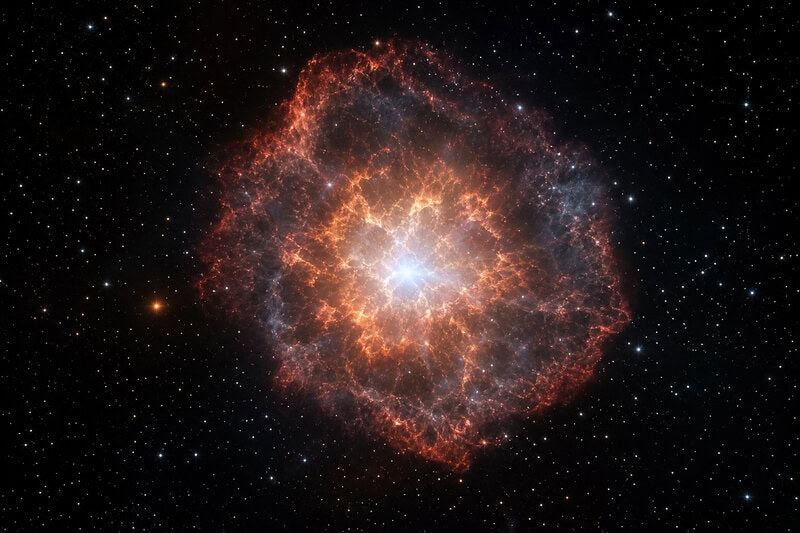
When Bellatrix’s core finally exhausts its nuclear fuel — on a timescale that stellar-evolution models estimate at roughly a few million years, though precise figures depend heavily on assumptions about mass-loss rates — the result will be a core-collapse supernova. The iron core, which cannot generate energy through fusion, will collapse in milliseconds under its own gravity. The rebound shock wave will tear the outer layers apart in an explosion that, from Earth, would likely be visible in broad daylight.
What that explosion leaves behind — a neutron star or, if the remaining core mass exceeds roughly three solar masses, a stellar-mass black hole — depends critically on how much material Bellatrix loses during the intermediate phases. This is why the transformation described above is not merely a curiosity: it is a key determinant of the supernova’s character and aftermath. The intermediate story and the final story are inseparable.
It is important to distinguish confidence levels here. That Bellatrix will eventually die in a core-collapse supernova is established scientific consensus. That it will do so “in a few million years” is an order-of-magnitude estimate carrying significant uncertainty, not a precise prediction. Researchers working with data from ESA’s Gaia mission are actively refining mass, age, and distance estimates for Orion’s stars in ways expected to sharpen these timelines within the coming decade.
Unlike Betelgeuse — whose proximity of roughly 700 light-years and dramatic dimming in 2019-2020 prompted widespread discussion of a possible imminent explosion — Bellatrix sits at an estimated distance of about 250 light-years. Closer, in other words. Any supernova would be spectacular from Earth, but at that distance it poses no meaningful threat to the biosphere.
Bellatrix in the Broader Story of Orion’s Stars
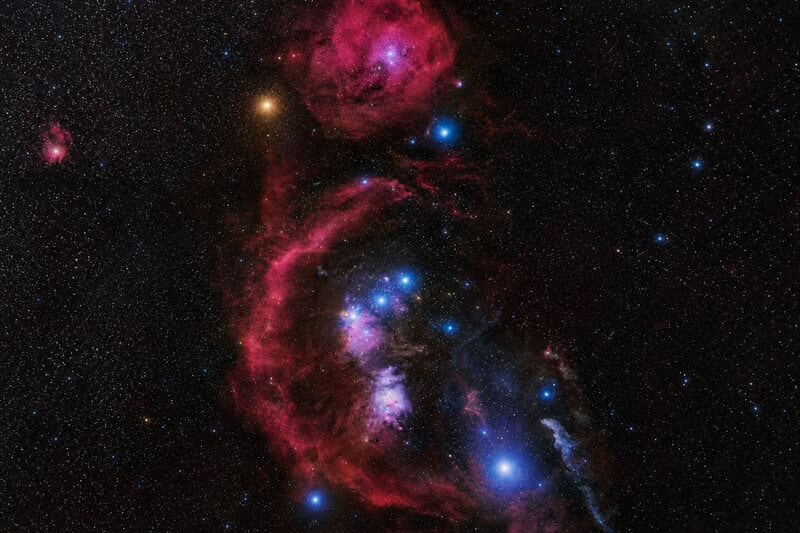
The Orion OB1 stellar association — the loose grouping of hot, massive stars to which Bellatrix belongs — has already produced multiple supernova events over the past few million years, evidence of which is preserved in the region’s interstellar gas and dust structure. Bellatrix, Rigel, and Betelgeuse are, in this context, the current generation of a cycle that has been running for tens of millions of years.
Rigel appears to be a blue supergiant further along toward explosion; Betelgeuse is a red supergiant already in what researchers consider its pre-supernova phase; and Bellatrix represents an earlier, transitional chapter of the same narrative. Studying all three simultaneously — their variability, spectral lines, temperature gradients, and mass-loss signatures — allows astronomers to test stellar-evolution models against stars of similar age but slightly different masses, essentially watching the same story unfold at different speeds within a single constellation.
The single largest remaining uncertainty in Bellatrix’s future is its mass-loss rate. How aggressively its stellar winds strip material from its outer layers will determine whether it completes the red supergiant phase, loses its envelope early to become a stripped Wolf-Rayet-like object, or follows some intermediate path. Current models differ substantially on this point, and the disagreement has direct consequences for predicting supernova types across an entire class of massive stars — not just Bellatrix.
There is also the unresolved question of the “red supergiant problem” — the observed deficit of red supergiants just below the luminosity threshold where supernovae occur, identified in a landmark 2009 study by Smartt and colleagues. This deficit raises the possibility that some stars in Bellatrix’s mass range collapse quietly into black holes without producing a visible explosion at all. That scenario remains contested, but it has not been ruled out, and it serves as a reminder that stellar evolution still contains genuinely open questions at its most dramatic moments.
A Star Still Worth Watching
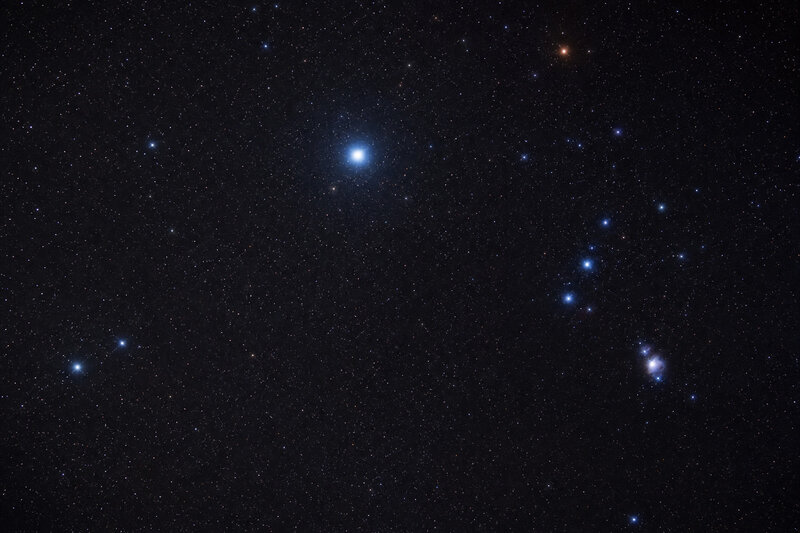
For navigators, poets, and anyone who has simply looked up at Orion on a winter night, none of this turmoil is perceptible. Bellatrix will shine from Orion’s left shoulder across every human lifetime for millennia to come, its blue-white light arriving steadily from 250 light-years away, carrying no visible hint of the extraordinary interior drama it encodes. The star’s strange fate — swell before you explode, transform before you die — is written in physics that plays out on timescales no human civilization will survive to witness directly.
But understanding that fate, and the sequence of transformations that precede it, tells us something genuinely important: in stellar evolution, the ending is shaped by everything that comes before it. Bellatrix is not simply a bomb waiting to go off. It is a complex, evolving system in the middle of a long transformation — and what it does next, before the supernova, may turn out to be the most instructive part of its story.