The Bunyip
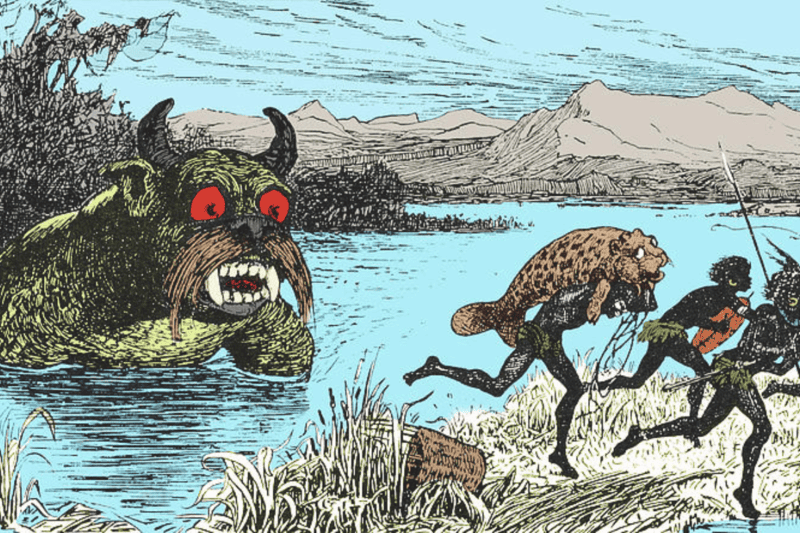
Venturing into the intriguing realm of Indigenous Australian folklore, we uncover the enigmatic Bunyip—a mythical creature with a seemingly harmless name that belies its perilous nature. In a country renowned for assigning endearing names to deadly creatures, the Bunyip stands out as a legendary amphibious lake monster.
Its haunting reputation includes laying in wait at night to devour unsuspecting prey, with a particular fondness for women and children. Descriptions of the Bunyip vary widely, incorporating canine faces, crocodile-like heads, glowing eyes, jet-black fur, equine tails, and flippers or thick legs. As an apex predator, the Bunyip signals its approach with eerie howls before launching its lethal attack.
The Bunyip’s historical significance intertwines with European settlers taking Indigenous Australian mythology seriously, with some attributing its origins to Irish Púca folklore. During the 19th century, reported Bunyip sightings proliferated, culminating in the first written use of the term in 1845, describing fossils near Geelong as evidence of a deceased Bunyip.
A peculiar skull found in New South Wales fueled public fascination, even if identified as a deformed foal or calf. The Bunyip phenomenon captivated Australians, resulting in expeditions to capture the creature, only to discover mundane explanations like a large Platypus. Despite its heyday waning in the 1950s, the Bunyip remains an enduring symbol, representing Australia’s unique blend of myth and wildlife, where, as the saying goes, “something is gonna try to kill you at some point.”