
At least ten finger rings recovered from elite Bronze Age tombs in the ancient Aegean have been identified through chemical analysis as very likely forged from meteoritic iron — metal that did not originate on Earth, but arrived here from space. The discovery, reported across multiple scientific outlets including Science News and Science Alert, reframes a familiar piece of jewelry as something altogether extraordinary: a wearable fragment of the cosmos that, roughly 2,500 to 3,500 years ago, appears to have served as a marker of power among the ruling classes of the Minoan and Mycenaean civilizations.
Why Iron Was More Precious Than Gold in the Bronze Age
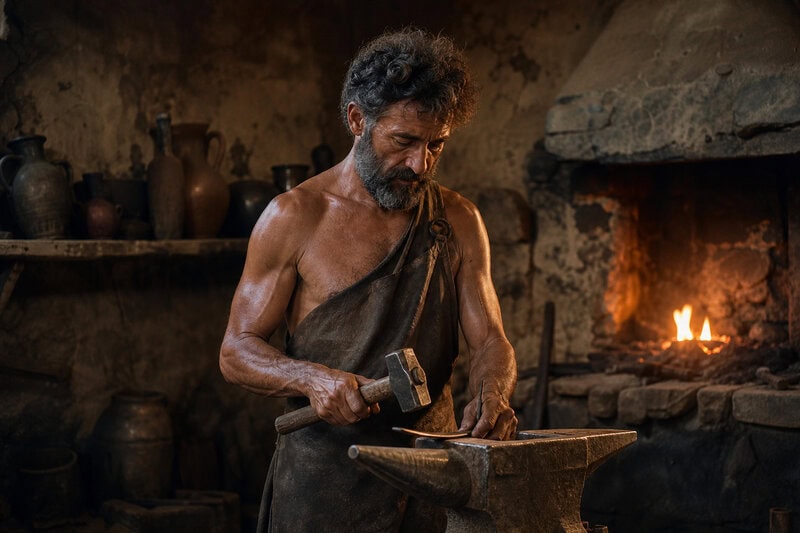
To appreciate why a meteorite ring would have carried extraordinary prestige, it helps to understand the material world of the Bronze Age — the broad period running from roughly 3300 to 1200 BCE. During this era, smiths had not yet mastered the high-temperature techniques required to smelt usable iron from terrestrial ore at any meaningful scale. Bronze, an alloy of copper and tin, dominated toolmaking and weaponry. Iron, by contrast, was vanishingly rare in workable form, and its scarcity made it more valuable than gold by weight in some ancient Near Eastern texts.
Meteorites — chunks of metal-rich rock that survive the fiery passage through Earth’s atmosphere and reach the ground — offered a remarkable exception. Many meteorites, particularly the class known as iron meteorites, arrive already in a metallic state that requires no smelting, only skilled hammering and shaping. This meant that a Bronze Age craftsperson who obtained a meteorite fragment had access to workable iron without any of the technological infrastructure that would later make the Iron Age possible. The material was, in every practical sense, a gift with no earthly substitute.
Researchers note that meteorites provided a rare but ready source of iron for ancient Bronze Age cultures before smelting became common. That combination of workability, durability, and literally extraterrestrial origin gave meteoritic iron both practical and deeply symbolic weight in cultures that had no scientific framework for understanding where it came from — only the knowledge that it fell from the sky.
How Scientists Tell Space Metal From Earthly Iron
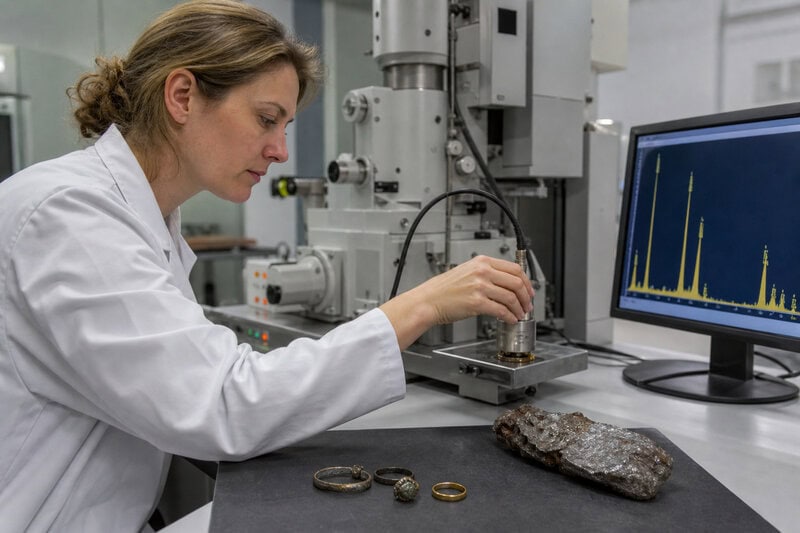
The identification of meteoritic iron in archaeological objects depends on elemental chemistry. Meteoritic iron characteristically contains elevated levels of nickel and cobalt in ratios that simply do not occur in terrestrial iron ores or in the slag and metal produced by early smelting processes. These geochemical signatures act as a fingerprint, allowing researchers to distinguish space metal from earthly metal with a high degree of confidence.
The primary analytical tool in this research is energy-dispersive X-ray fluorescence, or ED-XRF — a non-destructive technique that bombards an object with X-rays and reads the characteristic energy signatures emitted by the elements present. Because ED-XRF does not require sampling or physical alteration of an artifact, it is particularly well-suited to museum collections and irreplaceable archaeological objects. Chemical analysis of Bronze Age iron objects indicates that Greek nobles may have indulged in signet rings made with precious metal from space, according to the researchers behind the study.
Scientists are careful with their language here: “very likely meteoritic” is the precise phrasing the research uses, not “definitively proven.” As is standard in archaeometallurgy — the discipline that applies materials science to archaeological metal objects — independent replication, larger sample sizes, and complementary isotopic analysis would further strengthen confidence in the findings. That scientific caution is worth preserving; it reflects the rigor of the method, not a weakness in the conclusion.
What the Tombs Reveal: Power, Prestige, and the Minoan-Mycenaean Elite
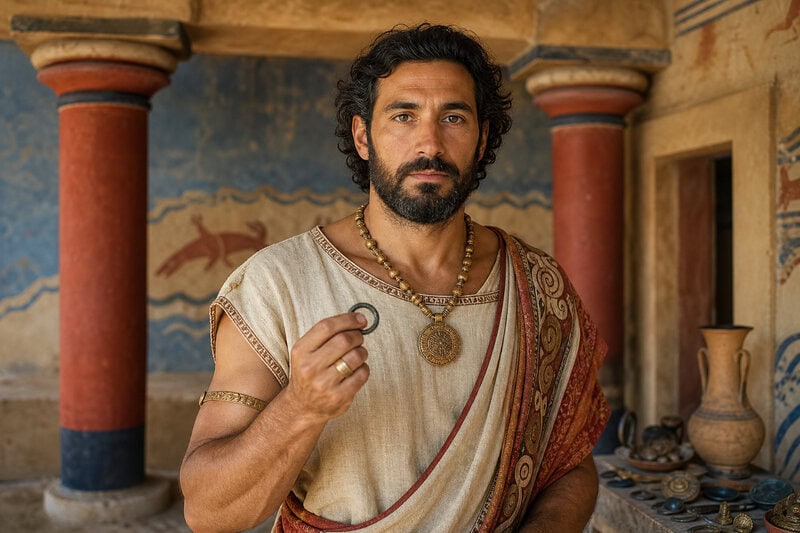
All of the finger rings identified as meteoritic iron were recovered from elite burial contexts associated with two of the dominant cultures of the Aegean Bronze Age: the Minoan civilization, centered on the island of Crete, and the Mycenaean civilization of mainland Greece. Both cultures are known for their palatial economies, long-distance trade networks, and elaborate mortuary practices that included interring the dead with objects signaling their rank and wealth.
The meteoritic iron rings were not buried alone. They were consistently found alongside gold, silver, and other high-status grave goods — a context that places them squarely within the material vocabulary of elite display rather than everyday life. As reporting from Phys.org notes, researchers speculate that rings likely made out of meteorites may have been popular power symbols among prominent individuals, members of the Minoan and Mycenaean elite — a hypothesis well-supported by the exclusivity of their burial settings.
Perhaps the most telling detail in the dataset is what did not test as meteoritic: tools, weapons, and other iron objects from the same period and region did not show meteoritic signatures. Only finger rings did. That pattern implies a deliberate, culturally specific choice to reserve space metal for personal adornment — for objects worn on the body in a way that would be visible to others — rather than for utilitarian purposes. The rings, in other words, appear to have been chosen for what they communicated, not merely for what they could do.
Analysis of the burial contexts reinforces the interpretation that these were curated status objects — carefully selected and intentionally placed — rather than incidental inclusions in the tomb assemblage.
The Fashion That Died With the Bronze Age Collapse
The cultural practice of forging finger rings from meteoritic iron appears to have had a clear chronological bracket. The trend flourished during the height of Minoan and Mycenaean palatial civilization and then disappeared by approximately 1200 BCE — the date historians associate with the Bronze Age Collapse, a poorly understood but catastrophic cascade of societal disruptions that ended palace-based civilization across the eastern Mediterranean within a few generations.
The timing is unlikely to be coincidental. After 1200 BCE, iron smelting from terrestrial ores began to spread across the Mediterranean world, gradually becoming routine. Once iron could be produced from ordinary ore, the unique scarcity that had given meteoritic iron its extraordinary value evaporated. A material that had been irreplaceable became, over centuries, commonplace. With the scarcity went the symbolic cachet.
The collapse of the palace economies also dismantled the administrative and trade networks through which rare materials were identified, moved across long distances, and transformed by specialist craftspeople into prestige objects. Meteorites, which are randomly distributed across landscapes, likely required deliberate search, recognition, and trade to reach the workshops where they were shaped into rings. Without the infrastructure of palatial redistribution, that supply chain may simply have ceased to function.
This tight chronological window — meteoritic iron rings flourishing before 1200 BCE and vanishing after it — is what allows researchers to interpret the phenomenon as a coherent elite cultural practice rather than a series of unrelated accidents scattered across time.
Broader Context: Space Metal Across the Ancient World
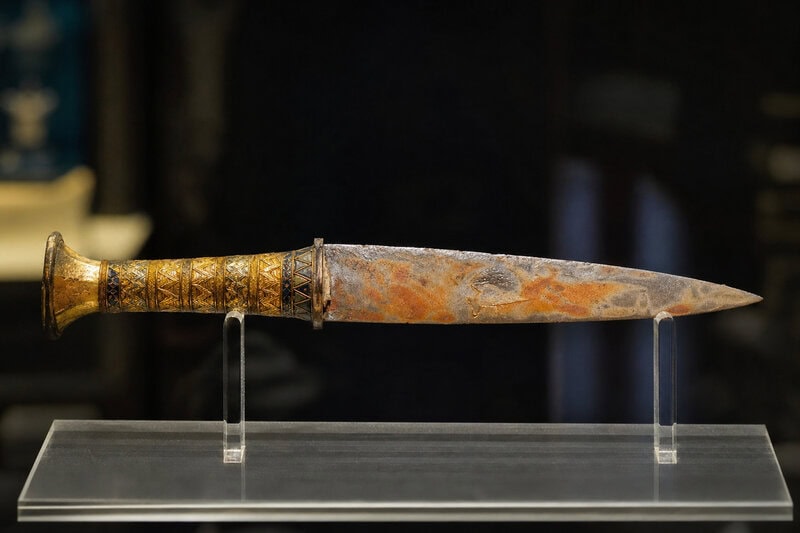
The Aegean findings fit into a broader pattern of ancient cultures identifying and deliberately using meteoritic material. Archaeologists have identified meteoritic iron in Tutankhamun’s famous iron dagger, in artifacts from the Shang Dynasty of ancient China, and in metal beads made by pre-Columbian peoples of North America. Across these widely separated cultures, the pattern suggests a cross-cultural capacity to recognize meteoritic material as different, rare, and worth preserving in high-status forms.
What distinguishes the Aegean case is the specific form chosen. Elsewhere, meteoritic iron was typically fashioned into weapons or ceremonial blades — objects with an aggressive or ritual function. In the Aegean Bronze Age, as Gizmodo’s coverage of the research highlights, the meteoritic material was shaped into finger rings: intimate, personal, socially visible objects of adornment. That choice reflects a culturally specific understanding of how extraordinary material should be displayed.
Together, these findings contribute to a growing body of archaeometallurgical evidence that space metal in the ancient world was not an accidental curiosity but a managed prestige commodity with deliberate cultural meaning — sought out, controlled, and deployed by elites who understood its rarity even if they had no scientific vocabulary for its extraterrestrial origin.
What Remains Uncertain — and Why It Matters

The researchers behind this work are explicit about the boundaries of their conclusions. The identification of these rings as meteoritic is described as “very likely” rather than certain, and a larger sample of tested objects along with complementary isotopic analysis could either confirm or refine the picture. Science News notes that the findings represent a significant but still-developing area of inquiry in Bronze Age archaeometallurgy.
Several important questions also remain open. How ancient craftspeople recognized a meteorite as a workable source of iron — whether by witnessing a fall, encountering surface finds weathered to a recognizable metallic character, or trading with other groups who had already processed the material — is not known and is actively debated among specialists. The social mechanism by which meteoritic iron acquired its prestige meaning is inferred from burial context rather than from any surviving written record, meaning the interpretation, while well-supported, is not definitive in the way that a textual source might be.
Future excavations, combined with the application of newer analytical techniques to previously unstudied Bronze Age iron objects held in museum collections, could substantially expand the known corpus. A larger dataset would sharpen the picture of whether meteoritic iron rings were a widespread elite fashion across the Aegean or a more localized phenomenon concentrated at particular sites or dynastic lines.
What the current evidence already establishes is striking enough on its own terms: that roughly 3,000 years ago, the most powerful people in the ancient Aegean world chose to wear on their fingers a metal that had traveled across interplanetary space to reach them — and that this choice was almost certainly no accident.