
In a conventional metal, electrical resistance falls predictably as temperature drops — and in copper or aluminum, the math behind that curve has been settled physics for decades. In a strange metal, that comfortable predictability vanishes: resistance decreases in a perfectly straight, featureless line all the way toward absolute zero, a behavior that has defied every standard model physicists have built over seventy years. Now, a team of researchers has turned a precision tool from quantum metrology — quantum Fisher information — on the problem, and the results reveal something even stranger than the resistance curve alone suggested.
The Metal That Should Not Exist
Strange metals are not a laboratory curiosity confined to exotic conditions. They appear at the heart of high-temperature copper-oxide superconductors, in heavy-fermion compounds where electrons behave as though they weigh hundreds of times their normal mass, and in twisted bilayer graphene systems that have captivated condensed matter physicists since 2018. In each case, the strange metal forms the “normal state” — the phase the material inhabits just above the temperature at which superconductivity switches on. Understanding what a strange metal actually is, at the quantum mechanical level, is therefore a prerequisite for understanding, and eventually engineering, materials that could superconduct at room temperature. That understanding has remained stubbornly out of reach.
As reported in research published in Nature Physics, physicists have now applied quantum Fisher information (QFI) — a concept borrowed from the science of ultra-precise quantum measurement — to characterize how deeply entangled the electrons in a strange metal actually are. The central finding is striking: as a strange metal forms, its QFI increases strongly and without a characteristic scale, a signature that has no counterpart in conventional metallic behavior and points toward a fundamentally new organizing principle in quantum matter.
What Makes a Metal ‘Strange’ in the First Place
To appreciate why this result matters, it helps to understand what physicists mean when they call something a Fermi liquid — the standard theoretical framework that strange metals violate. Landau’s Fermi liquid theory, developed in the 1950s, treats the electrons in a metal as weakly interacting “quasiparticles”: dressed-up versions of free electrons that carry the same charge and spin but whose effective mass has been renormalized by their interactions with neighboring electrons. The crucial point is that perturbations around the filled “Fermi sea” of electron states remain mathematically tractable, and resistance in such metals scales as the square of temperature — a clean, testable prediction confirmed in thousands of experiments on ordinary metals.
A strange metal, by contrast, is a metallic phase of matter not described well by Landau’s Fermi liquid theory of small perturbations about the Fermi sea. The quasiparticle picture breaks down entirely. Resistance scales linearly with temperature rather than quadratically, and the electrons cannot be decomposed into individual, weakly interacting units. This breakdown is not merely an inconvenience for theorists: it signals that the electrons are so strongly correlated, so deeply entangled with one another, that the entire many-body system must be treated as a single quantum object. Standard perturbation theory — the workhorse of theoretical physics — offers no foothold here.
Quantum Fisher Information: A Metrology Tool Meets Condensed Matter
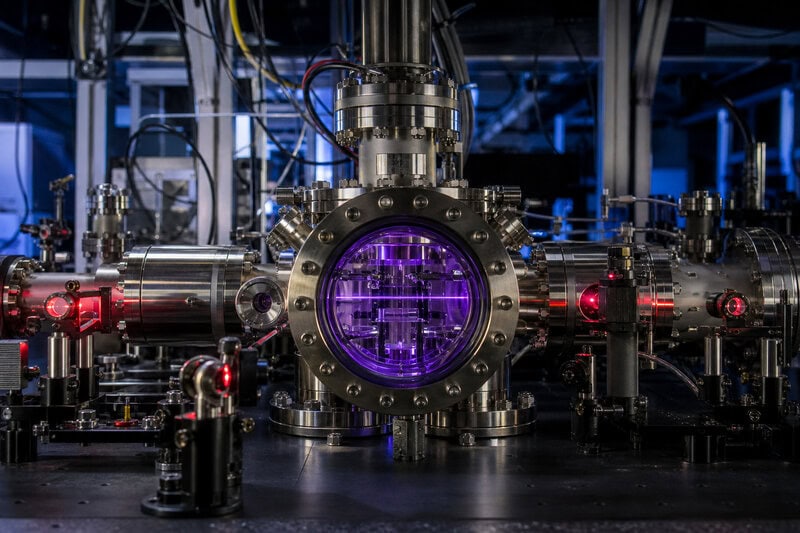
Quantum Fisher information is a central quantity in quantum metrology — the science of making the most precise possible measurements using quantum systems — and is the quantum analogue of the classical Fisher information that statisticians use to bound estimation error. In its metrology context, QFI quantifies how sensitively a quantum state responds to a perturbation: a higher QFI means the state changes more dramatically when nudged, which in a measurement device translates directly to better precision. Applied to a material, QFI becomes something different: a rigorous characterization of the richness and depth of the quantum correlations the material harbors.
Crucially, QFI also serves as a witness of multipartite quantum entanglement. This is a formal mathematical statement: if the QFI per particle exceeds the value achievable by any separable, unentangled state, the system is confirmed to harbor genuine many-body entanglement, not merely classical correlations that happen to look exotic. This makes QFI a particularly powerful diagnostic — it does not merely suggest entanglement is present, it certifies it. Physicists have now brought this tool to bear on strange metals, asking a pointed question: how do electron interactions, and the entanglement they generate, evolve as a material crosses from a conventional Fermi liquid into the strange metal phase?
An important practical advantage of this approach is that QFI is not purely a theoretical construct. It can, in principle, be extracted from dynamic susceptibility measurements — quantities accessible through neutron scattering and optical conductivity experiments already routinely performed at major research facilities worldwide. That connection between an abstract information-theoretic quantity and concrete laboratory observables is what gives this program its experimental traction.
What the Data Actually Show
The contrast between the two phases is sharp. In a Fermi liquid, QFI decreases as temperature rises: the system’s quantum coherence is gradually washed out by thermal fluctuations, entirely consistent with the quasiparticle picture in which each electron retains a well-defined individual identity. In the strange metal phase, the opposite occurs. The QFI increases strongly as the strange metal forms, and it does so without a characteristic scale — meaning there is no preferred energy or length at which the entanglement saturates or peaks. That scaleless growth is a hallmark of critical-like, scale-invariant physics, the kind associated with phase transitions where fluctuations extend across all length scales simultaneously.
This scaleless growth is the quantitative signature researchers have been seeking. It confirms that the breakdown of quasiparticles in a strange metal is not a gradual degradation of conventional behavior but an entry into a qualitatively different regime of quantum matter — one where entanglement, not kinetic energy or weak interactions, is the organizing principle. The QFI analysis also directly connects that entanglement to the anomalous electrical conductivity that gives these materials their name: linearly temperature-dependent resistance arises because strongly entangled electrons cannot be treated as independent carriers, and any theoretical framework that ignores their collective quantum character will fail to reproduce the transport data correctly.
UV-IR Mixing: A Phenomenon Without Precedent in This Context

Among the most striking results is what the researchers describe as UV-IR mixing — a coupling between high-energy (ultraviolet, or UV) and low-energy (infrared, or IR) physics. In ordinary physics, UV refers to short distances and high energies; IR refers to long distances and low energies. In a conventional metal, these regimes decouple cleanly: the low-temperature properties of a Fermi liquid are entirely determined by physics near the Fermi surface, and what happens at high energies is irrelevant to those low-energy properties. This decoupling is, in fact, the reason Fermi liquid theory works so well and is so predictive across such a wide range of materials.
In the strange metal, the QFI analysis reveals that this clean separation breaks down. High-energy and low-energy scales are entangled with each other: physics far from the Fermi surface influences ground-state properties in a way that cannot be integrated out or ignored. This constitutes the first observation of UV-IR mixing in this experimental context, and it carries deep theoretical implications. It means that any successful model of strange metals must, by construction, account for physics across all energy scales simultaneously — a constraint that immediately rules out large classes of simplified theoretical approaches, including straightforward marginal Fermi liquid descriptions and many slave-boson frameworks that have been proposed and actively pursued over the past several decades.
Why This Matters Beyond the Lab
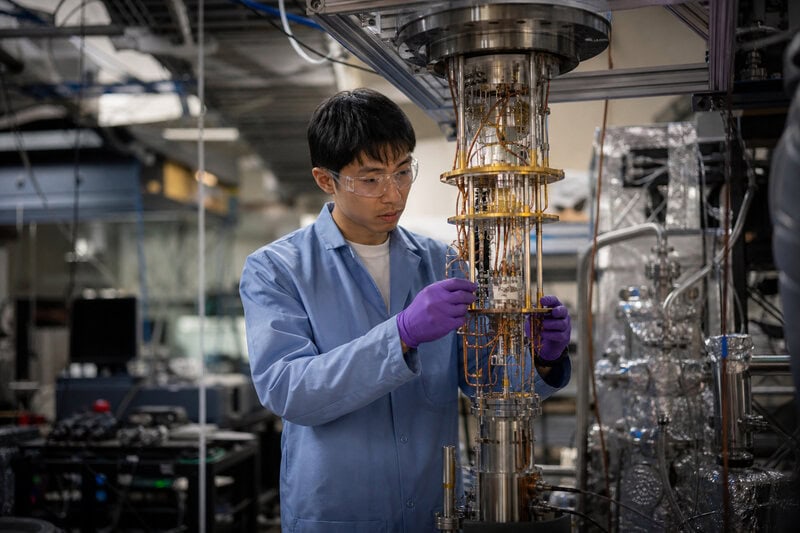
The practical stakes extend well beyond intellectual satisfaction. Because strange metals form the normal state from which high-temperature superconductors emerge, researchers at Rice University and collaborating institutions have emphasized that decoding strange metal physics is inseparable from the project of understanding — and ultimately designing — materials that could superconduct at technologically useful temperatures. Room-temperature superconductivity would transform energy transmission, medical imaging, and quantum computing infrastructure; the strange metal phase stands directly in the path of that goal, and QFI provides a new experimental handle on it.
For quantum technology more broadly, the confirmation of large-scale multipartite entanglement in a bulk solid-state material at readily accessible temperatures is notable in its own right. It raises the possibility that strange metals could serve as platforms for quantum sensing, or as test beds for entanglement-based theories of electrical transport. As Physics World has noted, the finding reframes the strangeness of strange metals not as a failure of existing theory but as evidence of a richer quantum reality operating in familiar solid-state systems — a conceptual shift with consequences for how experimentalists design probes and how theorists build models.
It is important, however, to be precise about what remains open. The QFI approach is a powerful new lens, not a completed theory. The precise microscopic mechanism driving strange metal behavior — whether it involves proximity to a quantum critical point, holographic duality as suggested by string-theory-inspired models, or some other organizing principle — remains actively debated. The findings constrain the space of viable theories substantially and eliminate entire classes of candidate models, but they do not yet select a unique winner. Theoretical progress and experimental confirmation must advance together before a consensus picture emerges.
Open Questions and the Road Ahead
The immediate theoretical challenge is to construct models of correlated electrons that are simultaneously consistent with scaleless QFI growth and UV-IR mixing. That dual constraint eliminates many candidate frameworks and sets a high bar for any new proposal. Experimentally, the next priority is to map QFI across the full phase diagrams of cuprate superconductors and heavy-fermion compounds — not just at isolated parameter values — to determine whether scaleless growth is a universal feature of all strange metals or is specific to particular material families or particular corners of their phase diagrams. That distinction matters: universality would point toward a single underlying mechanism, while material-specific behavior would suggest that the strange metal label encompasses more than one distinct quantum phase.
A longer-horizon ambition is to deploy QFI diagnostically in real materials — as a way to identify strange metal behavior without relying solely on transport measurements — potentially accelerating the discovery of new correlated quantum materials whose properties are currently invisible to conventional probes. Achieving that goal will require advances on two fronts simultaneously: experimentally, in measuring dynamic susceptibilities with sufficient precision and energy resolution to extract QFI reliably; and theoretically, in computing QFI from first principles for realistic models of strongly interacting electrons, where numerical methods remain computationally expensive.
The broader lesson may be methodological as much as physical. Borrowing the precision toolkit of quantum metrology and applying it to the messy, strongly correlated world of bulk condensed matter has opened a genuinely new window on materials that have resisted understanding for generations. The strange metal that should not exist is slowly, quantitatively, giving up its secrets — and the tool that is prying them loose was invented, originally, for an entirely different purpose.