
In 2022, a trading card game campaign raised $1.3 million for The Trevor Project through Wizards of the Coast’s Pride Across the Multiverse initiative — a set of Magic: The Gathering cards celebrating LGBTQ+ identity across its fantasy settings. The campaign arrived at a cultural moment when the word “multiverse” was everywhere: Marvel films, physics headlines, philosophy podcasts. Yet the science underneath the pop-culture spectacle is genuinely strange, genuinely contested, and far more interesting than any blockbuster has yet managed to convey.
Pride Across the Multiverse: What the Campaign Actually Was

Wizards of the Coast’s Pride Across the Multiverse was not simply a merchandising exercise. The 2022 initiative produced a limited-run Secret Lair drop — a curated Magic: The Gathering card set — featuring explicitly queer characters drawn from across the game’s sprawling fantasy multiverse. Characters including the vampire Sorin, reimagined with pride iconography, appeared alongside original artwork commissioned from LGBTQ+ artists. A portion of proceeds went directly to The Trevor Project, the leading national organization providing crisis intervention and suicide prevention services to LGBTQ+ young people. The campaign ultimately raised $1.3 million, a figure Wizards confirmed and Forbes reported in December 2022.
The initiative drew on Magic’s long-standing lore of a “multiverse” — dozens of distinct planes of existence, each with different physical rules, cultures, and histories, connected by planeswalkers who can travel between them. That fictional architecture, it turns out, has genuine and surprisingly rigorous scientific cousins.
What ‘Multiverse’ Actually Means: Four Distinct Scientific Concepts

One reason multiverse discussions generate so much confusion is that the word describes at least four separate scientific ideas, each with different levels of theoretical support and testability. MIT physicist Max Tegmark formalized this taxonomy in a widely cited 2003 paper in Scientific American, sorting multiverse proposals into four levels. Popular fiction — including Magic’s planar lore and Marvel’s cinematic universe — tends to collapse all four into a single dramatic premise, which is narratively convenient but scientifically misleading.
- Level I — Beyond the cosmic horizon: If space is infinite and the total amount of matter is finite, then identical arrangements of particles must eventually repeat at sufficiently large distances. A statistically indistinguishable copy of you almost certainly exists somewhere in an unbounded universe. No exotic physics required — only geometry and probability.
- Level II — Bubble universes from eternal inflation: Cosmologist Andrei Linde at Stanford University proposed that the inflationary expansion that followed the Big Bang may never fully stop. Regions where inflation ends become “bubble universes,” each potentially governed by different physical constants — different strengths of gravity, different masses for electrons. Experimental confirmation is currently beyond reach.
- Level III — Quantum branching: This is the Many-Worlds Interpretation of quantum mechanics. It is the level most directly analogous to fictional multiverse travel, and also among the most debated in contemporary physics.
- Level IV — Alternate mathematical structures: Tegmark’s most radical proposal holds that every mathematically consistent structure has physical existence. This is untestable by any known method and sits at the philosophical boundary of what most scientists are willing to call science at all.
The Many-Worlds Interpretation: Quantum Mechanics’ Most Radical Mainstream Idea

In 1957, Princeton physicist Hugh Everett III submitted a doctoral thesis proposing what is now called the Many-Worlds Interpretation (MWI) of quantum mechanics. The core claim is striking: every time a quantum event occurs — a radioactive atom either decaying or not, a photon striking a detector — the universe does not randomly select one outcome. Instead, it branches. Every possible outcome occurs, each in its own parallel branch of reality.
MWI is not fringe science. Surveys of professional physicists who study the foundations of quantum mechanics consistently rank it as one of the two most popular interpretations of the theory, rivaling only the older Copenhagen Interpretation — the view that quantum systems simply have no definite state until measured. The debate between these camps remains unresolved and active.
What MWI does not permit, however, is interdimensional travel of the kind Magic’s planeswalkers or Marvel’s heroes perform. Theoretical physicist Sean Carroll of Johns Hopkins University, author of Something Deeply Hidden (2019), has written extensively on this point. In MWI, parallel branches are mathematically orthogonal — they cannot interact, communicate with, or influence one another after splitting. The branches are real, in Everett’s framework, but they are permanently inaccessible. A hero leaping from one branch to another would violate the very quantum formalism that makes the theory coherent.
This is a critical distinction: MWI predicts parallel universes that exist in the same mathematical space as ours, separated by a quantum barrier that is, by the theory’s own logic, absolute. It does not predict parallel universes you can visit.
String Theory and the Landscape: 10500 Possible Universes
String theory — the framework that models fundamental particles as tiny, vibrating filaments of energy rather than point-like dots — generates its own multiverse proposal, and the numbers involved are almost incomprehensible. In a 2003 paper, Leonard Susskind at Stanford University described what he called the “string landscape”: roughly 10500 distinct possible universes, each corresponding to a different way the extra spatial dimensions that string theory requires could be curled up, or “compactified,” at scales too small to observe.
That figure — a one followed by five hundred zeros — is not a dramatic flourish. It emerges directly from the mathematics of how those extra dimensions can be configured. Each configuration produces a universe with different physical laws, different particle masses, and potentially different chemistry. Ours would be simply one stable solution among an almost limitless number.
The landscape hypothesis is, however, deeply controversial within physics. Nobel laureate David Gross has argued publicly that it renders string theory unfalsifiable — incapable, in principle, of making predictions that could be tested and potentially refuted. By the standard of scientific falsifiability articulated by philosopher Karl Popper, an unfalsifiable theory occupies an uncomfortable position between science and metaphysics. The string landscape is mathematically consistent and theoretically serious, but it remains entirely unconfirmed by experiment.
What the Cosmic Microwave Background Can — and Cannot — Tell Us
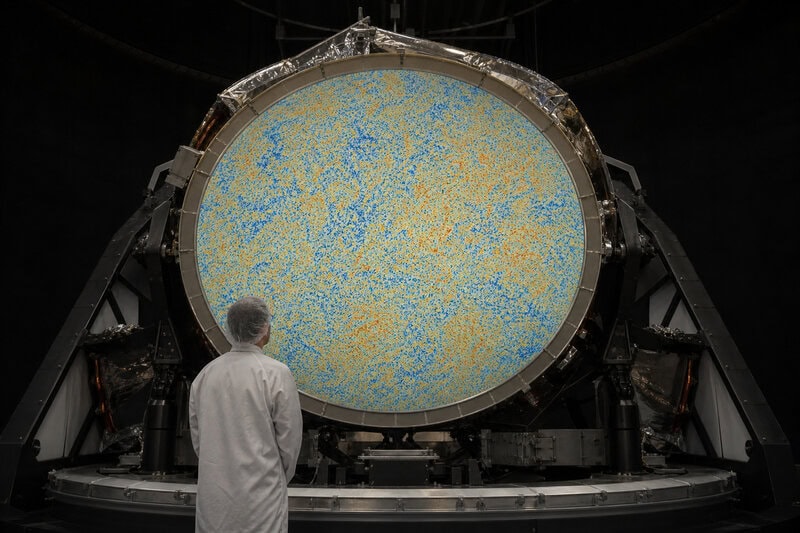
The Cosmic Microwave Background (CMB) is the faint thermal afterglow of the early universe, released approximately 380,000 years after the Big Bang and detectable today as a nearly uniform wash of microwave radiation across the entire sky. It is the most detailed observational record physicists have of the universe’s early conditions, and some researchers have searched within it for evidence of other universes.
The specific target is “bubble collision signatures” — distortions that eternal inflation theory predicts would appear in the CMB if our bubble universe had, early in its history, grazed a neighboring bubble. A 2015 study led by Stephen Feeney at University College London searched data from the European Space Agency’s Planck satellite for precisely these patterns and found no statistically significant evidence of bubble collisions.
The absence of a detection is not a refutation. The signatures, if they exist, may fall outside the region of sky examined, or may be too subtle for current instruments to resolve. The Simons Observatory, a next-generation CMB telescope under construction in the Atacama Desert in Chile, will map CMB polarization at substantially higher resolution and is expected to tighten constraints on inflation models significantly. But directly detecting the imprint of another universe remains outside its design scope. Multiverse science is currently in an era of constraint-setting, not confirmation — an important epistemic distinction that popular coverage rarely makes.
Where Fiction Gets It Wrong — and Surprisingly Right
Magic: The Gathering’s planar travel and Marvel’s multiverse mechanics both contain features that directly contradict the scientific models they draw inspiration from. Travel between branches, physical interaction across universes, and the transfer of matter or memory all violate the causal disconnection that is central to both MWI and string landscape models. In those frameworks, branches or bubble universes are separated not by a traversable distance but by a fundamental mathematical boundary.
That said, some fictional devices have loose — if imprecise — scientific analogues. The concept of “variants,” slightly different versions of the same character shaped by diverging choices at key moments, genuinely echoes Hugh Everett’s original intuition about branching histories. The emotional logic, if not the mechanism, is recognizable. Similarly, the use of “incursions” — universes physically colliding and annihilating each other — has a distant cousin in the bubble collision models that inflationary cosmology predicts, though those collisions would produce subtle statistical patterns in the CMB rather than dramatic conflicts between costumed characters.
Astrophysicist Katie Mack of the Perimeter Institute has noted publicly that fictional multiverses capture the spirit of quantum weirdness even when the technical details are wrong — a useful framing. These stories are not attempting to be textbooks. They use the emotional and imaginative texture of real scientific ideas to tell human stories, and on that level, the borrowing is legitimate. Pride Across the Multiverse extends this further: it uses the metaphor of many worlds as a space where different identities coexist with equal validity — which is, in its own way, a faithful extrapolation of the science’s most humanist implications.
The Bottom Line: What Physicists Actually Believe
There is genuine, peer-reviewed scientific support for the idea that our observable universe may not be the only region of space-time in existence — but “support” in this context means mathematical consistency and indirect inference, not direct observation or experimental confirmation. The Many-Worlds Interpretation is a legitimate, minority-but-mainstream position in the foundations of quantum mechanics. The string landscape is speculative but mathematically serious. Neither has been confirmed by experiment, and neither predicts a multiverse that any being could ever visit or directly detect.
Cosmologist Brian Greene of Columbia University, writing in The Hidden Reality (2011), characterized multiverse theories as “tentative and unproven” while arguing they represent physics pushed to its logical conclusions — a fair summary of where the field stands today. Enjoying multiverse fiction — whether a Pride-themed Magic: The Gathering set, a superhero blockbuster, or a literary novel — requires no scientific apology. Understanding what the real science does and does not say only makes the speculation richer: the actual physics is stranger, more contested, and in its own way more extraordinary than any story has yet fully captured.