
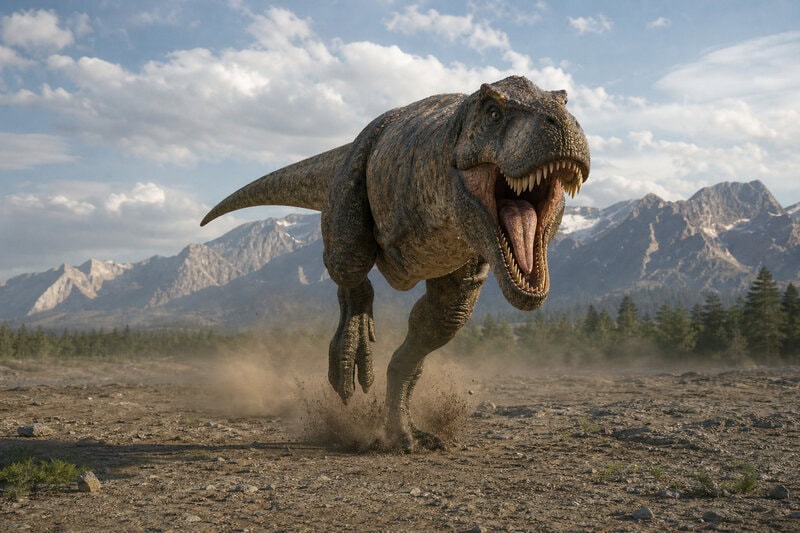
A 2017 biomechanical study published in PeerJ by University of Manchester researcher William Sellers calculated that a Tyrannosaurus rex running at Hollywood speeds — roughly 45 mph — would have shattered its own leg bones under the force of each stride. That single finding quietly invalidates decades of blockbuster chase sequences, and yet the monster sprinting toward the camera remains one of cinema’s most durable images.
The T. rex That Couldn’t Have Chased Your Car
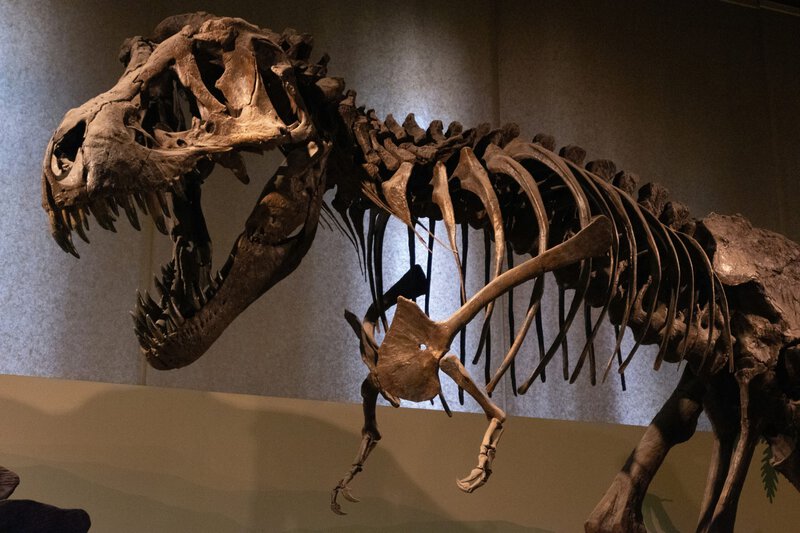
The timing of that reality check matters now because David Robert Mitchell’s The End of Oak Street (2026) has arrived in theaters to warm notices for its creature action and cooler ones for its screenplay. Starring Anne Hathaway and Ewan McGregor as suburban parents defending their children after their entire street is teleported back to the age of dinosaurs, the film has been praised as a clever, amusing Spielberg homage evoking 1980s Amblin adventure — and criticized, as Rough Draft Atlanta’s review notes, for a script too thin to support its ambitions.
Critics and audiences drawing comparisons to Jurassic Park are correct in more ways than they may realize: the film inherits not just that franchise’s sense of wonder but also its now-outdated movement choreography. Paleontologists say the gap between screen dinosaurs and real ones is not a matter of minor quibbling. It reflects decades of accumulated misunderstanding about animal biomechanics — the study of how physical forces interact with living bodies — posture, and metabolic strategy. That gap shapes public perception of prehistoric life in ways that are genuinely difficult to undo once embedded by repeated cinematic exposure.
The Tail-Drag Problem Hollywood Never Fully Fixed
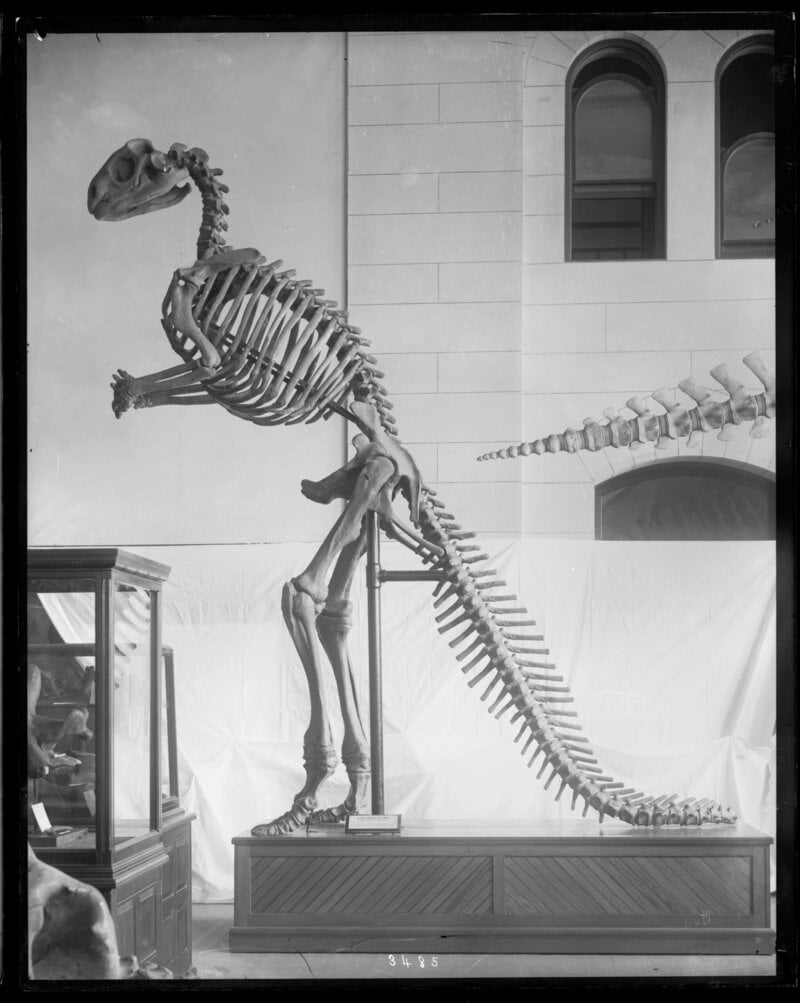
For most of the 20th century, museum reconstructions and films depicted large theropods — the bipedal, mostly carnivorous dinosaur lineage — dragging their tails along the ground like oversized lizards. That posture is now considered flatly wrong by the scientific consensus. Fossilized trackway evidence, including extensive Late Cretaceous sites studied by researchers at the Royal Tyrrell Museum of Palaeontology in Alberta, shows no tail-drag marks running alongside footprints. Large theropods held their tails elevated and roughly horizontal, functioning as a counterbalance to their forward-leaning torsos.
This horizontal, cantilever body plan — with the hips as the pivot point — fundamentally changes how these animals would have looked in motion. The image is less lurching monster and more purposeful, weight-forward athlete, not unlike a large ground bird moving at pace. One central creature in The End of Oak Street is reportedly a juvenile Tarbosaurus, a large tyrannosaurid from Late Cretaceous Mongolia closely related to T. rex. Like its North American cousin, Tarbosaurus would have carried its body in this horizontal attitude, tail aloft, head projecting forward — a silhouette that remains rare on screen even decades after the science settled.
Even films made after this consensus solidified in the 1990s frequently revert to the upright, tail-dragging posture for dramatic effect, because it reads as more monstrous to audiences unfamiliar with the underlying mechanics. The scientific reality — a horizontally balanced, purposeful predator — is arguably more unsettling, because it suggests genuine athletic competence rather than pantomime menace.
How Fast Could Dinosaurs Actually Move? The Biomechanics Breakdown
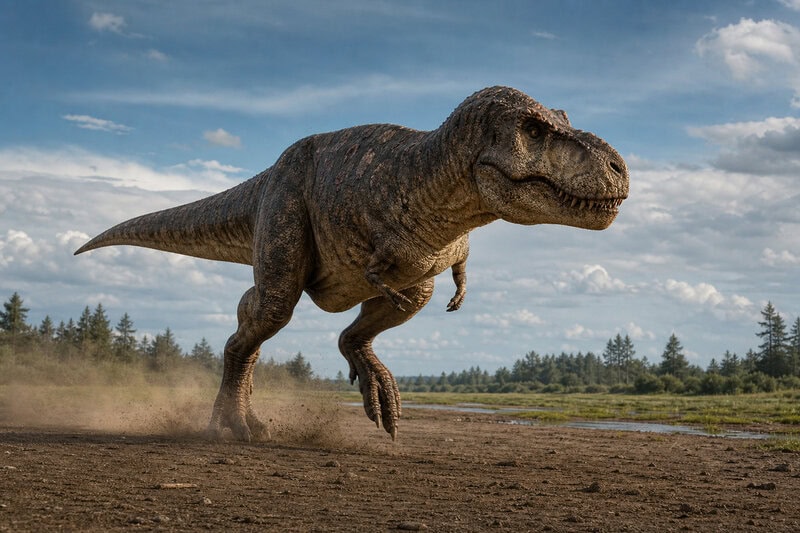
The Sellers et al. (2017, PeerJ) study used computer modeling of skeletal stress to estimate T. rex‘s top comfortable walking speed at approximately 2.86 mph — roughly a brisk human walking pace — with running biomechanically costly and likely reserved for short bursts rather than sustained predatory chases. A separate 2021 study by researchers at the Universitat Autònoma de Barcelona, published in Royal Society Open Science, analyzed fossilized T. rex trackways in New Mexico and concluded a preferred walking gait of around 4.6 mph, with the tail swaying gently side to side in a motion more analogous to a modern elephant than a sprinting reptile.
Smaller theropods present a meaningfully different picture. Animals in the 20-100 kilogram range, including many dromaeosaurids — the family that includes the raptors familiar from Jurassic Park — likely had agility and speed comparable to large flightless birds such as emus, which can sustain approximately 30 mph. Films rarely make this distinction, instead scaling predator speed uniformly upward regardless of body size. Dinosaur locomotion science increasingly treats body mass as the master variable: the heavier the animal, the more conservative its gait had to be to avoid catastrophic joint and bone loading, a principle well-established in modern large-mammal biomechanics research.
For a film like The End of Oak Street — where the dramatic engine requires dinosaurs to actively threaten human characters in real time — this creates an honest creative tension. As Inverse’s review of the film observes, the creature sequences are where the movie comes most alive, which means they are also where the distance between scientific reality and cinematic necessity is most visible.
The Feather Question: What Audiences Still Aren’t Seeing
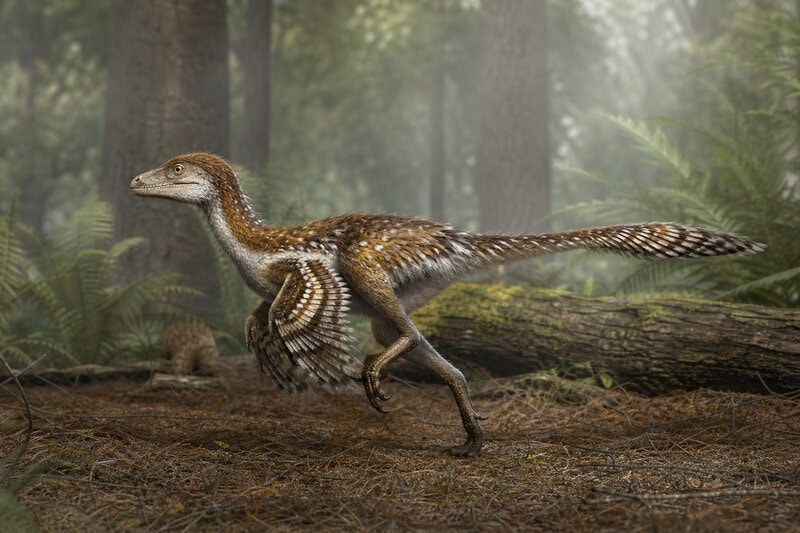
Since the discovery of feathered theropod specimens in China’s Yixian Formation beginning in the 1990s — with landmark species like Sinosauropteryx described by researchers at the Institute of Vertebrate Paleontology and Paleoanthropology in Beijing — the scientific consensus has firmly established that many non-avian dinosaurs bore feathers or proto-feathers. Most Hollywood productions, including films in the Jurassic Park tradition, continue to present entirely scaly predators.
For Tarbosaurus specifically, the picture is genuinely complicated. Direct feather impressions for the species have not been confirmed, and skin impressions from related large tyrannosaurids, including T. rex, suggest at least partial scale covering on some body regions. The full-feather versus full-scale debate for giant tyrannosaurids is a contested area of current research — not settled consensus — and fair-minded coverage should acknowledge that uncertainty. What is settled is that the uniform, head-to-tail scale covering depicted on screen for most large theropods is not well-supported by the fossil record, particularly for smaller species and for juveniles of large species, which may have retained more integumentary covering than adults.
Paleontologist and science communicator Dr. Thomas Holtz of the University of Maryland has noted publicly that the persistent depiction of naked, scaly theropods in popular media represents one of the largest divergences between current science and Hollywood’s visual template — a template largely set by the original 1993 Jurassic Park and remarkably resistant to revision. The movement implications of plumage extend beyond appearance: feathers affect thermoregulation models and potentially aerodynamic stability during rapid directional changes, both of which would alter how these animals maneuvered in ways no current major studio production has meaningfully explored.
Predator Behavior and the Myth of the Pure Killing Machine
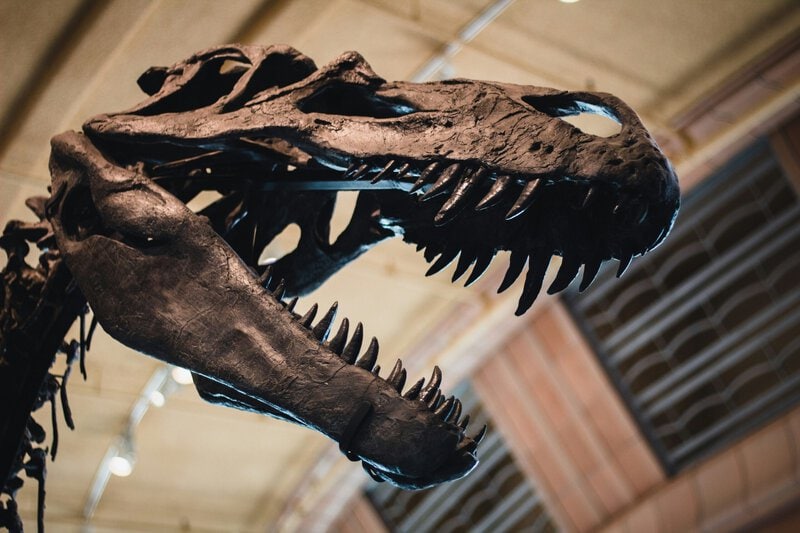
Modern paleontological thinking, reflected in work by researchers including Gregory Erickson at Florida State University, treats large tyrannosaurids as likely opportunistic feeders — capable predators that also scavenged extensively — rather than the relentless, exclusively active hunters that drive the dramatic logic of films such as The End of Oak Street. Growth-ring analysis of T. rex and Tarbosaurus bones, a technique Erickson’s lab has applied extensively, reveals slow juvenile growth phases and relatively low population densities. These life-history characteristics suggest predator-prey encounters would have been episodic rather than the near-constant threat cinema portrays.
Pack-hunting behavior, depicted or implied in several Jurassic Park-lineage films, remains speculative for most large theropods. The evidence base — primarily a handful of multi-individual fossil sites — is considered intriguing but not conclusive by the majority of working paleontologists, placing it firmly in the category of emerging and contested findings rather than established science.
None of this is a criticism of The End of Oak Street as entertainment. Early audience responses on Reddit’s Screen Unseen community reflect genuine affection for its creature sequences and its family-in-peril premise. The dramatic premise essentially requires Hollywood’s version of dinosaur behavior, and that is worth acknowledging as a deliberate creative choice rather than mistaking it for biological plausibility.
Where Paleontology and Hollywood Actually Agree
To be fair to filmmakers working in this tradition, some genuine advances have filtered through. The depiction of dinosaurs as warm-blooded, metabolically active animals — now supported by bone histology studies and isotopic analysis published in journals including Science and Nature — represents a meaningful departure from the cold, sluggish reptile model that dominated earlier cinema. The ecological framing in Amblin-style adventures, including The End of Oak Street, often implicitly treats dinosaurs as animals with territorial logic and parental instincts rather than supernatural evil, which aligns reasonably well with behavioral inferences paleontologists draw from nesting sites such as those described by Jack Horner and colleagues from Montana’s Two Medicine Formation.
The deeper public-science concern, as articulated by the Society of Vertebrate Paleontology in its ongoing science-communication initiatives, is that repeated cinematic reinforcement of inaccurate locomotion and behavior creates a lasting distortion in which audiences — and sometimes policymakers evaluating museum funding — treat Hollywood’s version as the authoritative one. Researchers including Dr. Andrea Cau have argued that scientifically grounded dinosaur movement — the weight-shifted, horizontal-bodied, potentially feathered reality — would be visually stranger and more cinematically striking than the recycled monster template, suggesting the real opportunity cost of inaccuracy is lost wonder, not lost drama.
A Smarter Way to Watch Dinosaur Movies
When watching The End of Oak Street or any film in the Jurassic Park tradition, audiences can apply a simple biomechanical checklist: Is the tail elevated and horizontal? Is the body angled forward rather than upright? Is predator speed plausibly scaled to body size? Is any feathering visible on smaller theropods? A film that answers yes to even two of these questions is already ahead of the historical average for the genre.
The thin script noted by critics reviewing the film may actually be less damaging to public scientific literacy than its movement choreography. Narrative weaknesses are obvious and forgettable; repeated visual misinformation about how large animals move embeds itself in intuitive, hard-to-dislodge ways. A generation that grows up watching large theropods sprint at 45 mph tends to carry that image into adulthood regardless of what they subsequently read.
The emerging field of dinosaur biomechanics — using CT scanning, computer simulation, and systematic comparison with living archosaurs including crocodilians and birds — is producing findings quickly enough that a film made today with current science would look meaningfully different from one made even five years ago. Studios willing to consult active researchers could gain both accuracy and novelty simultaneously. As a Spielberg homage, The End of Oak Street works affectionately within a beloved tradition. The most generous reading is that it succeeds as entertainment while serving as an inadvertent argument for why the next generation of dinosaur films might treat paleontology not as a constraint on spectacle, but as its most underutilized source of it.