
Every two to four years, NASA opens an application window that draws tens of thousands of hopeful candidates and closes it having selected a handful of human beings to train for spaceflight. What the agency’s own data reveals about that process is both humbling and, for the right candidate, surprisingly actionable.
The Odds Are Brutal — and the Bar Is Higher Than It Appears
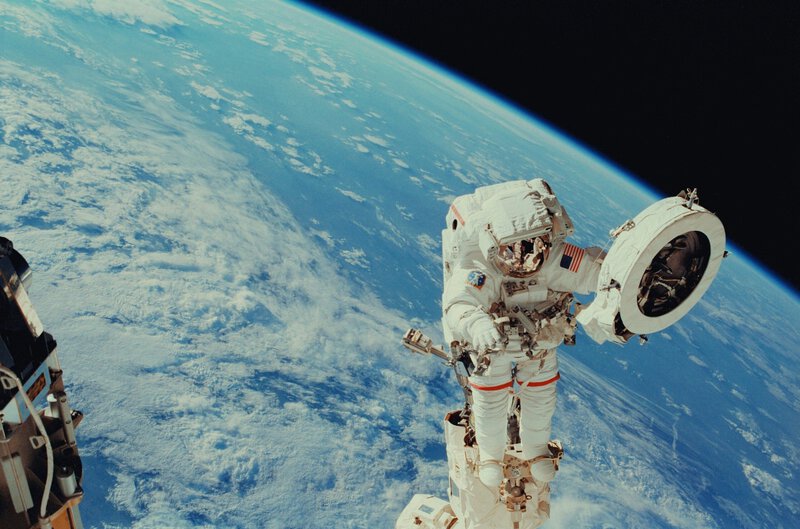
When NASA announced its latest astronaut candidate class, just 10 people were chosen from a pool of more than 8,000 applicants — a selection rate of roughly 0.1%. For context, Harvard’s undergraduate acceptance rate hovers around 3%, meaning the odds of becoming a NASA astronaut candidate are approximately 30 times worse than gaining admission to one of the world’s most selective universities.
Those numbers are not meant to discourage. They are meant to clarify. The raw rejection rate obscures a more specific story: a meaningful portion of that 8,000-person pool does not meet NASA’s published minimum eligibility criteria. Among genuinely qualified applicants, the effective odds are considerably better than the headline figure implies — which makes understanding the full filter more useful than fixating on a single statistic.
The Published Requirements — and What They Actually Mean in Practice

To enter the NASA astronaut application process, candidates must hold a master’s degree in a STEM field and have at least two years of relevant professional experience, or accumulate 1,000 hours of pilot-in-command time in jet aircraft. Medical fitness standards are non-negotiable: vision correctable to 20/20, blood pressure within defined limits, and a standing height between 5’2″ and 6’3″ for spacecraft compatibility. U.S. citizenship is required with no waiver or exception.
What NASA does not advertise as prominently is the gap between its stated minimums and the actual profiles of people who get selected. Doctoral degrees, test pilot credentials, and significant fieldwork experience — deep-sea research, Antarctic expeditions, remote field science — consistently appear in the backgrounds of chosen candidates. Meeting the published floor gets an application through the first filter. Exceeding it across multiple dimensions is what tends to earn an invitation to Houston.
Three professional pipelines have historically dominated astronaut classes: military aviators, research scientists, and engineers. Recent classes have drawn from all three, and candidates who bridge more than one — a research scientist with military service, for instance, or an engineer with extensive fieldwork — appear to fare particularly well in later evaluation stages.
What a Small Class Size Signals About NASA’s Current Priorities
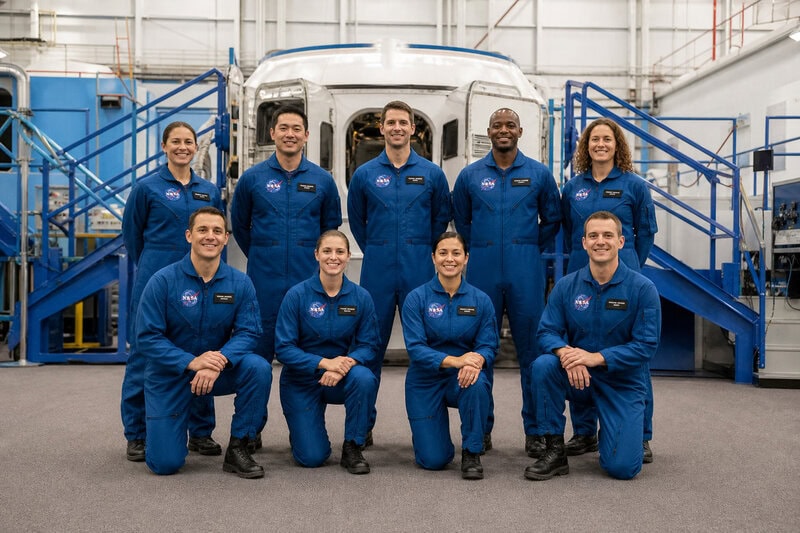
Selecting only 10 candidates in the most recent class — compared to 12 for NASA Astronaut Group 23, announced December 6, 2021 — suggests the agency is calibrating class size tightly to projected mission slots rather than building a large waiting roster. That compression carries a meaningful implication: every selected candidate has a realistic near-term path to a mission assignment, which raises the stakes of each individual pick and helps explain why the evaluation process is as intensive as it is.
The trend line is worth watching. As NASA commits to more complex, longer-duration missions under its deep-space exploration framework, the expectation appears to be that each incoming candidate carries a broader and more immediately deployable skill set. Smaller classes with higher per-candidate expectations represent a meaningfully different calculus than the larger cohorts of earlier eras.
Group 23 as a Data Point: What Recent Selection Patterns Reveal
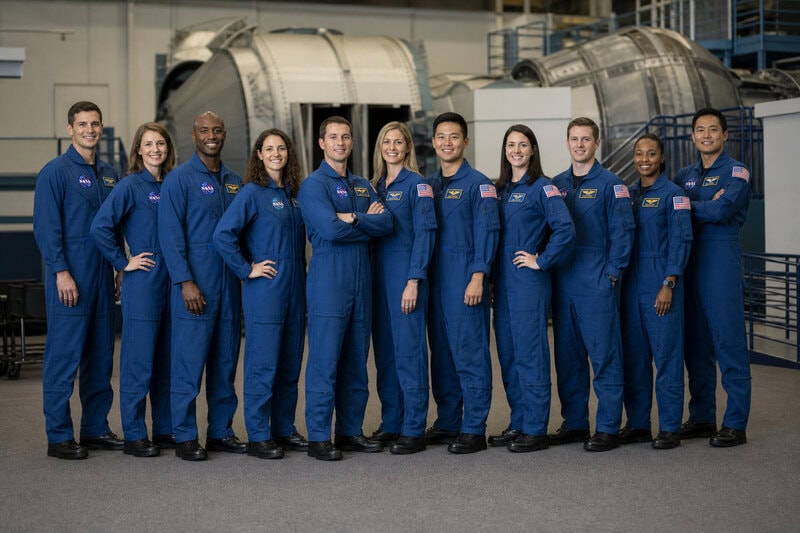
NASA Astronaut Group 23, nicknamed “The Flies,” comprised 12 candidates — seven men and five women. That gender breakdown reflects a broader trend: women now consistently represent 40 to 50 percent of recent astronaut classes, a sharp departure from the all-male groups of the 1960s. The class nickname is a small but telling cultural detail — NASA deliberately cultivates cohort identity to sustain candidates through the years of intensive training that follow selection.
Comparing Group 23 against the subsequent class of 10 reveals a tightening selection funnel that tracks closely with the agency’s shifting mission cadence and budget environment. For prospective applicants, the practical takeaway is this: the people being selected are not being chosen as future possibilities. They are being chosen as near-term operational assets, and their profiles reflect that.
The Selection Process: From Application to “Astronaut Candidate”
Applications are submitted through USAJOBS during a designated open window. NASA’s review process then narrows the field in distinct stages:
- A paper review of qualifications and eligibility against NASA’s published astronaut selection requirements
- Invitation-only interviews at Johnson Space Center in Houston
- A week of intensive medical and psychological evaluations for finalists
Candidates who clear every stage are offered “astronaut candidate” status — not the title of astronaut. That designation comes only after completing approximately two years of basic training covering spacewalk preparation, Russian language instruction, T-38 jet proficiency, robotics, and survival skills. The training curriculum is explicitly designed to surface and correct any gap before mission assignments are made. Washout during this phase, while uncommon, is possible.
One procedural detail that catches some applicants off guard: NASA does not accept applications outside of designated open windows, and there are no exceptions. The agency has not announced a timeline for its next open cycle following the most recent class reveal, but historical cadence suggests a new window could open within two to four years. Monitoring NASA’s official Astronaut Selection page and USAJOBS directly is the only reliable way to stay informed.
The Factors That Separate Finalists From the Rest
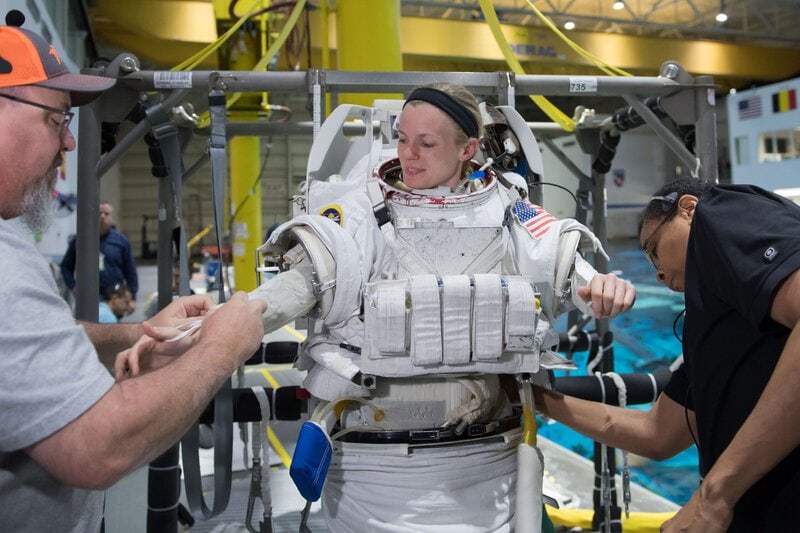
Operational experience under genuine pressure — military deployments, remote scientific fieldwork, emergency medicine — consistently appears in the backgrounds of selected candidates and is difficult to substitute with academic credentials alone. NASA evaluates teamwork and communication skills as rigorously as technical competence, and the agency explicitly states that how candidates perform during group exercises influences final decisions.
Two additional patterns emerge clearly from the history of astronaut selection:
- Persistence matters more than most applicants expect. Many successful candidates applied more than once. NASA’s own guidance encourages reapplication after gaining additional experience. Treating an early application as reconnaissance — a way to understand the process and identify gaps — is more productive than approaching a first attempt as a single high-stakes outcome.
- Physical fitness must be demonstrated as a sustained baseline, not a pre-evaluation peak. Medical reviewers are trained to distinguish candidates who have maintained consistent fitness over years from those who ramped up preparation specifically for the evaluation window. The distinction matters and is reflected in how candidates are assessed.
A Practical Framework for Prospective Applicants
If you meet NASA’s published minimum requirements today, the most defensible strategy the data supports is this: apply during the next open window and treat the cycle as a structured learning experience while continuing to build the experiential profile that advances candidates in subsequent rounds. The process rewards people who have spent years accumulating exactly the kind of record NASA is looking for — not people who began preparing after an announcement.
That means the most consequential preparation happens between application windows, not during them. Advanced degrees, flight hours, fieldwork, leadership under operational pressure, and demonstrated physical fitness are all long-lead investments. None of them can be meaningfully compressed into the months before an application deadline.
The astronaut selection process is, at its core, an extended argument that a candidate has already been living the life the job requires. The strongest applications make that argument with years of evidence. The best time to start building that record is before the window opens. The second best time is now.