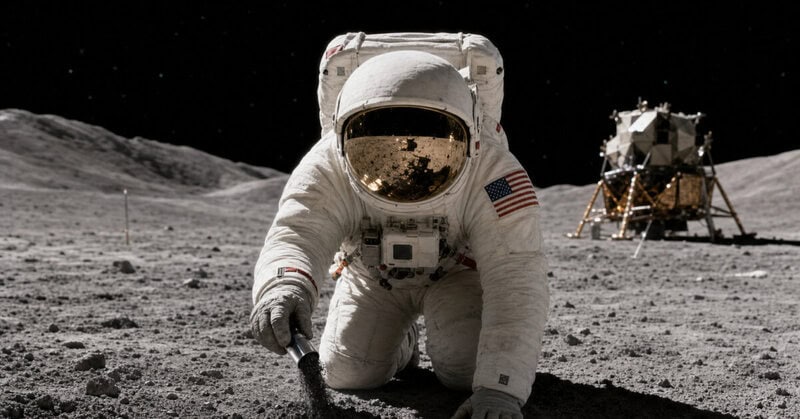
Shipping a single kilogram of cargo to the lunar surface costs roughly $1 million — which means that every bolt, beam, and blanket of insulation carried from Earth represents an almost absurd expense. Yet the moon is already blanketed in an inexhaustible supply of raw material: a fine, glassy powder called regolith that has spent billions of years becoming one of the most hazardous substances astronauts have ever encountered. Now, researchers at Purdue University are working to turn that hazard into a building asset, developing an ultralight aerogel — a highly porous, air-filled solid sometimes called “frozen smoke” — by combining simulated lunar dust with cellulose fibers derived from recycled cardboard waste. The goal is a thermal insulation material that could one day be manufactured on the moon itself, using the dust underfoot and the paper trash left over from crewed missions.
Moon Dust Is Not Sand — It’s a Microscopic Razor Field
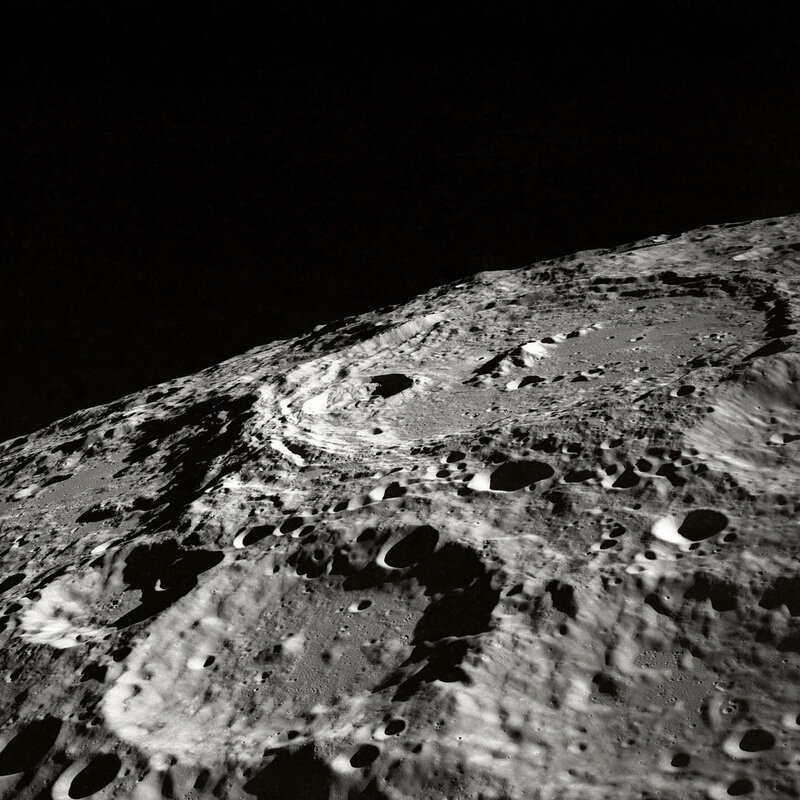
To understand why building with lunar regolith is simultaneously appealing and deeply complicated, it helps to understand what regolith actually is. Unlike beach sand, which has been smoothed by water and wind over millions of years, lunar regolith is a mixture of pulverized rock, mineral fragments, and glass beads with jagged, irregular edges at the microscopic level — a property scientists describe as high angularity. There is no weather on the moon to round those edges, so every particle retains the sharp geometry it acquired the moment it was shattered by a micrometeorite impact.
That physical structure makes regolith mechanically abrasive, but the hazard does not stop there. Because the moon lacks a global magnetic field, the solar wind — a constant stream of charged particles from the sun — embeds electrostatic charges into regolith grains. Those charges cause dust to cling aggressively to spacesuits, solar panels, helmet visors, and optical instruments. NASA’s Human Research Program has formally classified lunar dust adhesion as a primary risk for long-duration surface missions, and Apollo astronauts reported clogged equipment, scratched helmet visors, and lung irritation within hours of returning from moonwalks.
The respiratory concern is particularly serious. Regolith particles are fine enough to penetrate deep into lung tissue, and studies drawing on Earth analogs — such as occupational exposure to volcanic ash and industrial silica dust — suggest that chronic inhalation could cause lasting pulmonary damage. Definitive human data remains limited, given that no astronaut has yet spent enough consecutive time on the lunar surface to develop long-term symptoms, but the biological plausibility of the risk is well established in NASA’s research literature. Open Access Government notes that addressing dust hazards is inseparable from any serious plan to house humans on the moon for months or years at a time.
The paradox is striking: the same properties that make regolith dangerous — its abundance, fine particle size, and high surface reactivity — also make it an attractive feedstock for in-situ resource utilization, or ISRU. ISRU is the technical term for manufacturing building materials on-site from local resources rather than importing them from Earth. If regolith can be processed into something useful, the moon’s greatest nuisance becomes its most valuable construction material.
The Thermal Problem: 300 Degrees of Danger
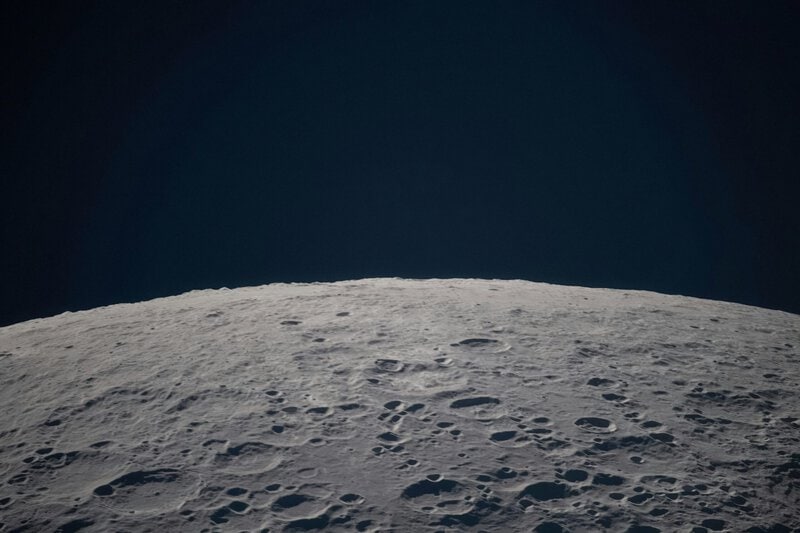
Before examining the Purdue solution, it is worth understanding exactly what a lunar habitat needs to survive. Without a significant atmosphere to buffer heat exchange, the lunar surface swings from roughly 127°C (260°F) in direct sunlight to approximately -173°C (-280°F) in shadow — a range of 300 degrees Celsius that would destroy most standard construction materials through repeated expansion and contraction alone. At NASA’s target site near the lunar south pole, the situation is more extreme still: permanently shadowed craters in that region maintain temperatures near -200°C year-round, making passive thermal regulation essentially impossible without purpose-built insulation.
A habitat’s thermal envelope — the insulating shell that keeps interior temperatures within a survivable range — is therefore one of the most demanding engineering challenges of the entire lunar architecture. Existing proposals include burying habitats under several meters of regolith for passive shielding, an approach that provides genuine protection but requires substantial excavation infrastructure and does not address situations where lightweight, deployable insulation is needed. Importing enough high-performance insulation from Earth is prohibitively expensive at current launch costs. This is precisely the gap that the Purdue aerogel research is designed to fill.
The Purdue Solution: Cardboard Waste Meets Crater Dust
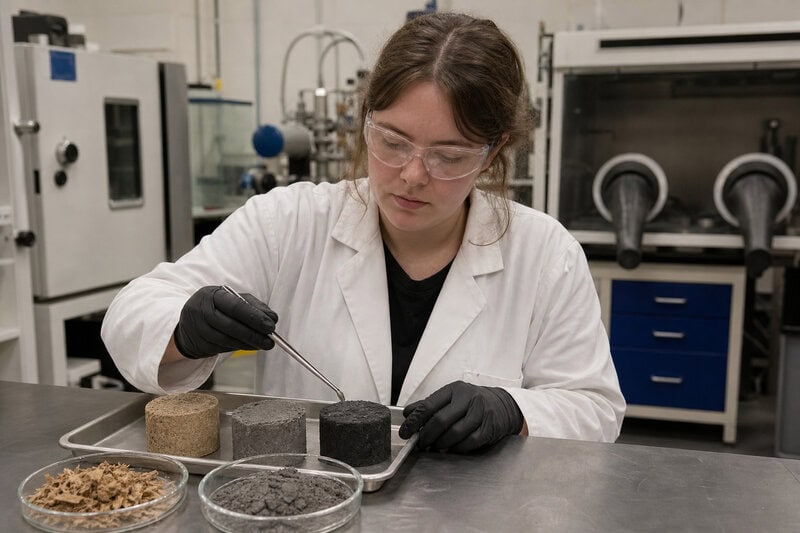
Aerogels are among the most thermally resistant solid materials known to materials science. The term refers to a class of highly porous solids in which a liquid component has been replaced by gas through careful drying processes, leaving a structure that can be up to 99 percent air by volume. The result is a material with extremely low thermal conductivity — meaning heat moves through it very slowly — combined with remarkably low density. Aerogels have been used in NASA missions before, including as insulation in Mars rovers, but they are typically manufactured from silica or synthetic polymers using processes that depend on Earth-based industrial infrastructure.
The Purdue University approach introduces two key innovations. First, researchers are building their aerogel scaffolding from cellulose fibers — the structural polymer found in plant cell walls and the dominant component of paper and cardboard — sourced from recycled cardboard waste. Cellulose can be processed into aerogel form through established techniques including freeze-drying and sol-gel chemistry, producing a lightweight, flexible matrix. Second, the team incorporates simulated lunar regolith — an engineered material designed to approximate the physical and chemical properties of real lunar soil, commonly called a regolith simulant — into that cellulose matrix. The regolith particles reinforce the structure and contribute additional thermal-blocking properties.
According to Purdue’s official newsroom, the resulting composite is described as ultralight and highly insulating, designed to function as a thermal shield layer within the walls of a lunar habitat. Critically, both primary ingredients could plausibly be sourced at a lunar outpost: regolith is available across the entire surface, and cellulose could be recovered from the paper and cardboard packaging waste generated continuously by a crewed mission. Space.com’s coverage of the research highlights that this closed-loop approach — in which mission waste is reprocessed into mission-critical materials — is a core feature of the concept, not an incidental benefit.
This design philosophy aligns directly with what mission architects sometimes call closed-loop logistics: rather than treating used packaging as waste to be stored or jettisoned, crews would feed it back into a manufacturing process that produces habitat components. The concept fits neatly within NASA’s Artemis program framework, which has identified ISRU as a key enabling technology for establishing a sustained human presence near the lunar south pole. As Starlust reports, multiple agency-funded projects are exploring sintered regolith bricks, 3D-printed regolith structures, and aerogel composites as complementary, rather than competing, habitat-building approaches.
What the Research Has — and Has Not — Proven
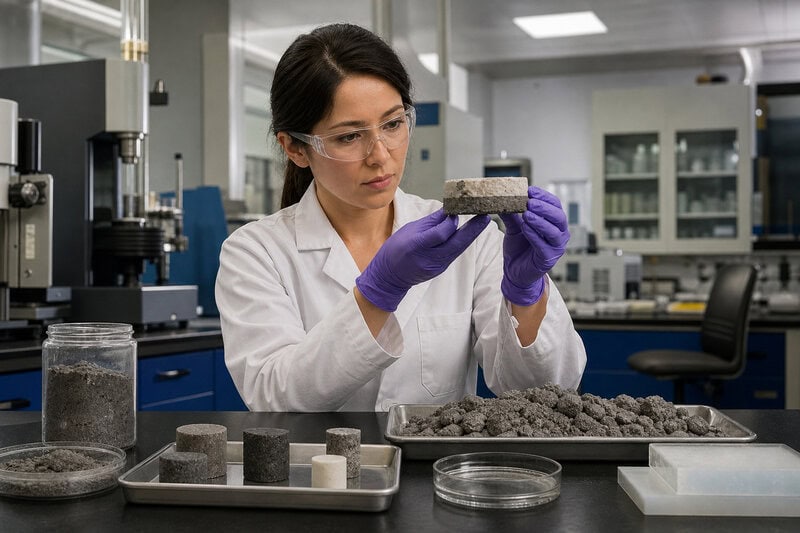
The Purdue aerogel composite is a genuinely promising materials-science result, but precision matters about what has and has not been demonstrated. All fabrication and characterization work to date has used lunar regolith simulant, not actual lunar dust recovered from Apollo missions or future sample-return efforts. Simulants are carefully engineered to match many physical properties of real regolith — particle size distribution, mineral composition, density — but they cannot fully replicate the electrostatic charge state, the nanophase iron content embedded by solar-wind bombardment, or the biological hazard potential of genuine lunar soil. How the composite aerogel behaves when real regolith is incorporated remains an open question.
The mechanical challenges are also substantial. Aerogels as a class are notoriously brittle — they can exhibit excellent thermal properties while being fragile under mechanical stress. Scaling a laboratory coupon to the size of a structural habitat panel, and ensuring that it retains integrity through thousands of thermal cycles spanning hundreds of degrees and under periodic micrometeorite bombardment, represents a significant unresolved engineering problem. Around Prague’s science desk notes that researchers themselves acknowledge the gap between demonstrating a material in controlled laboratory conditions and deploying it in the lunar environment.
Manufacturing process feasibility is a third open question. Producing aerogels typically requires precise temperature control and may involve liquid solvents during processing steps. Demonstrating that this manufacturing workflow can be executed reliably inside a lunar outpost — with the limited equipment mass that any mission can afford to carry — is a separate research problem not yet addressed in the published findings. Scientists working in this area characterize the current result as an early technology readiness level, a category NASA uses to indicate promising but pre-flight-ready work, and stress that independent replication, testing with actual regolith samples, and long-duration vacuum chamber validation are all required before the approach could be considered mission-ready.
None of these gaps diminish the significance of the result. They simply locate it accurately on the long road from laboratory proof-of-concept to deployed lunar infrastructure — a road that every serious space technology must travel.
The Bigger Picture: Circular Economy in Extreme Environments
The implications of the Purdue work extend well beyond lunar architecture. Aerogels derived from cellulose and waste materials have direct applications in terrestrial building insulation, cold-chain logistics packaging for pharmaceuticals and food, and industrial pipe insulation in cold climates. The lunar research program is, in a meaningful sense, subsidizing materials science that could reduce dependence on carbon-intensive synthetic insulation manufacturing on Earth.
More broadly, the cardboard-to-aerogel pipeline models a scalable approach to circular-economy thinking in extreme environments. If paper waste can become a structurally functional habitat component on the moon, the same logic applies — with appropriate engineering adaptation — to Antarctic research stations, disaster-relief shelters, and remote infrastructure projects where supply chains are constrained and waste disposal is a genuine burden. Yahoo Tech’s analysis of the research points to this dual-use potential as one reason the work has attracted attention beyond the aerospace community.
For NASA’s long-range ambitions at Mars, where transit times of six to nine months and launch costs even more prohibitive than those of lunar missions make Earth-sourced materials essentially impractical for large structures, the regolith-composite aerogel concept serves as a proof-of-principle that ISRU and waste-reuse can be combined into a unified habitat manufacturing strategy. The two approaches are not separate solutions to separate problems; they are complementary halves of the same closed-loop system.
The sharpest summary of where this research stands is this: lunar regolith spent roughly 4.5 billion years accumulating the properties that made it a hazard to every mission humans attempted — clogging engines, scratching optics, threatening lungs. With the right chemistry, those same properties may eventually make it one of the primary building blocks of the first permanent human settlement beyond Earth. That transformation is not yet proven, but the early evidence suggests it is not merely speculative either.