
Out of 521 woolly mammoth bones analyzed for ancient DNA, roughly 70 percent of the specimens recovered from sites where Ice Age humans were active turned out to belong to females — a proportion so statistically skewed that an international research team says it cannot be explained by chance, geography, or the ordinary processes by which large animals die. The implication, reported by Reuters on July 31, 2026, is striking: prehistoric hunter-gatherers appear to have deliberately, repeatedly, and preferentially killed female woolly mammoths across the Eurasian steppe, generation after generation.
A 70-Percent Finding That Changes What We Know
This finding did not emerge from a single excavation or a lucky unearthing of one exceptional skeleton. It came from a large-scale genomic survey — one of the biggest of its kind ever attempted for a Pleistocene species — in which researchers extracted and sequenced ancient DNA from 521 separate mammoth bones. Stockholm University was among the institutions involved, and described the work as the clearest genomic evidence yet of a deliberate human behavioral bias in prehistoric mammoth hunting.
The 70-percent female ratio at human-associated sites is not merely a curiosity. It represents a behavioral signature — a pattern written into bone by thousands of individual hunting decisions, now readable through the mammoths’ own genetic material tens of thousands of years later. Understanding what drove that pattern, and what it ultimately cost the species, requires first understanding how scientists can determine the sex of an animal that died before the last ice sheet retreated.
How Do You Sex a 10,000-Year-Old Bone?
Ancient DNA, or aDNA, is genetic material preserved inside bone, tooth enamel, or soft tissue for thousands — sometimes hundreds of thousands — of years. It is typically fragmentary and chemically degraded, but modern high-throughput sequencing technology can reconstruct meaningful genetic information from even small surviving fragments. This is the same field that reconstructed large portions of the Neanderthal genome and revealed that our own ancestors interbred with archaic human relatives.
Determining the sex of an ancient animal from aDNA relies on identifying sex-linked genetic markers — specific sequences found on sex chromosomes that differ reliably between males and females. Applied to mammoth remains, this technique allows researchers to assign biological sex to individual animals from bone fragments that carry no visible anatomical clues. The method is now considered standard practice in paleogenomics, the branch of genetics focused on ancient organisms.
What made this study unusually powerful was its scale. A dataset of 521 successfully sequenced specimens provides the kind of statistical leverage that is rare in paleontology, where sample sizes are typically measured in dozens rather than hundreds. The team was nonetheless careful to acknowledge an inherent limitation: aDNA degrades over millennia, and not every bone yields usable genetic material. The 521-sample figure represents only those specimens from which usable sequences could be recovered, meaning researchers had to account for the possibility that preservation conditions — not human behavior — could skew results. Their analysis concluded that preservation bias alone cannot explain the female-heavy pattern observed at human-associated sites.
Why Human Sites Look Different From Natural Death Sites
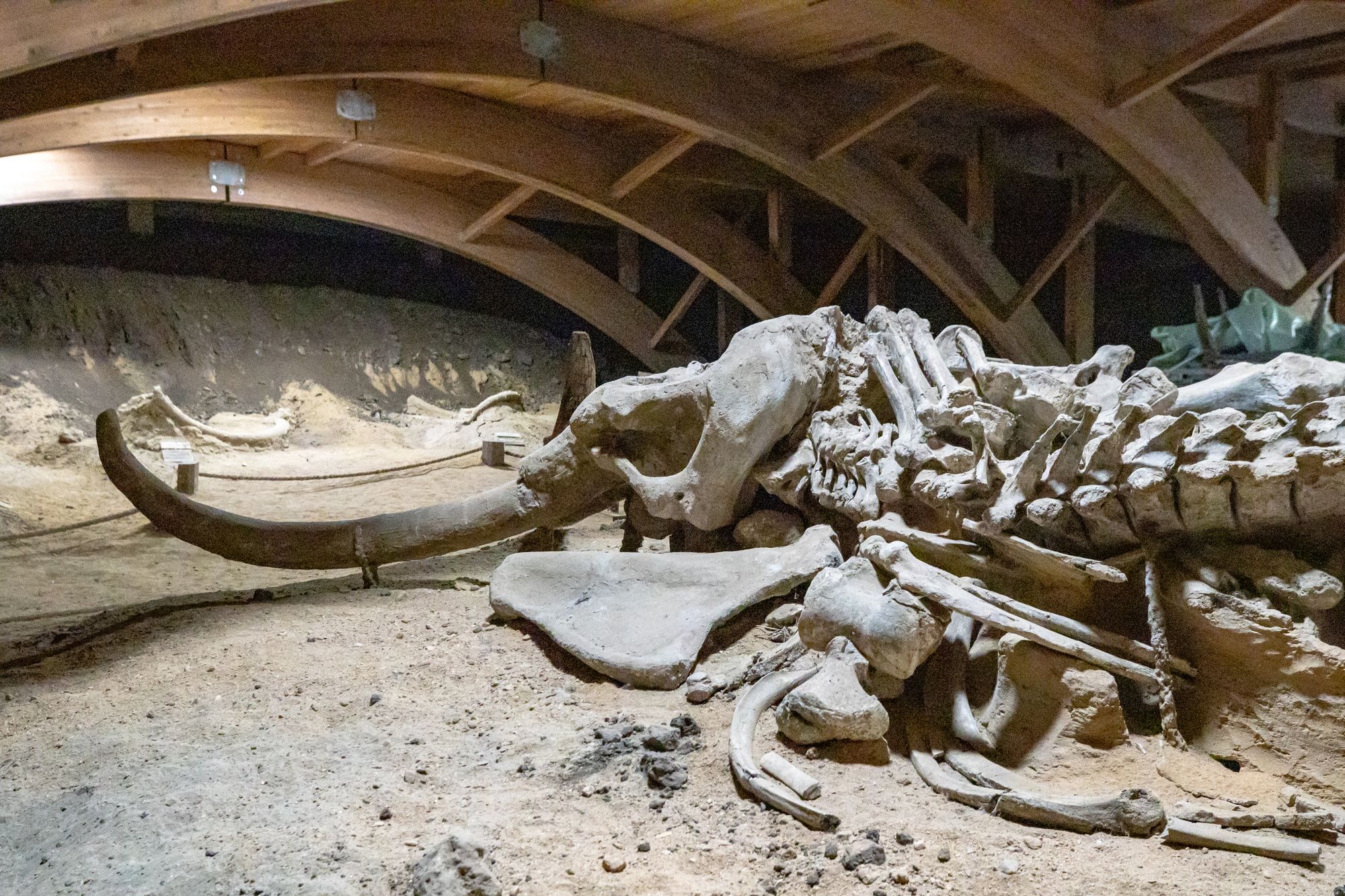
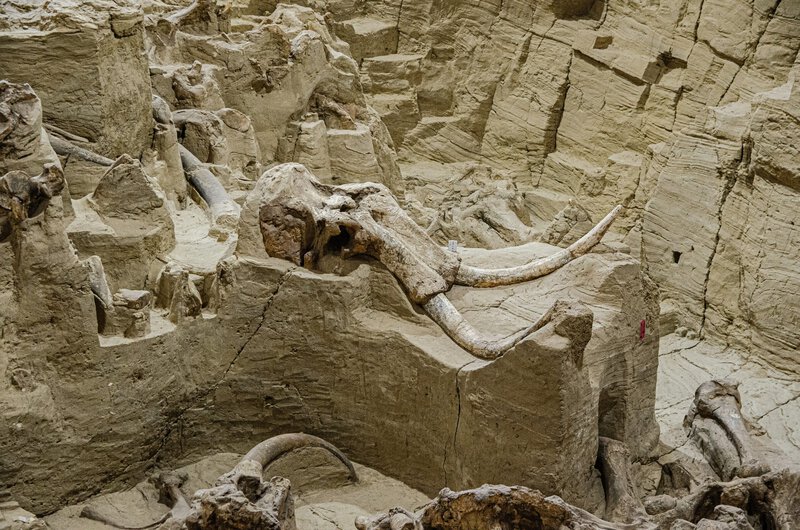
Not every accumulation of mammoth bones tells the same story. Paleontologists distinguish between two broad categories of mammoth deposit. The first are natural death assemblages — places where animals died from disease, drought, starvation, or old age, with remains accumulating over long periods without any human involvement. The second are human-associated sites, identified by the presence of stone tools, butchery marks on bones, hearths, and in some cases structures built from mammoth bones and tusks used as architectural material or fuel.
The contrast between these two site types is where the study’s central finding becomes most vivid. At natural accumulation sites, mammoth remains tend to skew male — a pattern consistent with well-documented behavior in living elephants, in which solitary adult males, who live apart from the herd for much of their lives, are more likely to die in isolation and be preserved as discrete skeletal deposits. At human-associated sites, the study found the opposite: females dominate at approximately 70 percent, according to the research team’s findings published through EurekAlert. The international team concluded that this female-heavy pattern is the genomic signature of preferential hunting, not a quirk of fossilization or site formation.
Human-associated large bone deposits on the Eurasian mammoth steppe are sometimes extraordinary in scale — dense concentrations of skeletal material co-located with evidence of sustained habitation, indicating that people returned to these locations repeatedly and processed large numbers of animals over extended periods. It is within these deposits that the female bias appears most clearly.
Why Female Mammoths? The Hunting Logic of the Ice Age
The DNA can identify a pattern, but it cannot directly record the reasoning of a hunter standing on a frozen steppe 20,000 years ago. To understand why females were targeted so consistently, researchers draw on behavioral ecology and the closest living analogue available: modern African and Asian elephants.
Female elephants live in cohesive, matriarchal herds led by experienced older females who guide the group to water, food, and safety. These herds are highly social, relatively predictable in movement, and — critically — visible as a group rather than as scattered individuals. Adult male elephants, by contrast, spend much of their adult lives as solitary or loosely associated animals, roaming larger territories and behaving less predictably. For cooperative hunters working together on an open landscape, a herd of females and their young would have presented a far more accessible and potentially more rewarding target than a lone bull.
Targeting a matriarchal herd also meant access to multiple animals simultaneously, including juveniles and subadults. For hunter-gatherer groups operating in a periglacial environment where calories were precious and storage opportunities limited, the ability to process several animals from a single coordinated hunt would have represented a significant tactical advantage. Popular Science’s coverage of the research explores these behavioral hypotheses in additional detail.
It is important to draw a clear line between what the data shows and what remains inference. The genomic evidence establishes that females were preferentially killed at human-associated sites. The specific motivations — herd accessibility, caloric strategy, cultural preference — are interpretations drawn from behavioral ecology and analogy with historically documented hunter-gatherer societies, not conclusions that emerge directly from the DNA sequences themselves.
The Extinction Equation: How Killing Females Accelerates Population Collapse
The reproductive mathematics of mammal populations make female-biased hunting far more dangerous to a species than an equivalent number of male kills. Females are the rate-limiting factor in population growth: removing males from a population reduces competition among survivors but barely slows the rate at which new calves are born, because remaining males can still mate with many females. Removing females, however, directly eliminates future reproductive capacity — every female killed is also every calf she would have carried and every grandcalf her daughters would have produced.
Woolly mammoths had reproductive rates comparable to those of modern elephants — roughly one calf every four to five years per female, with calves requiring years of maternal care before becoming independent. Each adult female killed therefore represented not just one animal but a cascade of lost reproductive potential stretching years or decades into the future. For a species already living at relatively low population densities across a vast but ecologically demanding landscape, sustained female-biased hunting imposed a compounding demographic cost that its slow breeding pace could not easily absorb.
This finding adds significant genomic weight to one side of a long-running scientific debate. The woolly mammoth’s extinction — occurring roughly 10,000 to 4,000 years ago across most of its range, with isolated island populations persisting somewhat longer — has been contested for decades between researchers who emphasize rapid climate warming and habitat loss and those who argue that human hunting pressure was the decisive factor. Smithsonian Magazine’s analysis of the study situates this new evidence carefully within that broader debate.
Crucially, the study’s authors do not claim that hunting alone drove woolly mammoths to extinction. The scientific consensus holds that the mammoth’s disappearance was most likely the result of multiple interacting pressures: a rapidly changing climate that shrank and fragmented the cold steppe habitat the species depended on, combined with sustained human predation that prevented populations from recovering. The female-hunting bias identified in this study is best understood as a mechanism that amplified the impact of human predation — not a single cause operating in isolation.
Where This Fits in the Mammoth Extinction Debate

The overkill hypothesis — the idea that human hunters arriving in new environments drove megafauna to extinction — was first formally articulated by paleontologist Paul Martin in the 1960s and has been supported and contested ever since. Some researchers argue that mammoth populations across Eurasia were already severely reduced and fragmented by climate-driven habitat changes before human hunting became ecologically decisive, and that a female-hunting bias observed in bone deposits may have varied in intensity across different regions and time periods.
What this new study contributes is not a final verdict but a substantial empirical data point: the largest ancient DNA sex-determination dataset for woolly mammoths assembled to date, showing a consistent and statistically robust pattern of female-biased kill sites across the Eurasian archaeological record. That is a meaningful advance in a field where large, well-controlled datasets are rare and where arguments have historically relied on far smaller samples.
Future research could test whether the female-bias pattern holds consistently across different geographic regions of the mammoth’s range, across different time periods as climate conditions changed, and across sites associated with different human cultural traditions. The aDNA sexing methodology used in this study is directly applicable to other Pleistocene megafauna as well, raising the possibility that sex-selective hunting was a widespread behavioral pattern across multiple large species and continents — a question that remains genuinely open.
What Ancient Mammoth Hunters Can Teach Us Today
The relevance of this research extends well beyond paleontology. Modern wildlife managers already recognize that hunting pressure concentrated on females can collapse slow-reproducing species far faster than total kill numbers alone would predict — a principle applied in contemporary conservation policy for elephants, rhinoceroses, and large cetaceans. The Ice Age mammoth data now provides a deep-time case study of that principle playing out at continental scale, across millennia, with ultimately irreversible consequences.
The bones of woolly mammoths, read through the genetic information preserved within them, are no longer silent about the circumstances of their owners’ deaths. They record, in molecular detail, a behavioral pattern that Ice Age hunters repeated so consistently and for so long that it left a statistical mark visible to researchers working tens of thousands of years later. The animals themselves have become witnesses to the choices that shaped their species’ fate — and the evidence, as the broader scientific community continues to examine and discuss, increasingly points toward human decisions, repeated across generations, that a slow-breeding, climate-stressed species ultimately could not survive.