
When astronomers search for another Earth, they are trying to pick out a candle flame beside a lighthouse — from across the ocean. The precision required of every optical component, and above all the primary mirror, is so extreme that a deformation smaller than a virus can silently erase a planet’s signal before a single photon is recorded.
Why Mirror Stability Defines the Entire Exoplanet Detection Problem
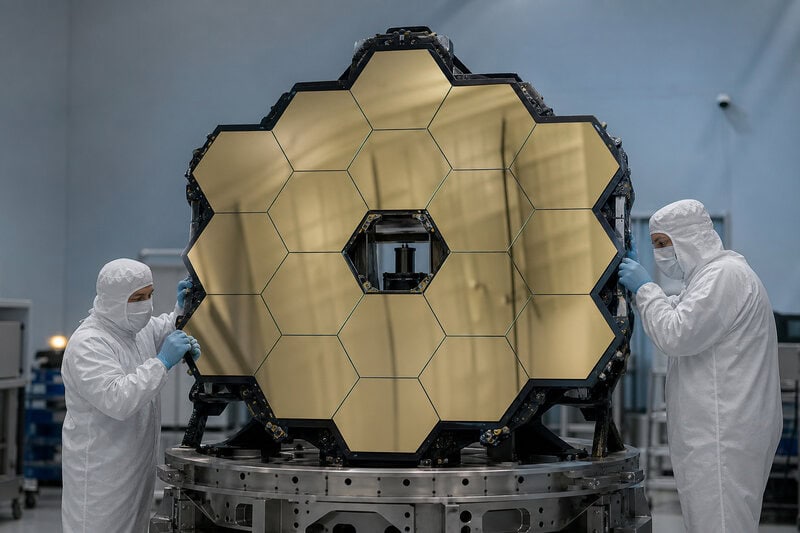
Most engineering tolerances in astronomy are tight. Mirror stability tolerances for high-contrast exoplanet imaging are in a different category entirely — they sit at the boundary of what current materials science and thermal engineering can physically achieve. Understanding why requires starting with the signal itself, because the signal is almost incomprehensibly small.
NASA cites a brightness contrast ratio of roughly ten billion to one between a Sun-like star and an Earth-sized planet observed in visible light. At that ratio, a single contaminating speckle of scattered starlight caused by a tiny mirror imperfection can outshine the planet itself, rendering it completely undetectable. No amount of additional observing time compensates if the mirror is generating false light at the level of the planet’s own faint glow. This extreme contrast is the foundational constraint that cascades through every other design decision in high-contrast astronomy technology.
Picometer-Scale Deformations — Smaller Than a Virus — Are Enough to Corrupt a Planet’s Signal
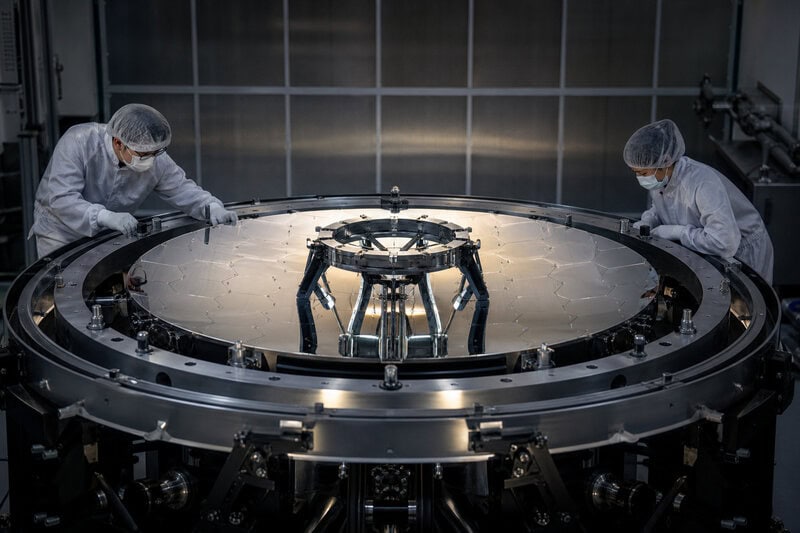
Changes in a mirror’s shape measured in picometers — trillionths of a meter, roughly one-hundredth the diameter of a hydrogen atom — are sufficient to alter a star’s diffraction pattern in ways that undermine coronagraph performance. To calibrate that scale physically: the smallest known viruses measure tens of nanometers, which is thousands of times larger than the deformations that matter here.
The threat does not come only from mechanical vibration. Thermal gradients of fractions of a degree Kelvin across a mirror surface can produce deformations at the picometer scale, meaning thermal control of the mirror assembly is every bit as important as its mechanical rigidity. Both failure modes produce the same result: a corrupted wavefront and a lost planet signal. Stability requirements at this scale have been studied extensively by NASA’s Habitable Worlds Observatory concept teams, which have identified picometer-level wavefront control as a hard technical prerequisite rather than a performance goal.
Mirror Drift Turns Controlled Starlight Suppression Into Controlled Failure

Coronagraphs — optical devices placed inside a telescope to block a star’s direct light — depend on the star remaining centered on a precisely shaped focal-plane mask to within nanometers of alignment. When the primary mirror drifts or flexes even slightly, the star’s position on that mask shifts, allowing leaked starlight to form quasi-static speckles that can mimic or overwhelm a planet’s faint signal. The suppression system does not fail catastrophically; it fails quietly, producing what looks like a null result.
This failure mode is consequential enough that the wavefront stability specification for NASA’s Roman Space Telescope coronagraph instrument is set at the picometer level per minute of observation. That figure exists because engineers have demonstrated, both analytically and in laboratory tests, that looser tolerances allow speckle noise to rise above the planet’s expected brightness. Suppressing starlight is an ongoing, dynamic process, not a one-time optical alignment, and the mirror must cooperate continuously throughout every observation.
Quasi-Static Speckles: Mirror-Born Impostors That Look Exactly Like Planets
When a mirror surface carries fixed but imperfect features — known as figure errors — those imperfections produce long-lived bright speckles in the focal plane called quasi-static speckles. Research published in The Astrophysical Journal by Hinkley et al. (2007) demonstrated that quasi-static speckle noise, not photon noise, was the primary barrier to detecting faint companions with the Hubble Space Telescope’s coronagraph. These features have since been identified as the dominant noise floor in both ground- and space-based coronagraphic imaging.
What makes quasi-static speckles uniquely damaging is their persistence. Unlike the rapidly dancing speckles produced by atmospheric turbulence, which average away over seconds, quasi-static speckles last for minutes to hours and do not diminish with longer exposure. A bright feature that appears at a fixed location in the focal plane and fails to fade as photons accumulate looks, to automated detection pipelines, almost identical to a real planet. Mirror figure quality is therefore a direct determinant of how many false positives contaminate an exoplanet survey — and of how much expensive follow-up time must be spent distinguishing artifacts from genuine detections.
JWST’s Segmented Mirror Introduced a New Class of Stability Risk
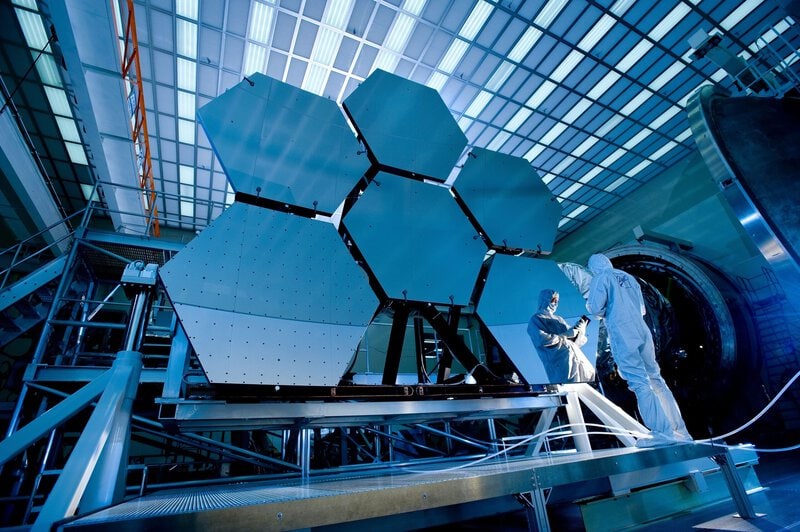
The James Webb Space Telescope’s primary mirror comprises 18 hexagonal, gold-coated beryllium segments that must collectively behave as a single continuous optical surface. Any relative drift between segments degrades the wavefront quality delivered to JWST’s instruments. Early in-orbit measurements reported by the Space Telescope Science Institute confirmed nanometer-level mirror movements — referred to as mirror drifts — that affect wavefront error and require correction through periodic realignment of individual segments.
For exoplanet science, the consequences are direct. JWST’s primary tool for characterizing planetary atmospheres is transit spectroscopy, in which the telescope measures the tiny change in a star’s infrared spectrum as a planet passes across its face. A mirror drift occurring mid-observation can introduce systematic noise that shifts the measured spectrum in ways that mask or mimic molecular absorption features — such as those produced by water vapor or carbon dioxide — that scientists are specifically searching for. Mirror drift and spectral precision are tightly coupled, and the segmented architecture that made JWST’s large aperture possible is the same architecture that introduced this particular vulnerability.
Mirror Diameter and Mirror Stability Impose Separate, Non-Interchangeable Constraints
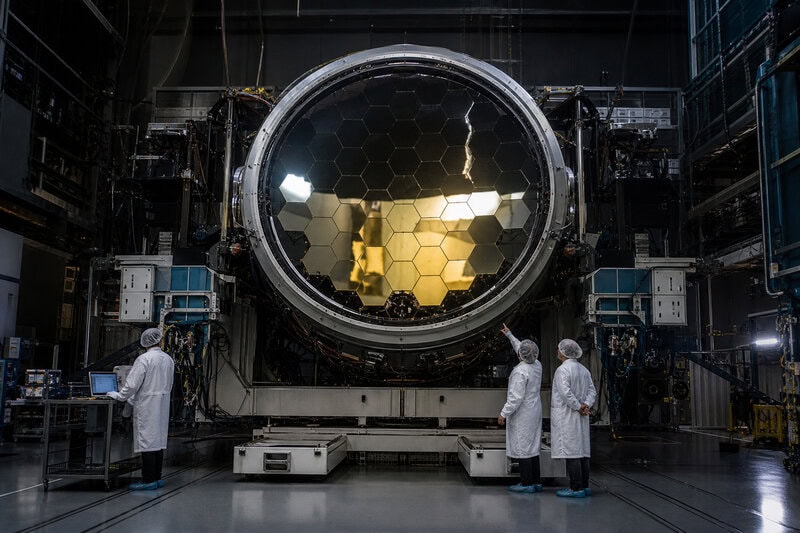
A mirror’s diameter and its figure stability govern two fundamentally different aspects of detection capability, and neither can substitute for the other. Diameter sets angular resolution, determining how close to a star a telescope can search — the inner working angle of the coronagraph scales with the ratio of wavelength to aperture. Figure stability sets the contrast limit, determining how faint an object can be detected at any given separation.
This dual-constraint framework was made concrete by the Klio 5-micron camera concept, proposed in 2004 for the 6.5-meter MMT Observatory. By using the telescope’s adaptive secondary mirror — one that corrects its own shape in real time — for coronagraphic imaging of giant exoplanets in the 3-5 μm wavelength range, rather than introducing a separate downstream deformable mirror, the design reduced the total number of optical surfaces in the beam. Fewer surfaces mean fewer opportunities for each reflection to add wavefront error. The concept illustrated a principle now standard in high-contrast instrument design: every optical surface is a potential source of figure error, and minimizing the number of surfaces in the beam is a legitimate stability strategy in its own right. Advances in exoplanet detection sensor technology continue to build on this dual-constraint framework.
Imaging an Earth-Analog Requires Maintaining the Star’s Image Position to 25 Milliarcseconds
Imaging an Earth-like exoplanet at a wavelength of 400 nanometers demands an angular resolution corresponding to a coronagraph inner working angle of 3 λ/D — approximately 25 milliarcseconds. That threshold defines how close to a star the telescope can look without the coronagraph mask blocking the planet along with the star. Meeting it requires the mirror to maintain its shape well enough that the star’s point-spread function neither broadens nor shifts by even a fraction of that angle during an observation lasting many hours.
Achieving this with a large segmented mirror in space requires active wavefront sensing and control systems that continuously sample the incoming wavefront and adjust segment positions in a closed feedback loop. This is not a one-time calibration performed before observations begin. It is a continuous process running throughout every science exposure, and any interruption or degradation of the control loop directly reduces the telescope’s ability to place an Earth-analog planet above its detection threshold.
Active Wavefront Control Can Compensate for Some Mirror Instability — But Not All of It
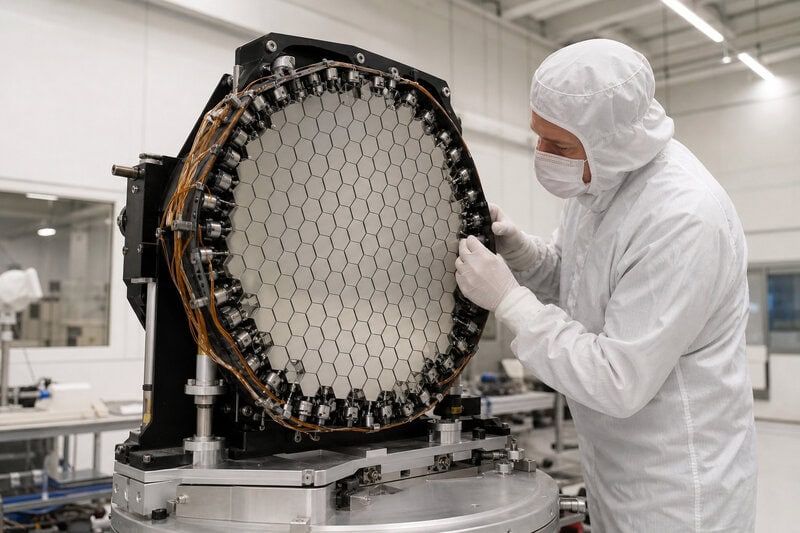
Deformable mirrors — thin mirror elements driven by hundreds to thousands of individually controlled actuators — can reshape themselves to cancel wavefront errors introduced by primary mirror instability. They are now standard components in high-contrast imaging instruments. The Roman Space Telescope’s coronagraph technology demonstration instrument uses two sequential deformable mirrors with up to 2,304 combined actuators, specifically to achieve the wavefront stability needed to suppress starlight to the parts-per-billion level required for exoplanet detection. That level of suppression, demonstrated in laboratory testbeds at the Jet Propulsion Laboratory, represents one of the most demanding optical engineering achievements in the history of the field.
Active correction has, however, a fundamental speed limit. Deformable mirrors can only correct errors as fast as the wavefront sensor can measure them. Mirror instabilities that evolve faster than the control loop’s bandwidth slip through uncorrected, seeding the focal plane with residual speckles. This bandwidth ceiling means active wavefront control complements a stable primary mirror rather than replacing the need for one. The better the mirror, the less correction the deformable mirror must supply — and the more of its dynamic range remains available to suppress the next-harder contrast challenge.
Thermal Expansion at Large Mirror Diameters Remains an Unsolved Engineering Challenge
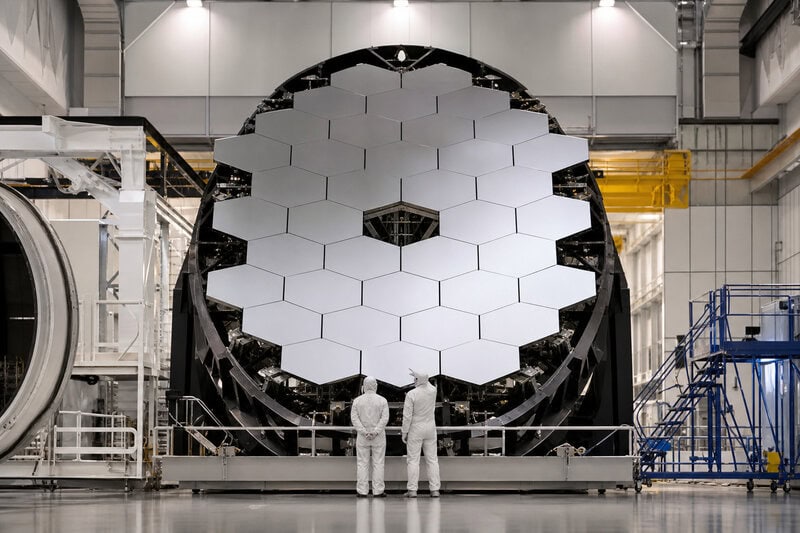
The Habitable Worlds Observatory, recommended as a priority mission by the Astro2020 Decadal Survey, is planned with a primary mirror of 6 meters or larger that must operate at stable cryogenic temperatures to minimize both thermal emission and mirror deformation. Even the most dimensionally stable materials currently available — ultra-low-expansion glass ceramics such as Zerodur and silicon carbide composites — retain residual thermal expansion coefficients that, at large diameters, translate millikelvin-scale temperature fluctuations into picometer-scale figure changes. At 6 meters, even a near-zero coefficient is not zero enough.
NASA’s ongoing technology maturation programs for the Habitable Worlds Observatory explicitly list mirror thermal stability as a top-tier risk that must be demonstrated at relevant scale before the mission can be confirmed for development. This places thermal mirror engineering — not optical design or launch vehicle selection alone — on the critical path of humanity’s next serious attempt to image and characterize Earth-like worlds around nearby stars. The materials science problem and the wavefront control problem are, at the scale this mission demands, effectively the same problem viewed from different disciplines.
Every Picometer of Mirror Control Is a Step Toward Another Earth
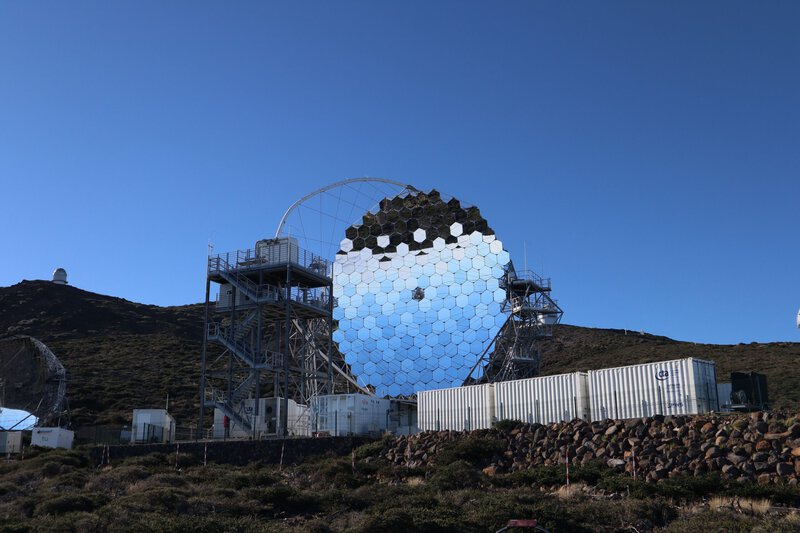
Mirror stability sits at the intersection of materials science, thermal engineering, precision mechanics, and optical physics. Progress in each discipline directly expands the catalog of worlds astronomers can hope to characterize. The constraints are severe: a ten-billion-to-one contrast ratio, picometer deformation tolerances, continuous closed-loop control throughout every observation, and thermal management challenges that current materials only partially solve. But the trajectory of the field — from Hubble’s fixed coronagraph to Roman’s active 2,304-actuator system to the Habitable Worlds Observatory’s planned capabilities — is one of consistent, measurable progress against each of those constraints. Every picometer gained in mirror control is, in the most literal sense, a step toward finding another Earth.