
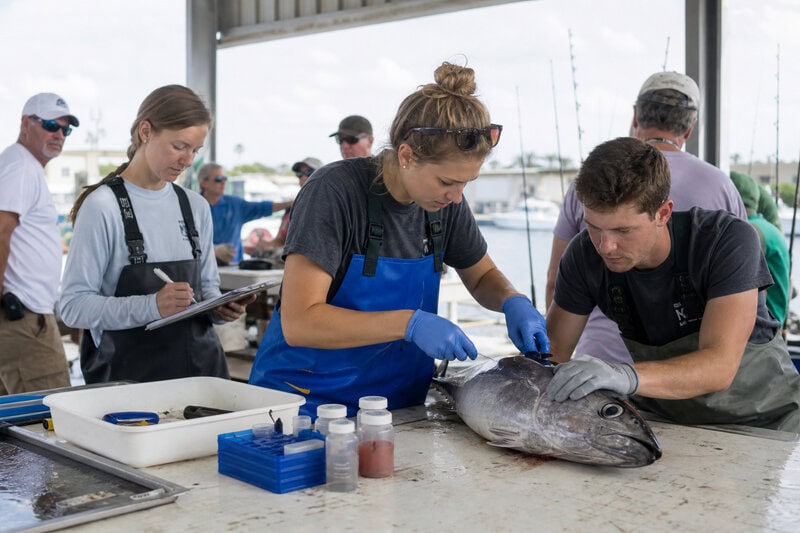
More than 100 University of South Alabama graduate students fanned out across the weigh stations of the Alabama Deep Sea Fishing Rodeo last July, moving methodically through a weekend catch that yielded approximately 500 biological samples — tissue clips, measurements, and ear bones pulled from red snapper and grouper hauled up from the northern Gulf of Mexico. To assemble an equivalent dataset by research vessel alone would cost millions of dollars and take years; here, it materialized in 72 hours on Dauphin Island.
A Century-Old Tournament, a 21st-Century Research Problem
The Alabama Deep Sea Fishing Rodeo, founded in 1929, predates most of the federal fisheries management infrastructure that now governs Gulf of Mexico fishing. That longevity matters scientifically: the tournament represents one of the longest-running records of recreational angler effort and catch composition on the northern Gulf Coast. Today it draws more than 4,000 anglers and roughly 100,000 spectators to Dauphin Island each July, making it one of the largest saltwater fishing tournaments in the world. The sheer volume of large, diverse, deep-water fish landing on its scales over a single weekend rivals what a research fleet might observe across an entire field season.
The modern event is organized around competitive species categories, with weigh stations processing everything from amberjack and wahoo to the federally managed reef fish — red snapper and grouper — that sit at the center of some of the most contested fisheries disputes in U.S. history. That concentration of catches, in one place, over a compressed window of time, is scientifically unusual and logistically difficult to replicate through any other means.
The University of South Alabama formalized its relationship with the rodeo when the tournament presented a $30,000 check to the University of South Alabama Marine Sciences program, transforming a sporting tradition into a funded research platform. The arrangement benefits both parties: the university gains structured access to a catch volume it could not generate independently, and the rodeo aligns its brand with Gulf conservation at a moment when the fishing community faces sustained scrutiny over its ecological footprint. This is not passive observation. Rodeo organizers schedule access, anglers consent to sampling, and university faculty supervise graduate students as they work the floor — making it a genuine science-tournament hybrid rather than opportunistic data collection.
What Graduate Students Actually Do at the Weigh Station
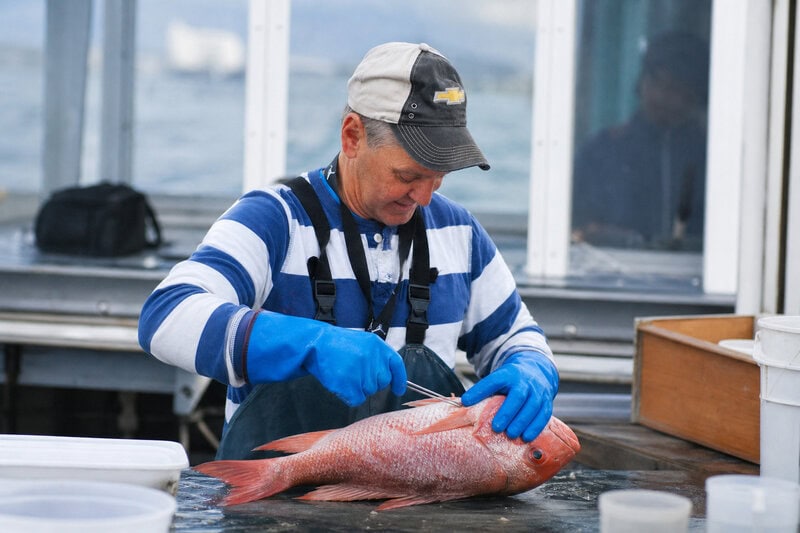
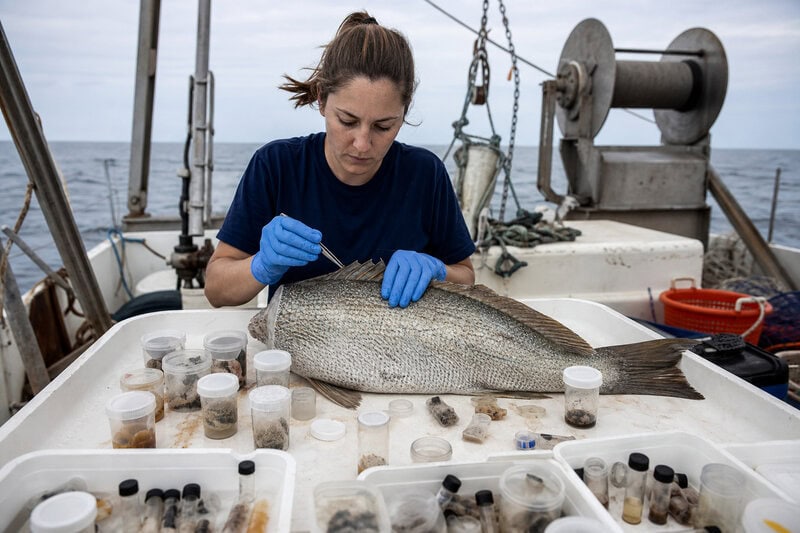
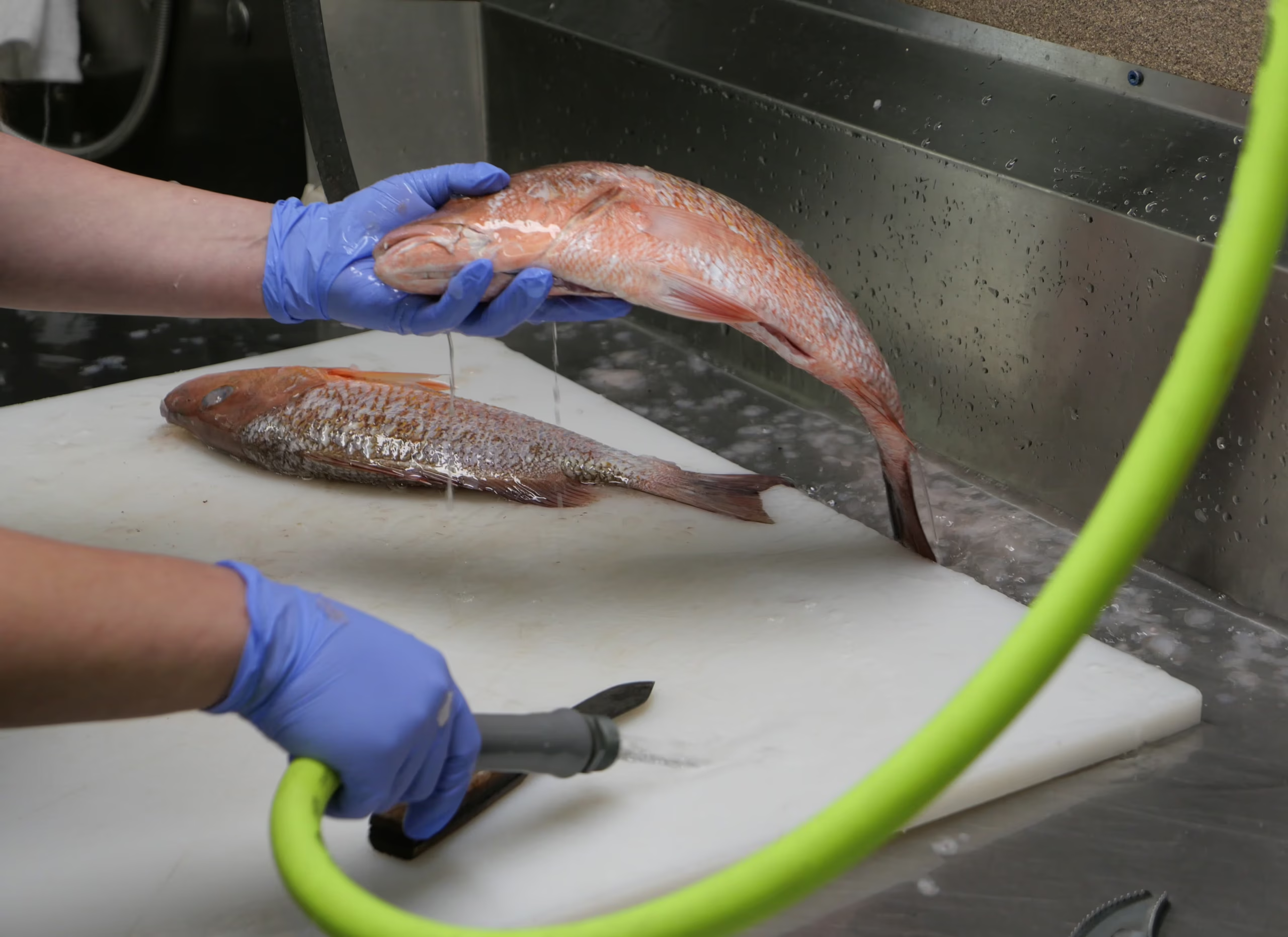
The sampling workflow is straightforward in concept and demanding in practice. When an angler brings a fish to the weigh station, graduate students request a small tissue clip, record total length and weight, and — for priority species like red snapper and grouper — extract the otolith. An otolith is a calcium carbonate structure inside a fish’s skull, sometimes called an ear bone, whose annual growth rings can be read under a microscope much like tree rings to determine the animal’s exact age. That age data feeds directly into stock assessments: the mathematical population models that federal regulators use to decide how many fish can be caught each year without pushing a species toward collapse.
Red snapper and grouper are the focal species for good reason. Both are managed under catch quotas that have been revised repeatedly amid fierce disagreement between scientists, regulators, and the Gulf fishing industry. Both inhabit deep rocky reefs at depths often exceeding 100 feet, where conventional SCUBA-based surveys are impossible. And both exhibit life-history traits — slow growth, late sexual maturity, lifespans that can exceed 50 years in red snapper — that make accurate age-at-size data unusually consequential for population modeling. A miscalibrated age estimate ripples through an entire stock assessment.
University of South Alabama researchers describe the rodeo sampling effort as generating a statistically meaningful snapshot of the size and age distribution of fish taken by recreational anglers in the northern Gulf — a segment of the fishery that federal trawl surveys are structurally unable to capture with comparable specificity. Approximately 500 samples across a single rodeo weekend is not a definitive census, but it is a dataset with real resolution, covering depth zones and size classes that standard government surveys routinely miss.
Students also collect stomach contents from selected specimens. Stomach-content analysis can reveal what deep-reef predators are eating, how diets shift seasonally, and whether prey availability near Dauphin Island is changing — baseline ecological data that is directly relevant to understanding how climate-driven changes are propagating through northern Gulf food webs.
The Data Gap: Why the Gulf’s Deep Reefs Resist Conventional Study
The northern Gulf of Mexico’s deep artificial and natural reefs — many sitting between 60 and 300 feet below the surface — host some of the region’s most commercially and recreationally valuable fish. But this depth range, which marine biologists call the mesophotic zone, sits below safe SCUBA limits and above the depth range where submersibles are routinely cost-effective. It is one of the least-surveyed environments in U.S. waters, and the species that live there are accordingly difficult to count.
Federal stock-assessment surveys have historically relied on trawl gear designed for soft-bottom habitat and open water. That gear systematically under-samples fish that live in tight association with hard structure — the reefs, ledges, and shipwrecks that red snapper and grouper prefer. The resulting bias has fueled years of conflict between scientists, regulators, and the Gulf fishing industry, with anglers and charter operators insisting that fish populations are healthier than federal models suggest, and federal scientists arguing that conventional survey methods are the most defensible available. Both positions contain legitimate empirical points, which is precisely why additional data sources carry weight.
Tournament sampling does not resolve that conflict on its own. Fisheries scientists are careful to note that rodeo data carries its own biases: anglers target large, trophy-class fish, concentrate effort on specific productive reefs, and use techniques optimized for success. A tournament catch is not a random sample of the population. But when those biases are transparently documented and accounted for in analysis, the data fills depth-specific and size-class gaps that government surveys leave open — functioning as a complement to, not a replacement for, conventional stock-assessment methods.
This approach fits within a broader movement in marine biology. Programs that engage recreational anglers as data collectors — from billfish tagging networks to shark identification applications — are increasingly recognized by NOAA and academic institutions as a cost-effective supplement to traditional survey methods, particularly for species that are rare, deep, or behaviorally difficult to capture with standard gear. The University of South Alabama’s rodeo partnership is among the more structured and well-funded examples of this model on the Gulf Coast.
Why This Field Experience Is Irreplaceable for Graduate Students
For more than 100 University of South Alabama graduate students, the rodeo partnership provides something that classroom and laboratory instruction cannot: real samples, real time pressure, and a real public-facing environment. Processing approximately 500 specimens over a weekend — maintaining chain-of-custody documentation, practicing species identification under field conditions, and explaining their work to curious anglers — builds the procedural fluency that employers in fisheries management, environmental consulting, and academic research explicitly look for in new hires.
Faculty from the University of South Alabama’s Marine Sciences program supervise students in real time, turning the weigh-station floor into an outdoor laboratory. Data-collection protocols practiced here are not hypothetical exercises; they generate material that will actually enter the scientific record, which raises the stakes and sharpens attention in ways that simulated exercises rarely achieve.
There is also a professional-network dimension that graduate curricula increasingly emphasize. Interacting directly with anglers, tournament officials, and visiting fisheries managers gives students practical experience in science communication and stakeholder engagement — competencies that are essential in a field where scientists face sustained pressure to make their findings legible and credible to non-expert audiences. Gulf fisheries management is a domain where public trust in science is genuinely contested, and students who can navigate that terrain are better prepared for careers in applied marine science.
The knowledge flow runs in both directions. Experienced tournament anglers often possess detailed local ecological knowledge — specific reef observations, accounts of seasonal movement patterns, records of anomalous catch events — that trained scientists can systematically document and, where appropriate, incorporate into broader ecological understanding. That reciprocal dynamic makes tournament science something more than data extraction; it is a form of structured dialogue between empirical traditions.
What the Data Could Eventually Change
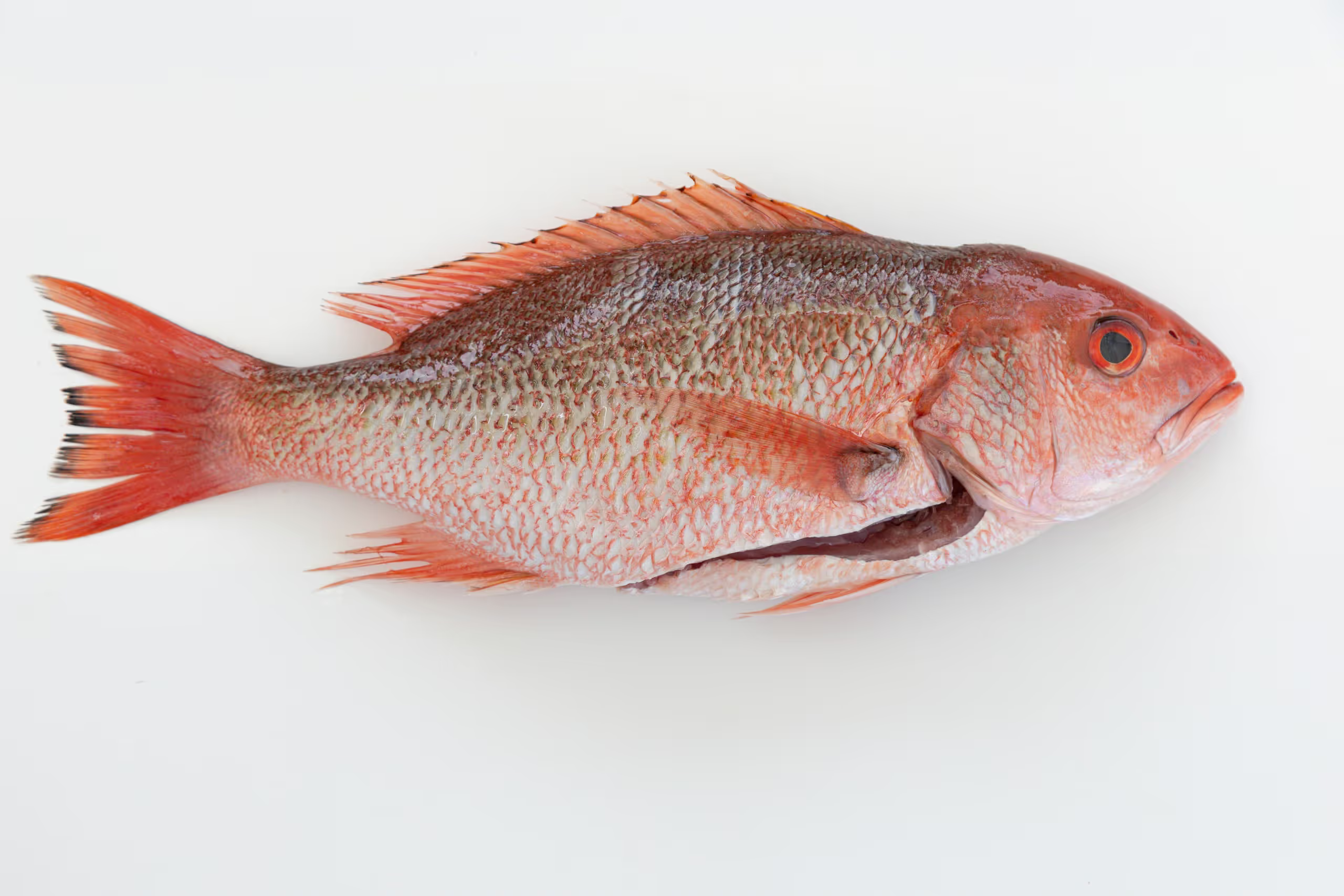
Red snapper management in the Gulf of Mexico has been one of the most contentious fisheries disputes in American regulatory history, marked by years of federal closures, litigation, and competing stock assessments that produced starkly different catch-limit recommendations. More granular, depth-resolved age-and-size data from recreational catches could sharpen the population models that underpin future quota decisions. Scientists are careful to note, however, that tournament data alone is not sufficient to revise a stock assessment — it must be integrated with, and validated against, other data sources through a formal scientific process.
An emerging area of inquiry — not yet a settled conclusion — concerns whether rodeo samples consistently reveal older, larger individuals in size classes that federal surveys undercount. If that pattern holds up across multiple years of sampling, it would be scientifically significant and would warrant dedicated hypothesis-driven investigation. The University of South Alabama partnership is positioned to generate the longitudinal data needed to test that question, provided the collaboration continues and sampling protocols remain consistent across years.
At the ecosystem level, stomach-content data from rodeo samples could contribute to understanding how the northern Gulf’s deep-reef food webs are responding to warming water temperatures and shifting prey distributions — questions with direct relevance to long-term fisheries sustainability that are currently difficult to answer with existing survey infrastructure.
The model is also scalable. Other large Gulf tournaments could adopt similar partnerships with regional universities, and the cumulative dataset across events and years could eventually support longitudinal analyses of fish population trends that no single research institution could afford to generate independently. The University of South Alabama’s approach at the Alabama Deep Sea Fishing Rodeo offers a replicable template: structured access, faculty supervision, angler consent, and a funding mechanism that makes the collaboration sustainable.
When Sport Fishing and Marine Science Share a Weigh Station
The University of South Alabama’s partnership with the Alabama Deep Sea Fishing Rodeo shows what a well-structured collaboration between a research institution and a major fishing tournament can produce: hundreds of biological samples from depth zones and fish size classes that conventional federal surveys systematically miss, collected at a fraction of the cost of an equivalent research-vessel deployment. More than 100 graduate students, approximately 500 samples, $30,000 in tournament funding, and nearly a century of rodeo history are converging on Dauphin Island to produce data that could eventually inform how the Gulf of Mexico’s most economically and ecologically important fish are managed.
As federal fisheries budgets face uncertainty and Gulf ecosystems continue to respond to warming waters and shifting prey distributions, science-tournament partnerships like this one offer a pragmatic, community-embedded model for sustained data collection — one that works precisely because it meets anglers where they already are, in the moment of maximum catch concentration, with consent, structure, and scientific oversight in place.
The Alabama Deep Sea Fishing Rodeo has always measured what anglers catch. Now, with University of South Alabama graduate students at the weigh station, it is beginning to measure what those catches mean.