
Beneath the sun-bleached soil of a Libyan coastal city, archaeologists have uncovered something that genuinely stopped specialists in their tracks: a previously unrecorded ancient theater overlooking the Mediterranean Sea, alongside the rediscovered remains of a rare Greek hippodrome and a sanctuary. This tripartite civic complex is already prompting scholars to reconsider how deeply Greek urban culture took root in North Africa. The discoveries, announced by the Antiquities Authority in Cyrene, were made at Apollonia — a site whose full archaeological significance had, until now, been substantially underestimated.
A Theater by the Sea — and a Discovery No One Saw Coming
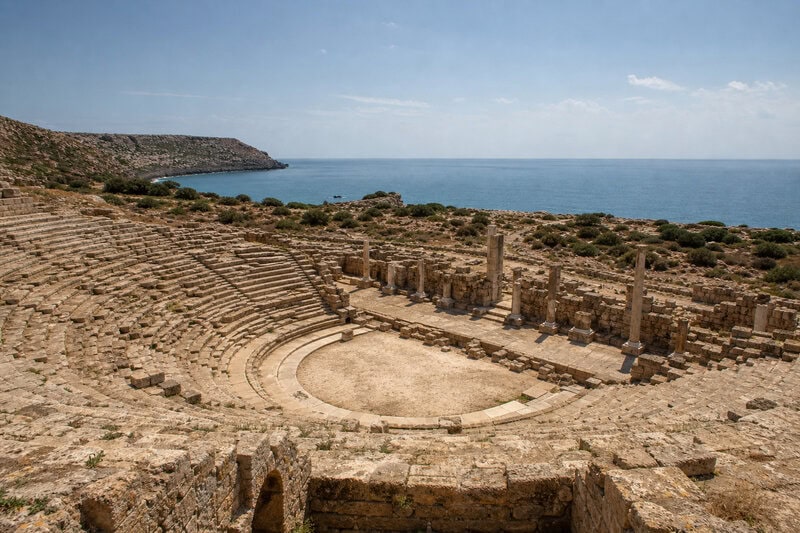
The headline find is the theater itself. Greek theater builders were skilled at exploiting natural topography — hillsides, hollows, elevated ridges — to create tiered seating that amplified sound and commanded dramatic sightlines. A seafront orientation of the kind documented at Apollonia is uncommon in the ancient record. The visual effect it would have produced — an audience gathered above the Mediterranean, watching performance framed by open water — makes this one of the most dramatically situated performance venues yet documented in the ancient Greek colonial world.
Equally significant is what arrived alongside it. The same excavation also surfaced the rediscovery of a Greek hippodrome and a sanctuary, giving researchers a multi-structure Hellenistic complex. Hellenistic refers to the period following Alexander the Great’s conquests, roughly 323 BCE onward, when Greek language, architecture, and civic institutions spread aggressively across the eastern Mediterranean and North Africa. The Antiquities Authority in Cyrene described the ensemble as reshaping scholarly understanding of the Mediterranean ancient world — a measured claim from an official archaeological body, and one specialists are treating accordingly.
Detailed reporting on the finds is available from Arkeonews, which covers the hippodrome and seaside theater discovery in full, and from Protothema’s coverage of how these Libyan archaeological discoveries are reshaping Mediterranean scholarship.
What Is Apollonia — and Why Does ‘Susa’ Keep Appearing?
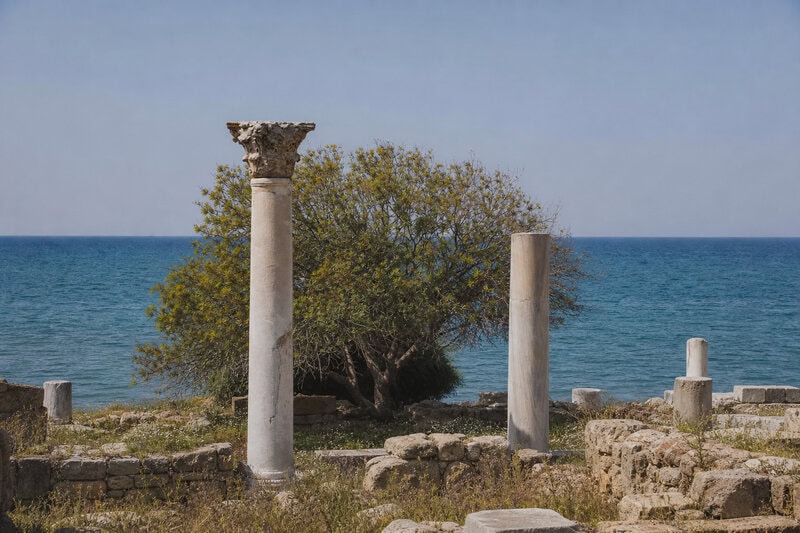
Apollonia was the principal seaport of Cyrene, the great Greek colonial city in what is now northeastern Libya, serving as its maritime gateway across centuries of trade and cultural exchange. The site carries the alternate name Susa — a designation used locally in Libya — and that naming coincidence has generated confusion in early reporting, because Susa is also the name of one of ancient Persia’s most celebrated capitals, located in modern-day Iran. The two cities share nothing beyond a name: the Apollonia finds are entirely North African in context, rooted in the Greek colonization of Cyrenaica that began around the seventh century BCE.
That distinction matters for understanding the historical stakes. The Persian Susa was a seat of Achaemenid imperial power; the Libyan Apollonia-Susa was a layered port city that absorbed Greek, Hellenistic, Roman, and Byzantine occupation over nearly a millennium. The newly found structures belong to the Hellenistic phase, placing them in the centuries when cities across Alexander’s former empire were rebuilding themselves in the architectural idiom of the Greek world. Comprehensive background on the site and its naming context is available from Libya Update’s report on the discovery of the ancient theater and Greek hippodrome in Susa.
The Hippodrome: A Rare Survivor of a Nearly Lost Building Type
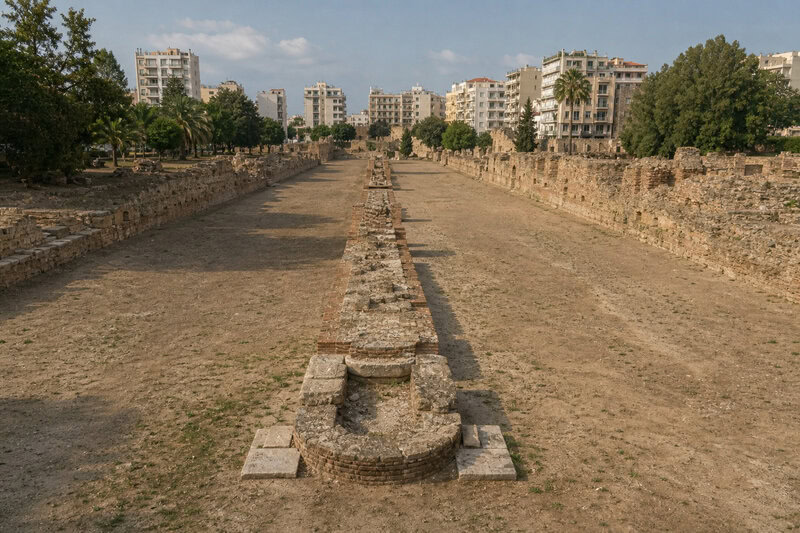
Of the two headline structures, the hippodrome may be the rarer find. A hippodrome — from the Greek hippos (horse) and dromos (course) — was an elongated stadium designed for chariot and horse racing, the ancient world’s most expensive and socially prestigious public spectacle. Maintaining a hippodrome required substantial civic wealth: the land footprint was enormous, the infrastructure complex, and the games themselves demanded the kind of elite patronage that signaled political power across the Hellenistic world.
Hippodromes are among the rarest surviving structures from antiquity. Their vast, open footprints made them prime targets for stone robbing — the systematic dismantling of monuments for reusable building material — and for agricultural conversion across the medieval and early modern periods. Most have been destroyed beyond archaeological recognition. The Antiquities Authority in Cyrene characterizes this as a rediscovery, suggesting the structure had been noted in earlier and incomplete surveys but never properly documented or excavated. That distinction tempers but does not diminish the significance: a hippodrome that has evaded full study for this long, in a region with known political barriers to systematic excavation, represents a genuinely substantial gap now beginning to close.
Its presence at Apollonia argues that the city was wealthy and politically connected enough to stage the kinds of elite equestrian competitions that reinforced civic identity in Hellenistic communities. Horse racing was not entertainment alone; it was a public declaration of civic ambition and cultural belonging within the broader Greek world.
The Theater: Architecture as a Political Statement
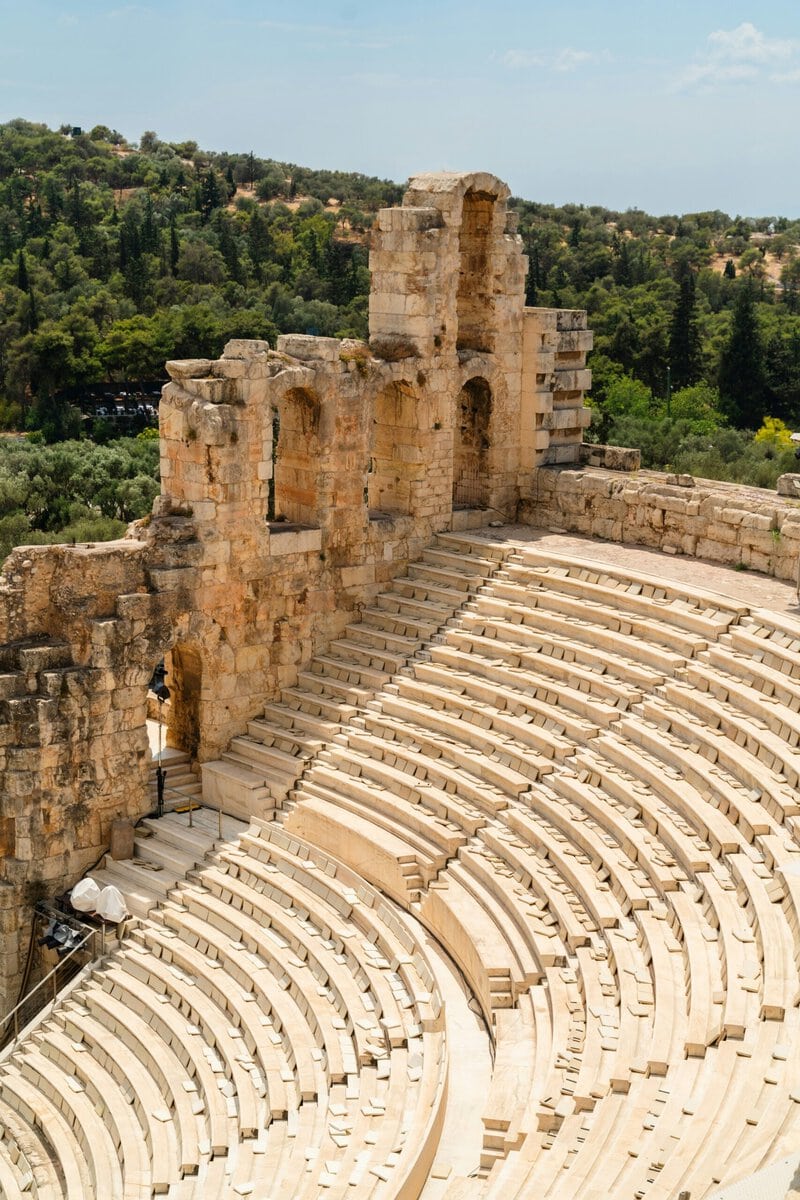
Greek theaters were civic infrastructure before they were entertainment venues. They hosted the religious festivals of the Dionysia, political assemblies, and dramatic competitions — tragedies, comedies, and choral performances — that collectively defined community identity in the Greek city-state tradition. To build a theater was to assert that a city was a full participant in Greek cultural life, not a peripheral outpost.
The Apollonia theater’s seafront position amplifies that statement considerably. Because the theater is described by the Antiquities Authority in Cyrene as recently identified rather than fully excavated, its precise dating, seating capacity, and architectural order remain subjects of active investigation — a point researchers are careful to note publicly. Preliminary assessments situate it within the broader Hellenistic tradition, but confirming whether it predates, coincides with, or postdates the hippodrome will require stratigraphic analysis: the systematic study of soil and debris layers to establish chronological sequence. No responsible interpretation of the complex as a whole can be offered until that work is completed and published.
What the Sanctuary Adds to the Picture
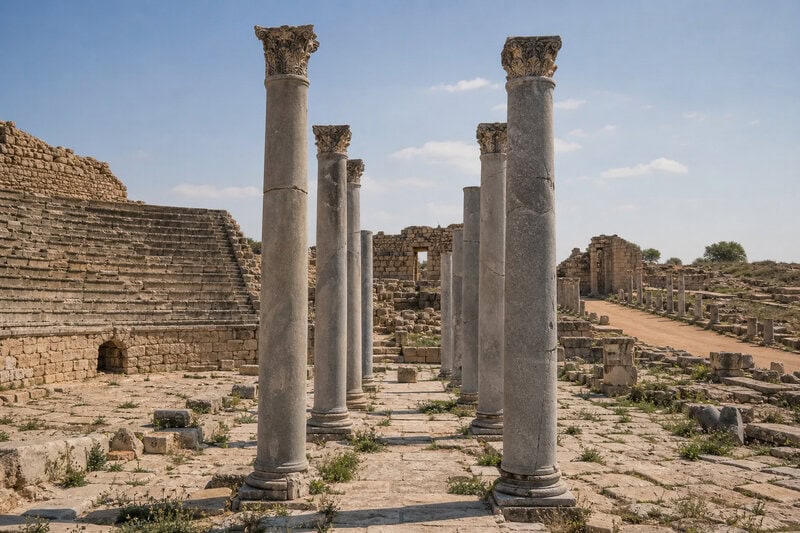
The third element of the complex — the sanctuary — may ultimately be the most interpretively revealing. Greek sanctuaries were not peripheral to civic life; they were its gravitational centers, the spaces around which commerce, governance, and social identity organized themselves. A sanctuary co-located with a theater and hippodrome strongly suggests that Apollonia hosted formal festival cycles, possibly dedicated to Apollo — the city’s namesake deity — that combined religious ritual, dramatic performance, and equestrian competition within a single monumental precinct.
This tripartite arrangement echoes the layout of major Panhellenic festival sites such as Olympia and Delphi, where sanctuary, theater, and athletic venue operated as an integrated complex drawing participants from across the Greek world. The parallel raises a genuinely important possibility: that Apollonia aspired to regional religious and cultural significance well beyond its role as a harbor town. Scholars are appropriately cautious, however. Drawing direct comparisons to Olympia or Delphi requires far more excavation data than currently exists. The sanctuary’s dedications, scale, and precise structural relationship to the theater and hippodrome are not yet established in the published record, and premature comparisons risk overstating what the evidence currently supports.
Why Libya — and Why Now?
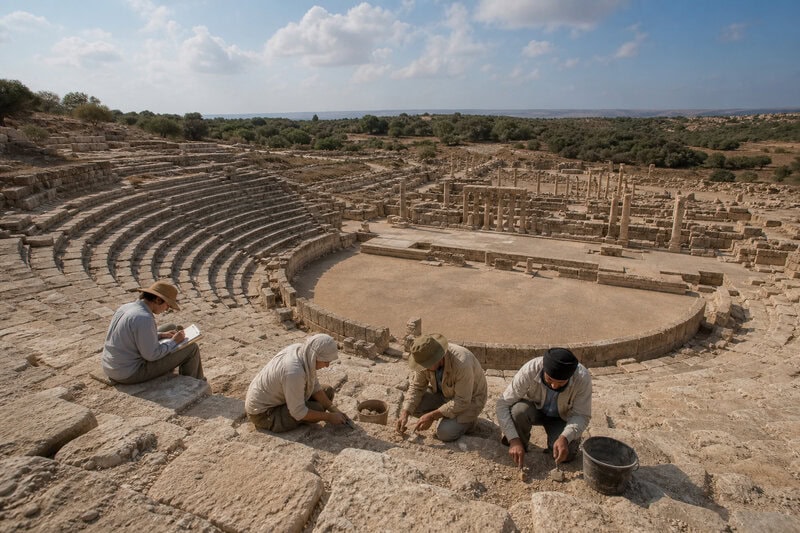
Cyrenaica, the northeastern region of Libya where Apollonia sits, contains some of the best-preserved Greek colonial remains anywhere in the world. Cyrene itself was recognized as a UNESCO World Heritage Site in 1982. Yet decades of political instability have severely constrained systematic excavation across the region, leaving major sites incompletely studied and, in some cases, vulnerable to damage. The involvement of the Antiquities Authority in Cyrene in this announcement signals a renewed institutional commitment to documenting the region’s heritage at a moment when Libyan authorities are actively working to reassert cultural stewardship over internationally significant sites.
Technology has also played a role in accelerating discovery. Remote sensing methods — including satellite imagery and ground-penetrating radar, which detects buried structures without the disruption of physical excavation — have transformed the pace at which architectural features can be identified at known sites. This helps explain how substantial new structures can emerge at a location like Apollonia that has been nominally known to scholarship for generations: the tools available to identify what lies beneath the surface have changed dramatically, even when the political and logistical conditions for full excavation have not always kept pace.
What This Means for the Bigger Historical Picture
The Apollonia finds contribute primary physical evidence to one of ancient history’s most debated questions: how completely, and in what material forms, did Hellenistic culture take root in the communities that Alexander the Great’s conquests drew into the Greek cultural orbit? A fully articulated civic complex — theater, hippodrome, sanctuary — at a North African port city argues that Hellenization in Cyrenaica was not a thin administrative veneer applied over local traditions, but a deep structural transformation of urban life with genuine monumental expression. Archaeologists are careful to stress, however, that this interpretation must be tested against the full excavation record before it can be stated with confidence.
The Antiquities Authority in Cyrene’s description of the finds as reshaping understanding of the Mediterranean ancient world reflects genuine scholarly weight. Each well-documented Hellenistic complex recovered anywhere around the Mediterranean refines the map of where Greek urban culture genuinely took hold, and each adds resolution to a historical picture that remains, in many regions, frustratingly incomplete. Full publication of excavation data, peer review, and comparative analysis with other Cyrenaican sites will be necessary before the discoveries’ ultimate significance can be assessed. That process will take years. What can be said now, on the basis of the evidence announced, is that Apollonia has just become a considerably more important site than most specialists had previously recognized — and that the research it will generate is only beginning.