Scientists Find Brightest Object Ever Observed
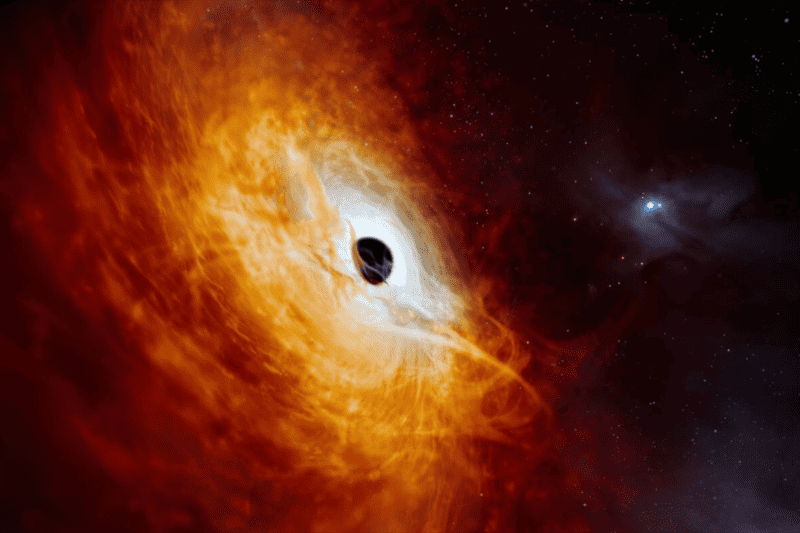
In a groundbreaking discovery, astronomers using the European Southern Observatory’s Very Large Telescope (VLT) have unveiled an extraordinary quasar, revealing it to be the brightest and most luminous object ever detected. These quasars are luminous cores of galaxies energized by supermassive black holes, with this one standing out for its rapid growth rate, consuming mass equivalent to one Sun per day.
Fueled by their resident black holes, quasars emit immense light, making them some of the most dazzling cosmic objects observable from Earth. Led by astronomer Christian Wolf from the Australian National University (ANU), the discovery of this colossal quasar, named J0529-4351. This colossal quasar, located over 12 billion light-years away, boasts a black hole with a mass equivalent to a staggering 17 billion Suns and shines with a luminosity exceeding 500 trillion times that of our own Sun.
Remarkably, J0529-4351 remained unnoticed despite being captured in images since 1980, only recognized as a quasar later due to its unprecedented luminosity. Identifying such distant and luminous objects requires advanced technologies like machine learning and instruments such as the VLT and ANU’s telescope. The discovery of J0529-4351 marks a significant milestone in our quest to understand the universe’s intricacies, with implications reaching far beyond the realm of astrophysics.
As we continue to unravel the mysteries of quasars and black holes, we inch closer to unraveling the universe and uncovering the secrets of our cosmic origins. For Christian Wolf and his colleagues, the pursuit of these celestial treasures is not just a scientific endeavor but a thrilling adventure that fuels their curiosity and passion for exploring the unknown depths of space.