
Somewhere in downtown Chicago, a pyramid stands in plain sight — and almost nobody notices it. This is not a metaphor. The city’s built environment, its museum vaults, and its everyday decorative objects carry the unmistakable grammar of ancient Egypt, layered so deeply into American visual culture that most people have learned, without realizing it, to look straight through it.
The Pyramid You Walk Past Every Day
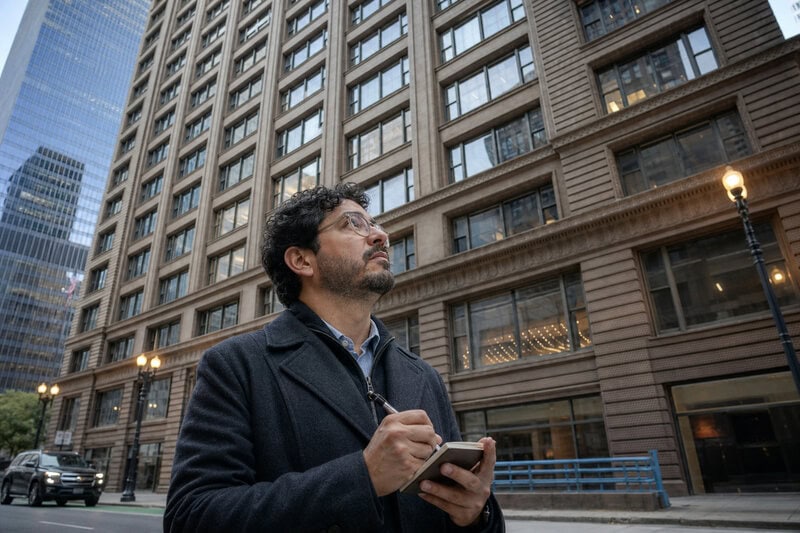
Urban historians use the phrase “monumental blindness” to describe what happens when a building style becomes so familiar that it ceases to register as a deliberate choice. Egyptian Revival architecture — a 19th-century design movement that borrowed obelisks, lotus columns, battered (inward-sloping) walls, and cavetto cornices from ancient Nile civilization — embedded itself so thoroughly into American civic and commercial buildings that it effectively disappeared into the background. Chicago is one of the richest examples of this phenomenon in the United States.
Chicago’s engagement with ancient Egypt spans at least 130 years of continuous collecting, building, and reimagining. It runs from the Art Institute’s first Egyptian acquisitions in 1890 through the present day. Chicago’s historic cemeteries contain pyramid-inspired funerary tombs whose battered walls and winged-sun-disk reliefs are direct expressions of Egyptian Revival grammar — structures that architectural historians recognize immediately, even as the joggers and dog-walkers who pass them daily do not. Architectural critics have also drawn comparisons between the bold geometric massing of the Obama Presidential Center and Egyptian monumental form, a parallel that places the city in a continuous conversation with these aesthetics spanning nearly two centuries.
The harder question is not whether this lineage exists. It clearly does. The harder question is why a Midwestern city on a freshwater lake keeps returning, again and again, to the imagery of a desert civilization that flourished more than two millennia ago.
What Egyptomania Actually Is — and Why It Never Fully Ends
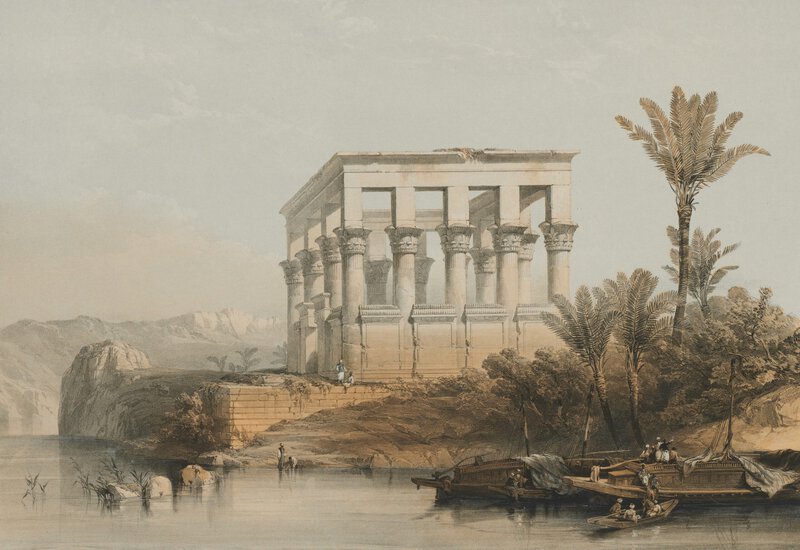
Egyptomania is the recurring, centuries-long Western obsession with ancient Egyptian aesthetics, symbolism, and mythology. It is distinct from academic Egyptology in a crucial way: Egyptomania is driven by popular imagination rather than scholarly rigor. It is less about what ancient Egypt actually was and more about what successive Western cultures needed it to be.
Historians trace the most explosive modern phase of this obsession to Napoleon Bonaparte’s 1798 Egyptian campaign, which brought European artists and scientists face-to-face with monuments at scale. The resulting scholarly publication, the Description de l’Égypte, flooded European and then American visual culture with images of sphinxes, hieroglyphs, and colossal statuary. A design craze crossed the Atlantic within decades, and American architects, cemetery designers, and furniture makers absorbed it enthusiastically.
Critically, the obsession has never been monolithic. It resurges in waves tied to specific trigger events — archaeological discoveries, blockbuster exhibitions, and world’s fairs — each wave reinterpreting Egypt through its own cultural anxieties and aspirations. The 1922 discovery of Tutankhamun’s tomb by Howard Carter ignited a global frenzy that rippled through fashion, architecture, and film well into the 1930s. Later, lavish Hollywood productions reignited mainstream American fascination with ancient Egyptian themes, demonstrating that Egyptomania is as much a media phenomenon as an architectural or archaeological one. This cyclical quality is precisely what makes Egyptomania so durable: it is not a single enthusiasm but a renewable one, capable of being reloaded by each generation with fresh cultural meaning.
Egyptian Revival Architecture Across America — and Chicago’s Place in It
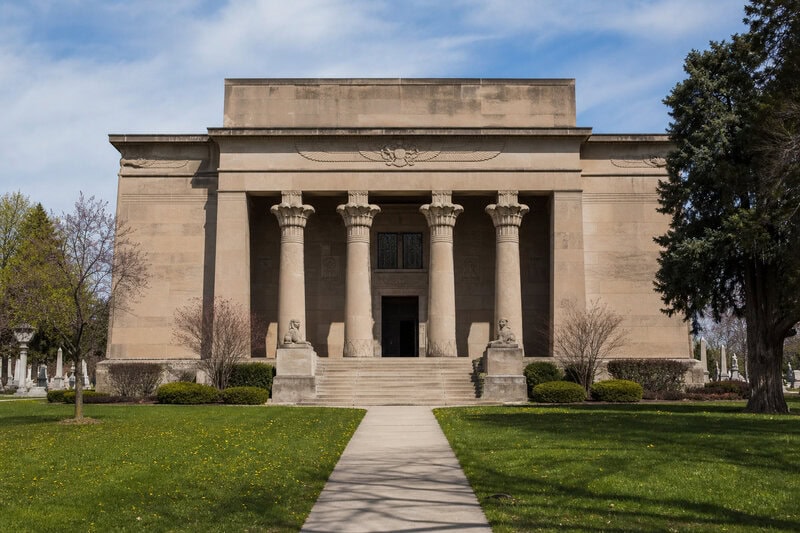
Egyptian Revival architecture flourished in the United States from roughly 1830 to 1850, favored for cemeteries, prisons, and libraries because its monumental permanence signaled eternity, authority, and the preservation of knowledge — qualities these institutions wanted to project. The style’s longevity in American architecture reflects what scholars describe as a persistent cultural equation between ancient Egypt and ideals of permanence, wisdom, and civilizational ambition.
Chicago adopted these motifs in funerary and institutional architecture with particular enthusiasm, in part because the city itself was engaged in a perpetual argument about its own significance. A city that burned to the ground in 1871 and rebuilt itself into a global metropolis within two decades had obvious reasons to be drawn to a civilization famous for building things that last. The pyramid-inspired tombs in Chicago’s historic cemeteries are not merely decorative choices. They are statements — made in the language of a civilization that had, by any measure, solved the problem of lasting.
That conversation extends to the present. The Obama Presidential Center’s geometric massing has drawn credible architectural comparisons to Egyptian monumental form, whether or not that was the designers’ explicit intention. Most Chicagoans are unaware they are participating in an aesthetic lineage nearly two centuries old — which is, itself, a testament to how completely Egyptian Revival grammar has been absorbed into the American visual vocabulary.
The Oriental Institute: Where Chicago Keeps Its Real Egyptian Treasures
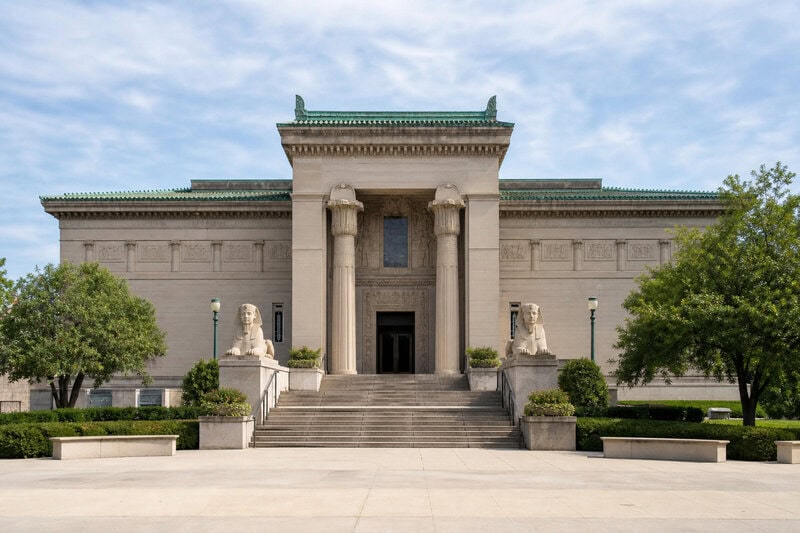
While Egyptomania decorates the surface of Chicago’s built environment, the Oriental Institute Museum at the University of Chicago holds something more substantive: one of the largest and most complete Egyptian collections in the United States, assembled through decades of systematic archaeological fieldwork rather than the opportunistic acquisition that characterized many 19th-century collections.
The Oriental Institute was founded by the pioneering American Egyptologist James Henry Breasted in 1919. Breasted was instrumental in establishing the scientific standards that distinguished serious Egyptology from the looting and trophy-hunting that had gutted so many sites in earlier eras. The Institute’s collection reflects that standard: these objects were excavated with documentation and archaeological context intact, not purchased for aesthetic thrill. Among its holdings is a fragment from the tomb of Diesehebsed — a tangible piece of private funerary art connecting Chicago directly to the lived religious world of ancient Egyptians, not merely to their monumental public architecture.
The Institute’s dual role as a research center and a public museum makes it one of the few places in the United States where the line between rigorous Egyptology and popular fascination with ancient Egypt is explicitly negotiated and explained to visitors. That negotiation matters enormously. It is the difference between understanding ancient Egypt and simply projecting onto it — a distinction that much of Egyptomania, by definition, collapses.
The Art Institute’s Hidden Egypt: 130 Years of Collecting, Mostly Out of Sight
The Art Institute of Chicago began collecting Egyptian art in 1890, making its Egyptian holdings among the oldest continuously maintained collections of ancient material in the American Midwest. For years, however, much of this collection remained out of public view — a curatorial reality reflecting a broader tension in American museums between storage capacity, display philosophy, and the perceived draw of Egyptian objects relative to other ancient cultures.
The museum’s subsequent recommitment to displaying its Egyptian holdings brought significant works back into public consciousness. The return of these treasures to public view raised an important question that institutions rarely ask themselves directly: how much cultural knowledge is effectively lost when museums warehouse objects that communities have no opportunity to encounter? If a civilization’s artifacts sit unseen in a storage drawer for decades, they contribute nothing to a city’s living relationship with the past.
The Art Institute’s collecting history also illustrates how institutional acquisition decisions are rarely purely aesthetic. They respond to donor networks, world events, and the cultural moment in which a civilization suddenly feels urgently relevant. American Egyptomania shaped what museums bought, what they displayed, and how they framed ancient Egypt for their publics — a feedback loop between popular fascination and institutional authority that continues to operate today, even when museums prefer not to acknowledge it.
Egypt in Everyday Chicago: Jewelry, Wallpaper, and Cigarette Cases
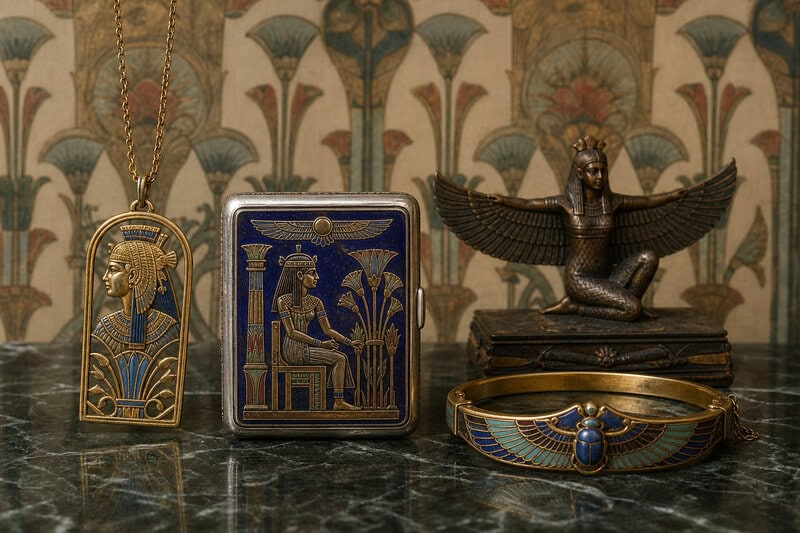
Egyptomania’s reach into daily life was never limited to grand architecture or elite collecting. Egyptian motifs spread across jewellery, clothing, furniture, wallpaper, and cigarette cases, embedding the iconography of pharaohs and lotus blossoms into the texture of ordinary domestic existence. Chicago, as a major manufacturing and merchandising hub in the late 19th and early 20th centuries, was both a producer and a consumer of this decorative wave. Department stores and mail-order catalogs — Chicago institutions in the age of Montgomery Ward and Sears — distributed Egyptian Revival design objects to households across the Midwest, making ancient Egypt a presence in parlors and dressing tables far from any museum.
This democratization of Egyptian imagery is precisely what distinguishes Egyptomania from elite antiquarianism. It made ancient Egypt a shared visual language available to anyone who could afford a length of patterned wallpaper or a scarab-motif brooch. Scholars of material culture argue that this saturation of everyday objects with Egyptian motifs is why the style feels simultaneously familiar and invisible to modern eyes: generations of exposure trained people to recognize these images as simply “decorative” — to strip them of their ideological freight and accept them as neutral pattern. They were never neutral. They carried, even in their most commercialized forms, associations with eternity, mystery, and power that their designers understood and their buyers absorbed without always knowing it.
Why Ancient Egypt Still Fascinates Us — and What Chicago’s Obsession Reveals
Psychologists and cultural historians have proposed several non-exclusive explanations for Egypt’s enduring grip on the Western imagination: its visual distinctiveness, the internal coherence of its mythological system, its sustained association with death and the afterlife, and the sheer survival of its physical monuments against every erosion that time can produce. No single explanation is sufficient, and scholars are careful to distinguish between what draws a 19th-century cemetery designer to a battered wall and what draws a 21st-century visitor to a mummification documentary.
Emerging scholarship in cognitive anthropology offers a suggestive additional framework. Some researchers propose that ancient Egypt appeals to what they describe as “minimally counterintuitive” thinking — its gods, rituals, and cosmology are strange enough to be memorable but structured enough to be comprehensible. This combination, the argument goes, makes them cognitively sticky across cultures and centuries in a way that more radically alien systems are not. Whether or not this framework fully accounts for Egypt’s durability, it points usefully toward the cognitive dimension of cultural fascination that purely historical explanations tend to overlook.
Chicago’s particular relationship with Egyptomania — sustained across architecture, museum collecting, decorative arts, and recurring waves of popular enthusiasm — suggests that the fascination also serves different psychological functions at different historical moments. It offers a sense of permanence during instability. It offers exoticism during cultural homogenization. It offers apparent spiritual depth during secular disenchantment. The city that rebuilt itself from ash was always going to be drawn to the civilization that built things no fire could touch.
The most honest answer to why ancient Egypt still fascinates may be that it functions as a mirror. Each era finds in Egypt the virtues it most wants to claim for itself — wisdom, endurance, mystery, grandeur. Chicago, a city that has always argued loudly and publicly for its own monumental significance, has found in Egypt a particularly flattering reflection. The pyramid stands in plain sight. It always has. The question is simply whether, finally, we are willing to stop walking past it.