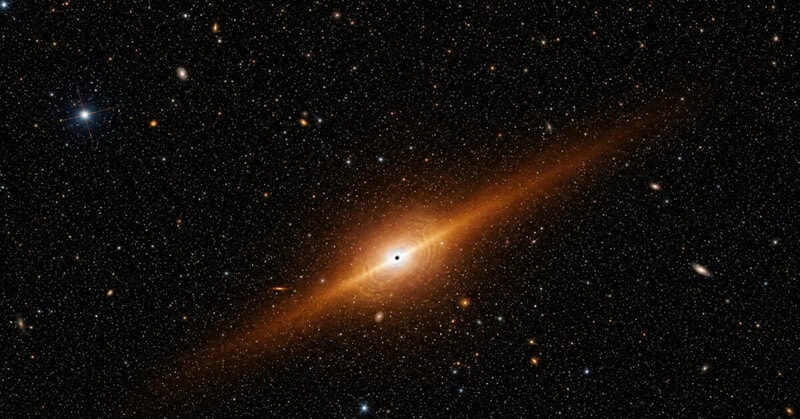
A supermassive black hole blazing with the energy of a trillion suns has been spotted at the edge of the observable universe — in a place, and at a time, where it has no straightforward right to exist. Astronomers have confirmed that this object, a quasar powered by a supermassive black hole, was already shining just 630 million years after the Big Bang — making it the earliest-known quasar ever observed and forcing a reckoning with what scientists thought they understood about the universe’s first structures.
A Monster That Shouldn’t Exist Yet
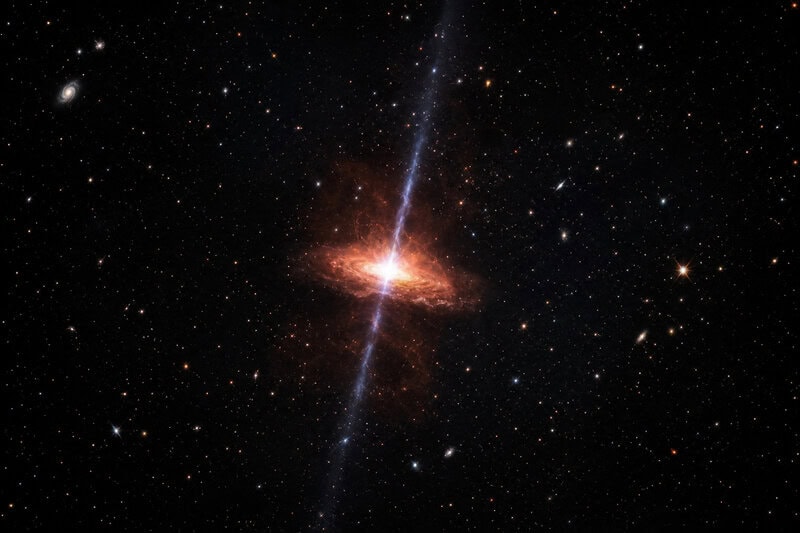
The newly identified quasar is approximately 40 million years older than the previous record holder. In everyday terms, that gap sounds modest. In cosmological terms, it represents an enormous leap backward toward the cosmic dawn — a period so early in the universe’s history that the basic ingredients of galaxies were still assembling themselves from primordial gas. The light now arriving at our telescopes left this object roughly 13.1 billion years ago, when the cosmos was less than five percent of its current age.
The central paradox is straightforward to state, even if it is far from straightforward to resolve: standard models of black hole formation struggle to explain how an object this massive could have assembled itself so quickly after the universe was born. Those models expect black holes to begin small and grow gradually — not to arrive, fully enormous, before the universe has barely drawn its first breath.
This discovery, confirmed jointly by ESA’s Euclid space telescope and the James Webb Space Telescope, is pushing astronomers to reconsider how the universe’s most extreme objects came to be.
What Is a Quasar, and Why Does Distance Matter So Much?
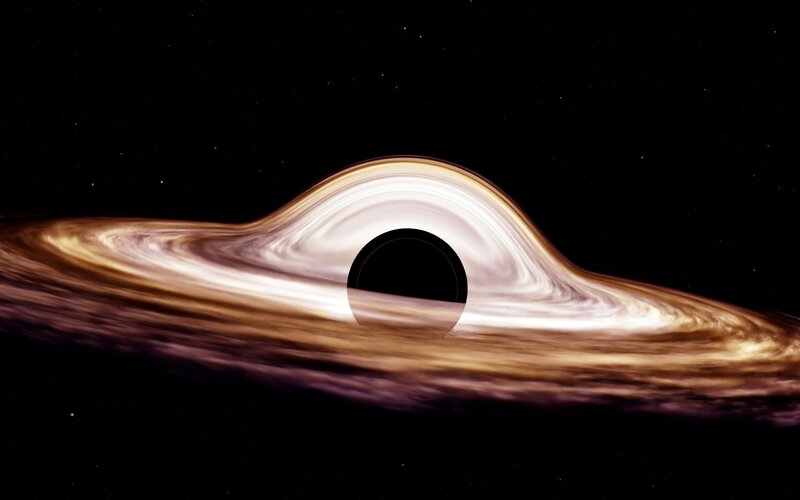
A quasar — short for “quasi-stellar object” — is an extraordinarily luminous galactic core powered by a supermassive black hole that is actively devouring surrounding gas and dust. As material spirals inward, it heats to extreme temperatures and releases more energy than entire galaxies packed with hundreds of billions of stars. From a distance of billions of light-years, that concentrated brilliance can outshine everything else in its cosmic neighborhood, which is precisely what makes quasars detectable across such vast stretches of space and time.
Distance matters here for a reason rooted in the physics of light itself. Because light travels at a finite speed, observing a quasar that existed 630 million years after the Big Bang is not simply a feat of long-range astronomy — it is a form of time travel. The photons arriving at Euclid’s detectors today have been traveling for approximately 13.1 billion years. Astronomers are not seeing this object as it is; they are seeing it as it was, in the universe’s infancy.
Each successive record-breaking quasar pushes the confirmed timeline of supermassive black hole formation closer to the Big Bang, narrowing the window in which these objects had to grow. Among the 31 early-universe quasars that Euclid identified in this survey, the record-breaker stands entirely apart — it is not just the most distant quasar in this dataset, but the most distant quasar ever confirmed by any observatory.
How Euclid Found a Needle in a Cosmic Haystack
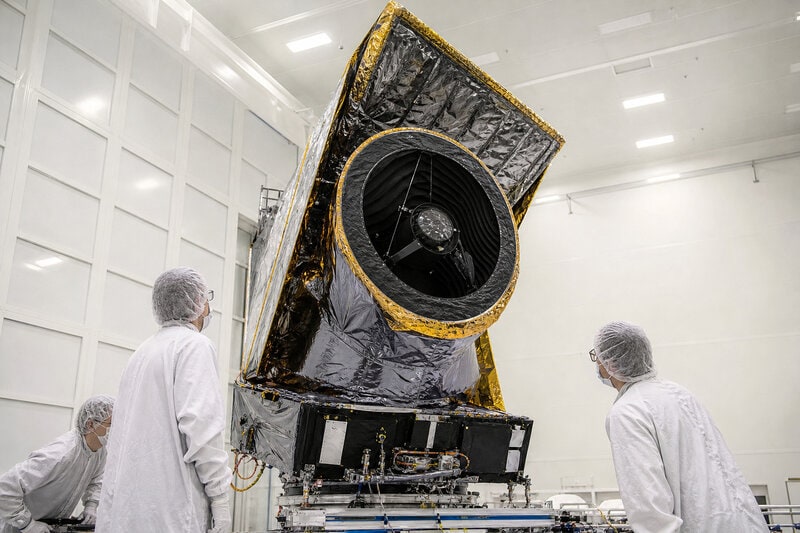
ESA’s Euclid space telescope was not designed primarily as a quasar-hunter. Its core mission is to map the large-scale structure of the universe — charting the distribution of billions of galaxies to probe dark matter and dark energy. But that wide-field ambition turns out to be precisely the capability needed to surface rare, ancient objects that narrower targeted searches are likely to miss.
Euclid identified candidate high-redshift quasars — objects whose light has been stretched to longer, redder wavelengths by the expansion of the universe during its long journey to us — by scanning for sources that effectively disappear at shorter wavelengths. This “dropout” technique is a classic signature of extreme distance: the more the universe has expanded since an object’s light was emitted, the more dramatically that light is shifted toward the red end of the spectrum, eventually vanishing from shorter-wavelength detectors entirely.
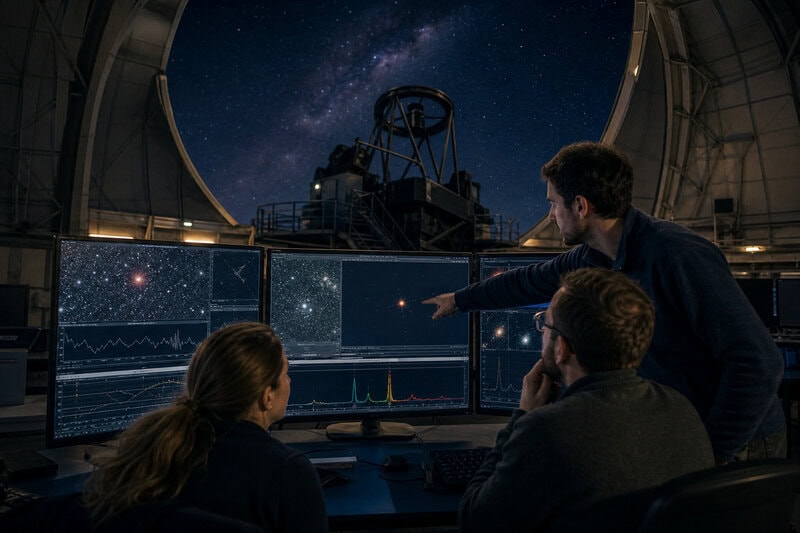
Identifying a candidate, however, is not the same as confirming it. Follow-up observations with the James Webb Space Telescope provided the spectroscopic precision needed to verify the quasar’s redshift and lock in its record-breaking distance, illustrating how next-generation observatories function best not in competition but in concert. Euclid casts a wide net; JWST examines what it catches with extraordinary detail.
The yield from this single survey dataset — 31 early-universe quasars, including one record holder — signals that Euclid will systematically reshape the census of the early cosmos over its operational lifetime, projected to span roughly six years and cover approximately 15,000 square degrees of sky.
The Core Problem: Black Holes That Grew Too Fast
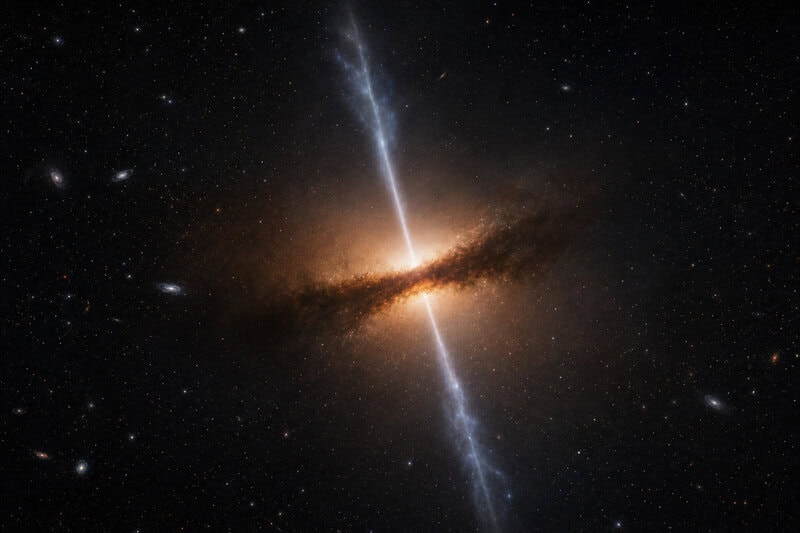
To appreciate why this quasar is so theoretically troubling, it helps to understand what standard models predict. In the prevailing picture of black hole formation, these objects begin their lives as stellar remnants — the collapsed cores of massive stars, typically ranging from a few to perhaps a few hundred solar masses. From those modest starting points, they are expected to grow gradually by pulling in surrounding gas and by merging with other black holes over billions of years.
The problem this quasar creates is one of time. Fitting a supermassive black hole — an object potentially billions of times more massive than the Sun — into a window of only 630 million years pushes or exceeds the theoretical speed limit for black hole growth, even if accretion ran at maximum efficiency from the very beginning.
The key physical constraint is called the Eddington limit — the natural ceiling on accretion at which the outward pressure of radiation from infalling, superheated material exactly balances the inward pull of gravity. At this equilibrium, further accretion is effectively suppressed. Standard models assume black holes grow at or below this rate. Building a supermassive black hole by 630 million years after the Big Bang, starting from a small stellar remnant, challenges that assumption severely.
It is worth being precise about what is established and what is not: the existence of these massive early black holes is now observational consensus, confirmed across multiple independent surveys and observatories. The mechanism that produced them remains an open and vigorously contested scientific question with no settled answer.
Leading Theories: How Could They Have Gotten So Big So Fast?
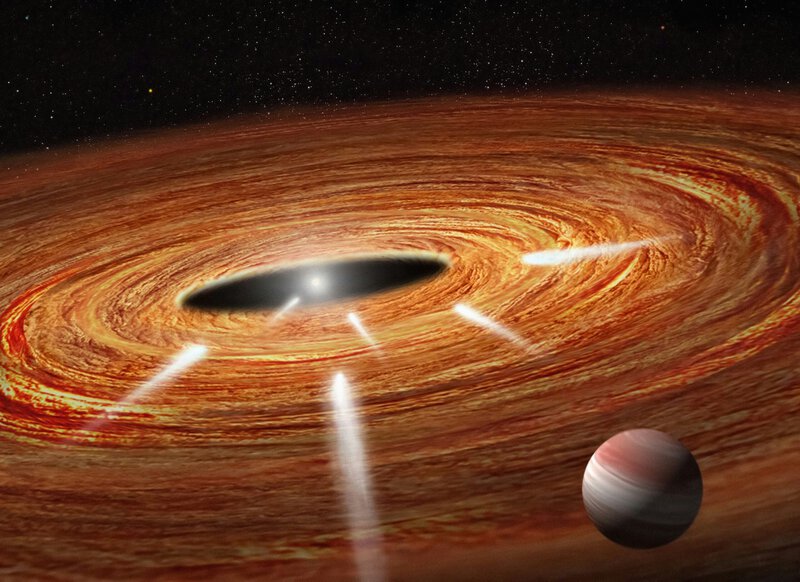
Several competing explanations have been proposed, each with genuine theoretical support and significant remaining uncertainties.
- Heavy seeds from direct collapse. Some theorists propose that the first black holes did not form from ordinary stellar deaths at all. Instead, in the right conditions, enormous primordial gas clouds may have collapsed directly into black holes of ten thousand to a hundred thousand solar masses — bypassing the stellar stage entirely. These “heavy seeds” would have had far less catching up to do. The hypothesis is physically plausible and mathematically tractable, but it has not yet been confirmed by direct observation.
- Super-Eddington accretion. A competing idea holds that early black holes briefly consumed matter at rates far exceeding the Eddington limit, enabled by the unique conditions of a denser, hotter early universe in which radiation could be trapped more efficiently within infalling gas. Replicating this in computer simulations remains computationally demanding, and the conditions required may have been rare.
- Runaway mergers in dense clusters. In the compact, crowded star clusters that may have populated the early universe, black holes could have merged repeatedly and rapidly, bootstrapping their mass in a way that isolated-growth models do not capture. This pathway could operate in combination with the others rather than as a standalone explanation.
None of these mechanisms has been confirmed as the dominant pathway to supermassive black hole formation. Discoveries like Euclid’s record-breaking quasar provide the observational pressure that will eventually help distinguish between these theories by narrowing the range of conditions that must have existed in the early universe.
What This Means for Cosmology — and What Comes Next
It would be tempting to frame this discovery as simply another “biggest, fastest, oldest” milestone in a field that generates them regularly. That framing would undersell it. This quasar is a data point that constrains entire classes of cosmological models — models describing when and how the first structures condensed out of the smooth, hot plasma that filled the universe in its earliest moments.
Euclid’s long-term impact is likely to extend well beyond this single record. As its survey expands toward the full 15,000 square degrees planned over six years, the telescope is expected to uncover many more early-universe quasars. The critical scientific question is whether this record-breaker represents a rare cosmic accident — an extreme statistical outlier — or whether supermassive black holes were more common in the early universe than current models predict. A larger sample, which Euclid is well-positioned to provide, is the only way to answer that question reliably.
The James Webb Space Telescope’s complementary role will be equally important. JWST’s ability to characterize the host galaxies surrounding Euclid’s quasar candidates — measuring stellar mass, star formation rates, and the relationship between black hole mass and overall galaxy mass — will be critical to building a complete picture. The two appear to shape each other’s growth in a process called co-evolution, and understanding that relationship is as scientifically significant as the distance record itself.
If Euclid continues to find supermassive black hole-powered quasars at these distances in significant numbers, theorists may need to substantially revise the timeline and mechanisms of cosmic structure formation. That revision is already underway — but it is far from complete, and the evidence needed to settle it is only beginning to arrive.
The Bottom Line
ESA’s Euclid telescope has identified the earliest-known quasar ever observed, powered by a supermassive black hole that existed just 630 million years after the Big Bang — approximately 40 million years earlier than the previous record holder — with confirmation provided by the James Webb Space Telescope. How a black hole of this scale assembled itself in so little cosmic time is a question that current physics cannot fully answer, making this one of the most compelling open problems in modern astrophysics.
As Euclid’s survey expands and JWST continues to characterize each new discovery in detail, the picture of how the first supermassive black holes formed — and what they reveal about the universe’s earliest moments — is likely to change substantially in the years ahead. The universe, it turns out, was building monsters far earlier than scientists had thought. The task now is to figure out how.